


California's AB 35 Revolutionizes Medical Malpractice Compensation: $1M Wrongful Death Cap Takes Effect January 2025
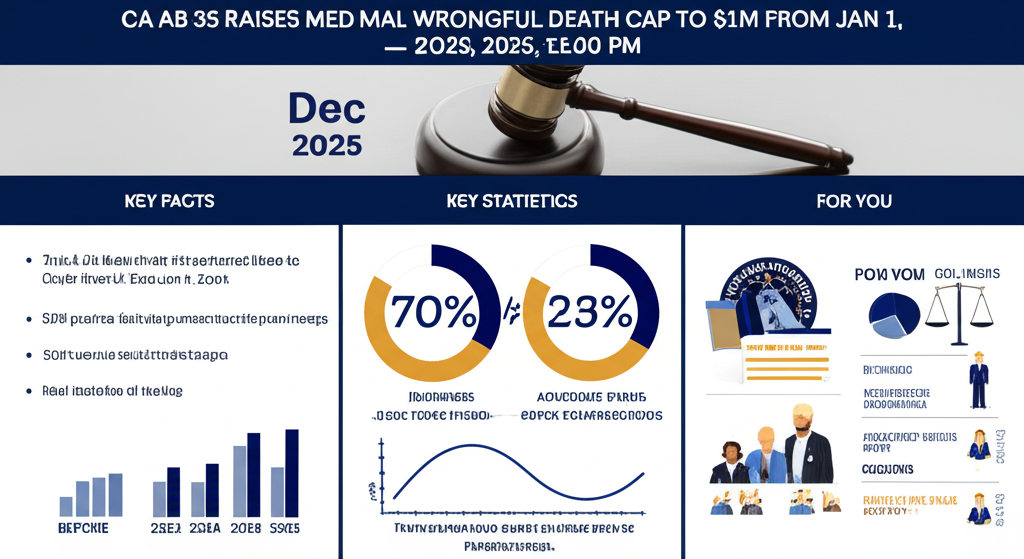
California's Assembly Bill 35 (AB 35), signed into law and effective January 1, 2025, eliminates the longstanding $250,000 cap on non-economic damages in medical malpractice cases involving wrongful death. This landmark reform raises the limit to $1 million for wrongful death claims and $500,000 for non-death cases, with annual increases of $50,000 for the next decade to combat inflation.[2] For the first time since 1975, victims' families and survivors can pursue compensation that more accurately reflects profound losses like pain, suffering, emotional distress, and loss of companionship.
Background on the Outdated MICRA Caps
The Medical Injury Compensation Reform Act (MICRA) of 1975 imposed a $250,000 ceiling on non-economic damages in med mal suits to curb insurance costs and physician shortages. Over nearly 50 years, this fixed amount failed to adjust for inflation—equivalent to about $1.3 million today—leaving families undercompensated in catastrophic cases.[2] AB 35 addresses this by indexing caps to economic reality, potentially boosting case values significantly for misdiagnosis, surgical errors, birth injuries, and hospital negligence.
Key Provisions of AB 35 and Immediate Legal Implications
- New Caps Structure: $500,000 for non-fatal injuries; $1 million for wrongful death, rising by $50,000 annually through 2035.[2]
- Attorney Fees Adjustment: Contingency fees capped at 20% on damages between $600,001-$1,149,999 and 15% above $1,150,000, balancing plaintiff recovery with lawyer incentives.
- Retroactivity Limited: Applies only to incidents post-January 1, 2025; pre-2025 cases remain under old rules.
- Broader Impact: Encourages settlements by making trials more viable for defendants, as juries can now award fuller non-economic relief.[2]
Legal experts predict a surge in filings, as the reform signals California's commitment to patient rights amid rising healthcare costs. Insurers may face higher payouts, but proponents argue it deters negligence without driving physicians away—California's doctor supply has remained stable despite past reforms.[2]
Real-World Context: Record 2025 Personal Injury Verdicts Highlight Rising Stakes
AB 35 arrives amid blockbuster 2025 verdicts underscoring the value of strong claims. In Louisiana, a jury awarded Jose Valdivia $411 million—the state's largest single-plaintiff personal injury verdict—for brain and spinal injuries from a 2022 scaffolding collapse at a Phillips 66 refinery.[1] Similarly, California saw a $36.4 million verdict by PARRIS Law Firm for a Palmdale car crash victim with traumatic hemoperitoneum and chronic pain.[1]
These cases, while not med mal, illustrate jury willingness to deliver massive awards for catastrophic harm, now amplified by AB 35 for wrongful death. A Los Angeles jury's $32.5 million to Briana Booth for a 2018 multi-vehicle crash back injury and a $7.25 million federal verdict against Universal Studios for a ride malfunction further signal courts' focus on accountability.[1] In med mal, a 2024 Washington settlement of $9.9 million for delayed cancer diagnosis previews potential under new caps.[6]
Settlement Trends in 2025 California Personal Injury Cases
Average settlements hover at $55,000, ranging $3,000-$75,000 for most claims, but severe cases like spinal trauma or brain injuries reach six-seven figures.[3] Soft-tissue injuries (whiplash, sprains) settle $2,500-$25,000, escalating to $25,000-$75,000 with chronic issues or herniated discs.[3] AB 35's higher minimum insurance limits—$30,000/$60,000 bodily injury (doubled) and $15,000 property (tripled)—bolster negotiations.[2]
| Injury Type | Average Settlement Range (2025 CA) | Key Drivers |
|---|---|---|
| Minor Soft-Tissue (Whiplash) | $2,500-$25,000 | Medical records, recovery time[3] |
| Chronic Back/Whiplash Combo | $25,000-$75,000 | Imaging, disability evidence[3] |
| Spinal Trauma/TBI | $100,000s-$Millions | Long-term care costs[3] |
| Med Mal Wrongful Death (Post-AB35) | Up to $1M+ Non-Econ | New caps, negligence proof[2] |
Actionable Guidance: Steps for Medical Malpractice and Injury Victims
If you've suffered from medical negligence, an accident, or lost a loved one, act swiftly—California's two-year statute of limitations for personal injury/wrongful death starts from discovery.[2] Here's how to protect your rights:
Immediate Post-Incident Actions
- Seek Urgent Care: Document all treatments, diagnoses, and symptoms thoroughly—medical bills form economic damages core.[3]
- Preserve Evidence: Photos of scenes, witness contacts, incident reports; for med mal, request full records via HIPAA.
- Avoid Insurer Statements: Recorded calls can twist facts; direct queries to an attorney.
Building a Strong Claim Under AB 35
- Consult a Specialist: Engage a board-certified personal injury attorney experienced in med mal—contingency basis means no upfront fees.
- Gather Expert Opinions: Independent medical experts validate negligence, crucial for caps piercing.
- Calculate Damages: Economic (bills, lost wages) + non-economic (pain, now uncapped higher). Use tools like life care plans for future needs.[3]
- Negotiate Strategically: With doubled insurance mins, push beyond lowballs; 2025 trends show leverage for severe cases.[2][3]
- File if Needed: Demand letters precede suits; AB 35 strengthens wrongful death postures.
For Floridians traveling or with CA ties, note jurisdiction—incidents in California fall under AB 35. Orlando's Imigrar Law Firm partners with CA counsel for cross-state claims, ensuring seamless representation.
Common Pitfalls to Avoid
- Signing quick releases without valuation.
- Ignoring future costs like therapy or adaptive equipment.[1]
- Missing deadlines—clock ticks from injury awareness.
Why This Matters for Victims Nationwide
AB 35 sets a precedent; other states watch as California balances victim justice with system stability. Paired with 2025 verdicts like Texas' $831M dram shop case, it empowers claimants.[1] Recent class actions (e.g., $5M EyeMed breach, Dec 2025 deadline) show compensation trends.[5]
PFAS and AFFF suits offer models for mass torts, with $2B NJ settlements in 2025.[4] For personal cases, documentation reigns—turning tragedy into accountability.
Contact Imigrar Law Firm Today
At Imigrar Law Firm in Orlando, our team guides injury victims through claims, from accidents to med mal. Schedule a free consultation to assess your case under 2025 reforms. Call now—justice delayed is justice denied.
Disclaimer: This article provides general information, not legal advice. Consult an attorney for personalized guidance. Sources verified as of December 2025.[1][2][3]


