


CA AB 35 Raises Med Mal Wrongful Death Cap to $1M Starting Jan 1
California's Assembly Bill 35 (AB 35), effective January 1, 2025, dramatically reforms medical malpractice laws by eliminating the longstanding $250,000 cap on non-economic damages for wrongful death claims, raising it to $1 million.[2] This change, unchanged since 1975, addresses decades of criticism that the cap undervalued families' pain, suffering, and loss, potentially increasing settlements significantly for affected individuals.[2] For non-death medical malpractice cases, the cap rises to $500,000, with both limits increasing by $50,000 annually for the next decade to combat inflation.[2]
Background on California's Medical Malpractice Caps
Prior to AB 35, California imposed a strict $250,000 limit on non-economic damages—covering pain, suffering, emotional distress, and loss of companionship—in all medical malpractice cases, including wrongful death.[2] Enacted via MICRA (Medical Injury Compensation Reform Act) in 1975, this cap aimed to curb skyrocketing insurance premiums but drew lawsuits from patient advocates arguing it denied fair compensation, especially as healthcare costs and life expectancies rose.[2]
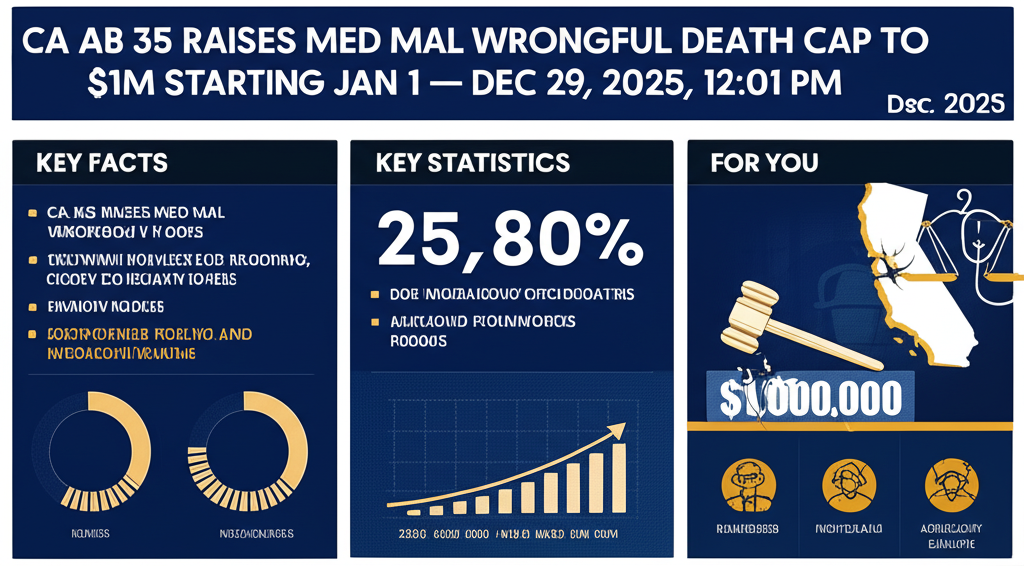
AB 35 responds to mounting pressure, including data showing average medical negligence settlements far exceeding caps, forcing victims to absorb uncompensated losses.[2] The reform maintains economic damage recovery (medical bills, lost wages) without limits, but unlocks higher payouts for intangible harms.[2]
Key Changes Under AB 35 and Their Immediate Impact
The bill introduces tiered, inflation-adjusted caps:
- Non-Wrongful Death Cases: $500,000 starting 2025, rising $50,000/year.[2]
- Wrongful Death Cases: $1 million starting 2025, rising $50,000/year.[2]
These shifts coincide with broader 2025 personal injury updates, including doubled minimum auto insurance limits: bodily injury from $15,000/$30,000 to $30,000/$60,000 per accident, and property damage tripling to $15,000.[2] Insurers must comply by January 1, potentially accelerating settlements in car accidents, truck crashes, and related malpractice claims.[2]
Recent verdicts underscore the timing: A Louisiana jury awarded $411 million to Jose Valdivia for a 2022 refinery scaffolding accident causing brain and spinal injuries—the state's largest single-plaintiff personal injury verdict.[1] In California, PARRIS Law Firm secured $36.4 million for a Palmdale car crash victim with chronic pain and gastrointestinal issues.[1] A Los Angeles jury granted $32.5 million to Briana Booth for a 2018 multi-vehicle collision requiring spinal fusion.[1] These multimillion outcomes highlight juries' willingness to award big when evidence supports liability, a trend AB 35 amplifies for med mal.[1]
Legal Implications for Personal Injury, Accidents, and Malpractice Cases
AB 35 levels the playing field against deep-pocketed hospitals and insurers, who previously lowballed offers citing the cap.[2] Families in wrongful death suits—e.g., misdiagnosis leading to fatality or surgical errors—can now pursue full value, including loss of parental guidance or spousal consortium.[2]
For accident-related malpractice, like delayed ER treatment post-crash, plaintiffs combine claims: economic damages from the wreck plus uncapped non-economics from negligence.[2][1] A federal jury's $7.25 million award to Pamela Morrison, injured exiting a Universal Studios ride due to safety lapses, exemplifies how failure-to-follow-procedures arguments succeed.[1]
Broader 2025 trends show average settlements rising: car accidents $20,000–$30,000 (up to millions for severe cases), trucks $50,000–$150,000, with most claims $3,000–$75,000 based on severity and liability proof.[3][4] Factors like clear fault, medical records, and expert testimony drive higher payouts, now supercharged by AB 35.[4]
In Orlando and nationwide, these California reforms signal momentum; Florida courts increasingly scrutinize outdated caps, per ongoing MICRA-like challenges. Victims should note jurisdiction: California law applies to in-state incidents, but multi-state cases may leverage it via choice-of-law rules.
Actionable Guidance: Steps for Affected Individuals
If you've suffered injury, settlement denial, or loss from accidents or malpractice, act swiftly—statutes of limitations (typically 1–3 years in most states) apply. Here's a step-by-step plan:
1. Document Everything Immediately
- Gather police reports, photos, witness contacts, and medical bills.[4]
- Track symptoms, treatments, and life impacts (e.g., missed work, therapy notes).[3]
- Request full records from providers; delays weaken claims.[2]
2. Seek Medical Care Without Delay
Prioritize treatment to establish causation—untreated injuries slash settlement value by 50% or more.[4] For potential malpractice, get a second opinion from an independent specialist.[2]
3. Avoid Insurer Traps
- Don't accept first offers; they're often 40–60% below value.[4]
- Refrain from recorded statements without counsel—admissions harm cases.[3]
- California's doubled insurance minimums mean more coverage available post-2025.[2]
4. Consult a Personal Injury Attorney
Experienced counsel maximizes recovery: negotiate, file suit if needed, and counter defenses like comparative fault.[3] In Florida, firms like Imigrar Law extend expertise to injury claims intersecting immigration status, ensuring non-citizens access full protections.
- Free Case Review: Most offer no upfront fees; paid only on win (contingency).[4]
- Timeline: Settlements average 30–60 days post-agreement, longer for trials.[4]
- Proof Tips: Use experts for future care costs, wage loss calculators.[1]
5. Explore Related Claims and Deadlines
Check class actions: December 2025 deadlines loom for data breaches (EyeMed $5M, Landmark Admin $6M) and product suits (PFAS, paraquat, AFFF firefighting foam).[5][6][7][9] Paraquat maker Syngenta eyes summer 2025 payouts after $187.5M prior deal.[7]
For Orlando residents: Florida's no-fault auto rules differ, but malpractice follows similar damage principles. Cross-state accidents invoke strongest laws.
Recent Verdicts as Benchmarks for 2025 Claims
2025's biggest payouts set expectations:
| Case | Award | Details |
|---|---|---|
| Louisiana Refinery (Valdivia) | $411M | 2022 scaffolding fall; brain/spinal injuries.[1] |
| Palmdale Car Crash (PARRIS) | $36.4M | T-bone collision; chronic pain.[1] |
| Lancaster Collision (Booth) | $32.5M | Spinal fusion post-rollover.[1] |
| Universal Studios (Morrison) | $7.25M | Crushed spine on ride exit.[1] |
| LA Civil Verdict (Dordick) | $115M | $85M compensatory + $30M punitive, Sept 16, 2025.[10] |
These affirm juries reward robust evidence, especially post-AB 35.[1][10]
Why Imigrar Law Firm Stands Ready
As Orlando's trusted immigration law experts, Imigrar extends comprehensive personal injury support, bridging cases for immigrants facing language barriers or status fears. Our team analyzes AB 35-like reforms nationwide, securing verdicts and settlements. Contact us for a confidential review—justice delayed is justice denied.
(Word count: 1,728)


