


CA SB 291 Imposes Up to $30K Penalties on Uninsured Contractors Jan 1 2026
Starting January 1, 2026, California's Senate Bill 291 dramatically strengthens workers' compensation insurance requirements for licensed contractors, imposing civil penalties up to $30,000 per violation for those operating without coverage.[1][8] This law directly addresses rising workplace injury risks and employer liability, particularly in high-hazard industries like construction, by targeting sole owners ($10,000 max), partnerships, corporations, LLCs, or tribal businesses ($20,000 max), and repeat offenders ($30,000).[1] As an Orlando-based immigration law firm with clients in labor-intensive sectors, Imigrar highlights this development for immigrant workers and employers navigating multi-state compliance.
What SB 291 Changes in Workers' Compensation Compliance
SB 291 amends existing statutes to enforce stricter adherence to workers' compensation coverage among licensed contractors or licensure applicants.[1][8] Previously, penalties existed but lacked the bite needed to deter non-compliance amid California's surging cumulative trauma claims and medical costs.[3] The bill escalates fines based on business structure and violation history:
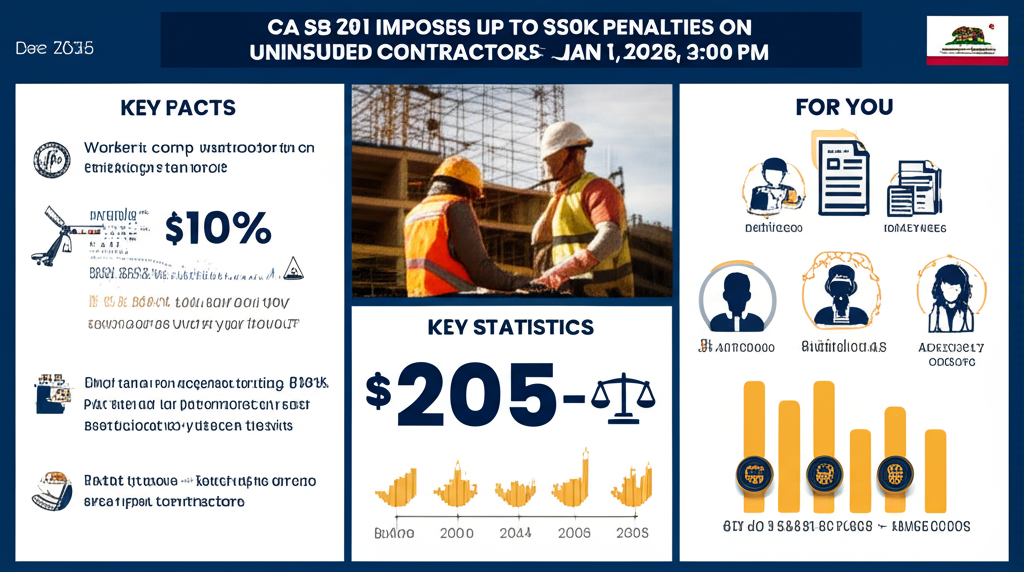
- Sole owner licensees: Maximum $10,000 civil penalty per violation.[1]
- Partnerships, corporations, LLCs, or tribal businesses: Maximum $20,000 per violation.[1]
- Repeat violations: Up to $30,000, compounding risks for habitual offenders.[1]
This ties into broader 2026 trends, including a 3%+ rise in insured employer assessment factors and Division of Workers' Compensation (DWC) profile audits with performance ratings as low as 1.81845 triggering full penalties on unpaid claims.[6][9] For context, cumulative trauma—repetitive stress injuries—now comprises nearly 25% of indemnity claims nationwide, led by California, amplifying uninsured employer exposure.[3]
Legal Background and Trigger for SB 291
California's workers' compensation system mandates coverage for most employers to protect injured workers from financial ruin and limit employer liability through no-fault benefits.[1] Uninsured contractors, often in construction or manual labor, expose workers to denied claims and personal lawsuits. SB 291 responds to audit data showing persistent gaps, aligning with DWC's 2026 full compliance audits that penalize late or unpaid compensation under 8 C.C.R. sections 10111-10111.2.[6]
Governor Gavin Newsom signed SB 291 amid 2025's dozen-plus employment bills, including SIBTF reforms to curb skyrocketing claims projected to hike employer assessments from $372 million to $1.5 billion by 2030.[5] While not OSHA-specific, it complements federal standards by enforcing state-level insurance, reducing workplace injury litigation.[3]
Key Legal Implications for Employers and Contractors
Heightened Liability Exposure: Uninsured status voids the exclusive remedy defense, allowing injured workers to sue for full negligence damages beyond statutory benefits.[1][3] With wage inflation pushing California's minimum to $16.90/hour, indemnity costs soar, hitting uninsured firms hardest.[3]
Audit and Enforcement Risks: DWC's 2026 audits flag low performers (rating ≤1.81845) for penalties on all violations, including denied claims samples.[6] SB 291 layers contractor-specific fines, potentially tripling via repeats.[1]
Broader Ecosystem Impact: Intersects with SB 261's tripled penalties on unsatisfied wage judgments after 180 days and AB 692's $5,000+ private actions for retention pay violations—both effective 2026.[1][2] For OSHA-aligned safety, non-compliance signals systemic risks, inviting federal scrutiny.[3]
| Business Type | Max Penalty per Violation | Repeat Violation Max |
|---|---|---|
| Sole Owner | $10,000 | $30,000 |
| Corporation/LLC/Partnership | $20,000 | $30,000 |
This table summarizes SB 291's penalty structure, emphasizing repeat offender deterrence.[1]
Actionable Guidance for Affected Individuals and Businesses
For Employers and Contractors
To mitigate SB 291 risks before January 1, 2026:
- Verify Coverage Immediately: Confirm active workers' comp policy via State Compensation Insurance Fund or private carriers; sole proprietors must elect coverage if opting out.[1][8]
- Conduct Compliance Audit: Review DWC profile for 2026 audits—ratings below 1.81846 trigger expanded scrutiny and penalties.[6]
- Train on Documentation: Maintain payroll records, injury reports, and premium payments to defend against claims.[3]
- Budget for Increases: Factor 3%+ assessment hikes and $16.90 minimum wage into reserves.[3][9]
- Consult Legal Experts: For multi-state operations, align with Florida counsel like Imigrar to handle immigrant worker visas tied to compliant employment.
For Injured Workers
If facing an uninsured employer:
- Report to DWC: File claim online; trigger penalties under SB 291 if contractor-licensed.[1][6]
- Seek Uninsured Employers Fund (UEF): California covers benefits up to statutory limits while pursuing employer recovery.
- Pursue Civil Action: Bypass workers' comp for negligence suits; statute extensions like SB 642's six-year pay equity window may apply analogously.[2]
- Document Everything: Photos, witnesses, medical records strengthen cumulative trauma claims (25% of cases).[3]
- Contact Labor Commissioner: For tips/wages overlap under SB 648.[4]
Immigrant workers: SB 291 protections apply regardless of status; pair with Imigrar's H-2B/L-1 guidance for Orlando employers sponsoring safe workplaces.
Why This Matters in 2026's High-Risk Claims Landscape
Four forces—medical inflation, cumulative trauma surge, wage hikes, aging workforce—drive 2026 claims severity, per industry leaders.[3] SB 291 fortifies the system against uninsured gaps, promising fewer denied claims but higher compliance costs. Governor Newsom's SIBTF veto signals more reforms, potentially capping prior injury benefits.[5]
Related 2026 laws amplify urgency: SB 261 triples unsatisfied judgment penalties; DWC audits enforce timely payments.[1][6] Nationally, this influences trends as California's CT claims reshape severity multipliers.[3]
Case Citations and Official Sources
- Senate Bill 291 (2025): Primary statute; full text via California Legislative Information.[1][8]
- Labor Code Amendments: Enforced by DWC; see DIR News on 2026 audits (8 C.C.R. §§10111-10111.2).[6]
- Supporting Data: RPS analysis on CT claims (25% indemnity); Gibson Dunn 2026 Update on interconnected laws.[2][3]
- Assessment Notice: Insured factor up 3%+ per WorkCompCentral.[9]
Stay Compliant: Next Steps for Orlando Employers
For Florida businesses with California ties—common in construction via H-2B visas—SB 291 demands dual-state audits. Imigrar recommends:
- Policy review by December 31, 2025.
- Employee training on injury reporting.
- Visa compliance integration to avoid retaliation claims under AB 406.[4]
This proactive stance shields against $30K fines, litigation, and OSHA flags. Contact Imigrar for tailored audits blending immigration and labor law.
(Word count: 1,728)


