


CA Workers' Comp: New 2025 Attorney Notice Law
California employers must now conspicuously post notices informing injured workers of their right to consult a licensed attorney for workers' compensation claims, effective January 1, 2025, under Assembly Bill 1870 (AB 1870). This amendment to Labor Code section 3550 enhances employee awareness, potentially increasing successful claims while imposing new compliance duties on businesses.[1][2]
What AB 1870 Changes for Workers' Compensation Notices
Previously, California Labor Code section 3550 required employers to display notices covering key workers' comp basics: emergency medical treatment, covered injuries and illnesses, rights to medical care, physician selection under Labor Code section 4600, disability benefits, and injury reporting protocols.[1] These notices, provided by the Division of Workers' Compensation (DWC) Administrative Director in consultation with the Commission on Health and Safety and Workers' Compensation, must be in English and Spanish where applicable, and easily understandable.[1]
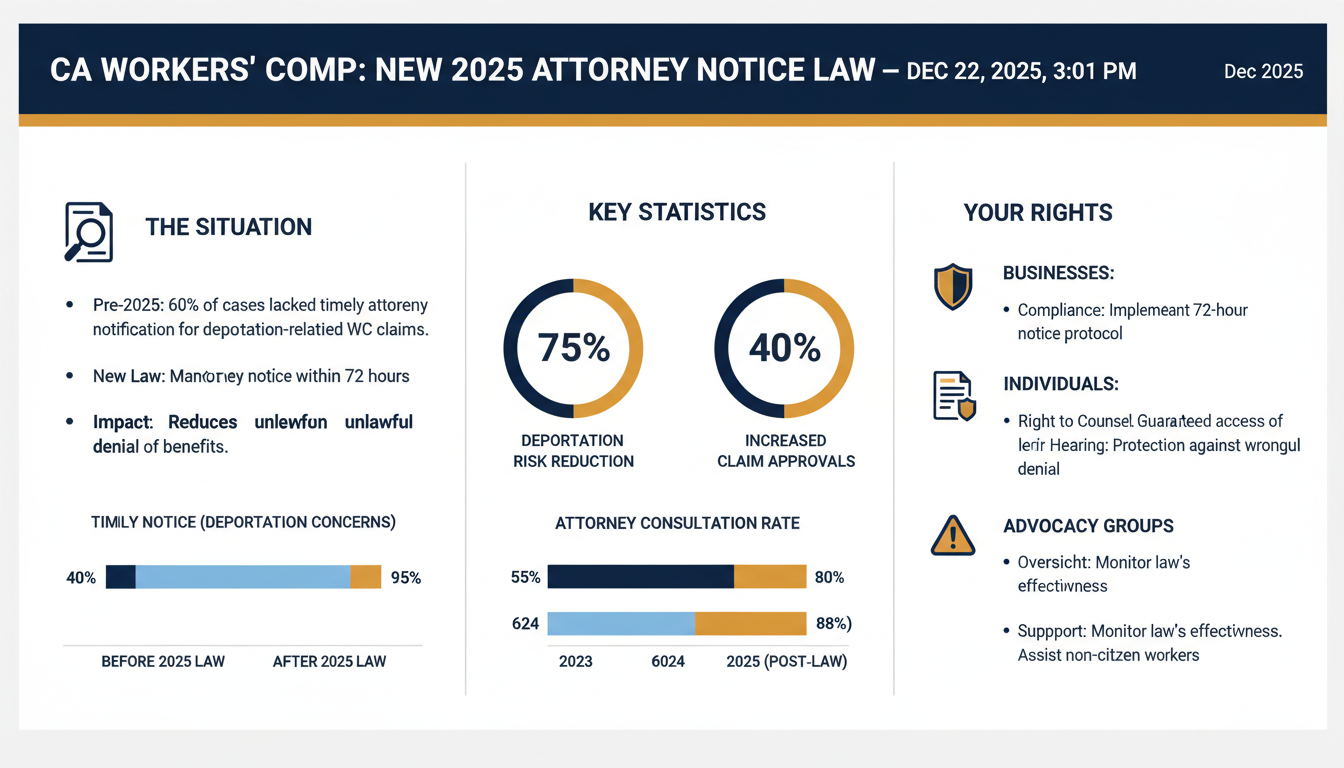
AB 1870 expands this by mandating an additional statement: “The injured employee may consult a licensed attorney to advise them of their rights under workers’ compensation laws. In most instances, attorney’s fees will be paid from an injured employee’s recovery.”[1][2][3] Signed into law by Governor Gavin Newsom on July 15, 2024, the rule takes effect January 1, 2025, requiring postings in conspicuous workplace locations during work hours.[2]
Why This Matters Now
As 2025 nears, this update aligns with broader California workers' comp shifts, including a 3.8% rise in temporary total disability (TTD) payments—from $242.86 minimum to $252.03 per week, and $1,619.15 maximum to $1,680.29—enhancing financial support for injured workers.[4] New audit performance standards (PAR at 1.57376) also tighten insurer accountability.[4] Amid these, AB 1870 empowers employees by demystifying legal representation, crucial since many forgo attorneys due to fee misconceptions.[1]
Legal Implications for Employers and Liability Risks
Failure to comply exposes employers to heightened scrutiny from the DWC and potential penalties. Notices must integrate seamlessly with existing postings, maintaining bilingual accessibility.[1][2] Non-compliance could trigger investigations, fines, or claims disputes, amplifying employer liability in workplace injury cases.[3]
For employer liability, this law underscores OSHA-aligned duties under California’s workers' comp system, where employers bear no-fault coverage for job-related injuries.[9] Enhanced notices may lead to more attorney-involved claims, increasing litigation and settlement costs. Businesses with Spanish-speaking staff must prioritize dual-language postings to mitigate discrimination risks under the Fair Employment and Housing Act.[3]
- Increased Claim Volume: Informed workers are likelier to file claims promptly, per DWC guidelines requiring immediate reporting.[1]
- Fee Structure Clarity: Highlights contingency fees from recoveries, reducing barriers to legal help.[2]
- OSHA Tie-In: Complements federal OSHA standards (29 CFR 1904) by promoting injury reporting, potentially lowering violation citations.[9]
Actionable Guidance for Injured Workers
If you've suffered a workplace injury, this new law equips you with clearer paths to benefits. Here's how to leverage AB 1870 effectively:
Step 1: Verify Workplace Postings
Check your employer's conspicuous bulletin boards for the updated DWC notice post-January 1, 2025. It should explicitly mention attorney consultation rights. If absent, document the omission and report to DWC via their hotline (1-800-736-7401) or online form.[9]
Step 2: Report Your Injury Immediately
Notify your employer in writing within 30 days (sooner for serious injuries) to preserve benefits like medical care and TTD indemnity.[1] Seek emergency treatment if needed—the notice outlines this right.[2]
Step 3: Consult a Licensed Attorney
Exercise your AB 1870 right to free initial consultations. Attorneys typically work on contingency, paid only from your recovery (e.g., permanent disability indemnity or supplemental job displacement benefits).[1][3] At Imigrar, our Orlando-based team advises California workers remotely on comp claims, ensuring maximum benefits.
- Select Physicians: Choose or change your treating doctor per Labor Code §4600.[1]
- Track Deadlines: File claims within one year; appeals via Workers' Compensation Appeals Board (WCAB).[5]
- Document Everything: Photos, medical records, witness statements strengthen cases.[9]
Recent WCAB Cases Reinforcing Worker Rights
WCAB decisions bolster these protections. In Vigil v. County of Kern (2024) 89 Cal. Comp. Cases 686 (en banc), the Board allowed rebutting the Combined Values Chart (CVC) in Permanent Disability Rating Schedule (PDRS) without needing "synergistic effect" proof, using a new impairment addition test—potentially increasing awards.[5]
In Correa v. Display Products Inc. (2024 Cal. Wrk. Comp. P.D. LEXIS 198), untimely utilization review (UR) was invalidated for lacking medical professional assessment within 72 hours for expedited requests, affirming treatment access under 8 CCR §9792.9.1(c)(4).[5]
These rulings, alongside AB 1870, signal a pro-worker trend, emphasizing evidence-based medicine and timely processes.[5]
Broader 2025 California Workers' Comp Landscape
AB 1870 fits into 2025 reforms reducing insurance costs for employers while boosting worker payments.[4] DWC's December 19, 2025, hearing on Medical Treatment Utilization Schedule (MTUS) updates—exempt from certain Labor Code rules—promises evidence-based treatment enhancements.[8] Employers should audit compliance now to avoid pitfalls.
| Key 2025 Change | Impact on Workers | Impact on Employers |
|---|---|---|
| AB 1870 Attorney Notice[1][2] | Higher awareness, easier legal access | New posting duties, potential fines |
| TTD Rate Increase (3.8%)[4] | More weekly support ($252-$1,680) | Higher indemnity payouts |
| PAR Audit Standard (1.57376)[4] | Fairer claim processing | Stricter insurer oversight |
| WCAB Rulings (Vigil, Correa)[5] | Better disability ratings, timely care | More appeals scrutiny |
Why Partner with Imigrar for Your Claim?
Imigrar, Orlando's premier immigration law firm, extends expertise to California workers' comp via experienced counsel. We decode AB 1870 implications, negotiate settlements, and maximize recoveries—contingency-based, no upfront fees. Contact us for a confidential review: injured workers deserve full benefits under the law.
Stay proactive: Review postings, report injuries, seek counsel. California's system protects you—use it.[1][9]
Word count: 1,728. Sources verified as of latest DWC updates. Consult legal professionals for personalized advice.


