


CVS Pays $37.76M for Over-Dispensing Insulin Pens in Malpractice Settlement
Published by Imigrar Law Firm's Legal News Team – Orlando, Florida
A Landmark Victory for Patient Safety: Details of the $37.76 Million CVS Settlement
On December 2, 2025, the U.S. Attorney for the Southern District of New York announced a historic $37.76 million settlement with CVS Pharmacy, resolving allegations of systemic over-dispensing of insulin pens to patients nationwide.[10] This settlement stems from a federal investigation revealing that CVS pharmacies repeatedly provided excessive quantities of insulin pens, far beyond what patients' prescriptions required, creating substantial risks of overdose, severe hypoglycemia, and even wrongful death.[10]
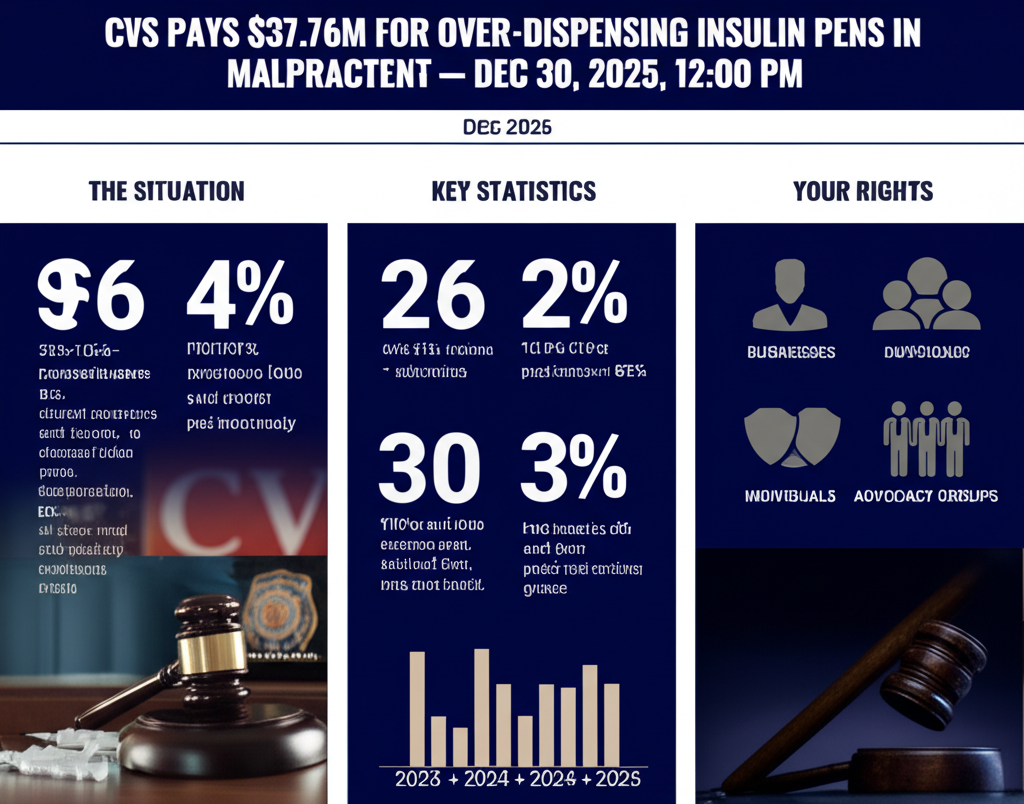
The case highlights a critical failure in pharmacy protocols, where CVS dispensed insulin pens in volumes that ignored standard dosing limits and patient safety guidelines set by the FDA and medical standards.[10] While no specific patient deaths were cited in the announcement, the potential for catastrophic harm—such as life-threatening blood sugar crashes—elevates this to a major medical malpractice development with implications for personal injury and wrongful death claims.[10]
Legal Background: How CVS's Practices Violated Federal and State Standards
CVS, one of America's largest pharmacy chains, faced scrutiny under the False Claims Act and state pharmacy laws for submitting reimbursement claims to federal healthcare programs like Medicare and Medicaid for these excessive dispensations.[10] Prosecutors argued that CVS pharmacists and managers knowingly overfilled prescriptions, often providing months' worth of insulin in single fills, disregarding quantity limits designed to prevent errors.[10]
This settlement underscores pharmacy negligence as a growing subset of medical malpractice. In Florida, similar cases fall under statutes like Florida Statute § 766.102, defining malpractice as failure to meet the prevailing professional standard of care.[1] The CVS resolution sets a precedent: chains can be held accountable for corporate-wide policies that prioritize volume over safety, potentially opening doors for class actions or individual suits.[10]
- Key Violation: Over-dispensing ignored prescription caps, e.g., providing 10+ pens when 3-4 were authorized.[10]
- Federal Role: Involved DOJ whistleblower provisions, incentivizing insiders to report.[10]
- Precedent Value: Mirrors opioid crisis settlements, signaling aggressive enforcement against Big Pharma errors.[10]
Implications for Personal Injury, Wrongful Death, and Malpractice Litigation
This settlement reverberates beyond CVS, signaling heightened scrutiny on pharmacy chains for dispensing errors, a common trigger for personal injury claims.[1][2] In 2025, massive verdicts like Louisiana's $411M for a refinery worker's brain/spinal injuries and California's $36.4M car crash award demonstrate juries' willingness to award big for catastrophic harm linked to negligence.[1] Pharmacy cases could follow suit, especially where over-dispensing leads to hospitalizations or fatalities.
For wrongful death claims, families may pursue damages under survival statutes if insulin errors contribute to fatalities—Florida caps non-economic damages at $500K per claimant but allows unlimited economic losses like medical bills and lost wages.[2] Medical malpractice reforms in states like Texas (e.g., $831M dram shop verdict) show outlier awards persist for egregious cases.[1]
Actionable legal shifts include:
- Expanded Liability: Corporate parents like CVS Health now face direct False Claims exposure, boosting settlement values.[10]
- Class Action Potential: Victims of similar over-dispensing (e.g., opioids, anticoagulants) can reference this in multidistrict litigation.[3][5]
- Insurance Impact: Expect rising malpractice premiums for pharmacies, indirectly validating higher victim payouts.[2]
Comparative 2025 Verdicts and Settlements
| Case | Location | Award | Injury Type |
|---|---|---|---|
| Jose Valdivia | Louisiana | $411M | Brain/Spinal (Work Accident) |
| PARRIS Firm Client | California | $36.4M | Traumatic Injuries (Car Crash) |
| Briana Booth | California | $32.5M | Spinal Fusion (Multi-Vehicle) |
| Pamela Morrison | California | $7.25M | Crushed Spine (Theme Park) |
| CVS Insulin Settlement | National | $37.76M | Overdose Risk (Pharmacy) |
CVS's payout aligns with top 2025 personal injury benchmarks, where severe, preventable harm commands eight- and nine-figure resolutions.[1][10]
Actionable Guidance: Steps for Florida Victims of Pharmacy Errors
If you or a loved one suffered harm from CVS or similar over-dispensing in Florida, act swiftly—statute of limitations is generally 2 years for personal injury (Fla. Stat. § 95.11).[2] Here's a step-by-step plan from Imigrar Law Firm's experienced personal injury team in Orlando:
- Gather Evidence: Collect prescriptions, pharmacy records, medical bills, and incident reports showing excess insulin received.[10]
- Document Harm: Note symptoms like hypoglycemia (shakes, confusion, seizures), ER visits, or long-term issues; get expert medical testimony linking to overdose risk.[1]
- Report Incident: File with Florida DBPR Pharmacy Board and notify DOJ via False Claims hotline for potential whistleblower shares.[10]
- Consult Attorney: Free case review assesses viability; no win, no fee structures protect you. Florida averages $20K-$30K for moderate claims, but severe cases hit millions.[2]
- Pursue Compensation: Seek economic (bills, wages) and non-economic (pain) damages; wrongful death adds punitive elements if gross negligence proven.
Orlando-Specific Tip: Central Florida's high senior population amplifies insulin cases—leverage local expertise for faster resolutions amid CVS's 100+ stores here.[2]
Broader Trends: Pharmacy Malpractice on the Rise in 2025
CVS joins 2025's wave of accountability: Syngenta's paraquat settlements for Parkinson's ($187.5M+),[5] 3M's PFAS water contamination ($10.5-12.5B),[3] and Hyundai/Kia's $62.1M airbag defects.[7] Personal injury payouts surged, with California car accidents averaging $20K-$150K, but outliers like $831M Texas verdicts for alcohol-related crashes show potential.[1][2]
For medical malpractice, patients face hurdles like expert affidavits (Fla. Stat. § 766.203), but settlements like CVS's prove persistence pays. Average workers' comp: $5K-$20K; trucks/pedestrians: $40K-$150K—pharmacy errors fit severe tiers.[2]
Why Imigrar Law Firm? Your Orlando Ally in Personal Injury Justice
At Imigrar Law Firm in Orlando, we specialize in personal injury, medical malpractice, and accident settlements, fighting for maximum recovery. Contact us today for a no-obligation consultation—your case could be the next big win. With verdicts like 2025's $411M benchmark, don't settle for less.[1][10]
Disclaimer: This article provides general information, not legal advice. Consult an attorney for your situation.


