


Immediate development: DHS ends several family reunification parole processes
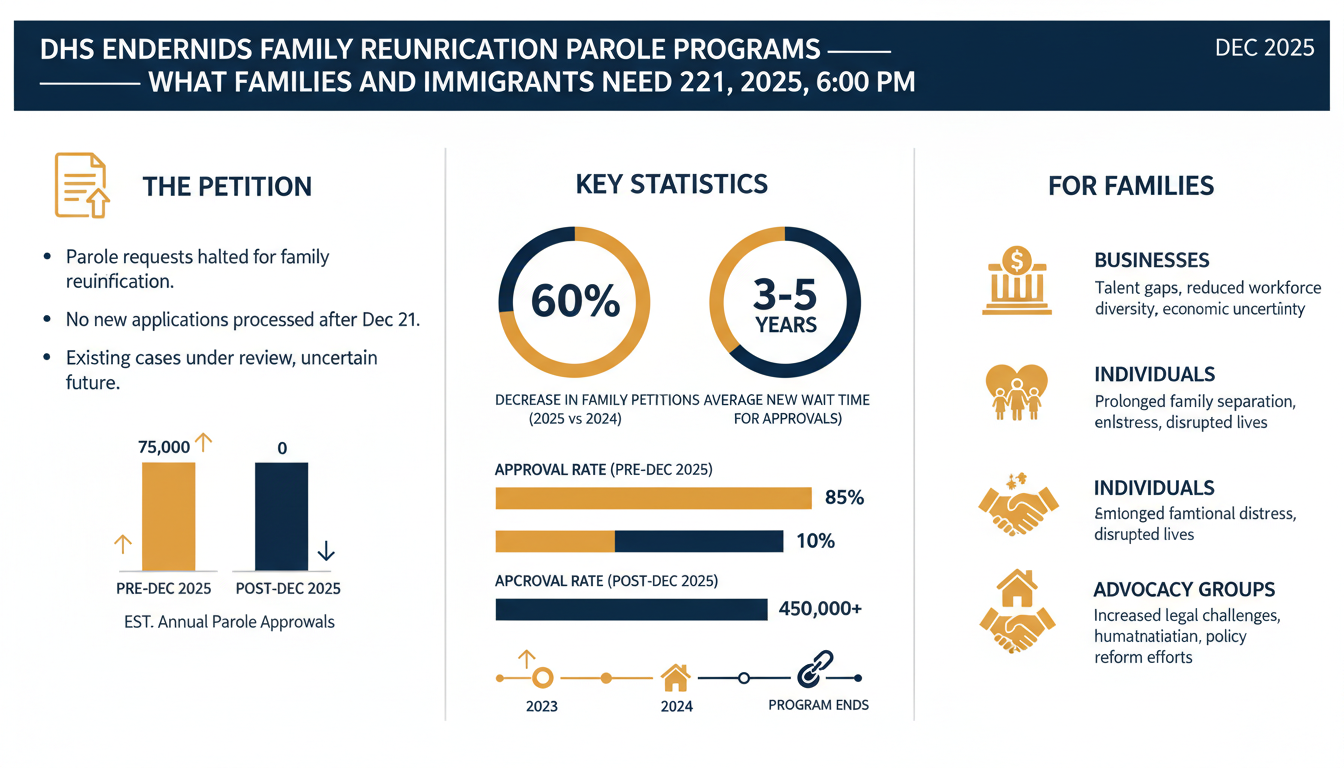
The Department of Homeland Security (DHS) announced it is terminating multiple family reunification parole programs that had allowed certain beneficiaries of approved immigrant visa petitions and their relatives to enter the United States while waiting for visas, effective in mid-December 2025, narrowing lawful channels for family-based entry for nationals of countries such as Cuba and Haiti and others impacted by these programs [1].
What happened (the factual record)
According to legislative and policy summaries published in December 2025, DHS issued an alert in mid-December stating it would end a set of family reunification parole processes that had been used to admit relatives of approved immigrant petition beneficiaries so they could remain in the United States while immigrant visas became available [1].
Advocates and legislative briefings report the Department characterized the move as intended to “end the abuse of the humanitarian parole process,” and the change follows other recent administrative shifts tightening parole, employment authorization, and screening policies for noncitizens [1][5].
Legal implications — what this change means
- Narrowing of lawful pathways: Termination of family reunification parole eliminates a discretionary channel that some families relied on to remain together in the U.S. while waiting for a family-sponsored immigrant visa, increasing time separated or forcing applicants to wait abroad for consular processing [1][2].
- Increased backlogs and risk of prolonged separation: With parole no longer available as an interim admission, beneficiaries and their relatives may face longer separations or the difficult choice to enter the U.S. without inspection, with attendant removal risks [3][2].
- Impact on related benefits and processes: Parole recipients historically could seek employment authorization or enroll dependents in certain benefits while in the U.S.; termination may limit or delay access to work permits, school enrollment continuity, and healthcare access tied to presence in the U.S.[5][6].
- Discretion and enforcement posture: DHS framed the termination as responding to misuse of parole, signaling an enforcement-first posture that may accompany other restrictions—e.g., shorter EAD validity, expanded vetting, and new parole fees—affecting a broad range of immigrants [5][4][8].
- Potential legal challenges: Changes to parole policy are typically subject to administrative-law review; stakeholders and advocates may seek litigation arguing arbitrary or capricious rulemaking depending on how DHS implements the terminations and whether adequate notice-and-comment or statutory authority issues arise [1][4].
Who is affected
The immediately affected groups include:
- Relatives of foreign nationals from countries specifically named in DHS alerts and program notices (reports cite Cuba and Haiti among the impacted countries) who planned to use family reunification parole to enter or remain in the U.S. while visas became available [1].
- Approved beneficiaries of family-based immigrant petitions whose dependents anticipated parole as an interim solution [3].
- Immigration practitioners, sponsors, and community organizations assisting mixed-status families who must now revise reunification strategies and timelines [2][6].
Authoritative sources and citations
The termination was described in a December 12–16, 2025 DHS alert summarized in legislative bulletins and policy trackers [1].
Broader context on family-based visa categories and visa availability can be found in the Department of State Visa Bulletin (December 2025), which explains preference categories and numerical limitations that are central to why parole was used by some families as an interim pathway [3].
Related administrative changes—shorter EAD validity and new parole fees—have been tracked by legal firms and immigration policy centers; for example, Holland & Knight and other outlets summarized major regulatory changes in late 2025 including EAD rule changes and a new parole fee implemented by legislation and agency action [5][1].
Actionable guidance for affected families and immigrants
The following steps prioritize preserving legal options, preparing for longer waits, and minimizing risk. This is practical, not legal advice—consult a qualified immigration attorney for case-specific counsel.
- Confirm whether your case used or planned to use family reunification parole. Check any DHS/USCIS notices, approval documents, or communications with your attorney or the U.S. embassy/consulate; document dates and program names referenced [1].
- Review your pending filings and priority dates. For family-sponsored petitions, identify the petition category (e.g., F1, F2A, F2B) and current priority date per the State Department Visa Bulletin to estimate when an immigrant visa may become available; this helps plan whether relatives will need to remain abroad until consular processing is possible [3].
- File or maintain nonimmigrant or immigrant forms promptly. If you qualify for an alternate nonimmigrant status (e.g., certain work or student visas) or have an adjustment of status pathway, discuss immediate filing with counsel to avoid gaps; timely filings are essential for preserving work-authorized status in some scenarios [5][6].
- Seek or renew employment authorization where eligible. If a relative previously relied on parole-based EADs, evaluate eligibility for other EAD categories; note that USCIS has recently reduced some EAD validity periods, so plan renewals earlier than before [5][7].
- Consider consular processing timelines and travel risks. If parole is not available, consular processing abroad will likely be the only feasible route for many family-based immigrant visas; ensure medicals, documents, police certificates, and translations are current to avoid further delays [3].
- Protect immigration records and evidence. Keep copies of all petitions, notices, and correspondence; collect documents proving relationships (birth certificates, marriage certificates), financial support affidavits, and photos, which will be needed for visa interviews and potential litigation or appeals [2].
- Explore humanitarian or other forms of relief if separation creates urgent need. In narrow cases, parole may still be available for urgent medical needs, imminent death funerals, or other limited exceptions; review DHS’s stated exceptions and consult counsel quickly to apply [5].
- Connect with local legal services and community organizations. Nonprofit immigrant legal providers and bar association referral services can provide low- or no-cost screenings and may help prioritize urgent applications or identify pro bono litigation opportunities [2].
- Document and prepare for potential administrative or court challenges. If you believe the termination was applied improperly to your case, preserve evidence of reliance on prior DHS guidance and solicit counsel to evaluate administrative remedies or litigation [1][4].
Sample checklist for an affected sponsor or beneficiary
- Locate and save notices showing parole eligibility or prior parole approvals.
- Check Visa Bulletin and calculate current priority date backlog for your category and country [3].
- Gather originals and translations of identity and relationship documents.
- Request immigration records (FOIA) if DHS/USCIS previously communicated eligibility that was later revoked.
- Schedule a consultation with an immigration attorney experienced in family-based immigration and administrative litigation.
Possible next legal and policy developments
Advocates may challenge DHS’s termination of family reunification parole in litigation alleging administrative procedural defects or statutory overreach; courts have previously enjoined or limited expansive immigration measures when agencies fail to follow proper rulemaking or justify discretion adequately [1][4].
Separately, Congress could pursue legislative fixes to restore or replace parole-based reunification mechanisms, but such measures would require bipartisan support and time to enact, leaving immediate relief uncertain [1].
Where to find reliable updates and legal help
- Consult official DHS and USCIS alerts for the precise text of any parole termination notices and any listed exceptions or implementation dates.
- Monitor the Department of State Visa Bulletin for family preference movement and consular processing guidance [3].
- Use reputable immigration law firm alerts and established advocacy groups for practice-oriented summaries and alerts about litigation or policy reversals [5][2].
- Contact local immigrant legal service providers, AILA (American Immigration Lawyers Association) referral networks, or your state bar’s immigration law section for attorney referrals [2][6].
Key citations and official materials
This article is based on the December 2025 policy summaries and legislative bulletins describing DHS’s mid-December alert terminating family reunification parole processes [1]; the State Department Visa Bulletin for December 2025 describing family preference categories and visa availability relevant to family reunification planning [3]; and legal-practice summaries of related regulatory changes (EAD validity, parole fees, and biometric/ vetting expansions) providing context for the policy environment in late 2025 [5][4][8].
Final practical note
Families affected by this termination should act quickly to preserve alternatives: confirm case-specific facts, consult experienced immigration counsel, gather documentary evidence of relationships and prior DHS communications, and prepare for longer consular waits or alternate visa strategies. Given the rapidly evolving administrative landscape and associated rule changes, timely legal advice is essential for preserving options and minimizing harm [1][3][5].