


Overview — What happened
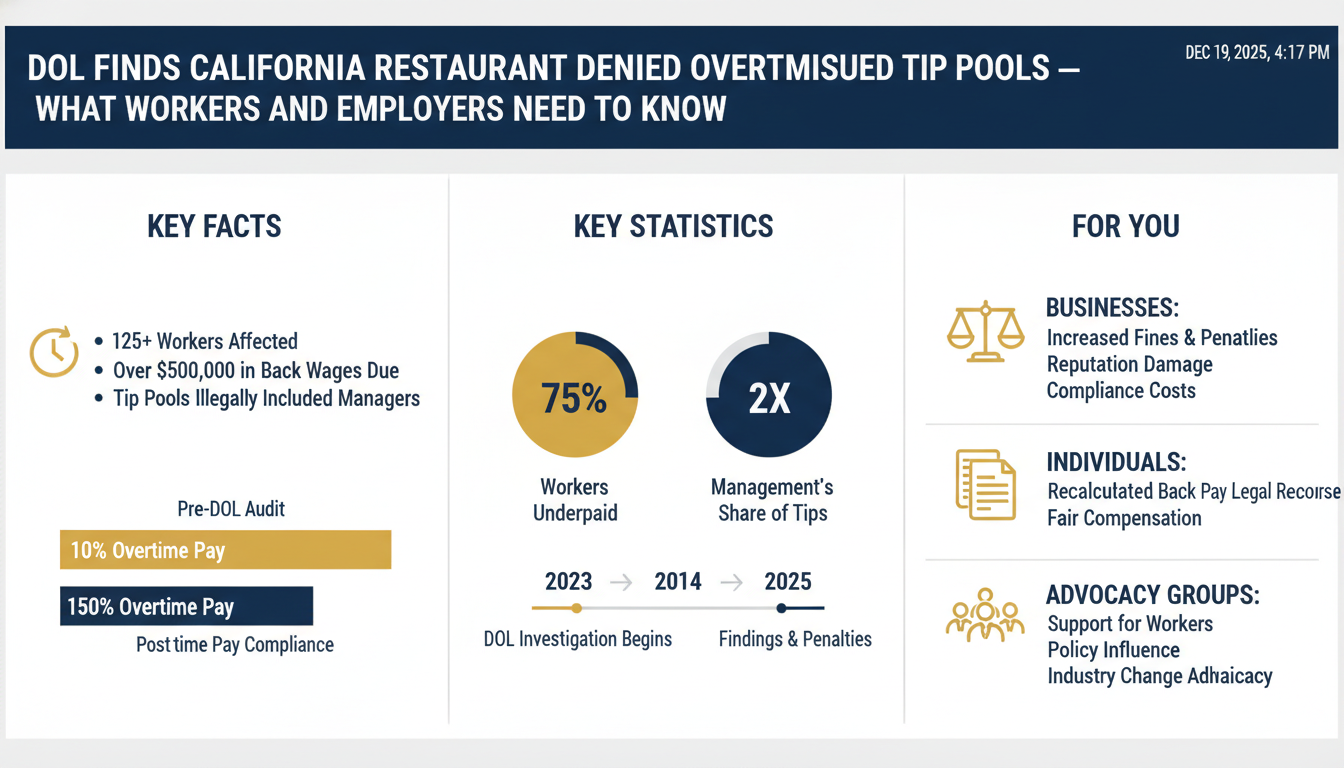
The U.S. Department of Labor’s Wage and Hour Division (WHD) issued a press release finding that Naya Ding Inc., a California restaurant, denied workers overtime pay and operated invalid tip pools; the employer was ordered to pay back wages and civil money penalties following the investigation[5].
Why this matters now
This enforcement action highlights two hot-button wage-and-hour issues that frequently intersect with workplace injury and employer liability concerns for hospitality workers: (1) proper overtime calculation and (2) lawful tip pool administration. Both issues can increase financial exposure for employers and affect injured workers’ access to wages and benefits during recovery[5].
The legal findings — key points from the DOL release
- Overtime violations: WHD concluded that Naya Ding Inc. failed to pay overtime to employees who worked more than 40 hours in a workweek, resulting in back wages due to affected workers[5].
- Invalid tip pools: The agency found the restaurant operated tip pools that were unlawful under the Fair Labor Standards Act (FLSA) and related guidance, resulting in additional back pay and potential civil money penalties[5].
- Remedial measures: WHD ordered the employer to pay back wages and any assessed civil money penalties and implemented corrective steps as part of the settlement or enforcement action[5].
Relevant law and authority
The WHD enforces the Fair Labor Standards Act, which requires employers to pay nonexempt employees at least the federal minimum wage and overtime (time-and-a-half) for hours worked over 40 in a workweek, subject to exemptions and state law that may provide greater protection[5].
The FLSA also restricts tip pooling arrangements: employers may require tip pooling among employees who customarily and regularly receive tips, but employers and managers may not retain employee tips, and certain allocations that result in employer tip retention or improper distribution are unlawful under federal guidance and regulations (29 U.S.C. § 203(m); Department of Labor regulations and opinion letters).
Intersection with workers’ compensation and employer liability
Although WHD actions focus on wages, these findings have practical effects on workplace-injury and employer-liability issues:
- Wage records and claims: Wage-and-hour investigations often produce payroll records that injured workers or their attorneys can use to calculate lost earnings, temporary total disability, or average weekly wage for workers’ compensation claims (state-specific calculation rules apply).
- Insurance implications: Significant wage exposure from back-pay orders can increase an employer’s loss history and influence workers’ compensation premiums or trigger scrutiny from insurers and regulators.
- Commingled violations and liability: Evidence that an employer misclassified employees, manipulated payroll, or unlawfully handled tips may support broader claims of negligence, bad faith, or willful misconduct in related litigation—potentially affecting remedies or penalties in other forums.
Practical legal implications for workers
Workers affected by similar practices should consider these immediate legal implications and steps:
- You may be owed unpaid wages and overtime. Under the FLSA, employees can be entitled to back pay for unpaid minimum wage or overtime; the DOL’s WHD can pursue enforcement, and employees may bring private lawsuits seeking back pay and liquidated damages where appropriate (29 U.S.C. § 216(b)).
- Tip pool violations can increase recoveries. If an employer unlawfully retained or misapplied tips, affected workers may be entitled to recovery of those tips and related damages under federal or state law[5].
- Workers’ compensation claims remain distinct. Wage-and-hour relief does not replace workers’ compensation benefits for workplace injuries, but payroll records produced during investigations can help prove wage loss for workers’ compensation benefit calculations.
- Retaliation is prohibited. Federal and many state laws protect employees who file wage complaints or participate in investigations; unlawful retaliation can trigger separate claims for reinstatement, damages, and attorneys’ fees.
Practical legal implications for employers
Employers should recognize increased enforcement risk and consider immediate compliance measures:
- Audit payroll and tip practices now. Conduct an internal compliance audit of timekeeping, overtime eligibility, and tip pool arrangements. Confirm that tip pools include only eligible employees and that management or supervisors do not retain any portion of tips.
- Corrective action and back pay budgeting. Be prepared to identify and correct past underpayments; set aside reserves for potential back wages and civil penalties if violations are discovered.
- Train managers and staff. Provide clear written policies and training on exempt vs. nonexempt classification, overtime calculation, and lawful tip pooling to reduce risk of repeat violations.
- Coordinate with counsel and insurers. Engage employment counsel promptly and notify applicable insurers if wage exposures could implicate broader liability coverage or claims handling.
Actionable guidance — step-by-step for affected workers
If you believe you were denied overtime or your tips were improperly pooled, consider taking the following steps:
- Gather documentation: Collect pay stubs, tip records, schedules, timecards, texts or emails about schedules or pay, and any employee handbook or policy documents.
- Request wage records: Ask your employer in writing for payroll records and tip-pool distributions; federal and state law may require maintaining such records for specific periods.
- File a WHD complaint: You may file a complaint with the Department of Labor’s Wage and Hour Division, which investigates FLSA matters and can recover unpaid wages and penalties on your behalf[5].
- Consider private counsel: An employment lawyer can assess whether a private FLSA action is appropriate and whether liquidated damages or attorney’s fees are available (29 U.S.C. § 216(b)).
- Protect yourself from retaliation: Keep records of any adverse actions by your employer after you raise concerns; contact counsel or WHD immediately if you face discrimination or termination for complaining about wages.
Actionable guidance — step-by-step for employers
Employers in hospitality and related industries should act quickly to limit liability:
- Perform a compliance audit: Review classifications, overtime calculations, timekeeping systems, and tip pool structures against federal and state law; document findings and remediation plans.
- Fix errors promptly: If underpayments are found, calculate and remit back wages and correct pay practices; voluntary correction can mitigate exposure to penalties in some situations.
- Revise policies and train staff: Update employee handbooks and train supervisors on lawful tip pooling and overtime rules; ensure written tip-pool agreements and transparent distribution methods.
- Engage counsel early: Retain employment counsel to coordinate responses to investigations and to negotiate settlements where appropriate; counsel can also advise on state-specific nuances and insurance notification obligations.
How this decision connects to OSHA and workplace safety
Although the DOL’s WHD investigation focuses on wage issues, there are practical connections to Occupational Safety and Health Administration (OSHA) concerns and employer liability for workplace injury:
- Recordkeeping and investigations overlap: Workplace investigations often uncover multiple compliance areas—payroll audits can reveal staffing practices that affect safety (e.g., understaffing leading to rushed shifts and increased injury risk).
- Resource strain: Large wage assessments can strain employer finances, potentially reducing investments in safety programs unless addressed promptly.
- OSHA citations and joint enforcement: Employers under WHD enforcement may attract closer scrutiny from OSHA or state safety agencies, particularly if complaints reference unsafe working conditions alongside wage concerns.
Key sources and authorities
- U.S. Department of Labor, Wage and Hour Division press release on the investigation of Naya Ding Inc. (DOL-WHD enforcement action, Dec. 19, 2025)[5].
- Fair Labor Standards Act provisions and enforcement authority, 29 U.S.C. § 201 et seq.; private enforcement provision, 29 U.S.C. § 216(b).
- Department of Labor guidance and regulations on tip pooling and permissible allocations (see DOL regulations and opinion letters interpreting 29 U.S.C. § 203(m)).
Frequently asked questions
Will collecting unpaid wages affect my workers’ compensation claim?
Recovering unpaid wages or tips through a WHD action or lawsuit does not substitute for workers’ compensation benefits, which address medical care and wage replacement for workplace injuries; however, payroll documents from wage cases can help establish average weekly wage or other calculations used in workers’ compensation claims.
Can my employer legally make me participate in a tip pool?
Yes, but only if the tip pool is limited to employees who customarily and regularly receive tips (e.g., servers, bussers, bartenders) and if the employer does not retain any portion of employees’ tips; state laws may be more restrictive than federal law and should be checked for additional protections.
What remedies are available if my employer retaliates?
Retaliation for filing wage complaints or participating in investigations is prohibited; remedies can include reinstatement, back pay, compensatory damages, and attorneys’ fees under federal and state statutes—report retaliation to WHD and consult an employment lawyer promptly.
Next steps — protecting your rights or your business
Workers who suspect unpaid overtime or unlawful tip pooling should gather documentation and file a complaint with the Wage and Hour Division or consult an employment attorney; employers should immediately audit pay and tip practices, correct deficiencies, and retain counsel to manage enforcement risk[5].
For assistance in Orlando and Florida-specific matters—such as how state law interacts with federal FLSA requirements or how payroll findings affect workers’ compensation calculations—contact experienced employment and workers’ compensation counsel to evaluate your situation and next steps.


