


USCIS Slashes EAD Validity to 18 Months: Critical Impacts on Immigrant Families
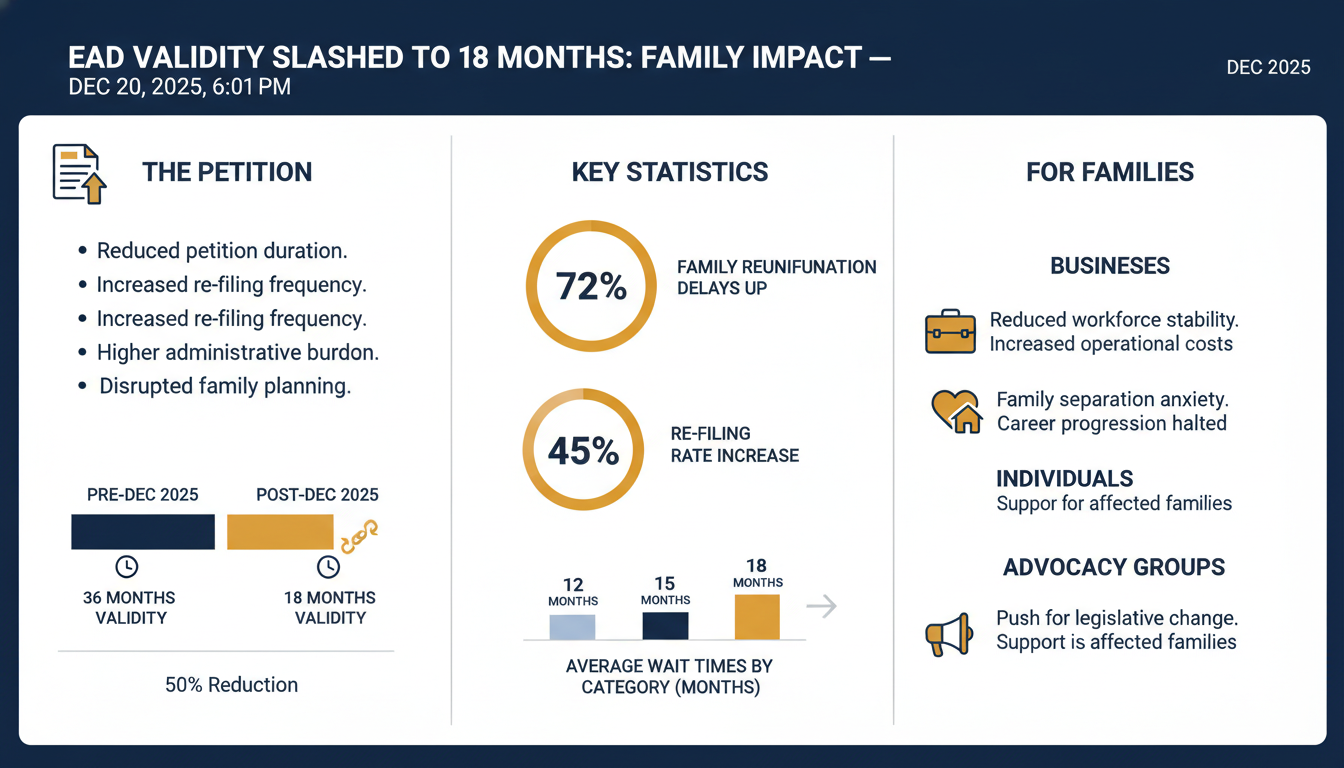
In a sweeping policy shift effective immediately, U.S. Citizenship and Immigration Services (USCIS) has reduced the maximum validity period for many Employment Authorization Documents (EADs) from five years to just 18 months. This change, announced in early December 2025, primarily affects asylum applicants, Temporary Protected Status (TPS) holders, and certain family-based immigration categories, creating urgent challenges for thousands of immigrant families nationwide.[3][4][5][7][8]
The New EAD Rule: What Changed and Why
The Trump Administration justifies the reduction as a measure to enable more frequent security screenings, reversing extensions implemented under the prior administration to address USCIS processing backlogs.[4] Previously, EAD renewals for eligible categories like asylum pending (c)(8), TPS (a)(12), and adjustment of status (c)(9) could automatically extend up to 540 days while applications were pending, providing work continuity.[5] Now, initial and renewal EADs in these categories cap at 18 months, with no automatic extensions beyond that for filings after October 30, 2025.[5][8]
Key affected categories include:
- Asylum applicants (c)(8): Those awaiting asylum decisions, often families fleeing persecution.[4][7]
- TPS holders (a)(12): Protected from deportation due to conditions in home countries like Haiti, Venezuela, and Ukraine.[5]
- Adjustment of status (c)(9): Family-sponsored green card applicants, including spouses and children of U.S. citizens or permanent residents.[3]
- Other humanitarian categories: Such as parolees and VAWA self-petitioners.[4]
This aligns with broader December 2025 updates, including biometric collection starting December 26 and expanded vetting for family visa applicants.[5][6] USCIS Policy Alert PA-2025-27 formalizes the EAD reduction in the Policy Manual.[8]
Legal Implications for Families and Immigrants
The shortened EAD validity exacerbates USCIS delays, where renewal processing often exceeds six months—and sometimes years—for family-based and humanitarian cases.[5] Families risk employment gaps, loss of income, and inability to meet public charge requirements under the Immigration and Nationality Act (INA) Section 212(a)(4), potentially jeopardizing green card approvals.[1]
Under INA Section 208 for asylum and Section 244 for TPS, work authorization is tied to pending status, but the 18-month cap could force re-applications mid-process, compounding fees ($410–$520 per EAD) and uncertainty.[3] For family reunification, this intersects with Visa Bulletin delays: December 2025 shows F2A (spouses/children of LPRs) advancing minimally, with per-country caps straining waits.[2]
Courts may see challenges, echoing blocks on other Trump-era policies like birthright citizenship efforts (Supreme Court docketed December 5, 2025).[1] Legal experts note this tests executive authority limits without congressional action.[4]
Broader Policy Context
This EAD cut accompanies:
- Expanded travel bans under Proclamation 10949, now barring immediate family immigrant visas from 19+ countries (effective post-December 2 holds on I-589 asylum forms).[6]
- New $1,000 parole fee (October 16, 2025), limiting family humanitarian entries except medical/funeral cases.[5]
- Social media vetting for H-4 dependents (December 15, 2025), impacting family work authorization.[6]
These create a "chilling effect," deterring families from benefits and risking inconsistent outcomes.[1]
Actionable Guidance: Steps for Affected Families
Immigrant families in Florida and beyond must act swiftly to mitigate risks. Imigrar, your Orlando immigration law firm, recommends the following:
1. File EAD Renewals Immediately
- Submit Form I-765 at least 180 days before expiration to maximize the 18-month validity.[3][7]
- Include Form I-797 receipt notice for any automatic extension (limited now).[5]
- Track status online via USCIS Case Status tool; expedite if job loss looms (evidence required).
2. Assess Eligibility for Alternatives
| Category | Alternative Options | Key Forms/Citations |
|---|---|---|
| Asylum Pending | Expedite request; TPS if eligible | I-589 hold review (PM-602-0192)[6] |
| TPS Holders | Re-register early; H-4 if spouse qualifies | INA §244; USCIS TPS page |
| Family Adjustment | Premium processing (if available); F2A filing | I-485; Visa Bulletin Dec 2025[2] |
3. Financial and Public Charge Planning
- Document sponsor affidavits (Form I-864) showing income above 125% poverty line to counter public charge fears.[1]
- Avoid benefits if possible; consult counsel on "totality of circumstances" test.
- Secure employer letters verifying job offers for EAD expedites.
4. Seek Professional Legal Help
Complex cases—such as mixed-status families or those with DACA/TPS overlaps—require tailored strategies. Contact Imigrar for:
- Free eligibility assessments via our Family-Based Adjustment Tool (updated December 17, 2025).[9]
- Representation in USCIS interviews, appeals, or litigation.
- Orlando office consultations: Schedule amid rising detention funding ($15B+ FY2026).[4]
Proposed bills like the Reuniting Families Act (S. 3419) could double family visas and cap waits at 10 years—monitor via congressional trackers.[1]
Real Stories and Expert Insights
Families like TPS-protected Venezuelans in Florida report anxiety over job losses, mirroring a Chinese asylum seeker's detention despite credible claims.[4] Experts from the Migration Policy Institute emphasize congressional limits on such executive actions.[4] At Imigrar, we've assisted hundreds navigating similar shifts, ensuring compliance while advocating rights.
Looking Ahead: Stay Informed
With biometrics mandatory December 26 and Diversity Visa cutoffs tightening (SR: 01SEP20), vigilance is key.[2][5] Subscribe to Imigrar alerts for Visa Bulletin updates and policy shifts. Our team tracks Supreme Court birthright citizenship arguments and Dream Act progress (bipartisan permanent status path).[1]
Don't let policy whiplash derail your American dream. Imigrar provides compassionate, expert guidance for Orlando families.
Disclaimer: This article synthesizes public sources as of December 2025; consult an attorney for personalized advice. Imigrar is not affiliated with USCIS.