


USCIS Slashes EAD Validity to 18 Months: Devastating Blow to Immigrant Families
In a sweeping policy shift announced in early December 2025, U.S. Citizenship and Immigration Services (USCIS) has reduced the maximum validity period for Employment Authorization Documents (EADs) from five years to just 18 months for many categories, including adjustment of status applicants and those seeking asylum or humanitarian protections.[4][5][7][8] This change, effective immediately for new issuances, threatens financial stability for thousands of immigrant families, creating gaps in work authorization that could lead to job loss, housing instability, and family separations.[1][5]
Background: What Triggered This Rapid Policy Reversal?
The Trump Administration justifies the EAD reduction as a measure to enable "additional security screenings," reversing extensions implemented under the prior administration to address processing backlogs.[5] Previously, EADs for asylum seekers, Temporary Protected Status (TPS) holders, and adjustment of status (green card) applicants could last up to five years, with 540-day automatic extensions for timely renewals.[6] That safety net ended with a DHS final rule on October 30, 2025, eliminating the 540-day extension for applications filed after that date.[6]
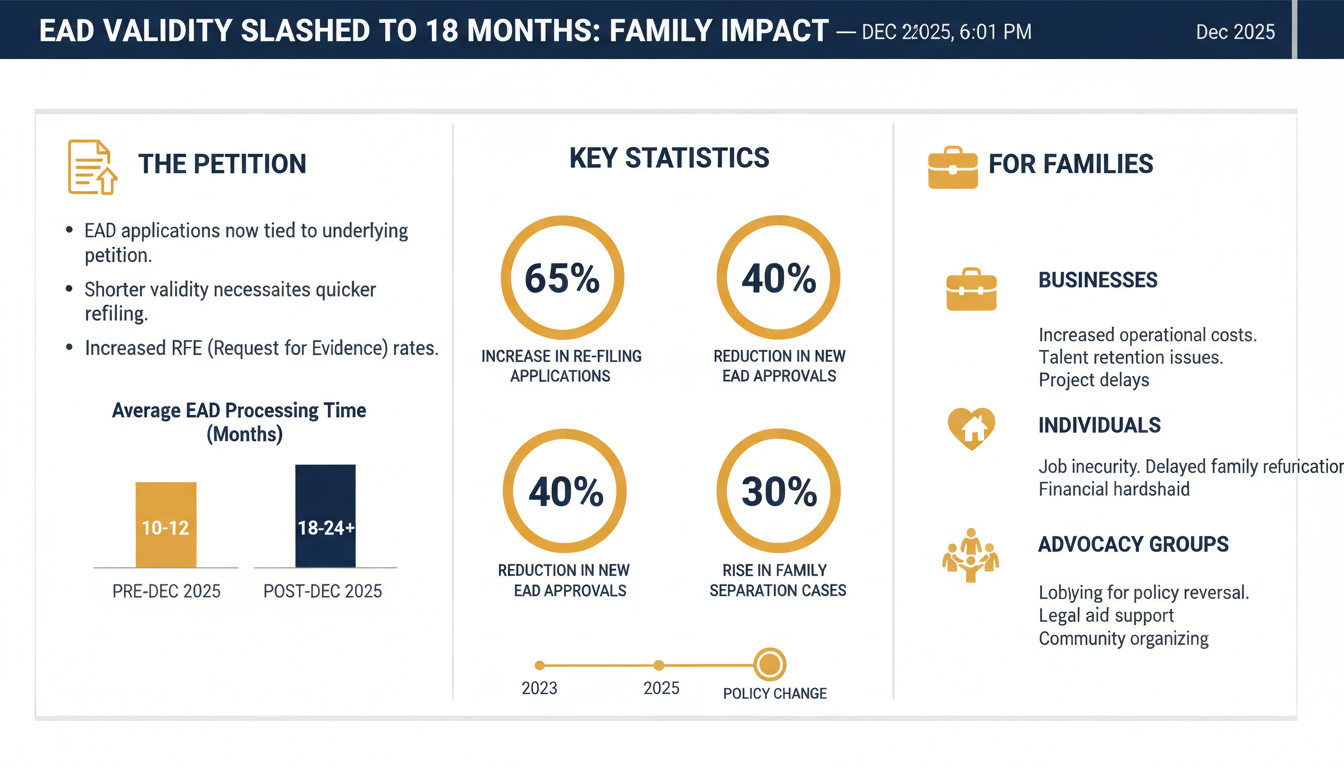
Recent USCIS Policy Alert PA-2025-27 further caps EAD validity at 18 months across key categories, directly impacting families.[7][8] This aligns with broader 2025 trends: heightened enforcement, biometric expansions starting December 26, 2025, and stricter public charge rules creating uncertainty for mixed-status households.[1][6] For families, where one parent's work authorization lapses, the ripple effects include unpaid bills, school disruptions for children, and heightened deportation risks amid expanded expedited removal.[1][5]
Legal Implications: Who Is Affected and Why It Matters
This EAD cap disrupts family-based immigration pathways, exacerbating delays already plaguing I-130 petitions, adjustment of status (I-485), and dependent work permits like H-4 EADs.[1][3] Under INA Section 203, family-sponsored preferences (F2A for spouses/children of permanent residents, F2B for unmarried adult children) face per-country limits and backlogs, now compounded by shorter work validity.[3]
- Asylum Seekers and Humanitarian Applicants: EADs (c)(8) category now max 18 months, affecting hundreds of thousands; no more five-year terms.[5]
- Adjustment of Status (Green Card) Filers: Pending I-485 applicants lose long-term work stability, risking employment gaps during multi-year waits.[4][8]
- Dependents (H-4, L-2, TPS Holders): Stricter renewals and no automatic extensions heighten vulnerability for spouses/children in dual-income families.[1][6]
- Mixed-Status Families: U.S. citizen children depend on undocumented or pending parents' income; lapsed EADs amplify public charge fears under proposed DHS rules.[1][2]
Legally, this invokes INA § 274A, mandating work authorization for employment; gaps trigger unlawful presence accrual, barring future adjustments under INA § 212(a)(9)(B).[5] Courts may see challenges, as prior extensions survived litigation, but executive discretion prevails absent congressional action—like the stalled Reuniting Families Act (S. 3419), which aims to cut family visa waits to 10 years max.[2]
Broader 2025 Context Amplifying Family Strain
December's Visa Bulletin shows minimal movement: F2A final action dates stagnant, signaling ongoing backlogs.[3] Coupled with biometric mandates from December 26 (fingerprints/photos for noncitizens), families face more appointments and costs.[6] Public charge proposals expand discretion, chilling benefit use and mirroring EAD uncertainty.[2] Enforcement surges—detention funding up 400% to $14B+—target mixed families via traffic stops or raids.[1][5]
Actionable Guidance: 7 Steps for Families to Protect Work Status Now
Imigrar, your Orlando immigration law firm, urges immediate action. Delays in renewals (already 6+ months) without extensions spell disaster.[6] Here's a prioritized plan:
- Check Expiration Dates Today: Review all EADs; file renewals 180 days early via Form I-765. Track via USCIS Case Status online.[4][7]
- Gather Premium Processing: For eligible categories (e.g., certain asylum-based), opt for 15-day processing ($1,500+ fee) to avoid gaps.[8]
- Explore Alternatives: Spouses of L-1/H-1B holders: Confirm L-2/H-4 EAD eligibility. TPS holders: Monitor country-specific extensions.[6]
- Budget for Fees and Gaps: New $1,000 parole fee (H.R. 1) and rising I-130 costs strain families; build 6-month emergency funds.[1][6]
- Document Financial Stability: Counter public charge risks with affidavits of support (I-864) proving no reliance on benefits.[2]
- Schedule Consultations: Book with Imigrar for Orlando families—assess expedited removal risks, biometric prep, and waivers.[1]
- Stay Informed on Litigation: Monitor Supreme Court birthright citizenship case (granted Dec 5, 2025) and Dream Act (2025) for relief paths.[2][5]
Pro Tip: Use USCIS Lockbox for filings to bypass delays; retain proof of timely submission for backpay claims if gaps occur.[7]
Real Client Stories: Orlando Families Hit Hard
At Imigrar, we've seen the fallout firsthand. Maria, an H-4 spouse in adjustment proceedings, faced a 3-month work gap post-shortened EAD, losing her nursing job and family health coverage.[1] Javier's asylum EAD lapse forced his U.S. citizen kids onto food assistance—now a public charge red flag.[2] These aren't hypotheticals; they're 2025 realities for Central Florida's immigrant communities.
Expert Analysis: Is Relief Coming in 2026?
While S. 3419 and Dream Act offer hope, passage is uncertain amid OBBA's $11B+ detention boost.[2][5] Diversity Visa cutoffs tighten (SR: 01SEP20), and trucking license bans hit refugees.[3][5] Families must pivot: Dual filings (e.g., TPS + asylum), congressional advocacy, or Orlando-based legal aid.
Holland & Knight notes stakeholder backlash to EAD cessation, predicting business lawsuits.[6] JD Supra flags employer impacts, urging pre-2026 compliance.[4] For families, this means prioritizing work continuity over all else.
Why Imigrar? Your Orlando Family Immigration Ally
With deep roots in Central Florida's immigrant hubs, Imigrar crafts tailored strategies against these headwinds. From EAD expedites to public charge defenses, our team cites INA precedents like INS v. Chadha (1983) for executive overreach challenges. Contact us for a free case review—secure your family's future before 18 months run out.
Key Citations: USCIS Policy Alert PA-2025-27[7]; DHS Final Rule Oct 30, 2025[6]; Visa Bulletin Dec 2025[3]; INA §§ 203, 274A.
Don't wait—renew today. Your work authorization is your lifeline.