


Overview — What happened
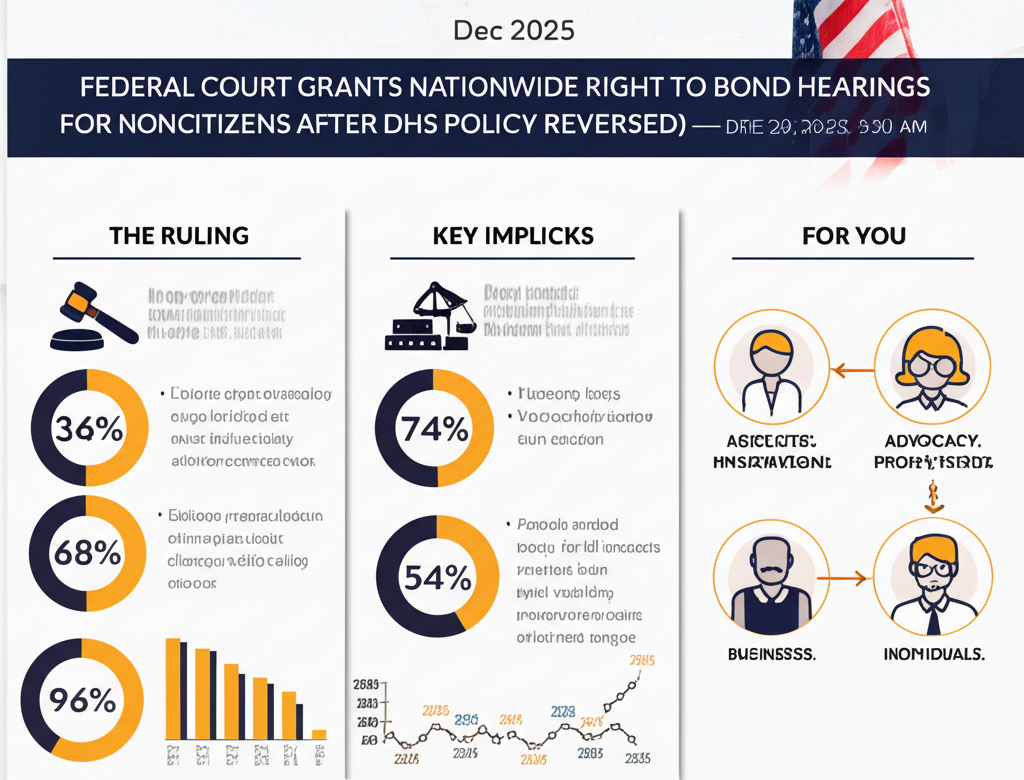
A federal district court in California issued a ruling clarifying and affirming that a nationwide class of noncitizens is entitled to bond hearings in immigration removal proceedings, and the court set aside a Department of Homeland Security (DHS) and Department of Justice (DOJ) policy that had sought to categorically deny bond eligibility to people who entered without inspection; the decision enforces the classwide right to individualized custody determinations rather than automatic mandatory detention[4].
Key documents and sources
- Press release and case information from the American Civil Liberties Union (ACLU) describing the federal court order affirming the nationwide class right to bond hearings[4].
- Public reporting on related Supreme Court and federal litigation regarding immigration enforcement policies in late 2025, including the U.S. Supreme Court docket and reporting on immigration-judge speech restrictions (contextual background)[1][2][3].
Background — the policy the court struck down
In July 2025, DHS and DOJ announced a new enforcement policy declaring that noncitizens who entered the United States without inspection would be categorically ineligible for release on bond during removal proceedings, effectively imposing mandatory detention on that group.[4]
Advocates challenged that policy in class-action litigation led by the ACLU, ACLU of Southern California, the Northwest Immigrant Rights Project, and USC Gould School of Law Immigration Clinic, arguing it violated due process and longstanding immigration adjudicative practice that permits individualized bond hearings.[4]
The court's ruling — what the judge ordered
U.S. District Judge Sunshine Sykes (Central District of California) issued a clarifying order that:
- Affirmed a previously certified nationwide class of noncitizens who entered without inspection as having a right to bond hearings; and
- Entered final judgment declaring the DHS/DOJ categorical-denial policy unlawful and setting it aside as applied to the class; and
- Explained the need for clarity because evidence showed government officials and immigration judges were being directed to ignore earlier court orders, creating confusion and unlawful directives.[4]
Legal basis and reasoning (concise)
The court found that the government’s new categorical rule — that anyone who entered without inspection is automatically ineligible for bond — conflicted with procedural due process protections and prior judicial orders that require individualized custody determinations during removal proceedings.[4]
Judge Sykes pointed to the government’s disregard for earlier summary-judgment orders and the practical consequence that immigration judges were being told to ignore the court’s rulings, prompting the court to enter a final judgment clarifying the rights of class members nationwide[4].
Why this decision matters — legal and practical implications
- Restores individualized bond hearings: Detained noncitizens within the certified class regain the right to individualized custody and bond hearings rather than facing categorical detention without individualized consideration[4].
- Nationwide effect: Because the court issued relief on behalf of a nationwide class, immigration authorities across the United States are constrained from applying the categorical policy to class members[4].
- Limit on administrative overreach: The ruling underscores judicial limits on agency rulemaking that seeks to eliminate long-established individualized procedures in removal hearings[4].
- Operational impact on DHS/ICE and immigration courts: Immigration judges and ICE officers must follow the court’s order and provide individualized bond determinations for class members unless and until an appellate court or the Supreme Court rules otherwise[4].
- Potential for appeal and further litigation: The government may seek appellate review or emergency relief; national practitioners should monitor filings for injunctions or stays that could alter immediate applicability[4].
Who is covered — class membership explained
The certified class covers noncitizens who entered the United States without inspection and who were subject to the DHS/DOJ categorical-denial policy at issue in the litigation; the court’s final judgment specifically declares the rights of those class members to bond hearings and to have the policy set aside as applied to them[4].
Actionable guidance — what affected individuals should do now
If you or a loved one is detained and entered without inspection, take the following steps immediately:
- Inform counsel and the immigration judge about the court’s order: Provide your attorney and the immigration judge with notice of the District of California’s ruling affirming the nationwide class right to bond hearings so they can seek an individualized custody determination for you[4].
- Request a bond hearing or reconsideration: If you were denied bond on the basis of the categorical policy, your attorney should file an administrative or judicial request to reopen or reconsider custody based on the court’s final judgment[4].
- Document directives from DHS/ICE or the immigration court: Keep written copies or record dates and specifics of any government directives that reference categorical detention; the court specifically noted government instructions to ignore prior orders as a basis for clarifying relief[4].
- Contact experienced immigration counsel or legal aid groups: Organizations involved in the litigation (ACLU, ACLU SoCal, Northwest Immigrant Rights Project, USC Gould Immigration Clinic) may have resources or referrals for class members and detained noncitizens seeking representation[4].
- Prepare releasability information: Work with counsel to assemble evidence commonly considered at bond hearings (ties to community, employment, family, criminal history, flight risk factors, and any humanitarian equities) to present at the custody hearing.[4]
For immigration attorneys — litigation and tactical considerations
- File immediate motions where appropriate: Seek bond hearings, emergency stays of detention, or motions to reopen where clients were denied bond under the categorical policy; cite the district court’s final judgment and any controlling local orders[4].
- Preserve the record for appeal: If administrative officials refuse to comply, contemporaneously document refusals and seek emergency relief in federal court to enforce the judgment.[4]
- Monitor appellate activity: Track whether the government appeals or seeks emergency relief from a higher court; an appeal or stay could limit the ruling’s immediate effect in some jurisdictions[4].
- Coordinate with national advocacy groups: Class counsel and civil-rights organizations may issue practice advisories, model pleadings, or strategic guidance for practitioners representing class members.[4]
Potential defenses and likely government responses
The government may argue on appeal that Congress or immigration statutes permit categorical detention in some circumstances or that agency enforcement priorities justify the policy; however, the district court determined the categorical rule conflicted with due process and prior judicial orders as applied to the certified class[4].
Practitioners should be prepared for the government to seek stays of the district court’s judgment, file appeals to the Ninth Circuit, or ask the Supreme Court for emergency relief if the ruling is perceived to significantly alter national enforcement operations[4].
Related federal litigation and context
This decision is part of a broader wave of litigation and judicial scrutiny of recent federal immigration policies in 2025, including disputes that reached or touched the Supreme Court concerning immigration enforcement actions and administrative directives[2][3].
For example, the Supreme Court in late December 2025 addressed other immigration questions and denied emergency relief in at least one dispute over immigration-judge speech restrictions, reflecting heightened judicial involvement on immigration-administration matters[2][3].
Where to find the official order and further reading
- ACLU press release and case background describing the federal court’s final judgment and classwide relief[4].
- District court docket and orders filed in the Central District of California (search by Judge Sunshine Sykes and the case name listed in ACLU materials) for the controlling opinion and final judgment[4].
- U.S. Supreme Court opinions and reporting for related immigration matters during the 2025 term for broader legal context[1][2][3].
Practical next steps — checklist for clients
- Ask your attorney to confirm whether you are a member of the certified class and whether the district court’s judgment applies to your case[4].
- Request an immediate bond/custody hearing if detained and not yet afforded one, citing the district-court ruling[4].
- Gather evidence of community ties, employment prospects, and other mitigating factors to present at a bond hearing[4].
- If you cannot afford private counsel, contact local legal-aid organizations or national groups involved in the litigation for assistance or referrals[4].
Limitations and possible future developments
The district court’s decision provides significant relief for class members, but it is subject to appeal and potential stays that could narrow its immediate reach in some jurisdictions; practitioners and clients should closely monitor appellate filings[4].
Additionally, future litigation may clarify the scope of the ruling, which currently applies to the certified nationwide class and may leave open questions about persons outside that class or alternative detention authorities under different statutory provisions[4].
Final note
If you or a family member is detained or facing removal and believe this ruling may apply, consult experienced immigration counsel promptly to preserve rights and pursue individualized bond relief under the district court’s judgment.[4]


