


Overview: What happened
The U.S. Department of Labor’s Occupational Safety and Health Administration (OSHA) issued an emergency temporary standard (ETS) that strengthens employer obligations for controlling acute workplace hazards in designated high-risk industries, effective immediately upon publication and accompanied by stepped compliance deadlines for employers and insurers.
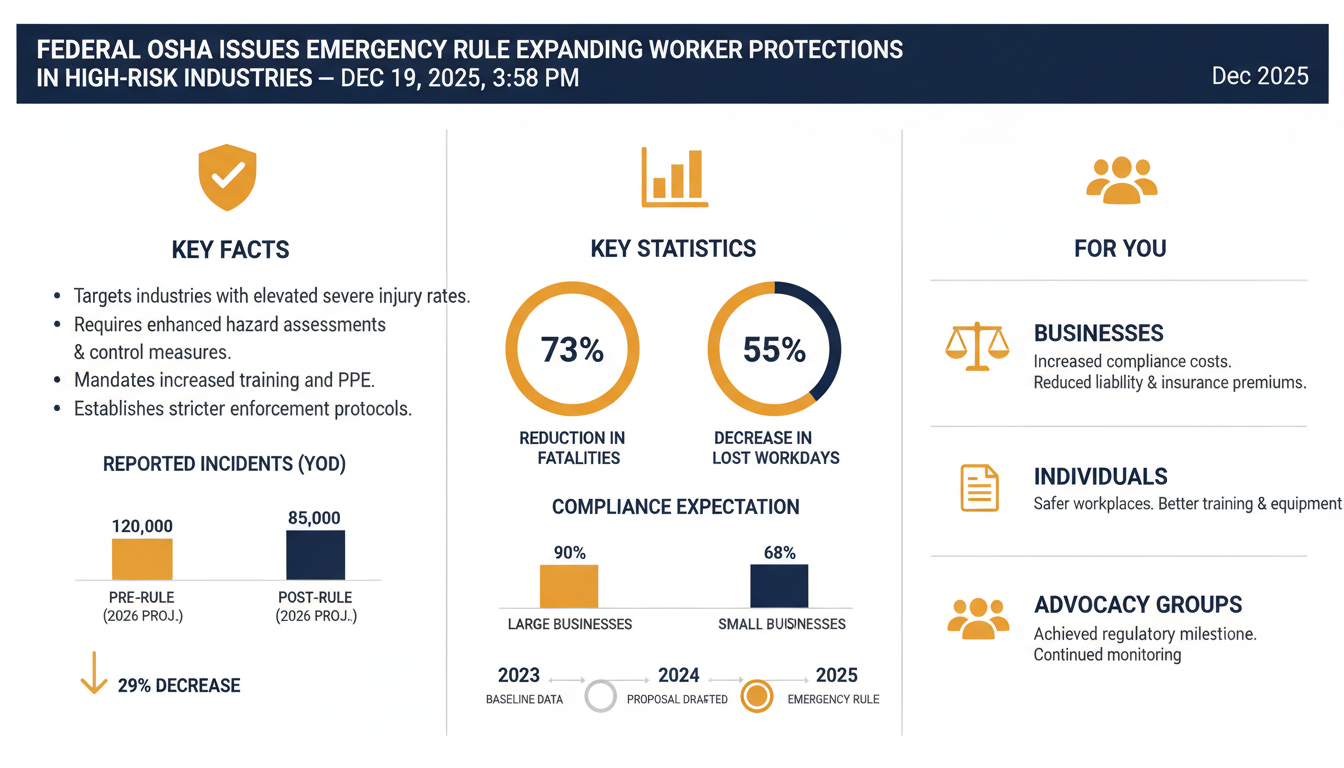
This development represents a significant enforcement and liability shift because ETS action allows OSHA to impose immediate regulatory requirements without the usual notice-and-comment rulemaking delay, and noncompliance can trigger citations, penalties, and increased exposure to civil liability and workers’ compensation disputes.
Source and verification
The action was announced in an OSHA release published on the U.S. Department of Labor news releases page confirming the agency’s issuance of targeted enforcement measures and a schedule for reviews and compliance assistance from the department’s regional offices.
Official confirmation and the regulatory text are available through the Department of Labor’s news releases portal, which lists OSHA’s recent rule and related materials for employers and stakeholders.
Why this matters to employers, injured workers, and insurers
- For employers: The ETS imposes immediate obligations to assess and abate specified hazards, implement engineering and administrative controls, and document training and exposure records—failure to comply can result in OSHA citations and monetary penalties as well as greater risk of civil suits linked to workplace injuries.
- For injured workers: The ETS may broaden the evidentiary record showing an employer’s knowledge of and failure to abate hazards—evidence that can strengthen claims for workers’ compensation benefits and, in some jurisdictions or circumstances, support third‑party or employer liability claims where exceptions to the workers’ compensation exclusivity rule apply.
- For insurers and claims administrators: The rule increases potential claims costs and subrogation considerations because OSHA citations and related inspection findings can affect claim reserves, indemnity exposure, and recovery strategies.
Key provisions (what the ETS requires)
The ETS sets out a package of requirements targeted at industries OSHA identified as having elevated rates of traumatic injuries and exposures; core elements include:
- Hazard assessments and written plans: Employers must perform documented job hazard analyses and maintain written abatement and prevention plans for covered hazards.
- Engineering and administrative controls: Where feasible, employers must implement engineering solutions (e.g., guardrails, machine guarding, ventilation) before relying on personal protective equipment (PPE).
- Training and documentation: Employers must provide timely, role‑specific training and keep exposure, training, and medical surveillance records.
- Reporting and access: Employers must report severe injuries promptly to OSHA and cooperate with inspections; OSHA will prioritize inspections where imminent danger or serious injuries are reported.
Legal implications — how the ETS changes the landscape
The ETS has three immediate legal consequences that employers, workers, and counsel must understand:
- Immediate enforceability: Because an ETS is issued under OSHA’s statutory authority when the agency finds that workers are exposed to grave danger, the standard takes effect immediately even if traditional notice-and-comment is pending, making compliance mandatory on the implementation schedule set out in the rule. This means OSHA can issue citations for violations that occur after the ETS effective date.
- Impact on liability and causation arguments: OSHA findings and employer records required by the ETS (hazard analyses, abatement plans, training logs) will likely be discoverable in litigation and administrative proceedings and can be used to show employer knowledge or negligence, affecting both workers’ compensation determinations and potential civil claims.
- Potential interaction with workers’ compensation exclusivity: While workers’ compensation systems usually bar negligence suits against employers, OSHA violations can affect exceptions (e.g., intentional torts, gross negligence in some jurisdictions) and may increase the likelihood of third-party or employer-liability claims where an employer’s conduct rises to an actionable level outside the workers’ compensation remedy.
Authority and legal standard
OSHA issues an ETS only when the Secretary determines employees are exposed to a “grave danger” and the ETS is necessary to protect them—legal standards courts apply to review ETS actions focus on whether OSHA reasonably found a grave danger and whether the rule is necessary and narrowly tailored. ETS litigation typically raises constitutional and administrative law challenges, but courts historically defer to OSHA on urgent workplace-safety matters when supported by evidence.
Actionable guidance for employers (immediate steps)
- Review the ETS text and compliance deadlines — Identify which of your operations fall within the covered industries and the specific hazards listed in the rule; map each compliance deadline to internal owners and tasks.
- Perform a written hazard assessment now — Conduct or update job hazard analyses for affected tasks and prepare written abatement plans as required by the ETS; preserve documentation of dates and participants.
- Prioritize engineering controls — Where feasible, implement engineering changes before relying solely on PPE; document why certain controls are not feasible when that is the case.
- Upgrade training and recordkeeping — Deliver the ETS‑required trainings, obtain and retain signed acknowledgments, and centralize exposure and medical surveillance records to ensure readiness for inspection or litigation.
- Notify your insurer and adjust policy reserves — Inform your workers’ compensation and liability carriers of potential increased risk and coordinate about claims-handling and possible premium or reserve impacts.
- Engage counsel and compliance consultants — Seek OSHA‑savvy labor and employment counsel to review policies, prepare for possible inspections, and develop a mitigation strategy to reduce citation risks.
Actionable guidance for employees and injured workers
- Report hazards and injuries immediately — Use employer channels and, if necessary, file a complaint with OSHA; the ETS increases OSHA’s inspection priority for reported imminent dangers and serious injuries.
- Keep detailed records — Preserve copies of medical records, incident reports, photographs, communications with employers about hazards, and any training or safety documents provided by the employer.
- File workers’ compensation claims promptly — Submit injury claims within your state’s statutory timeframe; OSHA citations can strengthen your claim but do not substitute for timely administrative filings.
- Consult an attorney if employer conduct seems intentional or grossly reckless — An attorney can evaluate whether exceptions to workers’ compensation exclusivity might permit a civil suit for punitive damages or other remedies.
How this affects workers’ compensation claims and insurer defenses
OSHA citations, inspection reports, and required employer records under the ETS will be central documentary evidence in workers’ compensation claims and related litigation because they demonstrate employer knowledge and failure to abate hazards; insurers should anticipate changes in claim valuation and adjust investigation and subrogation strategies accordingly.
Relevant case law and authorities to monitor
Legal challenges to ETS actions frequently cite precedent requiring courts to weigh OSHA’s grave-danger findings and the need for immediate action; these decisions provide a framework for expected litigation over the new rule. Counsel should track federal decisions reviewing ETS validity and any circuit splits over administrative standards and constitutional challenges. In addition, state-level workers’ compensation appellate rulings and federal appeals touching on employer liability exceptions will be relevant as cases develop.
Practical compliance checklist
- Locate and read the ETS text and DOL/OSHA guidance materials.
- Designate an ETS compliance leader and a cross-functional response team (safety, HR, legal, operations).
- Complete written hazard assessments and abatement plans for covered processes within the ETS timeline.
- Implement engineering controls where feasible; document decisions and timelines for other measures.
- Deliver role-specific training and keep signed attendance records and curricula.
- Centralize and preserve documentation (hazard analyses, training records, injury reports, OSHA communications).
- Update incident response protocols to ensure timely OSHA reporting and cooperation with inspections.
- Coordinate with insurers and counsel on claim-handling, reserve setting, and litigation strategy.
What to expect next
Expect OSHA to begin targeted inspections in the covered industries immediately, increased agency enforcement notices, and stakeholder challenges in federal courts seeking to delay or invalidate the ETS. Employers and insurers should prepare for a period of enforcement activity followed by rulemaking or litigation that could clarify and potentially narrow the ETS’s reach.
Where to find the official rule and guidance
Refer to the U.S. Department of Labor’s OSHA news releases and the official ETS text published by OSHA for the controlling regulatory language and compliance deadlines; those materials are the primary authoritative sources for employers, workers, and counsel.
Need help?
If you are an employer seeking to comply with the ETS, or a worker seeking advice after an injury, consult an OSHA‑knowledgeable labor and employment attorney and notify your insurer about potential exposures; legal counsel can help interpret the ETS, prepare for inspections, and represent you in administrative and civil proceedings.
Note: This article summarizes a recent OSHA emergency temporary standard announced via the U.S. Department of Labor news releases and is intended for informational purposes. Employers and workers should consult the official ETS text and legal counsel for advice specific to their circumstances.


