


Understanding the January 2026 U.S. Travel Ban and Its Family Impacts
The U.S. immigration landscape shifted dramatically with Presidential Proclamation 10998, issued on December 16, 2025, and effective January 1, 2026, at 12:01 a.m. EST. This expansion of prior restrictions under section 212(f) of the Immigration and Nationality Act (INA) imposes full entry bans and partial restrictions on foreign nationals from 21 additional countries, citing national security and vetting concerns.[4][5] For immigrant families, this means disrupted reunifications, delayed green card processes, and urgent needs for waivers—particularly affecting spouses, children, and extended relatives.[2][4]
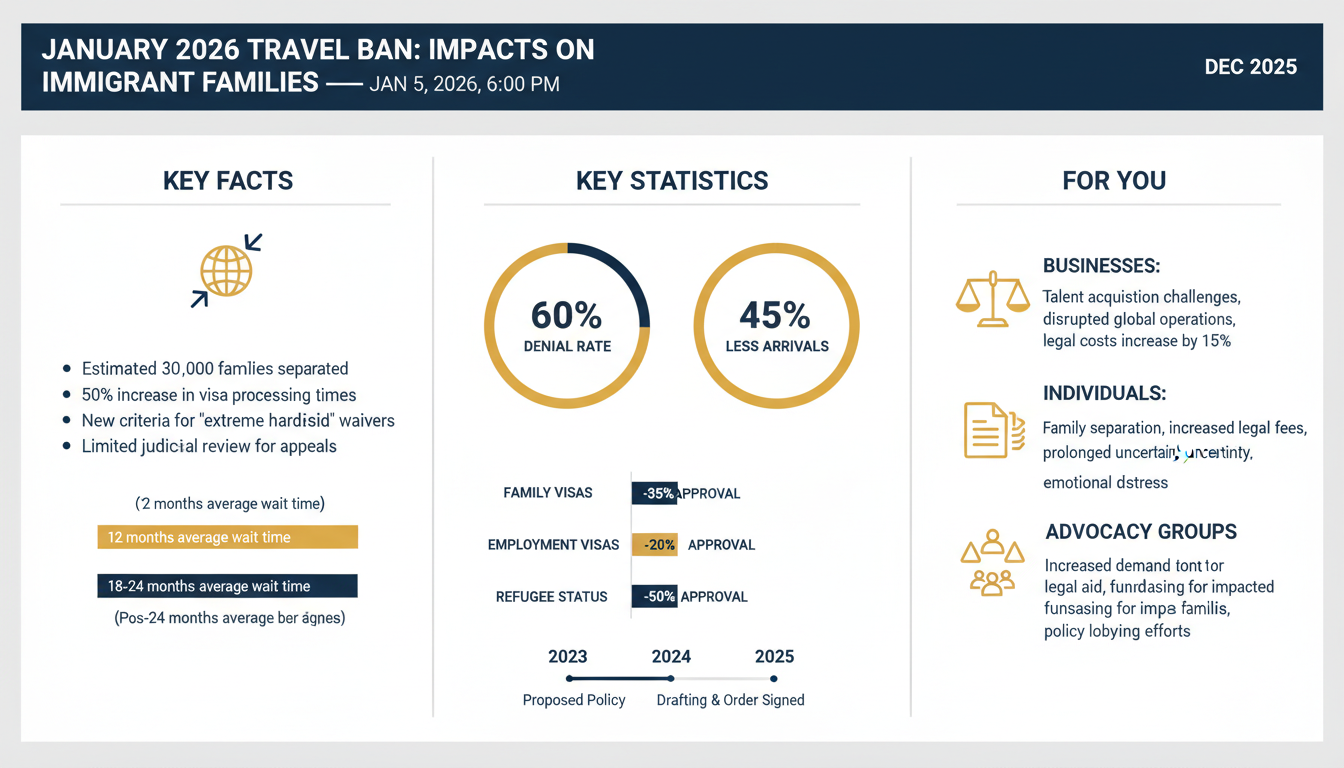
Key Provisions of Proclamation 10998
The proclamation builds on Proclamation 10949 (June 4, 2025), extending bans to sub-Saharan African nations and Caribbean countries previously exempt from comprehensive restrictions.[4][5] It targets individuals outside the U.S. without valid visas as of the effective date, applying to immigrant and nonimmigrant categories unless waived.[4]
- Full Entry Bans: Complete prohibition on entry for nationals of designated countries seeking immigrant visas or certain nonimmigrant visas.[5]
- Partial Restrictions: Limits on specific visa classes, with mandatory enhanced vetting including social media reviews.[2][5]
- Eliminated Exceptions: No categorical waivers for immediate family on immigrant visas, adoptions, asylum seekers, or Convention Against Torture (CAT) protections previously available under Proclamation 10949.[5]
Enforcement considers not just nationality but birthplace and travel history, broadening the scope beyond passports.[2] Approved benefits for entrants post-January 20, 2021, from affected countries now face re-review, potentially revoking statuses.[5]
Legal Implications for Families and Immigrants
This ban directly contravenes family unity principles in U.S. immigration law, which prioritize categories like F2A (spouses and minor children of permanent residents) under INA Section 203(a).[3] Families in oversubscribed F1, F2B, and F3 categories—already facing backlogs per the January 2026 Visa Bulletin—now encounter compounded barriers.[1][3]
Disrupted Family-Based Petitions
For I-130 petitioners (U.S. citizens or lawful permanent residents sponsoring relatives), priority dates must align with Visa Bulletin Charts A or B, but travel bans halt consular processing abroad.[1][3] F2A sees limited movement, yet affected nationals cannot enter even if dates are current.[1] Mexico and Philippines categories advance incrementally (e.g., F1 Mexico forward, F2B Philippines progress), but bans override availability.[1]
Courts may see challenges akin to Trump v. Hawaii (585 U.S. 667, 2018), upholding prior bans under national security deference, though family impacts could prompt lawsuits testing waiver equity.[5]
Heightened Vetting Overlaps
Concurrent changes amplify risks: State Department mandates social media disclosure for H-1B/H-4 applicants (announced December 3, 2025), with USCIS's new Vetting Center screening for threats.[2] CBP expands biometrics at ports.[2] Families blending employment and family paths (e.g., H-4 dependents seeking adjustment) must navigate both.[2]
Who Is Affected: A Breakdown
| Category | Affected If... | Examples |
|---|---|---|
| Full Ban Countries | Outside U.S. without valid visa on Jan 1, 2026 | Nationals applying for F1/F2A/F3 visas[4] |
| Partial Restrictions | Seeking restricted nonimmigrant visas | B-1/B-2 visitors, students from listed nations[5] |
| Derivative Family | Spouses/children of principals from banned countries | H-4 dependents, DV derivatives[2][3] |
| Prior Entrants | Entered post-Jan 20, 2021; benefits re-reviewed | Recent green card holders facing revocation[5] |
Source countries include new additions from Africa and the Caribbean, per Proclamation 10998.[4] Lawful permanent residents (LPRs) with valid visas are generally exempt, but re-entry risks heightened scrutiny.[2]
Actionable Guidance: Steps for Affected Families
Imigrar urges immediate action. Do not delay—deadlines loom as the ban activates in days.[4]
Immediate Travel and Planning
- Postpone non-essential travel for late December 2025/January 2026; build buffer time for returns.[2]
- Secure valid visas before January 1 if possible—consular appointments are backlogged.[4]
- Identify affected family members by nationality/birthplace; document U.S. ties.[2]
Pursuing Waivers and Exceptions
National interest waivers remain discretionary but viable for compelling cases.[4]
- Eligibility: Critical business, medical treatment, U.S.-benefiting education/research, or family reunification.[4]
- Process: File waiver request during visa interview; expect re-interviews and delays.[5]
- Evidence: Submit affidavits, employer letters, medical records proving necessity.[4]
Consult counsel for DS-5535 updates or prior social media disclosures.[2]
Alternative Pathways
- Adjustment of Status: If in U.S. lawfully, file I-485 using January 2026 Visa Bulletin Dates for Filing chart (mandatory for family/employment filings).[1][3]
- Parole or TPS: Check eligibility if from designated countries; monitor USCIS alerts.[5]
- Employment-Based Shift: Explore EB categories showing progress (e.g., EB-2/3 forward movement).[1]
- Diversity Visa (DV-2026): Act before September 30, 2026 cutoff, but bans limit derivatives.[3]
Avoid fraud—USCIS denies cases with inconsistencies amid new vetting.[2]
Document Preparation Checklist
- Priority date confirmation via I-797.[1]
- Public social media profiles (no deletions).[2]
- Proof of U.S. sponsor's status (birth certificates, LPR cards).[3]
- Waiver-supporting evidence packages.[4]
January 2026 Visa Bulletin: A Mixed Outlook Amid Bans
Released concurrently, the bulletin offers incremental relief but underscores backlogs.[1][3] Family-sponsored limits: 226,000 annually, per-country cap 7% (25,620).[3] Use Dates for Filing for all filings—no Final Action this month.[1]
- F2A: Limited forward movement, critical for spouses/minors.[1]
- F2B Philippines/Mexico: Advances, but bans block entry.[1]
- F3 Philippines: Incremental progress.[1]
Families must file promptly if dates align, pivoting to domestic adjustment.[1]
Long-Term Strategies and Firm Support
Expect litigation; past bans faced injunctions (e.g., IRAP v. Trump, 2017, later reversed). Monitor federal dockets.[5] Enhanced compliance tracking signals stricter enforcement.[6]
At Imigrar, our Orlando team specializes in family reunification amid policy flux. Schedule a consultation for personalized case reviews, waiver filings, and bulletin monitoring. With expertise in INA Sections 201-203 and proclamation challenges, we maximize approvals despite headwinds.[1][3][4]
Stay informed: Visa Bulletins update monthly; proclamations evolve. Act now to protect family unity.