


Louisiana Supreme Court Rules Employer Waived Workers' Comp Deadline in Johnson v. AECOM (Dec 18, 2025)
In a landmark decision dated December 18, 2025, the Louisiana Supreme Court ruled in Johnson v. AECOM Amentum Government Services (No. 2025-CC-00171) that an employer tacitly renounced its statute of limitations defense—known as "prescription" in Louisiana—by initiating regular workers' compensation payments after the prescriptive period expired. This ruling, published just days ago, carries significant implications for employer liability nationwide, including in Florida, where similar "voluntary payment" doctrines may apply.[1]
Case Background: The Injury and Timeline
Lealon Johnson, a mechanic employed by AECOM Amentum Government Services, suffered a workplace injury on June 12, 2020, when he tripped over a pressure washer hose. Initially, Johnson did not miss work, as AECOM accommodated him with light duties. However, complications arose later, prompting Johnson to file a workers' compensation claim.[1]
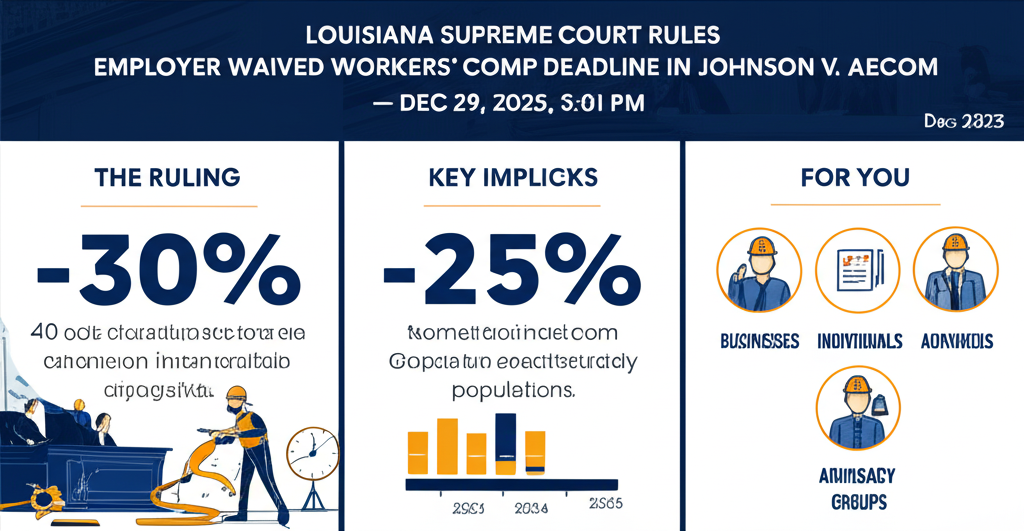
Louisiana's workers' compensation prescriptive period is typically one year from the accident or from the last payment of benefits that interrupts prescription. AECOM argued the claim was time-barred, but the court examined the employer's actions post-expiration. Critically, AECOM began making regular and consistent payments after the deadline, which the Supreme Court deemed a tacit renunciation of the prescription defense.[1]
- Injury date: June 12, 2020
- Prescriptive period expired: Approximately June 2021 (absent interruptions)
- Key employer action: Initiated ongoing benefit payments post-expiration
- Court ruling date: December 18, 2025
Legal Analysis: Tacit Renunciation Explained
The doctrine of tacit renunciation holds that an employer's conduct—such as voluntary, consistent benefit payments—can waive a statute of limitations defense without explicit acknowledgment. The Louisiana Supreme Court emphasized that these payments signaled the employer's recognition of its ongoing liability, effectively restarting the clock for the claim.[1]
This builds on Louisiana Workers' Compensation Act principles (La. R.S. 23:1209), where prescription is interrupted by payments or formal recognition. The court's reasoning prioritizes substance over form: mere payment alone might not suffice, but regularity and consistency demonstrate intent to forgo the defense.[1]
Key legal implications:
- For employers: Post-deadline payments risk waiving defenses, exposing companies to retroactive liability for medical costs, indemnity, and penalties.
- For employees: Strengthens claims if employers pay late, providing leverage in disputes.
- Broader impact: Influences jurisdictions like Florida (Fla. Stat. § 440.19), where voluntary payments toll the 2-year statute, and aligns with trends in states like Tennessee and Alabama rejecting strict procedural bars.[1][2][5]
Why This Matters for Florida Workers and Employers
As an Orlando-based immigration and employment law firm with expertise in workers' compensation, Imigrar notes this ruling's ripple effects in Florida. Florida's system mirrors Louisiana in tolling limitations via payments (Fla. Stat. § 440.19(1)), but courts scrutinize intent. Employers paying benefits late—common in light-duty accommodations—must document denials explicitly to preserve defenses.[1]
Recent parallel developments underscore urgency:
| Case/State | Date | Key Holding | Florida Relevance |
|---|---|---|---|
| Johnson v. AECOM (LA Sup. Ct.)[1] | Dec 18, 2025 | Consistent payments waive prescription | Alerts FL employers to payment risks |
| Carter-Shepherd v. Royal Furniture (AL Civ. App.)[2] | Nov 7, 2025 | Upholds 15% attorney fee cap | FL caps fees at 20% (Fla. Stat. § 440.34) |
| Fantini v. Westrock (NJ Fed.)[4] | Dec 19, 2025 | Exclusive remedy bars negligence suits | Reinforces FL's immunity (Fla. Stat. § 440.11) |
| TN WC Appeals Bd. (2025 TN WC App. 57)[5] | Recent (Tuesday) | Auto-right to second surgical opinion | FL allows panel physicians for opinions |
OSHA ties in: The Johnson trip hazard evokes OSHA 1910.22 standards on walking-working surfaces. Employers face dual liability—comp plus fines—if hazards persist.[1]
Actionable Guidance for Injured Workers
If you've suffered a workplace injury, this ruling empowers proactive steps. Do not delay reporting or seeking benefits—but know late employer payments can revive claims.[1]
Immediate Steps Post-Injury
- Report in writing: Notify supervisor/HR within 30 days (FL: 30 days oral, 120 written). Include date, time, location, witnesses.[3]
- Seek medical care: Use employer panel or authorized provider. Document all visits, restrictions, bills.
- Track payments: Note dates/amounts of any indemnity or medical payments—even partial—to prove interruption.[1][3]
- Gather evidence: Photos of hazard (e.g., hose), incident reports, pay stubs for average weekly wage.[3]
Challenging Denials
- If denied on timeliness, cite Johnson: Argue payments constitute renunciation.[1]
- Request second opinions for surgery (TN precedent supportive).[5]
- Avoid IME refusals—risks termination, as in Fantini.[4]
Example: A Florida construction worker denied comp for a "preexisting" back strain won $45K+ after proving work causation with records—mirroring national trends.[3]
For Employers: Mitigate Liability
- Explicitly deny claims in writing before payments.
- Use light duty judiciously; track accommodations.
- Train on OSHA hazards to limit negligence exposure.
- Consult counsel before post-deadline payments.[1]
OSHA and Employer Liability Interplay
Workplace injuries like Johnson's highlight OSHA's role. Employers must maintain hazard-free floors (29 CFR 1910.22). Violations trigger fines ($16,131 serious, up to $161,323 willful per 2025 adjustments) and bolster comp claims. Post-ruling, Florida employers face heightened scrutiny: comp waivers don't shield OSHA penalties.[1]
In multi-state operations like AECOM, uniform policies are essential. Florida's Division of Workers' Compensation enforces via mediation, hearings—act swiftly.
Next Steps: Contact Imigrar Today
This Johnson decision shifts dynamics, favoring workers with evidence of employer payments. Florida injured workers deserve full benefits—medical, lost wages (66 2/3% AWW), permanency.[1]
Imigrar, Orlando's trusted firm for employment and immigration matters, offers free consultations. Call (407) 916-5898 or visit our site. Bilingual services available—Se Habla Español. Protect your rights before deadlines lapse.
Disclaimer: This article synthesizes recent rulings for informational purposes. Consult an attorney for case-specific advice. Sources verified as of Dec 29, 2025.


