


Overview — recent, significant verdict in personal injury litigation
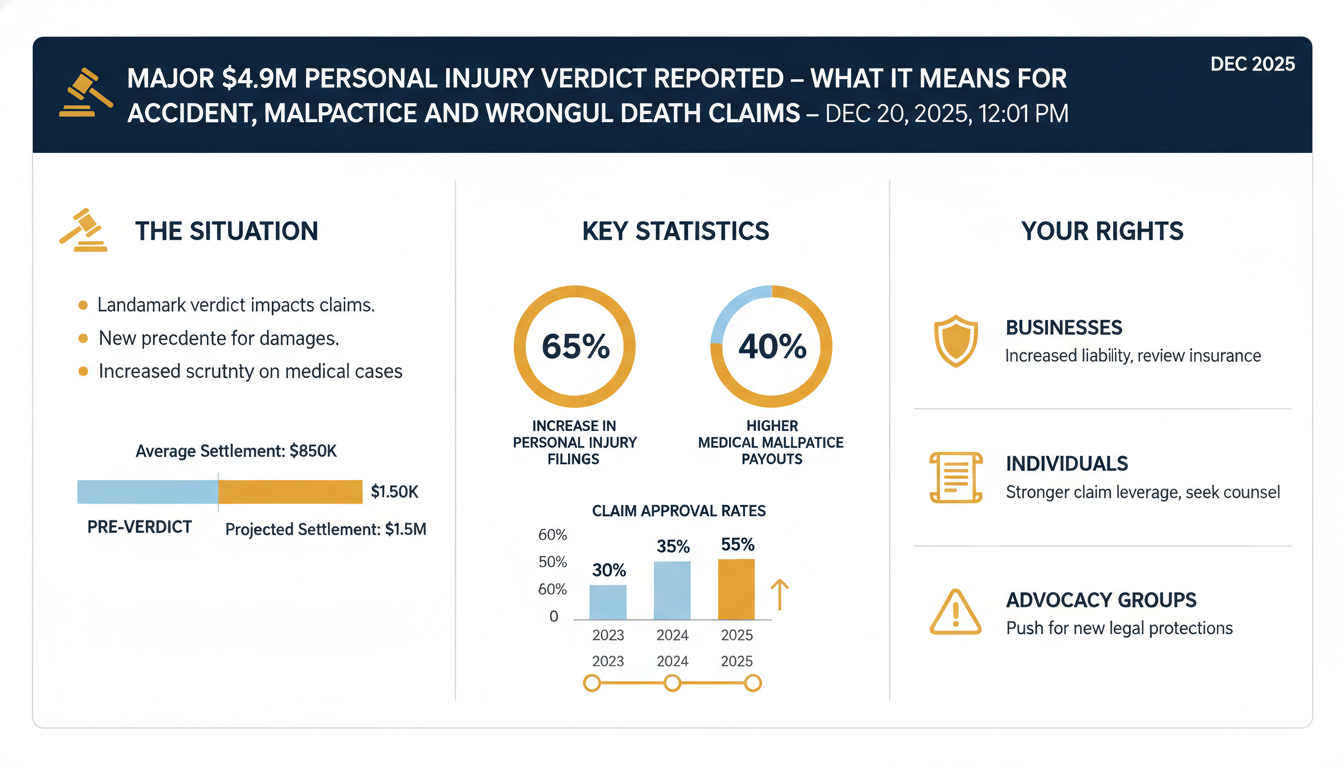
On December 19, 2025, news services reported a reported $4,900,000 jury verdict in a personal injury auto case described in national verdict listings as “Personal Injury Auto v. Auto” with a $4.9 million award recorded by legal reporting services[8].
Why this development matters
Large jury awards like the $4.9 million decision matter beyond the parties involved because they can influence settlement negotiations, insurance carrier valuation of claims, and plaintiffs’ and defendants’ litigation strategies in accident, medical malpractice, and wrongful death matters[8].
Details of the reported verdict
The Daily Journal’s verdicts and settlements reporting lists a $4,900,000 verdict in the category “Personal Injury Auto v. Auto” dated December 19, 2025, indicating a jury award in an auto‑related injury claim[8]. Public summaries in verdict databases typically include the case type, the verdict amount, and sometimes a brief description of the injury or legal theory; however, they do not always provide full pleadings or appellate developments in the immediate aftermath[8].
Limitations of the available public record
- Media and verdict‑listing services frequently publish amounts and categories but may omit full case captions, court dockets, or appellate activity; the Daily Journal entry provides the award amount and classification but not the full opinion or pleadings[8].
- Without the court docket, it is difficult to know whether the award will be reduced by comparative fault, capped by statutory limits (for example, in certain medical malpractice contexts), or reduced on post‑trial motions for remittitur[8].
Legal implications for accident, medical malpractice, and wrongful death claims
Several practical legal implications follow from high jury awards in personal injury trials:
- Settlement leverage increases for plaintiffs. A recent large verdict can raise settlement demand ranges in similar factual contexts because insurers reassess trial risk and potential exposure[8].
- Insurer defense strategies tighten. Carriers may invest more in pretrial investigation, expert witnesses, and stricter reserve management to avoid repeat high payouts[8].
- Judicial review and post‑trial motions become important. Defendants commonly seek remittitur or judgment notwithstanding the verdict (JNOV) to reduce or overturn large awards; plaintiffs should be prepared for appeals that can alter or affirm the award[8].
- Comparative fault and statutory caps matter. In states with comparative negligence rules or statutory caps (notably some medical malpractice statutes), large jury awards can be reduced or modified by operation of law or post‑trial findings; practitioners must analyze governing state law to estimate recoverable net awards[3][8].
Specific concerns for medical malpractice and wrongful death cases
While the reported $4.9M verdict was categorized as an auto case, its ripple effects extend to malpractice and wrongful death litigation in these ways:
- Valuation parallels: Evidence of high non‑economic awards in one domain can inform expectations for pain and suffering valuations in other catastrophic injury cases, including medical malpractice and wrongful death, subject to statutory limits where applicable[3][8].
- Burden of proof and expert testimony: Plaintiffs in malpractice and wrongful death claims must still establish causation and damages through admissible expert evidence — a high jury verdict does not change the foundational proof requirements, but it can encourage claimants to pursue trial when evidence is strong[3][8].
- Insurance and indemnity impacts: Hospitals, physicians, and public entities may revisit policy limits and indemnity arrangements in light of jury award trends[8].
Actionable guidance for individuals affected by accidents, medical errors, or wrongful death
If you or a loved one has been injured or died as a result of another’s conduct, apply the following steps to protect rights and maximize recovery:
1. Preserve evidence immediately
- Collect photographs, video, and witness contact information at the scene of an accident or from the medical setting.
- Request and preserve medical records early — hospitals and providers often retain records for a limited time and routine retention policies may lead to loss of key evidence.
2. Seek prompt medical care and document treatment
- Prompt, well‑documented medical treatment helps establish causation and damages. Follow treatment plans and keep all bills, prescriptions, and provider communications.
3. Contact an experienced attorney without delay
- Statutes of limitations vary by claim type and jurisdiction; missing a filing deadline can forfeit claims entirely. An attorney can identify deadlines, preserve claims, and handle subpoenas for records[3].
- Choose counsel experienced in catastrophic injury, medical malpractice, or wrongful death as appropriate — verdict trends show specialized trial experience affects outcomes and settlement leverage[8].
4. Avoid giving recorded or signed statements to insurance companies without counsel
- Insurers may use early statements to minimize liability. Direct communications should be handled by counsel once possible.
5. Understand damages and likely recovery
- Economic damages: medical bills, lost wages, future care — preserve documentation to support precise calculations.
- Non‑economic damages: pain and suffering, loss of enjoyment — jury awards on these items vary widely and are influenced by jurisdictional norms and statutory caps where present[3][8].
- Wrongful death claims: include loss of companionship and consortium; rules and beneficiaries who may recover differ by state and require prompt legal analysis.
6. Be prepared for litigation and post‑trial processes
- Even after a favorable verdict, defendants often pursue remittitur, post‑trial motions, or appeals. Plaintiffs should plan for enforcement and potential reduction of awards[8].
- Structured settlements and tax considerations: large awards are sometimes converted to structured settlement payments; counsel and financial advisors should analyze these options for long‑term financial security.
Relevant case listings and official sources to consult
To verify awards, track appellate developments, and locate pleadings, consult these sources:
- Verdict and settlement reporting services such as the Daily Journal’s verdict listings, which reported the $4.9M personal injury verdict on December 19, 2025[8].
- State court dockets and PACER for federal cases — these provide full case captions, pleadings, orders, and post‑trial motions (use the case number from reporters or obtain via counsel).
- State bar association or court websites for rules on malpractice caps and wrongful death statutes (state law practice guides and statutes govern liability and damages[3]).
How Imigrar (Orlando) can help — practical next steps
If you are in Florida or elsewhere and affected by an accident, medical malpractice, or a wrongful death:
- Contact an attorney immediately to confirm the applicable statute of limitations and begin evidence preservation.
- Obtain all medical records, bills, and employment records; request copies rather than relying on providers to retain originals.
- Do not sign releases or provide recorded statements to insurers without counsel.
Potential follow‑up developments to watch
- Post‑trial motions or remittitur filings in the reported $4.9M case; these may reduce or uphold the award on procedural grounds[8].
- Insurance industry reactions: changes to reserves or settlement patterns if more high awards are reported in December 2025 and early 2026[8].
- State legislative or appellate actions that affect non‑economic damage caps or liability rules in medical malpractice and wrongful death litigation[3].
Sources and verification
The $4,900,000 personal injury verdict was reported in a verdicts and settlements listing maintained by the Daily Journal on December 19, 2025[8]. For comparative guidance on personal injury valuation and statutory limits, see practice materials discussing typical settlement ranges and malpractice limits in jurisdictions such as California (as an example of how caps and ranges operate)[3].
Primary sources to consult for your case
- Daily Journal — Verdicts & Settlements listing for the $4.9M award[8].
- State court docket or PACER (for federal cases) for the controlling pleadings, judgment entries, and post‑trial motions (search using the case caption details from verdict reports)[8].
- State statutes on medical malpractice caps and wrongful death beneficiary rules (consult your state legislature or official code online)[3].
If you would like, Imigrar’s team can check the specific court docket for the December 19, 2025 verdict, evaluate whether it is factually similar to your case, and advise on next steps for claims, preservation, and potential litigation strategies. Contact us to schedule a case review so we can locate the full docket, advise on deadlines, and begin evidence collection immediately.


