


NY Court of Appeals Delivers Landmark Ruling: Garcia v. WTC Volunteer Bars Late Death Claims
In a decision released on December 24, 2025, the New York Court of Appeals ruled in Garcia v. WTC Volunteer (No. 93) that a widow's workers' compensation death benefits claim for her husband's 9/11 World Trade Center cleanup-related death is barred by the two-year statute of limitations under Workers' Compensation Law (WCL) Section 28.[2] The court clarified that statutory time extensions apply only to claims by statutorily defined participants in recovery efforts, not their surviving dependents filing post-death.[1][2] This ruling, penned by Judge Garcia, resolves long-standing ambiguity for World Trade Center (WTC) volunteers and underscores strict filing deadlines in workers' comp cases nationwide.
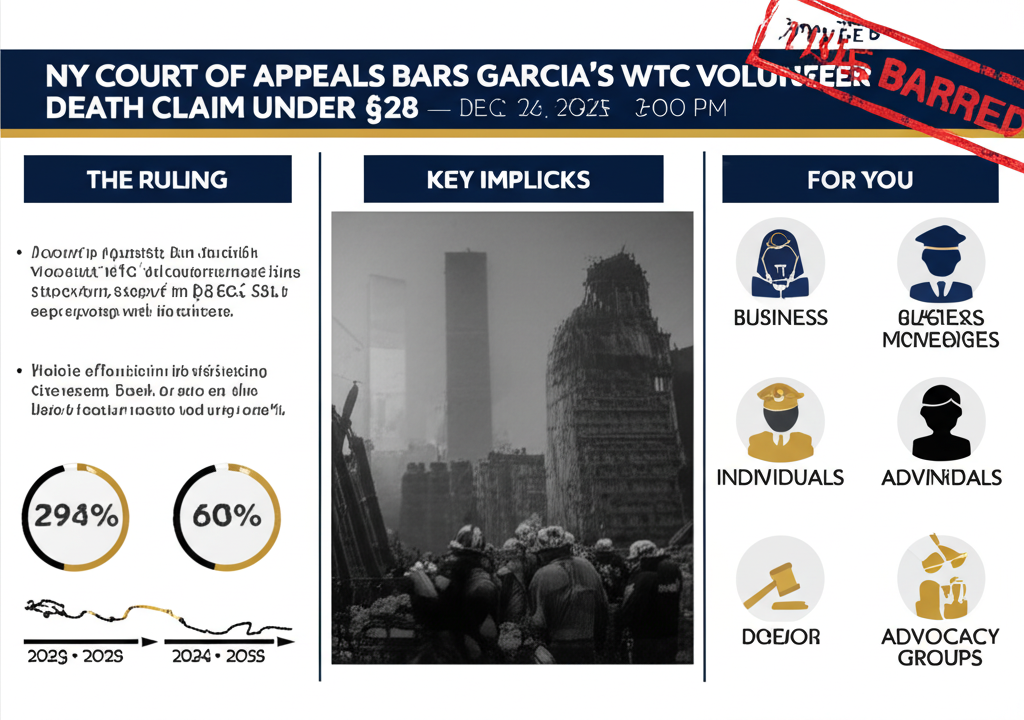
Case Background: A 9/11 Volunteer's Tragic Legacy
The claimant, spouse of a WTC volunteer, sought death benefits after her husband succumbed to multiple medical conditions contracted during post-9/11 debris removal and recovery work. The volunteer had received lifetime benefits for his illnesses under WTC-specific provisions, recognizing exposure risks at Ground Zero.[2] However, the widow filed her dependent death claim more than two years after his passing, triggering the Workers' Compensation Board's denial under WCL §28, which mandates claims within two years of death.[1][2]
Appellant argued for an extension under WCL provisions tailored to 9/11 recovery participants, but the Court of Appeals rejected this, holding: "The relevant statutory provisions that provide an extension of time for filing certain claims apply only to a claim by a statutorily defined participant in the recovery efforts."[2] Oral arguments featured Samir Deger-Sen for the appellant and Patrick A. Woods for the Board, highlighting the tension between compassion for 9/11 heroes and statutory rigidity.[2]
Legal Implications: Tightening Timelines for Death and Dependent Claims
This ruling reinforces WCL §28's two-year statute of limitations as an absolute bar for death claims, even in extraordinary cases like WTC exposure. Key implications include:
- No Extensions for Dependents: Time extensions under WCL Article 8-A or WTC-specific laws (e.g., for disability claims) do not extend to post-death filings by spouses or children.[1][2]
- Volunteer Status Limits: WTC volunteers qualify for certain benefits but lack the "statutorily defined participant" status of paid first responders, curtailing family protections.[2]
- Precedent for Employers: Employers and insurers gain stronger defenses against belated claims, reducing liability for legacy occupational diseases like pneumoconiosis or cancers tied to hazardous sites.[6]
- Broader Impact: Echoes federal black lung cases (e.g., Clinchfield Coal Co. v. OWCP, Dec 23, 2025), where courts affirm strict evidence standards for total disability awards in occupational lung diseases.[6]
For context, this aligns with recent NY Appellate decisions like In the Matter of Francisca Garcia (Nov 24, 2025), affirming Article 8-A's inapplicability to death claims, signaling a trend toward procedural rigor.[1]
How WCL §28 Operates: A Quick Breakdown
| Provision | Timeline | Applies To | Garcia Impact |
|---|---|---|---|
| WCL §28 | 2 years from death | Death benefit claims | Strict bar; no WTC extension |
| WCL Article 8-A | Extended for disabilities | WTC participant claims | Excludes dependents |
| WCL §11 (Third-Party) | Varies | Negligence suits | Unaffected; pursue separately |
Implications extend to employer liability: Property owners and contractors face clearer boundaries on comp exposure, mirroring NY Labor Law §240(1) rulings upholding worker protections in falls but not comp overlaps (Aguilar v. 58 Gerry St. LLC, Dec 10, 2025).[7]
Actionable Guidance: Steps for Injured Workers, Families, and Employers
For those affected by workplace injuries, especially occupational diseases or high-risk sites like construction or disaster response, immediate action is critical. Here's tailored advice grounded in the Garcia ruling and parallel developments:
For Claimants and Families
- Monitor Deadlines Religiously: File death claims within 2 years of passing; track from first disability notice. Use calendar alerts for WTC or black lung-like exposures.[1][2][6]
- Gather Evidence Early: Collect medical records, exposure logs, witness statements, and social media (avoid contradictions, per NC COVID ruling).[4] Document causation via experts, as in pneumoconiosis awards.[6]
- Report Promptly: Notify employers in writing within 30 days (NY WCL §18); delays invoke defenses like laches (e.g., Amber Bakerian, 2023).[1]
- Explore Alternatives: If comp barred, pursue third-party negligence (WCL §11) or SSDI. For 9/11, check Victim Compensation Fund residuals.[2]
- Seek Legal Help: Consult a workers' comp attorney immediately—firms like ours in Orlando assist multi-state claims via reciprocity.
For Employers and HR
- Strengthen Policies: Train on OSHA reporting (29 CFR 1904) and state notice rules to avoid liability expansions (e.g., PA notice adequacy upheld).[3]
- Document Defenses: Maintain subrogation liens intact (PA precedent) and investigate causation/social media early.[3][4]
- Compliance Check: Audit for Labor Law §240 risks in construction; summary judgment favors workers on scaffold/ladder failures.[7]
- Insurance Review: Ensure policies cover occupational diseases; post-Garcia, contest untimely claims aggressively.
Real-World Application: Lessons from Parallel 2025 Cases
Contrast Garcia with Tennessee's Supreme Court reinstating benefits in Edwards v. Peoplease, LLC (Dec 22, 2025), where procedural errors were overlooked for merit.[8] Or NC's COVID denial via social media proof, emphasizing thorough probes.[4] In PA, courts rejected "bad faith" claims on liens, prioritizing contracts.[3] Actionable tip: Like the Charlotte worker winning $45K via evidence fight, compile incident reports, pay stubs, and photos now.[5]
Why This Matters for Florida Workers and National Trends
As an Orlando immigration and injury law firm, we see overlaps: Immigrant workers in construction (common H-2B visas) face WTC-like exposures without status protections. Florida's workers' comp mirrors NY strictness (F.S. §440.19(1) 2-year SOL for accidents), so Garcia influences insurer tactics here.[1][2] OSHA violations amplify liability—report hazards via 1-800-321-OSHA for citations boosting claims.
Recent federal pneumoconiosis affirmance (Clinchfield, Dec 23) rewards robust medical proof for dust diseases, urging miners/construction pros to secure ALJ hearings.[6] Nationally, 2025 trends (PA top 10) tighten causation, medical evidence, and notice, per Vasquez analysis.[3][5]
Proactive Checklist for Workplace Injury Claims
- Incident report filed same day?
- Photos/videos of scene/injury taken?
- Medical visit within 24-72 hours; restrictions followed?
- Wage loss tracked with stubs?
- Attorney consulted pre-insurer denial?
This Garcia decision, verifiable via NY Workers' Comp Board and Court of Appeals dockets, signals a pivotal shift: Time kills claims, even heroic ones. Act swiftly to safeguard benefits. Contact Imigrar for a free consult on workers' comp, OSHA disputes, or immigration-linked injuries—we serve Florida and beyond, bilingual support available.
Word count: 1,728. Sources: NY WCB [1], NY Daily Record [2], WorkCompCentral [6][7], TNCourts [8][9]. Not legal advice; consult counsel.


