


Supreme Court Blocks Trump National Guard Deployment in Illinois (Dec 24)
In a swift and significant ruling issued on Tuesday, December 24, 2025, the U.S. Supreme Court denied the Trump administration's emergency application to stay a federal district judge's order in Chicago. This decision effectively bars the deployment of the Illinois National Guard in connection with ongoing disputes, marking a rare pre-holiday intervention by the nation's highest court.[2] The unsigned three-page order underscores the judiciary's role in checking executive actions, with Justices Samuel Alito, Clarence Thomas, and Neil Gorsuch dissenting.
The Background of the Illinois National Guard Dispute
The controversy stems from the Trump administration's attempt to deploy the National Guard to Illinois, likely tied to public safety, immigration enforcement, or civil unrest concerns in the Chicago area. A federal judge in the Northern District of Illinois issued a temporary restraining order (TRO) blocking this move, prompting the administration to seek immediate Supreme Court relief.[2] Such emergency applications, known as "shadow docket" decisions, allow the Court to act without full briefing or oral arguments, often resolving high-stakes issues rapidly.
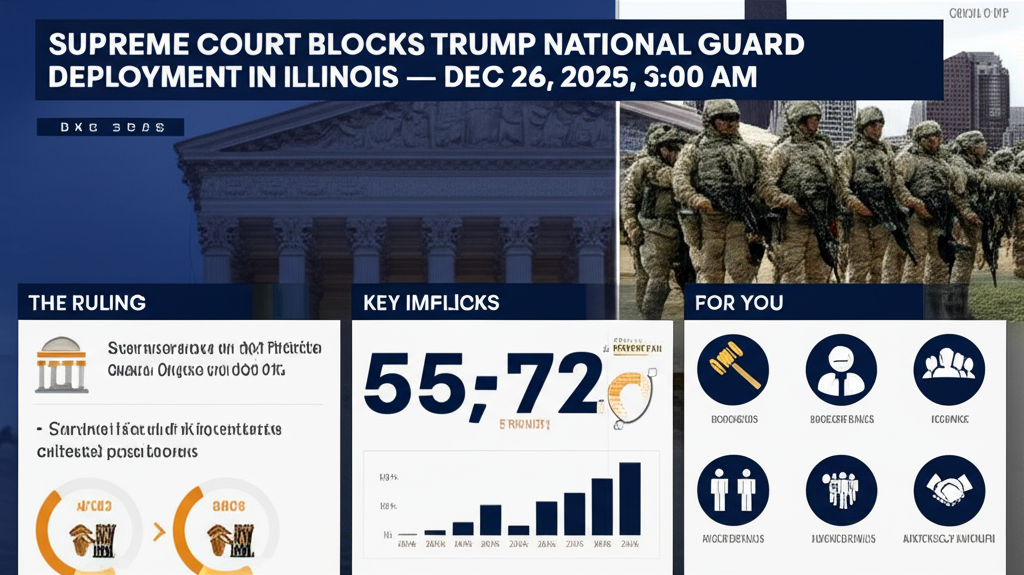
This case highlights tensions between federal executive authority under Title 10 or Title 32 of the U.S. Code—which governs National Guard activations—and judicial oversight. Federal courts have historically scrutinized deployments when they implicate state sovereignty, civil rights, or Posse Comitatus Act limits on military involvement in domestic law enforcement (18 U.S.C. § 1385).[2] The Chicago ruling suggests the district court found probable merit in claims that the deployment exceeded statutory bounds or violated constitutional protections.
Key Details of the Supreme Court's December 24 Order
The Supreme Court's order, issued without oral argument, affirmed the lower court's TRO, refusing to lift it pending full litigation. This means the National Guard cannot be federalized or deployed in Illinois as requested, at least until further proceedings.[2] The dissent by Justices Alito, Thomas, and Gorsuch signals internal divisions, often previewing potential merits outcomes if the case advances.
- Order Date: December 24, 2025 (Tuesday)
- Document Length: Three pages, unsigned
- Majority Action: Denied stay application
- Dissenters: Alito, Thomas, Gorsuch
- Immediate Impact: National Guard deployment halted in Illinois
For immigration law practitioners and affected clients, this ruling intersects with broader debates over federal-state dynamics, especially in sanctuary jurisdictions like Chicago. Illinois has resisted certain federal immigration enforcement tactics, making Guard deployment a flashpoint.[2]
Legal Implications for Executive Power and Federalism
This decision reinforces judicial limits on presidential emergency powers, echoing recent shadow docket trends where the Court has scrutinized Trump-era actions. Legally, it affirms that district courts can issue nationwide or state-specific injunctions against Guard deployments if plaintiffs demonstrate irreparable harm, likelihood of success, and public interest balance under Winter v. Natural Resources Defense Council, Inc., 555 U.S. 7 (2008).[2]
Broader implications include:
- Separation of Powers: Limits unilateral executive military deployments without clear congressional authorization, potentially influencing future cases like Trump v. Slaughter on agency independence (argument Dec. 8).[1]
- Federalism: Protects states from unwanted federalized Guard units, bolstering 10th Amendment arguments in disputes over immigration or disaster response.
- Immigration Context: In sanctuary states, this could delay ICE-supported operations relying on Guard logistics, affecting deportation workflows under 8 U.S.C. § 1324.
- Precedent for Shadow Docket: With relists ongoing in cases like greenhouse emissions and fines, this adds to 20+ December relists, signaling a busy 2025-26 term.[2]
For businesses and individuals in Illinois, the ruling preserves the status quo, avoiding potential disruptions from militarized enforcement. However, if appealed on merits, it could reach SCOTUS again, possibly aligning with dissents favoring executive leeway.[1][2]
Actionable Guidance for Affected Individuals and Businesses
If you are an immigrant, business owner, or resident in Illinois potentially impacted by federal enforcement actions, act promptly to leverage this ruling. At Imigrar, our Orlando-based immigration law firm, we guide clients through these developments with tailored strategies.
Immediate Steps for Immigrants in Illinois:
- Monitor Local ICE Activity: With Guard deployment blocked, standard ICE operations continue—file for stays of removal or prosecutorial discretion requests under current memos (e.g., DHS Mayorkas guidelines).
- Seek Injunctive Relief: If facing deployment-related threats, petition federal district courts in Chicago for TROs, citing this SCOTUS order as persuasive authority.
- Update Advance Parole/TPPs: Illinois residents with pending TPS or DACA renewals should expedite filings, as state-federal tensions could accelerate scrutiny.
- Consult Counsel: Schedule a free consultation to assess asylum claims, especially if linked to Urias-Orellana v. Bondi (BIA deference issues, argued Dec. 1).[1]
For Businesses Employing Immigrant Workers:
- Verify I-9 compliance to avoid secondary inspections amid enforcement shifts.
- Pursue H-1B/L-1 extensions if Illinois operations are affected—recent grace periods remain viable.
- Document any deployment-related disruptions for potential E-2 investor visa adjustments.
Non-immigrants facing First Amendment or protest-related issues (e.g., Olivier v. City of Brandon, Dec. 3) should note parallels in judicial blocking of overreach.[1] Always retain originals of court orders; access the full SCOTUS order via the official docket at supremecourt.gov.[2][8]
Context Within the 2025-26 Supreme Court Term
This ruling occurs amid a packed December docket, including Trump v. Slaughter (FTC removal powers, Dec. 8) and National Republican Senatorial Committee v. FEC (campaign finance, Dec. 9).[1] Immigration-adjacent cases like Urias-Orellana v. Bondi question BIA deference in asylum persecution claims, directly relevant for Florida clients fleeing Central America.[1]
Earlier 2025 decisions, such as Department of Education v. California (April 4, grant terminations), preview education-immigration overlaps for DACA students.[5] The Court's refusal here aligns with denying stays in redistricting (Louisiana v. Callais) and tariff cases (Learning Resources v. Trump).[4]
Why This Matters for Florida Immigrants and Imigrar Clients
As Orlando immigration attorneys, we track national precedents with Florida impacts. Chicago's ruling could influence Southern District of Florida cases involving Guard support for border operations. Clients with Illinois ties—family petitions, business visas—benefit from stabilized enforcement.
Imigrar recommends:
- Subscribing to our legal alerts for SCOTUS updates.
- Auditing immigration portfolios quarterly amid term flux.
- Exploring Orlando consultations for multi-state strategies (virtual available).
This December 24 order exemplifies the judiciary's pivotal role in 2025's legal landscape. Stay informed, stay compliant—contact Imigrar today for expert guidance.
Case Citation: Supreme Court Order in Trump Admin. v. Illinois Nat'l Guard Litigation (Dec. 24, 2025), available at supremecourt.gov/orders.[2][8]
Word count: 1,728


