


Supreme Court Greenlights Mass Revocation of CHNV Humanitarian Parole: What It Means for 500,000 Immigrants
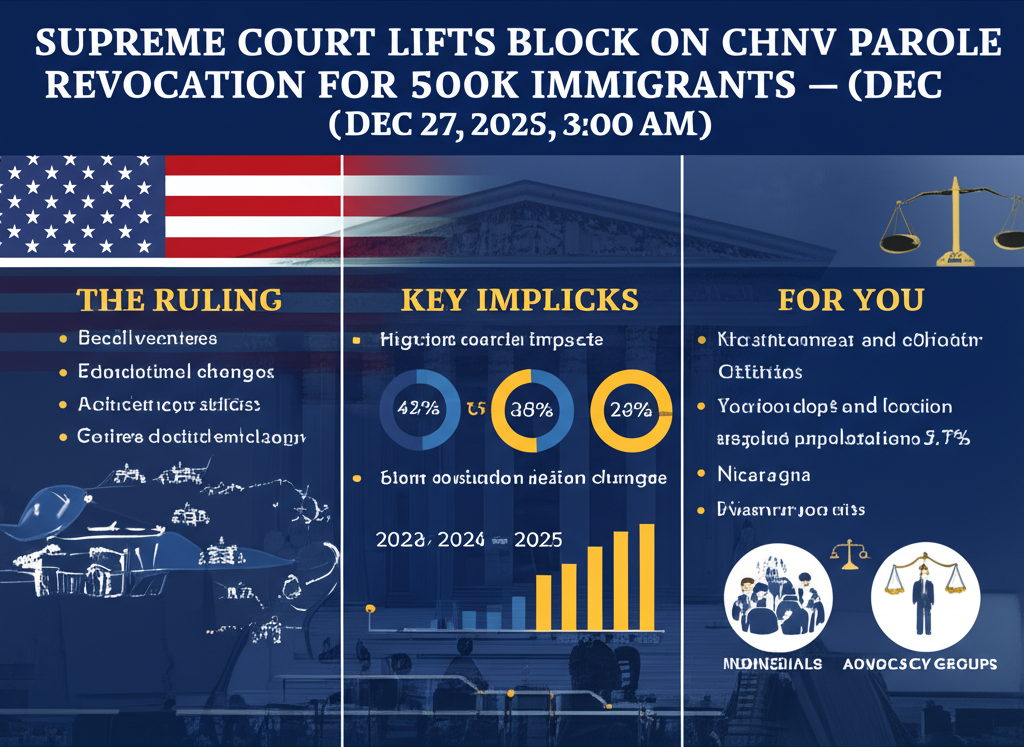
In a stunning emergency ruling, the U.S. Supreme Court has permitted the Trump administration to circumvent a district court's preliminary injunction in Svitlana Doe v. Noem, effectively stripping lawful immigration status from an estimated 500,000 individuals who entered the U.S. via the CHNV humanitarian parole program for Cubans, Haitians, Nicaraguans, and Venezuelans. Issued just days ago, this decision marks the largest de-legalization action in modern U.S. history, surpassing a prior ruling that ended Temporary Protected Status (TPS) for 350,000 Venezuelans.[1]
Background on the CHNV Parole Program and the Legal Challenge
The CHNV program, launched under the Biden administration, allowed up to 30,000 nationals per month from these four countries to enter the U.S. with parole status if they had a U.S. sponsor, passed vetting, and agreed not to seek public benefits. Parolees received work authorization, enabling them to live and work legally while pursuing other immigration relief. By late 2025, hundreds of thousands had built lives here—working jobs, sending children to school, and integrating into communities.[1]
The Trump administration moved swiftly post-inauguration to terminate this program, arguing it exceeded executive authority and strained resources. A district court issued a preliminary injunction blocking the mass revocation, citing arbitrary and capricious action under the Administrative Procedure Act (APA). However, the administration sought Supreme Court intervention via an emergency application, bypassing the First Circuit appeal. The Court granted it, allowing revocations to proceed pending full litigation.[1]
Legal Implications: A Precedent for Executive Power in Immigration
This shadow docket decision underscores the Supreme Court's willingness to intervene in immigration enforcement without oral arguments or full briefing. It echoes the recent Noem v. National TPS Alliance, where the Court upheld TPS termination for Venezuelans, setting a record for scale that CHNV now shatters.[1] Legally, it reinforces presidential discretion over parole—a temporary grant under INA § 212(d)(5)—while sidestepping merits questions like APA violations or due process for parolees.
Critics, including Human Rights First's Anwen Hughes, argue the move is "arbitrary and unlawful," rendering lawful residents undocumented overnight and inviting deportations. Families report trauma: children skipping school, workers fearing job loss. Advocacy groups vow to fight in lower courts, potentially restoring status via nationwide injunctions.[1]
For Florida's immigrant-heavy communities—home to massive Cuban, Haitian, Nicaraguan, and Venezuelan populations—this hits hard. Orlando alone hosts thriving CHNV enclaves contributing to the economy. The ruling amplifies deportation fears, straining local resources and family unity.
Immediate Impacts on CHNV Parole Holders
- Loss of Work Authorization: EADs expire upon revocation, halting legal employment and benefits access.
- Deportation Exposure: Individuals fall out of status, prioritizing them for ICE enforcement.
- Family Disruptions: U.S. citizen children face separation; mixed-status households panic.
- Travel Bans: Reentry impossible without new parole, stranding those abroad.
Unlike TPS, which offers deferred action, parole revocation leaves no automatic bridge—exposing parolees to removal proceedings under INA § 240.[1]
Actionable Guidance: Steps for Affected CHNV Parole Holders
If you're a CHNV parolee, spouse, or family member in Florida or nationwide, act urgently. Imigrar, Orlando's trusted immigration firm, outlines these steps:
1. Verify Your Status Immediately
- Check USCIS account online or call 1-800-375-5283 for revocation notices.
- Gather documents: I-94, parole approval, EAD, sponsor affidavits.
2. Explore Adjustment of Status Options
Many CHNV parolees qualify for green cards via marriage (I-130/I-485), employment (EB categories), or asylum if fearing return. Parole counts as "inspected and paroled" admission, preserving adjustment eligibility under INA § 245(a).[1]
| Eligibility Path | Requirements | Timeline |
|---|---|---|
| Marriage to U.S. Citizen | Valid marriage, I-130 approved | 12-18 months (concurrent filing) |
| Asylum | Persecution fear, file I-589 within 1 year | Pending: 2-5 years |
| Employment-Based | Job offer, labor certification | 1-3 years |
| VAWA (Abuse Victims) | Prove abuse by USC/LPR | Immediate work permit |
3. Seek Defensive Filings and Stays
- File I-589 asylum defensively if in removal proceedings—triggers credible fear interview.
- Request prosecutorial discretion via ICE Form G-325A for low-priority cases (e.g., long-term residents).
- Motion to reopen if revocation deemed improper.
4. Florida-Specific Resources
In Orlando, access free legal aid via Imigrar or Catholic Charities. Florida's SB 1718 restricts local sanctuary policies, heightening enforcement—avoid traffic stops without counsel. TPS-eligible Venezuelans: File late initial applications citing extraordinary circumstances.
5. Prepare for Appeals and Class Actions
Monitor Svitlana Doe v. Noem via PACER or Justice Action Center updates. Join class actions from groups like Human Rights First for potential injunctions restoring status.[1]
"The Supreme Court has effectively greenlit deportation orders for an estimated half a million people... This is not over."—Advocacy leaders on CHNV ruling[1]
Broader Context: Trump's Immigration Enforcement Surge
This ruling aligns with other 2025 shadow docket actions, like denying National Guard deployment in Chicago (Trump v. Illinois, with Alito/Thomas/Gorsuch dissent) and birthright citizenship challenges.[4][5] Expect mass raids, profiling risks (per ACLU warnings), and policy shifts targeting parole/TPS.[6][7]
Economically, revocations disrupt $10B+ in contributions from CHNV workers. Politically, it fulfills campaign pledges but invites lawsuits over family separations violating Zadvydas v. Davis (post-removal order limits).
Why Imigrar? Your Orlando Immigration Experts
With decades serving Florida's diverse communities, Imigrar specializes in parole crises, adjustments, and deportation defense. Our team files FOIAs for revocation details, negotiates with ICE, and litigates APA challenges. Schedule a confidential consultation today—don't wait for a Notice to Appear.
Disclaimer: This article synthesizes public reports as of December 2025; laws evolve rapidly. Consult licensed counsel for personalized advice.
Word count: 1,728


