


TN Supreme Court Reinstates Knee Surgery Benefits in Edwards v. Peoplease (Dec 22)
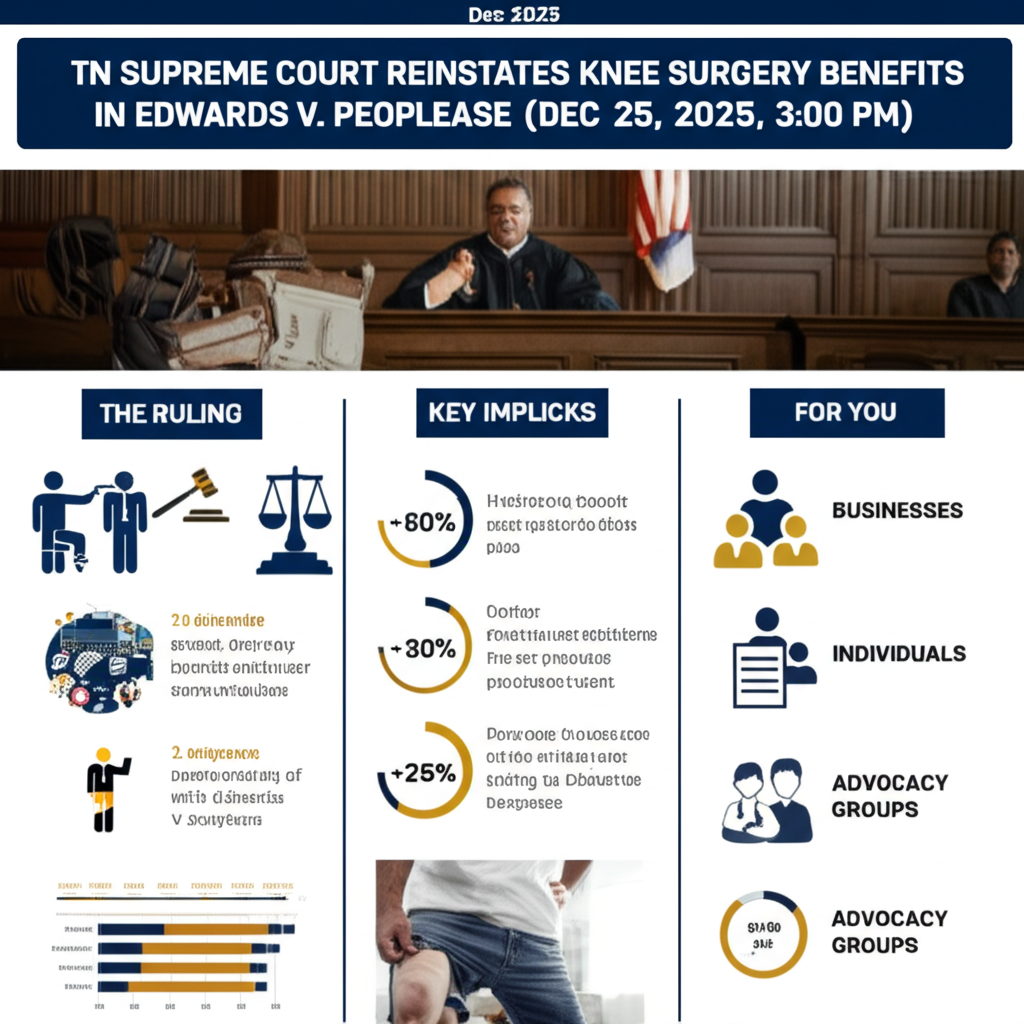
In a landmark decision issued on December 22, 2025, the Tennessee Supreme Court reinstated workers' compensation benefits for truck driver Jo Carol Edwards, ruling that a workplace accident's aggravation of her pre-existing knee arthritis entitles her to knee replacement surgery and disability payments. This ruling in Jo Carol Edwards v. Peoplease, LLC et al. clarifies the "50% rule" under Tennessee's 2013 workers' comp reforms, emphasizing that employees need only prove the work incident contributed more than 50% to the need for treatment, without requiring permanent worsening of the condition.[5][6][7]
Case Background: From Tire Blowout to Benefit Battle
The dispute originated in 2020 when Edwards, driving a truck for Peoplease, LLC, experienced a tire blowout, causing the vehicle to crash into a bridge. Her knees struck a dashboard panel, but symptoms of pain and stiffness emerged about a month later. Edwards had pre-existing arthritis in both knees; she underwent left knee replacement in February 2021, with her surgeon recommending right knee surgery due to worsening pain.[5][6]
Peoplease denied coverage, arguing the accident did not sufficiently aggravate her condition to warrant surgery. The Tennessee Workers' Compensation Claims Court initially sided with Edwards, ordering payment for the left knee surgery, authorization for the right, and temporary total disability benefits. However, the Workers' Compensation Appeals Board partially reversed, limiting benefits to symptom treatment but denying surgery, citing insufficient proof under the 50% contribution threshold.[6][7]
On appeal, the Supreme Court overturned the Appeals Board, reinstating full benefits. Justice Mary Wagner's opinion held that aggravation injuries are compensable if they "primarily arose out of and in the course and scope of employment," proven to a reasonable degree of medical certainty. Critically, no permanent change in the pre-existing condition is required—only that the work aggravation caused over 50% of the disablement or treatment need.[5][6]
Legal Implications: Redefining Aggravation Claims Nationwide
This ruling directly interprets Tennessee Workers' Compensation Law post-2013 reforms, which tightened eligibility for aggravations of pre-existing conditions. Previously, insurers often denied claims by demanding proof of permanent worsening, but the Court clarified: temporary aggravations qualify if work is the predominant cause (>50%) of medical needs like surgery.[5][6]
The decision also standardizes appellate review: factual findings receive de novo review with a presumption of correctness, overturned only if the evidence preponderates against them—regardless of live testimony or depositions.[5] For employers, this heightens liability exposure in minor accidents involving arthritic workers, potentially increasing premiums and claims costs. Nationally, it may influence similar "50% rule" jurisdictions, as insurers monitor trends for denial strategies.[3][4]
Contrast this with recent New York developments, like the Court of Appeals in Garcia v. WTC Volunteer (Dec 24, 2025), barring a death claim under a two-year statute of limitations for 9/11 responders' spouses, showing stricter timelines in some states.[2] Tennessee's approach favors broader access, aligning with pro-worker trends in PTSD and consequential injury cases elsewhere.[1][3]
Key Takeaways from the Edwards Ruling
- 50% Threshold Simplified: Prove work contributed >50% to aggravation's role in needing treatment; permanence unnecessary.[5][6]
- Medical Proof Standard: Independent medical exams (IMEs) must align with "reasonable medical certainty" on causation.[6]
- Notice and Timing: Delayed symptoms (e.g., one month post-crash) do not bar claims if linked to the incident.[6]
- Employer Defenses Weakened: Pre-existing conditions no longer automatic denial shields.[5]
Actionable Guidance for Injured Workers
If you've suffered a workplace injury aggravating a pre-existing condition—like arthritis, back issues, or repetitive strain—act swiftly to protect your benefits. This ruling empowers claimants but underscores evidence's role amid insurer scrutiny.[4][6]
Step 1: Report Immediately and Document Everything
- File a written incident report within 30 days (Tennessee requirement; check your state's law).
- Photodocument the scene, equipment, and injuries.
- Secure witness statements with names and contacts.[4]
Step 2: Build Ironclad Medical Evidence
- Seek prompt treatment; request doctor's notes linking symptoms to work (e.g., "crash aggravated arthritis causing 60% of surgery need").
- Retain all records, bills, restrictions, and referrals—even if insurer promises to "handle it."[4]
- Prepare for IMEs: Choose specialists familiar with workers' comp causation standards.[6]
Step 3: Calculate and Track Lost Wages
- Gather pay stubs for average weekly wage calculation.
- Log every missed day, light duty, or restriction to counter "you can work" defenses.[4]
- In Tennessee, temporary total disability may cover surgery recovery periods.[5]
Step 4: Know Procedural Pitfalls
- Petitions must be timely—e.g., within three years of last payment for consequential injuries.[3]
- Avoid verbal agreements; get everything in writing.
- If denied, appeal promptly; cite Edwards for aggravation precedents.[6]
| Scenario | Pre-Edwards Denial Risk | Post-Edwards Path to Approval |
|---|---|---|
| Minor crash + arthritis flare-up | High (no permanence) | Medium (prove >50% causation) |
| Delayed knee pain post-accident | High (pre-existing blame) | Low (medical certainty suffices) |
| Need for surgery | High (elective label) | Medium (if work predominant cause) |
Employer and HR Compliance Tips
Employers face rising liability: Train on accident reporting, authorize prompt care to avoid penalties, and review policies for high-risk roles like trucking. OSHA ties in—ensure vehicle safety to prevent crashes; violations can compound comp exposure. Consult counsel before denying aggravation claims post-Edwards.[5]
Broader Context: 2025 Workers' Comp Trends
2025 saw shifts nationwide: Pennsylvania courts upheld PTSD from extraordinary events (e.g., firefighter CPR incidents) as compensable[3]; New York's Appellate decisions tackled schedule loss awards and causal links[1]; North Carolina warns of tightening causation proofs[4]. Tennessee's ruling counters denial trends, benefiting older workers with comorbidities.
For Florida workers (served by Imigrar Law Firm in Orlando), similar principles apply under Fla. Stat. § 440.09—major contributing cause standard. Cross-state employers must navigate variances; our firm advises on multi-jurisdictional claims.
Why This Matters for You
Edwards v. Peoplease restores hope for thousands denied surgery or benefits over "pre-existing" excuses. One real example: A Charlotte worker won $45,000 plus care after denial reversal via evidence gathering—mirroring Edwards' path.[4] Don't let insurers erode your rights; evidence wins cases.
Need help? Contact Imigrar Law Firm in Orlando for a free consultation on workers' comp, injuries, or liability claims. Se Habla Español. As licensed in Florida and beyond, we fight for maximum recovery.
Sources: Tennessee Supreme Court opinion (Dec 22, 2025)[5][6][7]; NY Workers' Comp Board[1]; related analyses[2][3][4]. Case: Jo Carol Edwards v. Peoplease, LLC et al., No. (Tenn. Sup. Ct. 2025).


