


Child Immigration Status Updates: Why 2026 Families Must Pay Attention
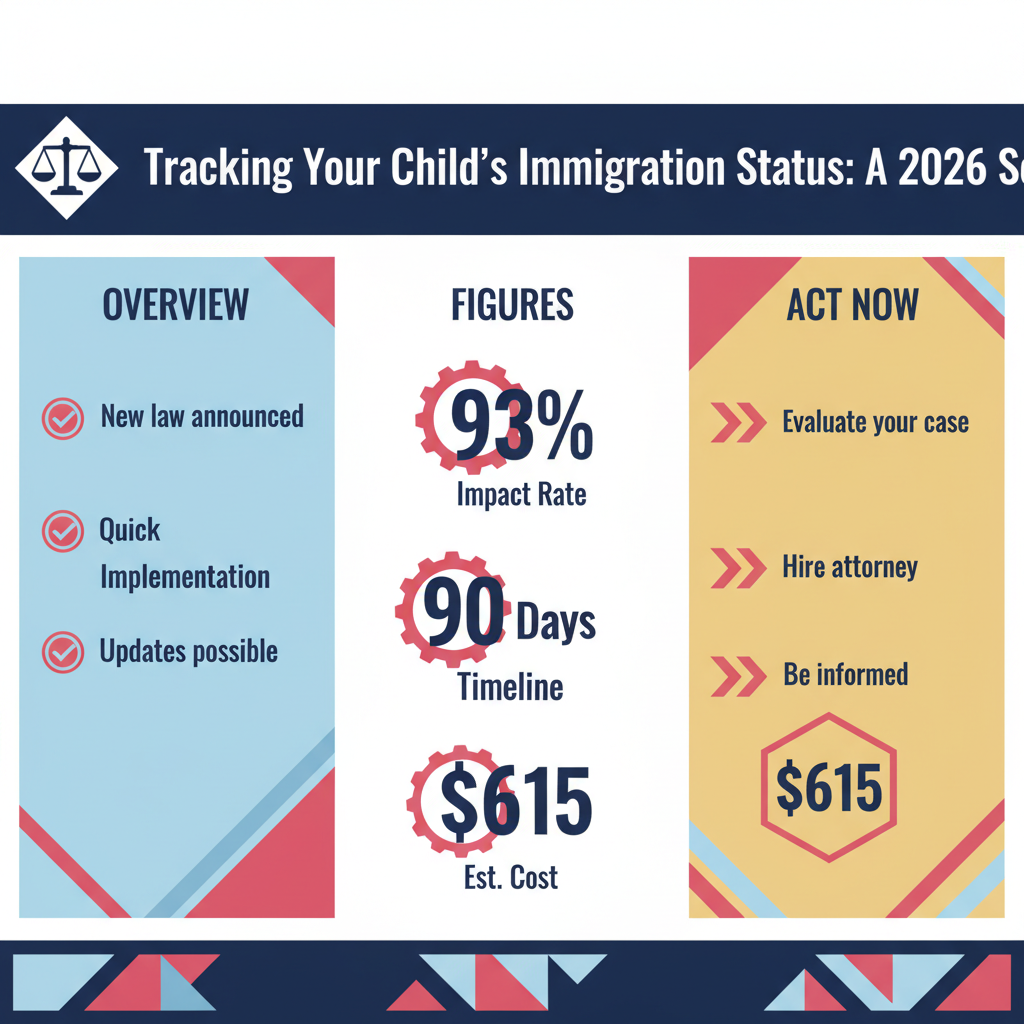
For immigrant families, a child’s immigration status can change faster than many parents realize. Turning 14, 18, or 21, new USCIS policies, and shifting visa backlogs can all affect whether your child keeps benefits, stays on a green card case, or “ages out” and must file separately.
This guide explains how to track and update your child’s status in 2026, how recent policy and processing changes affect kids, and what practical steps you can take now to protect your family’s future.
Key Ages When Your Child’s Immigration Status Can Change
Under U.S. immigration law, a “child” is generally an unmarried person under 21, but several important age milestones matter for status and benefits.
Age 13–14: Green Card & Work Permit Updates
- Green card fingerprinting & ID updates: If your child is applying for a green card inside the U.S., they will typically attend a biometrics (fingerprint) appointment starting from age 14. This is routine security screening and part of keeping the application moving.
- Work authorization (if eligible): Some teens in asylum, TPS, or adjustment of status cases can qualify for an Employment Authorization Document (EAD). This is not automatic; a separate application is required and timelines vary by category.
Age 18: Legal Adult, Still a “Child” for Many Immigration Purposes
- Adult under state law: At 18, your child is legally an adult for many purposes and must sign many immigration forms personally. Parents should prepare them to understand what they are signing.
- Still a “child” for many family categories: Under immigration law, an unmarried person 18–20 can still be a “child” for many benefits, including derivative status on a parent’s green card case or some humanitarian applications.
Age 21: Risk of “Aging Out” from Family Cases
Turning 21 is the most critical immigration age. Once a child turns 21, they are generally no longer considered a “child” for many family-based and derivative benefits, and may lose the ability to remain on a parent’s pending green card application unless protected by the Child Status Protection Act (CSPA).
Understanding the Child Status Protection Act (CSPA) in 2026
The Child Status Protection Act (CSPA) helps some children keep “child” status for immigration even after turning 21. But in 2025, USCIS adopted a stricter way of applying CSPA for many family-based cases, making it more likely that older teens could age out if parents do not plan ahead.[2]
How CSPA Works in Family-Based Green Card Cases
In many family cases, a child’s CSPA age is calculated by taking their age when a visa number becomes available and subtracting the time the petition was pending. If the result is under 21, the child can usually keep “child” status if they take action within the allowed period.
- Visa availability date matters: USCIS now uses a stricter method for deciding when a visa is “available,” which can push some kids over the 21-year limit.[2]
- Result: More teens close to 21 could lose CSPA protection and drop off a parent’s case if families do not monitor their timelines carefully.[2]
Which Children Are Most at Risk of Aging Out?
- Children listed as derivatives on a parent’s family-based petition (for example, F2A spouses and children of permanent residents, or other preference categories).[5]
- Teens who have been “waiting in line” for years because of backlogs in the Visa Bulletin.
- Children who are 16–20 when the parent’s priority date is approaching current.
Practical Steps to Protect a Child from Aging Out
- Step 1 – Check your priority date regularly: Use the State Department Visa Bulletin to see when your family category and country become current. The Bulletin explains that spouses and children of preference immigrants get the same status and order of consideration as the principal, but only once a visa is available.[5]
- Step 2 – Know which chart applies: For many family cases, you must know whether to use the “Dates for Filing” chart or the “Final Action Dates” chart. The choice affects when your child’s CSPA age is calculated.
- Step 3 – Get legal advice early, not at 20½: If your child is 16–20 and on a family case, consult an immigration attorney about:
- Filing a separate petition now, instead of waiting.
- Considering a different family category.
- Planning whether to process through consular processing vs. adjustment of status in the U.S.[2]
- Step 4 – Act quickly once a visa is available: After a visa becomes available, a child generally must “seek to acquire” permanent residence within a specific timeframe to keep CSPA protection. This usually means filing the green card application or taking concrete steps in the consular process.
Tracking Child Status Through the Visa Bulletin in 2026
The Visa Bulletin is updated monthly and controls when many children can get green cards or immigrant visas. The January 2026 Bulletin shows, for example, that spouses and children of permanent residents are in the F2A category, and that spouses and children of preference immigrants are entitled to the same status if accompanying or following to join the principal.[5]
How to Read the Visa Bulletin for Your Child
- Step 1 – Identify your category: Common child-related family categories include:
- F2A: Spouses and children (under 21, unmarried) of permanent residents.[5]
- F2B: Unmarried sons and daughters 21 or older of permanent residents.[5]
- Other categories may apply for adult sons and daughters of U.S. citizens.[5]
- Step 2 – Find your priority date: This is usually the date USCIS or the consulate accepted the family petition (Form I‑130).
- Step 3 – Compare your priority date to the chart: When your priority date is earlier than the date listed for your category and country, a visa may be available.
- Step 4 – Track derivative eligibility: Children accompanying or following to join a principal applicant must complete their processing before aging out or before certain program deadlines. For example, Diversity Visa (DV) spouses and children only qualify as derivatives until the end of that fiscal year (for DV‑2026, until September 30, 2026).[5]
Changes in Benefit Eligibility for Children Based on Status
Beyond green cards and visas, a child’s immigration status affects access to healthcare, education, and financial aid. Several 2025–2026 changes may impact your planning.
Health Coverage: Example of State Programs (Medi‑Cal)
Some states, like California, continue to provide full-scope Medicaid-equivalent coverage for certain children regardless of immigration status. California’s Medi‑Cal guidance states that children and youth under age 19 can apply for full-scope Medi‑Cal regardless of immigration status, as can certain young adults formerly in foster care up to age 26.[3]
However, some adults who previously qualified may lose full-scope coverage starting in 2026, creating a sharper difference between protections for children and adults.[3] Families should expect similar age- and status-based distinctions in many states and should check their local rules.
Tax Credits and Higher Education Credits
Federal tax law changes are also gradually tying more benefits to Social Security numbers (SSNs) and status.
- Child Tax Credit: Starting in tax year 2025, a child must have an SSN, and at least one parent must have an SSN that allows work in the U.S., to claim the Child Tax Credit.[1]
- Education credits: Beginning in tax year 2026, the American Opportunity Tax Credit and Lifetime Learning Credit will generally require SSNs for the taxpayer, spouse, and student, if applicable.[1]
Practically, this means families should plan early to obtain valid SSNs for eligible children and parents to avoid losing significant benefits once children reach college age.
School, College, and Your Child’s Status
K‑12: Right to a Public Education Regardless of Status
Under the Supreme Court’s Plyler v. Doe decision, undocumented children still have the right to attend public K‑12 schools, and districts are generally advised not to ask about immigration status when enrolling students.[6] While some states have considered laws that would limit or charge tuition, as of late 2025, Plyler remains the law nationwide.[6]
Parents should know that enrolling a child in public school does not require proving immigration status in most districts, and schools are not immigration enforcement agencies. However, local policies vary, so families should ask schools for their specific enrollment requirements and any policies protecting students from immigration enforcement on campus.[6]
College & Financial Aid: Who Counts as an Eligible Noncitizen?
For federal student aid in the 2025‑2026 academic year, a student must be a U.S. citizen, U.S. national, or an eligible noncitizen to qualify for federal grants and loans.[7]
- Eligible noncitizens generally include lawful permanent residents (green card holders), certain refugees and asylees, and a few other protected categories.[7]
- Undocumented students, including many DACA recipients, are still not eligible for federal student aid, although state or institutional aid may be available in some states.
Parents should review their child’s status well before high school graduation and discuss with an immigration lawyer whether a pending or potential case could result in an eligible status in time for college financial aid planning.
Monitoring Your Child’s USCIS and Consular Cases
Whether your child is a derivative on your case or has their own application, you should actively track every stage of the process. Processing times remain unpredictable in many family categories in 2026, though USCIS has been expanding digital processing and hiring more officers.[4]
Step‑by‑Step: Tracking a Child’s USCIS Case
- Step 1 – Keep all receipt numbers: Every application (I‑130, I‑485, I‑765, I‑131, etc.) has its own receipt number. Save copies of notices and emails in a secure folder.
- Step 2 – Create or use a USCIS online account: Link your child’s receipt numbers so you can see status updates and upload responses to any Requests for Evidence (RFEs).[4]
- Step 3 – Check processing times monthly: Use the online processing time tool for the relevant form and field office or service center. Many family-based petitions still face delays, especially for sibling or adult-child categories.[4]
- Step 4 – Respond quickly to RFEs: USCIS is paying close attention to proof of family relationships. Officers are carefully reviewing parent–child documentation and may issue RFEs or Notices of Intent to Deny if evidence is weak or inconsistent.[4]
- Step 5 – Update addresses promptly: If you or your child moves, file the required change of address so you do not miss critical notices or interview appointments.
Step‑by‑Step: Tracking a Child’s Consular Case
- Step 1 – Monitor the National Visa Center (NVC) portal: For overseas processing, you will receive NVC case numbers and instructions. Ensure all required fees are paid and documents uploaded.
- Step 2 – Watch the Visa Bulletin closely: For preference categories, NVC will not schedule interviews until a visa is available and your documents are complete.
- Step 3 – Confirm derivative eligibility before interview: Make sure your child is still under the age cutoff (or protected by CSPA) by the time the principal applicant’s interview is scheduled.
- Step 4 – Prepare relationship evidence: For parent–child cases, bring original birth certificates, adoption or guardianship orders if applicable, school or medical records showing the relationship, and photos or communication records if biological documentation is limited.[4]
When a Child’s Status Changes After Arrival
From Derivative to Independent Applicant
Sometimes a child enters the U.S. as a derivative on a parent’s visa or asylum/TPS case, but later needs to file their own application.
- Examples:
- A derivative child of a permanent resident parent later marries and must pursue their own category.
- A child granted derivative asylum may later file independently to bring their own spouse or children.
- Key step: Understand when derivative protection ends and what independent options exist (family sponsorship, humanitarian relief, or, in limited cases, employment or student options).
Special Protections for Vulnerable Children
Certain forms of relief are designed specifically for children, including Special Immigrant Juvenile (SIJ) status, VAWA self-petitions for abused children of residents or citizens, and certain asylum or trafficking protections. These categories often have strict age limits (frequently before age 18 or 21) and require court or agency findings.
If your child has faced abuse, neglect, abandonment, or trafficking, it is critical to speak with a qualified immigration attorney quickly to see whether they qualify for these time-sensitive forms of relief.
Common Mistakes Families Make with Children’s Status
- Waiting too long to plan for the 21st birthday: Many families do not realize how close a child is to aging out until it is almost too late. Begin planning around age 16–17 if a case is still pending.[2]
- Assuming school enrollment or SSNs equal lawful status: Public school enrollment and obtaining an ITIN or some state IDs do not create lawful immigration status.
- Not updating USCIS about key life changes: Moving, divorce, marriage of a child, or changes in custody can all affect a child’s eligibility and must be addressed.
- Underestimating relationship documentation: In 2026, USCIS is closely reviewing proof of genuine family relationships, including parent–child ties.[4] Missing or inconsistent documents can lead to delays or denials.
Encouraging Next Steps for Immigrant Families
Even with stricter CSPA rules, unpredictable processing times, and complex benefits rules, many families successfully secure permanent status for their children each year.[2][4][5] The key is to be proactive, organized, and informed.
Action Checklist for Parents in 2026
- Gather and safely store your child’s key documents: birth certificates, passports, school records, medical records, and any court orders.
- List all pending immigration cases that include your child (or could include them) and note receipt numbers and priority dates.
- Check the Visa Bulletin at least every 1–2 months if you have a family-based or diversity case involving your child.[5]


Have Questions About Your Case?
Schedule a free consultation with our attorney-reviewed team today