


Understanding Your Work Permit (EAD) in 2026
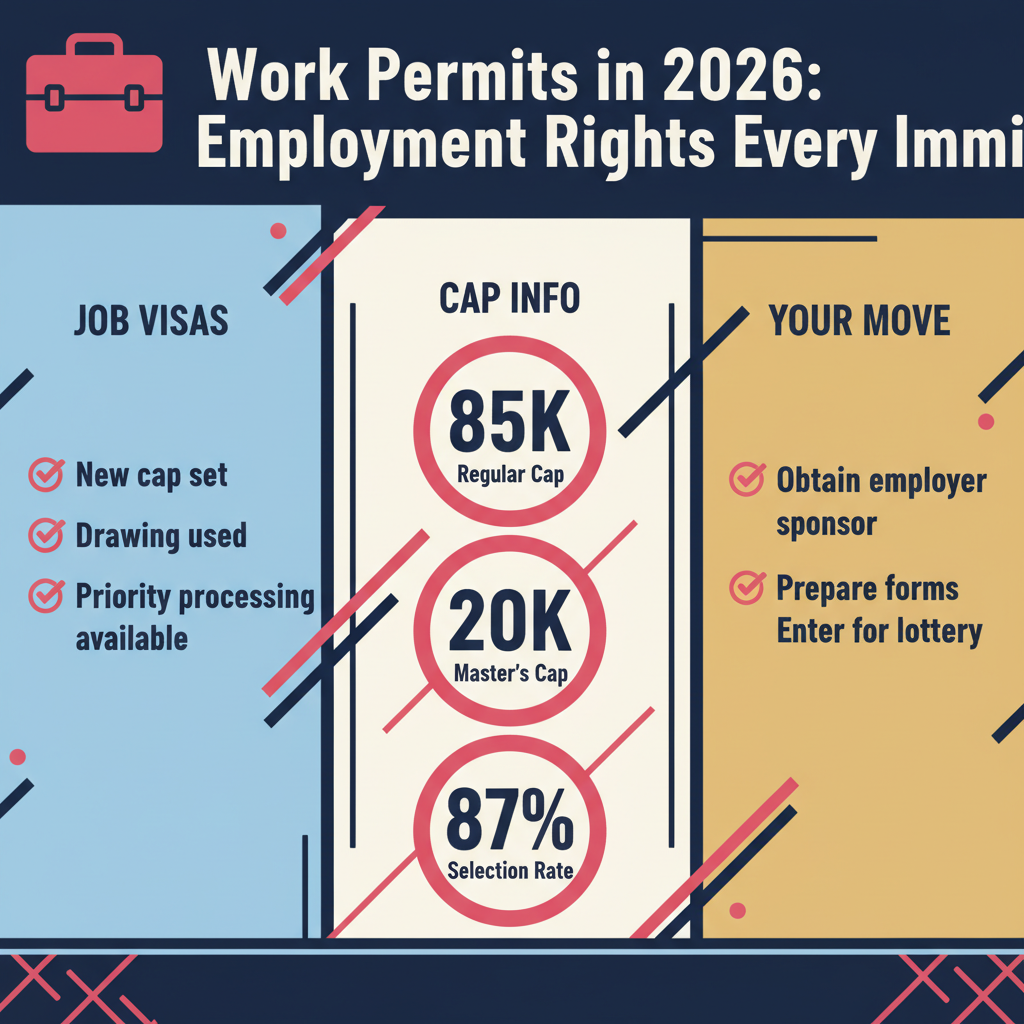
In the United States, most noncitizens who are not permanent residents or U.S. citizens need an Employment Authorization Document (EAD), commonly called a “work permit,” to work legally. Your EAD proves to employers that you are authorized to work in the U.S. under immigration law.
Several important rules changed in late 2025 and early 2026 that affect how long your work permit is valid and how renewals work.[1][3][5]
Who Typically Needs a Work Permit?
You generally need an EAD if you are in the U.S. and:
- Have a pending adjustment of status (green card) application (category C09).[1][3]
- Have a pending asylum application (category C08).[1][3]
- Were granted asylum or admitted as a refugee (categories A05, A03).[1][3]
- Have withholding of removal or deportation (category A10).[1][3]
- Hold certain temporary statuses (for example, some students, spouses of certain work-visa holders, or other humanitarian categories).
If you are a lawful permanent resident (green card holder) or a U.S. citizen, you do not need an EAD because your status itself authorizes you to work.
Key EAD Changes for 2025–2026 You Must Know
USCIS has made two major policy changes that directly impact many immigrants’ ability to work without interruption:
- Shorter validity periods: For many categories, the maximum EAD validity has been reduced from 5 years back to 18 months for applications filed or still pending on or after December 5, 2025.[1][3] This affects:
- Refugees (A03).[1]
- Asylees (A05).[1]
- Those with withholding of removal (A10).[1]
- Applicants with pending asylum (C08).[1]
- Applicants with pending adjustment of status (C09).[1]
- Certain cancellation of removal applicants (C10).[1]
- End of automatic extensions for many categories: An October 30, 2025 interim rule eliminated automatic extension of EADs for many categories.[1][3][5] Previously, filing a timely EAD renewal often gave you an automatic extension while USCIS processed your case. For many workers, that protection is now gone.
These changes mean you must be more proactive than ever to avoid gaps in work authorization.
How to Apply for a Work Permit (Form I‑765)
The process depends on your immigration category, but most applicants use Form I‑765, Application for Employment Authorization.
Step-by-Step: Initial EAD Application
Below is a general roadmap. Always confirm the latest instructions on the USCIS website or with an attorney, because forms and fees can change.
- Step 1 – Confirm your eligibility category.
Find the correct eligibility category (such as C09, C08, A03) based on your underlying immigration status or application. Filing under the wrong category can delay or derail your case.[1][3]
- Step 2 – Gather required documents.
Common items include:
- Copy of your current passport identity page.
- Copy of your I‑94 record (if available).
- Two passport-style photos that meet USCIS specifications.
- Copies of any previous EADs (front and back), if any.
- Proof of your underlying application or status (for example, I‑797 receipt notice for I‑485 or I‑589).
- Step 3 – Complete Form I‑765.
Follow USCIS instructions carefully. Make sure your name, address, A‑number, and eligibility category are correct and consistent with your other filings.
- Step 4 – Pay the filing fee (if required).
Some categories are fee-exempt or allow a fee waiver. Others require a filing fee that can change year to year. Use the USCIS fee calculator to confirm the exact amount before filing.
- Step 5 – File online or by mail (as allowed).
Many I‑765 categories can be filed online through a USCIS online account; others must be mailed to the correct lockbox address. Be sure to keep a full copy of everything you submit.
- Step 6 – Track your case.
After USCIS issues a receipt notice, use your receipt number to check your case status online. Consider creating an online account to receive electronic updates.
Typical Processing Times and What to Expect
Processing times vary depending on your eligibility category, USCIS workload, and the service center handling your case. Because automatic extensions have been cut for many people, backlogs can cause serious employment gaps if you do not plan ahead.[1][3][5]
You can check current estimated processing times on the USCIS website using your form type (I‑765) and the office processing your case.
Renewing Your Work Permit Without Losing Your Job
Due to the new policies, preventing a gap between your current EAD’s expiration and your new card’s approval is critical.
Key Changes That Affect Renewals
- Maximum validity is now generally 18 months for many refugee, asylum, and adjustment-based categories.[1][3]
- Automatic extensions are no longer available for many categories, which previously gave up to 180 days or more of continued work authorization after filing a renewal.[1][3][5]
- Existing 5-year EAD cards remain valid until their printed expiration date and are not shortened retroactively.[1]
Best Practices for Timely Renewal
Consider these practical steps:
- File as early as USCIS allows.
Many categories permit filing an I‑765 renewal up to 180 days before your current EAD expires. Use the full 180-day window whenever possible to reduce risk of gaps.
- Mark your calendar with multiple reminders.
Set reminders at 6 months, 4 months, and 3 months before expiration so you have enough time to collect documents, confirm fees, and file.
- Keep your address updated with USCIS.
If you move, file an address change promptly (Form AR‑11 or online) to avoid missing notices or your new card.
- Track your case after filing.
If your case is outside normal processing times, you may be able to submit an online inquiry, call USCIS, or in some urgent situations request expedited processing with supporting evidence.
- Talk early with your employer’s HR department.
Explain that you filed your renewal on time and share your receipt notice. While they may not allow you to work past the expiration if no automatic extension applies, early communication builds trust and allows planning for leave or schedule adjustments.
Your Rights at Work with a Valid Work Permit
Having an EAD gives you the right to work, but it also connects you to important worker protections under U.S. law. These protections usually apply regardless of immigration status—including to many workers without authorization—but having an EAD may make it easier to assert them.
Core Employment Rights
In most U.S. workplaces, you have the right to:
- Be paid at least the federal, state, or local minimum wage, whichever is higher, and overtime when applicable.
- Work in a safe and healthy environment, with protections under workplace safety laws.
- Be free from discrimination based on race, national origin, color, religion, sex, and other protected characteristics under federal and state law.
- Be free from discrimination based on citizenship or immigration status in many hiring and firing decisions, as enforced by federal authorities.
- Be free from harassment and retaliation for reporting unlawful practices or participating in investigations.
- Receive accurate wage statements where required by state law, and not be forced to “pay back” part of your wages to your employer.
Identity and Work Authorization Verification (Form I‑9)
When you start a new job, your employer must verify your identity and work authorization using Form I‑9. During this process:
- You choose which acceptable documents to present from the official list (for example, an EAD is a List A document).
- The employer cannot demand a specific document (like a green card) if other valid choices are available.
- The employer must apply the same rules to all workers—U.S. citizens and noncitizens—without discrimination.
If your EAD has an expiration date, your employer may need to reverify your work authorization before that date. If you present a new, unexpired EAD, they may continue your employment.
What Happens if Your Work Permit Expires?
If your EAD expires and you do not have continued authorization (for example, through an automatic extension that still applies to your category), you generally cannot legally work until a new EAD is approved.
Risks of Working Without Authorization
Working without authorization can:
- Put you at risk of termination by your employer.
- Create potential immigration consequences in certain situations, especially for future applications.
- Make it difficult to prove lawful work history for benefits that require authorized employment.
If Your EAD Will Expire Soon
If your work permit will expire and you are still eligible for a new one:
- File a renewal as soon as allowed under your category’s rules.
- Ask an experienced immigration attorney whether your category still benefits from any automatic extension or other protection.[5]
- Talk to HR and explain your timeline; provide your receipt notice to document that you have acted in good faith.
- Gather savings or support in case there is a temporary gap and you cannot work for a short period.
How Current Vetting and Security Policies Affect Work Permits
Recent government initiatives have intensified immigration vetting and security screenings, including expanded background checks and review of prior approvals for some individuals from certain countries.[1][3][6]
Why This Matters for Your EAD
Stricter vetting can affect EAD processing in several ways:
- More frequent renewals: USCIS explicitly linked the shorter EAD validity (18 months) to a desire for more frequent security checks.[1][3]
- Additional scrutiny for certain nationals: Policy changes tied to travel bans and security reviews can lead to longer background checks for some applicants.[6]
- Re-review of past approvals: For some individuals from restricted countries, the government may re-review previously approved benefits, which can delay new applications or renewals.[6]
This does not mean your application will be denied simply because of your nationality. But you should expect that security reviews can add time and sometimes trigger requests for additional evidence.
Practical Tips to Protect Your Work Authorization
In an environment of shorter validity periods and fewer automatic extensions, careful planning is essential. Here are concrete strategies you can use.
1. Build a Personal Immigration Calendar
- Keep a written or digital record of:
- EAD expiration date.
- Expiration dates of your underlying status (for example, I‑94, parole, or nonimmigrant visa status, if relevant).
- Receipt numbers and filing dates for I‑765, I‑485, I‑589, or other key forms.
- Set multiple reminders months before every important deadline.
2. Maintain a Complete Document File
Create a safe folder (both physical and digital) with:
- Copies (front and back) of all EADs you have ever had.
- All USCIS receipt and approval notices.
- Copies of immigration applications and supporting evidence.
- Any correspondence from USCIS, the Department of State, or immigration courts.
Having everything in one place makes it easier to respond quickly to Requests for Evidence (RFEs) and to prepare renewals.
3. Coordinate Your EAD Strategy With Your Long-Term Goals
Your work permit is often linked to a bigger immigration plan—such as seeking a family-based or employment-based green card, maintaining a humanitarian status, or pursuing another long-term option.
- Ask whether you can qualify for a more stable pathway (for example, a different status that may allow longer work authorization).
- Review your Visa Bulletin category if you are in an employment- or family-based preference category, so you understand when you might become eligible for permanent residence.[2][4]
- Update your attorney whenever your job, family situation, or travel plans change, because those changes can create new opportunities—or new risks.
4. Know How to Respond to Problems at Work
If your employer raises questions about your work authorization or discriminates against you because of your immigration status, you have options:
- Stay calm and gather documents: Have copies of your EAD, receipt notices, and any USCIS guidance showing your current authorization.
- Document any discriminatory treatment: Keep notes of dates, times, statements, and actions that concern you.
- Seek legal advice promptly: Employment and immigration laws interact in complex ways; a qualified attorney can help you respond correctly and protect both your job and your immigration case.
Frequently Asked Questions About Work Permits and Employment Rights
Can I change jobs if I have an EAD?
In many categories, your EAD itself is not tied to a specific employer, so you may change jobs as long as your underlying immigration status or application remains valid. However, some categories (for example, certain employment-based or dependent statuses) have restrictions. Always confirm with an immigration lawyer before changing jobs.
Does my EAD give me the right to reenter the U.S. after travel?
No. An EAD is proof of work authorization, not a travel document. If you plan to travel internationally, you may need a separate document (such as advance parole or a visa) depending on your situation. Traveling without the correct documents can jeopardize both your work permit and your long


