

The reporting that sparked this guide
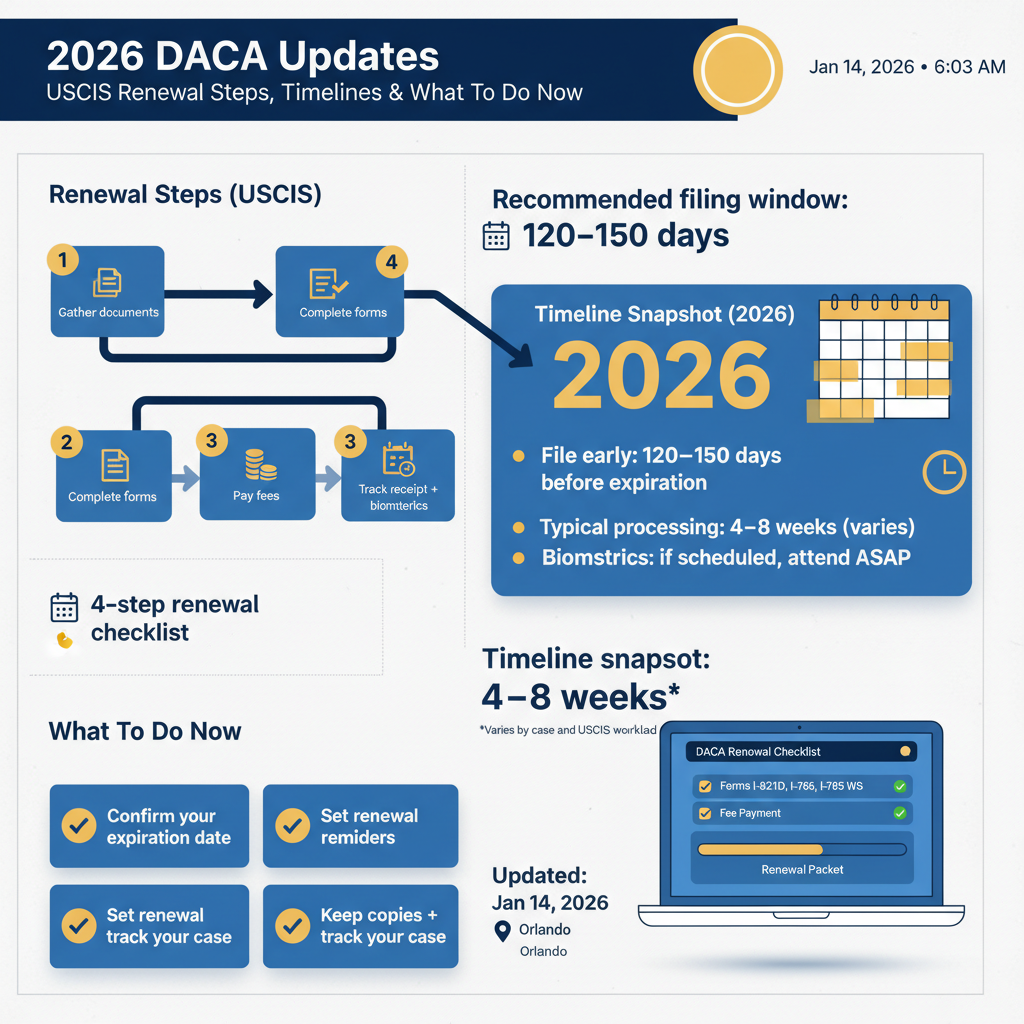
This article is based on recent public updates and ongoing coverage connected to USCIS guidance and announcements about DACA renewals and program operations. See the news feed here: DACA Program Updates and Renewal Information (USCIS).
Need Help? Our Orlando immigration team is ready to assist. Call +1 786-791-3106 for a free consultation, or message us online. Se Habla Español.
What This News Means for Immigrants in Orlando and Across Florida
Why this news is showing up now
DACA (Deferred Action for Childhood Arrivals) continues to be one of the most closely watched immigration programs in the United States because it sits at the intersection of agency policy, federal court litigation, and congressional inaction. As a result, DACA “news” tends to trend whenever USCIS updates its operational guidance, litigation milestones occur, or the public needs clarity on what is (and is not) currently available.
Important: As of today (2026-01-14), the most consistent, practical takeaway for most people is this: DACA renewals generally continue to be accepted and processed under USCIS procedures, while first-time/initial DACA requests have been restricted by ongoing litigation for several years. Because litigation can change quickly, always confirm the latest status directly through the USCIS official website and consider legal advice for your specific facts.
USCIS updates also matter because they can affect:
- How early you should file (e.g., the recommended 180 days before expiration)
- How long EAD/work permit renewals are taking (check USCIS Processing Times)
- Which forms and evidence USCIS expects (verify on USCIS Forms)
- How to respond to RFEs (Requests for Evidence) and avoid denials
How it can affect Florida residents
Florida has large immigrant communities across the I-4 corridor—including Orlando, Kissimmee, Sanford, and throughout Orange County—where DACA recipients rely on their Employment Authorization Documents (EADs) to work legally, renew driver licenses, and maintain stability for their families.
If your case is in Orlando or Central Florida, DACA renewal delays can create practical problems like:
- Employment interruptions when an EAD expires
- Difficulty renewing a Florida driver license or ID (requirements can vary by situation)
- Stress when travel, school enrollment, or job promotions require current work authorization
Reminder: DACA is not a green card and does not create lawful permanent residence. It is a form of discretionary “deferred action” plus the ability to apply for work authorization. That distinction is critical when planning long-term options such as Adjustment of Status through a family petition like Form I-130 and Form I-485, if eligible.
What DACA Program Updates and Renewal Information Is (and Why It Matters)
A plain-English definition
DACA is a USCIS-administered policy that—when granted—means the U.S. government chooses to “defer” (pause) removal action against an eligible person for a set period (typically two years) and allows them to apply for a work permit (EAD).
DACA “updates” and “renewal information” refers to the official instructions and operational rules USCIS uses to:
- Accept and process renewal requests
- Decide what evidence is required
- Issue biometrics appointments when needed
- Approve or deny DACA and EAD renewals
For many Dreamers, renewals are the difference between continuing to work, support children, and maintain normal life—or facing sudden disruption.
Key terms you need to know
- DACA: Deferred Action for Childhood Arrivals; a discretionary deferral of removal plus potential work authorization.
- Deferred action: A decision not to pursue removal for a period of time; it is not a visa or green card.
- EAD: Employment Authorization Document (work permit), generally requested with Form I-765.
- USCIS: U.S. Citizenship and Immigration Services; the agency that processes DACA.
- Biometrics: Fingerprints/photo/signature appointment; sometimes reused, sometimes required.
- RFE: Request for Evidence; USCIS asks for more documents before deciding.
- Notice of Action: USCIS receipt/decision notices (often Form I-797).
- Advance Parole: A travel document; DACA-based Advance Parole policies have changed over time and require careful legal review.
- Priority Date: A term used in many green card cases (family/employment). It is not a DACA concept, but it matters if you later pursue a green card.
- Adjustment of Status: Applying for a green card inside the U.S., often using Form I-485, if you qualify.
Warning: Because DACA is shaped by court orders, a “trend” or headline can be confusing. Always separate: (1) what USCIS is currently doing in practice for renewals, from (2) what might happen later depending on litigation.
Current Immigration Law: The Foundation
DACA exists within the broader framework of federal immigration law and executive branch discretion. While DACA itself was created by executive action and later agency rulemaking, USCIS processes DACA using authority connected to the Immigration and Nationality Act (INA) and federal regulations.
Federal requirements
Key legal and regulatory touchpoints that shape DACA and related benefits include:
- Immigration and Nationality Act (INA) (8 U.S.C. § 1101 et seq.): The primary federal immigration statute governing removal, admissibility, and benefits.
- Employment authorization regulations at 8 C.F.R. § 274a.12: Lists categories eligible for work authorization and governs EAD issuance. DACA recipients typically request EADs under category (c)(33).
- USCIS filing procedures: USCIS sets form instructions, evidence expectations, and biometrics rules via policy guidance and form directions.
DACA renewals generally require filing the standard DACA renewal package, which commonly includes:
- Form I-821D (Consideration of Deferred Action for Childhood Arrivals)
- Form I-765 (Application for Employment Authorization)
- Form I-765WS (Worksheet explaining economic need)
You should always confirm the current edition dates and instructions on the USCIS Forms page and file according to USCIS directions on the USCIS official website.
Reminder: Many families ask whether DACA renewals connect to family-based green cards, such as through Form I-130 and Form I-485. They are separate processes, but they can interact in planning—especially if you may qualify for Adjustment of Status in the future.
Florida-specific considerations
Immigration is federal, so DACA eligibility and renewal rules do not change state-by-state. However, Florida residents often face state-level practical issues where a valid EAD and approval notice are essential—especially for employment onboarding and certain licensing/ID renewals.
For Central Florida residents, keep in mind:
- Employers along the I-4 corridor may have strict HR timelines. A gap between EAD expiration and renewal approval can jeopardize work.
- If your case is in Orlando, you may interact with local USCIS processes indirectly (for example, biometrics at an Application Support Center). The Orlando USCIS Field Office typically handles many in-person matters for other case types, but DACA is usually adjudicated through USCIS service centers.
- If you ever move, you must update your address with USCIS promptly to avoid missed notices.
Need Help? Our Orlando immigration team is ready to assist. Call +1 786-791-3106 for a free consultation, or message us online. Se Habla Español.
How to Renew DACA: A Complete Step-by-Step Guide
Below is a practical renewal roadmap based on USCIS filing practices. Because USCIS procedures can change, verify the latest instructions and addresses on the USCIS official website before submitting.
Important: USCIS has long recommended filing DACA renewals about 180 days (6 months) before your current DACA/EAD expires. Many people also talk about a 90-day window, but the best practice for most renewals is to plan for the full 180 days to reduce the risk of gaps.
1) Confirm you are eligible to renew (and check your expiration dates)
Start by confirming the date your current DACA and EAD expire. Your EAD expiration is on the card itself; your DACA approval period is shown on your USCIS approval notice.
Generally, you may be eligible to renew if you:
- Previously received DACA
- Have not left the U.S. without authorization (consult an attorney if you traveled)
- Have not been convicted of disqualifying criminal offenses
- Continue to meet DACA guidelines (education/military, continuous residence, etc.)
Documents to gather at this step:
- Copy of your current EAD (front and back)
- Copy of your last DACA approval notice (I-797)
- Any new criminal/court documents (if applicable)
- Proof of any legal name change (if applicable)
2) Collect your renewal evidence and update your personal information
Even though renewals often require less evidence than initial filings, you should be ready to document any changes since your last approval—especially arrests, charges, or convictions (even if dismissed).
Documents to gather at this step:
- Government-issued photo ID (passport, state ID, etc.)
- Records of any arrests/citations and final dispositions
- Updated school enrollment, diploma, GED, or military records if relevant
- Two passport-style photos only if USCIS instructions require them for your filing method
- Address history and travel history since your last renewal
Warning: If you have any criminal history at all—DUI, driving without a license, domestic issues, marijuana possession, or anything involving police— do not guess. Get certified court dispositions and speak with counsel before filing.
3) Prepare the USCIS forms correctly (I-821D, I-765, I-765WS)
A typical DACA renewal package includes:
- Form I-821D: Your DACA request (renewal)
- Form I-765: Your work permit request (EAD)
- Form I-765WS: Worksheet showing economic need
Documents to gather at this step (to complete the forms accurately):
- Your A-Number (from EAD or USCIS notices)
- Your Social Security Number (if you have one)
- All prior USCIS receipt numbers for DACA/EAD
- Current and prior addresses, dates, and employer/school details
Reminder: Use the current form editions from the USCIS Forms page. USCIS can reject packages that use outdated editions or missing pages.
4) Pay the correct fees (or request a fee exemption only if eligible)
DACA renewals generally require paying USCIS fees that cover work authorization and biometrics. Fee amounts can change, so confirm the current fee on USCIS before filing.
Documents to gather at this step:
- Payment method (online payment account or check/money order if filing by mail)
- If requesting a fee exemption (rare and limited): evidence supporting eligibility per USCIS guidance
Important: Filing with the wrong fee is a common reason for rejection (not denial). A rejection can still be dangerous if you are close to expiration.
5) File your renewal and track your case (online account + receipts)
After filing, USCIS will issue receipt notices. You should track the case and keep copies of everything submitted. Check estimated times on USCIS Processing Times.
Documents to gather at this step:
- Full copy of your filing packet (PDF and paper)
- USCIS receipt notices (I-797) for each form
- USCIS online account login details (if applicable)
If your case is in Orlando and you move within Orange County or elsewhere in Florida, update your address with USCIS immediately so you don’t miss biometrics or RFEs.
6) Attend biometrics if scheduled and respond quickly to any RFE
Some renewals receive biometrics reuse; others get scheduled for an appointment. If scheduled, attend on time with the required ID. If USCIS issues an RFE, respond by the deadline with organized, complete evidence.
Documents to gather at this step:
- Biometrics appointment notice
- Photo ID matching your notice name (and name-change documents if needed)
- RFE letter and a complete response packet (if applicable)
Warning: Missing biometrics can lead to denial. Missing an RFE deadline almost always leads to denial.
7) Receive your decision and plan your next renewal cycle early
If approved, you will receive a DACA approval notice and your new EAD card. Review the dates immediately and save copies.
Documents to gather at this step:
- New EAD (front/back copy)
- New DACA approval notice
- Employer I-9 re-verification records (if your employer requests updated work authorization)
- Calendar reminders for the next 180 days early filing point
Practical Steps You Can Take Today
Whether you are 6 months from expiration or already inside the 90-day window, you can reduce risk by preparing now. The goal is to avoid gaps that can affect work, driver privileges, and stability for your household.
Actionable checklist (do this now)
- Check your expiration dates (both DACA approval period and EAD card) and mark your 180 days early filing date.
- Create a renewal folder (digital + paper): last approvals, EAD copies, passport/ID, and receipts.
- Order certified court dispositions for any contact with police/courts—even if dismissed or sealed (get legal guidance if sealed).
- Update your address with USCIS if you moved; missed mail is one of the fastest ways to lose a case.
- Review your entire history: travel, arrests, tickets, and prior immigration filings. Consistency matters.
- Check processing times and plan employment conversations early: USCIS Processing Times.
Document preparation guidance
A strong renewal filing is clear and consistent. Use a cover letter, tabbed exhibits (if mailing), and legible copies. Keep a “master timeline” of addresses, school/work, and any legal issues since your last renewal.
Reminder: DACA is discretionary. Even if you filed correctly, USCIS may ask questions. Being organized reduces stress and delays.
Timeline expectations
Processing times vary and can change quickly. Many renewals are processed within a few months, but delays happen. Check the most current estimates at USCIS Processing Times.
For Central Florida residents working in hospitality, healthcare, construction, and logistics along the I-4 corridor, the practical planning point is: file early enough to reduce the risk of an EAD gap, and keep your employer informed only as needed.
Need Help? Our Orlando immigration team is ready to assist. Call +1 786-791-3106 for a free consultation, or message us online. Se Habla Español.
How Imigrar Helps Immigrants in Orlando
At Imigrar, we focus on practical, family-centered immigration strategies under our tagline: Keep Families Together. We help DACA recipients and their families understand what USCIS is doing now, what risks exist, and how to file renewals cleanly and on time.
Our team can help you:
- Screen renewal eligibility and risk factors (including arrests and prior immigration history)
- Prepare and file DACA renewal packets with correct evidence and fees
- Respond to RFEs and resolve filing rejections
- Explore longer-term options (when appropriate), including family-based cases using Form I-130 and Form I-485, and evaluate Adjustment of Status possibilities
- Coordinate strategy if you are in removal proceedings (EOIR), including checking the court system at Executive Office for Immigration Review
If your case is in Orlando or anywhere in Florida, we can meet you where you are—whether you need a quick renewal review or a full strategy. We serve clients nationwide.
Call for a free consultation at +1 786-791-3106. Se Habla Español.
Frequently Asked Questions
Q: Am I still eligible to renew DACA if I had a lapse or my DACA expired?
A: Possibly, but it depends on how long it has been expired and your full history. Some people with expired DACA may be treated differently than standard renewals and could face higher scrutiny or different filing outcomes. Important: Do not assume you can file the same way as a normal renewal—get a legal review first, especially if your EAD expired long ago or you had any arrests.
Q: Does renewing DACA give me lawful status or a path to a green card?
A: No. DACA is not lawful permanent residence and does not directly create a green card path. However, DACA can help you remain in the U.S. and work lawfully while you explore other options. Some people may later qualify for family-based immigration through Form I-130 and possibly Form I-485 via Adjustment of Status, depending on how they entered the U.S., their family relationships, and other factors.
Q: How early should I file my DACA renewal to avoid losing my job?
A: USCIS has commonly recommended filing about 180 days before expiration. If you wait until the 90-day window, you may still be approved in time, but you are taking a bigger risk if processing slows or an RFE is issued. Check current estimates at USCIS Processing Times and plan for delays.
Q: What documents do I need for a DACA renewal?
A: Most renewals include: copies of your current EAD (front/back), your last approval notice, photo ID, and any documents showing changes since your last filing (especially certified court dispositions for any arrests/charges). You must also file the correct forms—typically Form I-821D, Form I-765, and Form I-765WS—using the current editions from USCIS Forms.
Q: How much does it cost to renew DACA?
A: USCIS fees can change, so confirm the current amount on the USCIS official website before filing. Reminder: Filing with the wrong fee can lead to a rejection and lost time. If cost is a concern, talk to a qualified attorney about any limited fee exemption possibilities and community resources—but do not file an incorrect request that could delay your renewal.
Q: What happens if my DACA renewal is denied?
A: A denial can have serious consequences: loss of deferred action, loss of work authorization, and increased risk of removal depending on your circumstances. Next steps depend on why USCIS denied the case (missing evidence, criminal issues, eligibility concerns, or other factors). Warning: If you receive a denial or an RFE/NOID (Notice of Intent to Deny), speak with an immigration attorney immediately to evaluate options and timing.
Q: Can I travel internationally with DACA?
A: Travel rules are complex and have changed over time. Some DACA recipients may seek Advance Parole, but it requires careful analysis of eligibility, risks, and current USCIS policy. Do not travel without proper authorization. For travel-related guidance, also review the U.S. Department of State resources and consult an attorney before making plans.
Common Mistakes (and How to Avoid Them)
Mistake #1: Filing too late and risking an EAD gap
Many people wait until the last minute, then face delays, RFEs, or mailing problems. The safest approach is to plan for the full 180 days. If your job is sensitive to work authorization timing (common across Orange County employers), late filing can create avoidable stress.
Mistake #2: Not disclosing arrests or failing to provide certified dispositions
USCIS can see many law-enforcement records. If you omit an arrest or provide incomplete court paperwork, you may trigger an RFE or denial. Always obtain certified court dispositions and get legal advice if anything is unclear.
Mistake #3: Using outdated forms, incorrect fees, or missing signatures
Rejections for technical issues are extremely common and can be devastating if you are close to expiration. Download the newest forms from USCIS Forms, follow the instructions carefully, and keep proof of delivery.
Need Help? Our Orlando immigration team is ready to assist. Call +1 786-791-3106 for a free consultation, or message us online. Se Habla Español.
Additional Official Resources (Read These First)
For the most reliable, up-to-date information, use official sources:
- USCIS official website
- USCIS Forms
- USCIS Processing Times
- U.S. Department of State
- Executive Office for Immigration Review
Reminder: If you are exploring family-based options (for example, marriage to a U.S. citizen), you may also hear about Priority Date and Adjustment of Status. Those concepts are not “DACA benefits,” but they can be part of a long-term plan.

Closing: Protect Your DACA—Plan Early and File Smart
DACA renewals are still one of the most important tools many Dreamers have to maintain stability, keep working, and support their families. The biggest controllable factors are timing, accuracy, and documentation.
If your case is in Orlando, if you live in Orange County, or if you work anywhere along the I-4 corridor, don’t wait until your card is about to expire. A small mistake can cause a rejection or delay that impacts your job and your family.
Need legal help with a DACA renewal or a long-term plan? Contact Imigrar today.
Need Help? Our Orlando immigration team is ready to assist. Call +1 786-791-3106 for a free consultation, or message us online. Se Habla Español.


