


The journey to U.S. citizenship is a significant milestone for many immigrants, symbolizing dedication, opportunity, and a deep connection to the American dream. However, this path is dynamic, with requirements and procedures subject to change by U.S. Citizenship and Immigration Services (USCIS). As an expert immigration law firm based in Orlando, Florida, Imigrar is committed to keeping you informed and prepared for every step of this crucial process.
Today, we address a significant development that will impact countless individuals aspiring to become U.S. citizens: the impending changes to the Naturalization Test in 2026. Understanding these modifications is paramount for anyone planning to apply for naturalization in the coming years.
Need Help? Our Orlando immigration team is ready to assist. Call +1 786-791-3106 for a free consultation, or message us online. Se Habla Español.
NEWS SOURCE REFERENCE SECTION
The reporting that sparked this guide: Naturalization Test Changes Coming in 2026 (Citizenship)
What This News Means for Immigrants in Orlando and Across Florida
The announcement of changes to the Naturalization Test in 2026 is not just another bureaucratic update; it’s a critical piece of information for every immigrant currently on the path to U.S. citizenship. For those living in Orlando, across Central Florida, or anywhere in the United States, understanding these modifications is key to a successful naturalization application. Imigrar, with our deep roots in Orlando and our nationwide service, is here to demystify these changes and provide actionable guidance.
Why this news is showing up now
USCIS, the federal agency responsible for administering immigration and naturalization benefits, periodically reviews and updates its examination processes to ensure they remain relevant, fair, and effective. The Naturalization Test, which assesses an applicant’s knowledge of U.S. history and government (civics) and their ability to read, write, and speak English, is no exception. The most recent significant overhaul of the test occurred in 2020, though many of those changes were later reverted in 2021. However, USCIS has continued its review, particularly through a pilot program that ran from December 2023 to February 2024. This pilot aimed to test potential new formats and questions for the civics portion of the exam, as well as an integrated English assessment.
Based on the findings and feedback from this pilot, USCIS is now moving forward with plans to implement new test components in 2026. This advance notice is intended to give applicants and legal practitioners ample time to prepare. The goal, as stated by USCIS, is to enhance the integrity and effectiveness of the naturalization process, ensuring that new citizens possess a foundational understanding of American civic principles and sufficient English language proficiency to participate fully in society.
How it can affect Florida residents
For the thousands of immigrants residing in Florida, particularly in bustling metropolitan areas like Orlando and throughout Orange County and the I-4 corridor, these changes will directly impact their naturalization journey. If your naturalization interview is scheduled to take place on or after the official implementation date in 2026, you will likely be subject to the new test format. This means:
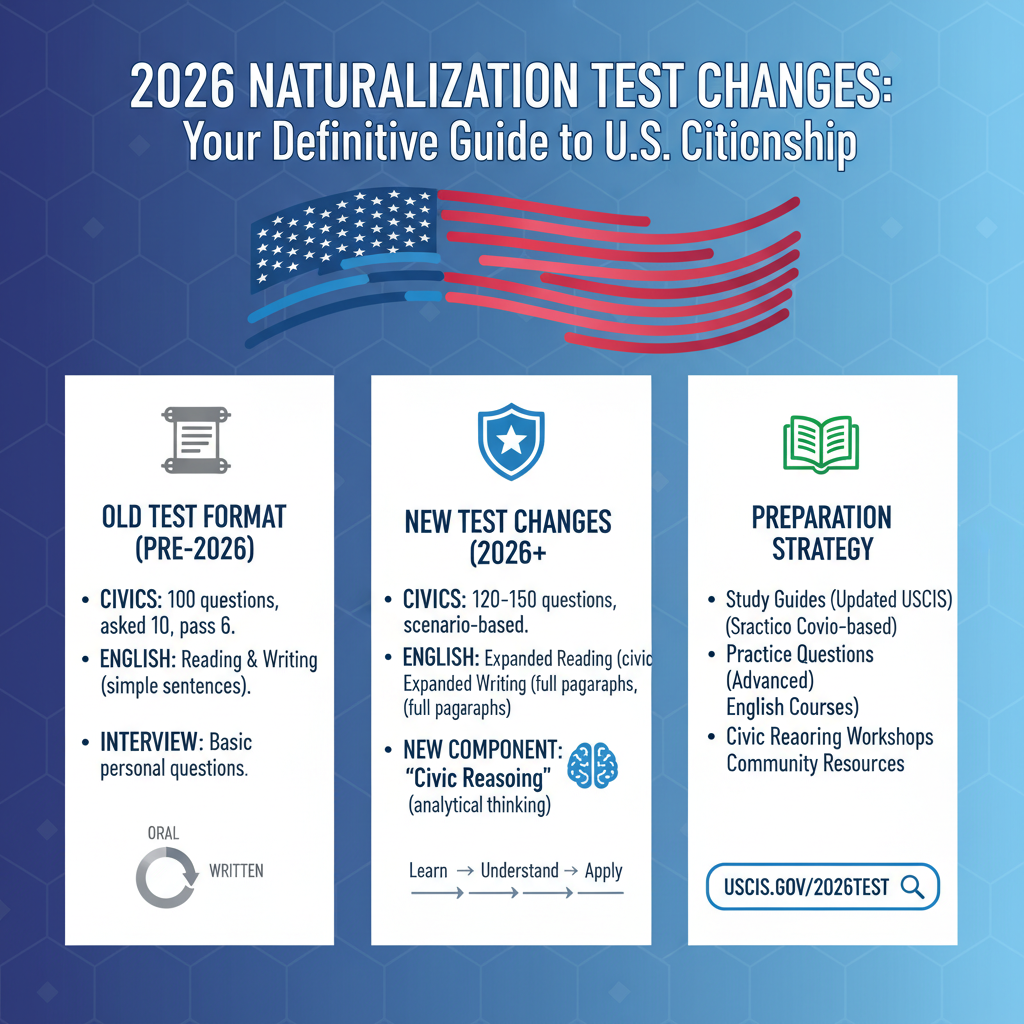
- New Study Strategies: The traditional approach of memorizing 100 civics questions and answers might not be sufficient. The new test is expected to include more scenario-based questions, requiring a deeper understanding of civic principles rather than rote memorization.
- Integrated English Assessment: While English proficiency has always been a component, the new test may integrate this assessment more thoroughly into the interview process, potentially through more conversational prompts or tasks that combine reading, writing, and speaking in a practical context.
- Increased Preparation Time: Applicants will need to dedicate more time to understanding the nuances of U.S. government and history, as well as refining their English communication skills.
- Impact on Processing Times: While not directly related to the test content, any significant change can sometimes lead to initial adjustments in processing times as USCIS staff adapt to new protocols. It is always wise to monitor USCIS Processing Times for the Orlando Field Office.
Important: Regardless of when you file your **Form N-400, Application for Naturalization**, if your interview occurs on or after the effective date of the new test in 2026, you will be tested under the new format. This underscores the critical need for early and informed preparation.
What the 2026 Naturalization Test Changes Are (and Why They Matter)
The process of becoming a U.S. citizen is known as **naturalization**. It’s a formal application through USCIS that, if approved, grants an eligible foreign national all the rights and responsibilities of a U.S. citizen. A key part of this process is the Naturalization Test, designed to confirm an applicant’s commitment to the U.S. and their understanding of its foundations.
A plain-English definition
The Naturalization Test is typically comprised of two main parts: an English test and a civics test. The English test evaluates your ability to read, write, and speak basic English. The civics test assesses your knowledge of U.S. history and government. The changes coming in 2026 are expected to modify both of these components, making them potentially more interactive and comprehensive.
- Civics Test Changes: Based on the pilot program, the civics test may shift from a purely question-and-answer format to include more scenario-based questions. For instance, instead of simply asking "Who elects the President of the United States?", a question might present a scenario about voting and ask how a citizen participates in the election process, requiring a more nuanced understanding and explanation. This aims to measure an applicant's comprehension of civic participation and principles, rather than just memorization.
- English Test Integration: While applicants are currently tested on reading (one out of three sentences correctly), writing (one out of three sentences correctly), and speaking English (assessed during the interview), the new format might integrate the English assessment more seamlessly into the civics portion or overall interview. This could involve describing pictures, explaining concepts, or engaging in more extensive conversations about the civics questions, thereby testing comprehension and expression more deeply.
These changes matter because they signify a move towards a more dynamic and perhaps more challenging evaluation of an applicant's readiness for citizenship. It emphasizes practical understanding and application of knowledge over simple recall. For those preparing, this means a shift in study methods and a greater focus on conversational English skills.
Key terms you need to know
Navigating the naturalization process requires familiarity with specific terminology. Here are some key terms that will be central to your understanding of the upcoming changes and the overall journey:
- Naturalization: The process by which a foreign-born individual voluntarily becomes a U.S. citizen. This is the ultimate goal of the process we are discussing.
- U.S. Citizenship and Immigration Services (USCIS): The federal agency within the Department of Homeland Security responsible for administering immigration and naturalization benefits. All applications and tests go through USCIS. You can find more information on the USCIS official website.
- Form N-400, Application for Naturalization: The primary form you must file with USCIS to apply for U.S. citizenship. This is the cornerstone of your application.
- Civics Test: The portion of the naturalization interview that assesses your knowledge of U.S. history, government, and civics. This is the part undergoing the most significant content changes.
- English Test: The portion of the naturalization interview that assesses your ability to read, write, and speak basic English. This component may become more integrated and interactive.
- Good Moral Character: A legal requirement for naturalization, meaning an applicant must demonstrate adherence to accepted moral standards during the statutory period (typically 3 or 5 years before applying). Criminal records or other issues can impact this.
- Continuous Residence: A requirement that an applicant must have maintained residence in the U.S. for a specified period (usually 5 years, or 3 years for spouses of U.S. citizens) immediately preceding the filing of **Form N-400**.
- Physical Presence: A requirement that an applicant must have actually been physically present in the U.S. for a certain aggregate period during their continuous residence.
- Oath of Allegiance: The final step in the naturalization process, where an applicant formally pledges loyalty to the United States. Upon taking the oath, you officially become a U.S. citizen.
- Naturalization Interview: The meeting with a USCIS officer where your application is reviewed, and the English and civics tests are administered. This is where the 2026 changes will be encountered.
Understanding these terms will empower you to better comprehend the naturalization process and the implications of the upcoming test changes. Imigrar is here to clarify any confusion and guide you through each step.
Considering applying for U.S. Citizenship? Don't navigate the 2026 test changes alone. Our experienced immigration attorneys in Orlando can help you prepare. Call +1 786-791-3106 today for a free consultation. Se Habla Español.
Current Immigration Law: The Foundation of Naturalization
While the Naturalization Test is changing, the underlying legal framework for naturalization remains stable. U.S. immigration law, primarily the Immigration and Nationality Act (INA), sets forth the requirements for becoming a U.S. citizen. Understanding these foundational laws is crucial, as they determine eligibility before you even consider the test itself.
Federal requirements
The primary legal provisions governing naturalization are found in Chapter 2 of Title III of the **Immigration and Nationality Act (INA)**. Key sections include:
- INA Section 312: This section outlines the English language and civics knowledge requirements. It states that an applicant must demonstrate "an understanding of the English language" and "knowledge and understanding of the fundamentals of the history, and of the principles and form of government, of the United States." This is the section directly impacted by the 2026 test changes. Exceptions exist for older applicants and those with certain disabilities.
- INA Section 316: This section details the general requirements for naturalization. These include:
- Age: Be at least 18 years old at the time of filing **Form N-400**.
- Lawful Permanent Resident Status: Be a **lawful permanent resident (Green Card holder)** for at least 5 years (or 3 years if married to a U.S. citizen and living with your spouse).
- Continuous Residence: Have maintained **continuous residence** in the U.S. for at least 5 years (or 3 years if married to a U.S. citizen) immediately preceding the date of filing your application. Absences from the U.S. can break continuous residence.
- Physical Presence: Have been **physically present** in the U.S. for at least 30 months (or 18 months if married to a U.S. citizen) out of the required 5 or 3 years.
- Residence in State/USCIS District: Reside for at least 3 months in the state or USCIS district where you file your application (e.g., Florida for those filing with the Orlando Field Office).
- Good Moral Character: Demonstrate **good moral character** for the statutory period (5 or 3 years). This means you must not have engaged in certain criminal acts or other behaviors that indicate a lack of good moral character.
- Attachment to the U.S. Constitution: Be able to demonstrate attachment to the principles of the U.S. Constitution and be well-disposed to the good order and happiness of the United States. This is often assessed through the Oath of Allegiance and your answers during the interview.
These federal requirements are non-negotiable and form the bedrock of any naturalization application. Even with test changes, these foundational eligibility criteria remain constant. For detailed information on these laws, you should always refer to the USCIS official website.
Florida-specific considerations
While the naturalization process is governed by federal law, there are practical considerations specific to Florida residents:
- USCIS Field Office: Most naturalization interviews for Central Florida residents, including those in Orlando, Kissimmee, and throughout Orange County, are conducted at the **Orlando USCIS Field Office**. Understanding the local office's procedures and typical processing times is beneficial.
- Processing Times: Processing times for **Form N-400** can vary significantly by field office. It is crucial for applicants in Florida to regularly check the USCIS Processing Times page, selecting the Orlando Field Office, to get an estimate of how long their application might take. As of April 2026, these times can range from several months to over a year.
- Local Resources: Florida offers various community organizations and resources that can assist immigrants with English language learning and civics education, which will be even more critical with the 2026 changes.
- Legal Support: For Central Florida residents, having an experienced immigration law firm like Imigrar, located in Orlando, provides local expertise and convenient access to support throughout the naturalization process.
Applicants must file **Form N-400, Application for Naturalization**, and potentially **Form N-648, Medical Certification for Disability Exceptions** if seeking a waiver for the English and/or civics test due to a medical condition. All necessary forms and instructions are available on the USCIS Forms page.

How to Prepare for Naturalization with the 2026 Test Changes: A Complete Step-by-Step Guide
Navigating the naturalization process requires meticulous preparation, especially with the upcoming changes to the test in 2026. This step-by-step guide will walk you through the journey, focusing on how to adapt your preparation for the new test format.
1) Determine Your Eligibility and Gather Initial Documents
Before anything else, confirm you meet all federal eligibility requirements outlined in INA Section 316. This includes age, lawful permanent resident status, continuous residence, physical presence, and good moral character. If you’re unsure about your eligibility, particularly concerning past travel or legal issues, consulting with an immigration attorney is highly recommended.
Required Documents (Initial Assessment):
- Your **Permanent Resident Card (Green Card)**.
- All passports (current and expired) for all travel history during your continuous residence period.
- Marriage certificates, divorce decrees, or death certificates if applicable (especially for 3-year residency rule).
- Birth certificates of your children (if applicable).
- Proof of selective service registration (if you are a male applicant who resided in the U.S. between ages 18 and 26).
- Tax returns for the past 5 years (or 3 years if applying as a spouse of a U.S. citizen).
- Documentation of any arrests, citations, or criminal history, even if charges were dropped or expunged.
Reminder: Begin collecting these documents early. Missing or incomplete documentation is a common cause of delays.
2) Prepare and File Form N-400, Application for Naturalization
This is the core of your application. Fill out **Form N-400** accurately and completely. Be truthful in all your answers, as any misrepresentation can lead to serious consequences. Pay close attention to questions regarding your good moral character, travel history, and any interactions with law enforcement.
Required Documents (with N-400 submission):
- Completed and signed **Form N-400**.
- Two identical passport-style color photographs (taken within 30 days of filing).
- A copy of the front and back of your **Permanent Resident Card (Green Card)**.
- Payment for the filing fee and biometric services fee (check the USCIS Fee Schedule for current amounts). You can pay by money order, personal check, cashier’s check, or credit card using **Form G-1450, Authorization for Credit Card Transactions**.
- Copies of any court dispositions, arrest records, or police reports if you have any criminal history.
- If applying based on marriage to a U.S. citizen, include copies of your marriage certificate, your spouse’s birth certificate or naturalization certificate, and evidence of the bona fides of your marriage (e.g., joint bank statements, utility bills, tax returns).
Warning: Ensure all copies are legible. Do not send original documents unless specifically requested by USCIS.
3) Attend Biometrics Appointment
After filing **Form N-400**, USCIS will send you an appointment notice for a biometrics services appointment at an Application Support Center (ASC). This is typically a brief appointment where your fingerprints, photograph, and signature are taken. These are used for background checks.
Required Documents (for Biometrics):
- The original **Appointment Notice (Form I-797C)**.
- A valid government-issued photo identification (e.g., Green Card, passport, driver’s license).
Important: Do not miss this appointment. If you have a legitimate reason to reschedule, follow the instructions on your appointment notice immediately.
4) Prepare for the Naturalization Interview and New Test Format
This is arguably the most critical stage, especially with the 2026 changes. Your interview will include the English and civics tests, and a review of your **Form N-400** application.
- Study for the Civics Test: While the exact new questions for 2026 are not yet finalized, begin by thoroughly studying the current 100 civics questions and answers available on the USCIS website. However, expand your preparation to understand the *concepts* behind these questions. Practice explaining historical events or governmental functions in your own words. Anticipate scenario-based questions that require critical thinking rather than simple recall.
- Enhance English Proficiency: The integrated English assessment means you need strong conversational English skills. Practice speaking about U.S. history and government. Read English newspapers or books. Practice writing simple sentences in English. USCIS provides study materials for English reading and writing tests. For those in Orlando, local community colleges and language centers offer excellent resources.
- Review Your N-400: Be prepared to answer every question on your **Form N-400** truthfully and consistently with your application. The USCIS officer will go through your application with you.
Required Documents (for Interview Preparation):
- All original documents that you submitted copies of with your **Form N-400** (e.g., Green Card, passports, marriage certificates, court documents, tax returns).
- Your interview appointment notice.
- Any updated documents since you filed your N-400 (e.g., new passport, updated tax forms, new marriage certificate).
5) Attend Your Naturalization Interview
Arrive on time at the **Orlando USCIS Field Office** (or your designated office). Dress professionally. Be polite and respectful to the USCIS officer. Answer all questions truthfully and to the best of your ability. During the interview, you will take the English and civics tests. If the 2026 changes are in effect, be ready for the new format, including scenario-based civics questions and a more integrated English assessment.
<

