


What This News Means for Immigrants in Orlando and Across Florida
Why this news is showing up now
The topic of Green Card interview preparation is perennially relevant because it represents a final, crucial hurdle for many immigrants. It’s not about new legislation changing interview protocols, but rather the ongoing importance of understanding the existing process. Every day, thousands of individuals are called for these interviews, making the need for accurate, actionable advice a constant demand. USCIS officers are tasked with verifying the truthfulness of applications and the eligibility of applicants, meaning that thorough preparation is always the key to a successful outcome. The news cycle's general focus on immigration law often highlights the complexities and challenges within the system, implicitly reinforcing the need for applicants to be exceptionally well-prepared for every stage, especially the interview. This constant background noise reminds us that while the law provides a path, navigating it effectively requires diligence.How it can affect Florida residents
For immigrants residing in Florida, particularly those in the bustling Orlando metropolitan area, the Green Card interview is often conducted at the Orlando USCIS Field Office. The specific nuances of local office procedures, officer discretion, and scheduling can add an additional layer of consideration. For Central Florida residents, understanding the local context, such as typical wait times or the specific questions often posed by officers in the region, can be incredibly beneficial. Moreover, Florida's diverse immigrant population means that a wide array of Green Card categories—from family-based petitions to employment-based applications—are processed here. Each category may have unique documentation requirements and interview points of focus. The stakes are high: a successful interview means securing permanent residency, allowing individuals to live, work, and thrive in communities like Orlando, Kissimmee, and across the I-4 corridor. Conversely, an unprepared applicant risks delays, requests for additional evidence, or even denial, which can have profound impacts on families already rooted in the Sunshine State.Need Help? Our Orlando immigration team is ready to assist. Call +1 786-791-3106 for a free consultation, or message us online. Se Habla Español.
What Green Card Interviews Are (and Why They Matter)
The Green Card interview is a formal meeting with an immigration officer designed to verify the information provided in your application and to determine your eligibility for lawful permanent residency in the United States. It is a critical step in the Adjustment of Status process (for those applying from within the U.S.) or Consular Processing (for those applying from abroad). This interview serves as the U.S. government's opportunity to ensure that you meet all legal requirements, that your application is truthful, and that you are not inadmissible to the U.S.A plain-English definition
Think of the Green Card interview as your chance to personally confirm everything you've stated in your immigration application. An immigration officer will review your submitted forms and documents, ask you questions about your background, your relationship (if applicable), and your reasons for seeking permanent residency. Their goal is to make sure you genuinely qualify for a Green Card and that there are no red flags or misrepresentations in your case. It's a fact-finding mission, and your cooperation and honesty are paramount.Key terms you need to know
Understanding the following terms will help you navigate the Green Card interview process more effectively: * **Adjustment of Status (AOS):** The process of applying for a Green Card while physically present in the United States. This typically involves filing Form I-485. * **Consular Processing:** The process of applying for a Green Card through a U.S. embassy or consulate in your home country. * **USCIS (U.S. Citizenship and Immigration Services):** The government agency responsible for processing immigration petitions and applications, and conducting Green Card interviews within the U.S. * **Department of State (DOS):** The government agency that oversees U.S. embassies and consulates abroad, handling Consular Processing interviews. * **Petitioner:** The U.S. citizen or lawful permanent resident who files an immigration petition (e.g., Form I-130) on behalf of an eligible relative. * **Beneficiary:** The immigrant seeking a Green Card, on whose behalf a petition is filed. * **Affidavit of Support (Form I-864):** A legally binding document signed by the petitioner (and sometimes a joint sponsor) to demonstrate that the beneficiary will not become a public charge in the U.S. * **Priority Date:** The date USCIS receives your immigration petition. This date is crucial for determining when an immigrant visa becomes available for certain categories. * **Inadmissibility:** Legal grounds that can prevent an individual from entering or remaining in the U.S., such as certain criminal convictions, health issues, or past immigration violations. * **Request for Evidence (RFE):** A letter from USCIS requesting additional documents or information to support your application. * **Notice of Intent to Deny (NOID):** A letter from USCIS indicating their intention to deny your application and providing you an opportunity to respond before a final decision.Current Immigration Law: The Foundation for Your Green Card Interview
The Green Card interview process is firmly rooted in U.S. immigration law, primarily the Immigration and Nationality Act (INA). This act outlines the eligibility requirements, grounds of inadmissibility, and procedures for obtaining lawful permanent residency. While specific regulations may be updated periodically, the core legal framework remains consistent.Federal requirements
The primary federal requirements for a Green Card are outlined in various sections of the INA. For family-based immigration, which constitutes a significant portion of Green Card applications, **INA § 201** and **INA § 203** define the categories of eligible relatives and the annual visa limits. **INA § 204** describes the petitioning process. The most common path for an interview in the U.S. is through Adjustment of Status under **INA § 245**, which requires the applicant to have been lawfully admitted into the U.S. and to meet specific eligibility criteria, including the availability of an immigrant visa number. Key legal requirements include: * **Valid Petition:** A U.S. citizen or lawful permanent resident must have filed an approved petition on your behalf (e.g., Form I-130, Petition for Alien Relative, or Form I-140, Immigrant Petition for Alien Worker). * **Immigrant Visa Availability:** An immigrant visa must be immediately available to you at the time of filing your Form I-485, Application to Register Permanent Residence or Adjust Status. Visa availability is tracked through the monthly Visa Bulletin published by the U.S. Department of State. * **Admissibility:** You must not be inadmissible to the U.S. on health, criminal, security, public charge, or other grounds as defined in **INA § 212**. This is where the medical examination (Form I-693) and the interview play a crucial role in assessing potential inadmissibility issues. * **Financial Support:** The petitioner must typically demonstrate the ability to financially support you, preventing you from becoming a "public charge," by filing Form I-864, Affidavit of Support. * **Bona Fide Relationship:** For marriage-based Green Cards, the interview heavily focuses on proving the authenticity of the marital relationship. All applicants must undergo a background check, including fingerprinting (biometrics), to ensure they meet national security and criminal history requirements. You can find detailed information about all forms and regulations on the USCIS official website.Florida-specific considerations
While federal law governs the underlying requirements, the processing of your application will involve interaction with local USCIS offices. For residents of Central Florida, including Orlando, Sanford, Kissimmee, and surrounding areas in Orange County, your Adjustment of Status interview will almost certainly be scheduled at the Orlando USCIS Field Office. This office is located at 6680 Corporate Centre Blvd, Orlando, FL 32822. Understanding the specific procedures and typical interview environment of the Orlando Field Office can be advantageous. While the core questions are standardized, individual officers may have different interviewing styles. It's important to remember that all USCIS offices operate under the same federal regulations, but local offices manage scheduling, specific document handling, and the physical location of your interview. Familiarizing yourself with the office's location, parking, and security protocols beforehand can help reduce stress on interview day. Imigrar, based in Orlando, has extensive experience with the local USCIS office and can provide tailored advice for clients in this region.Need Help? Our Orlando immigration team is ready to assist. Call +1 786-791-3106 for a free consultation, or message us online. Se Habla Español.
How to Prepare for Your Green Card Interview: A Complete Step-by-Step Guide
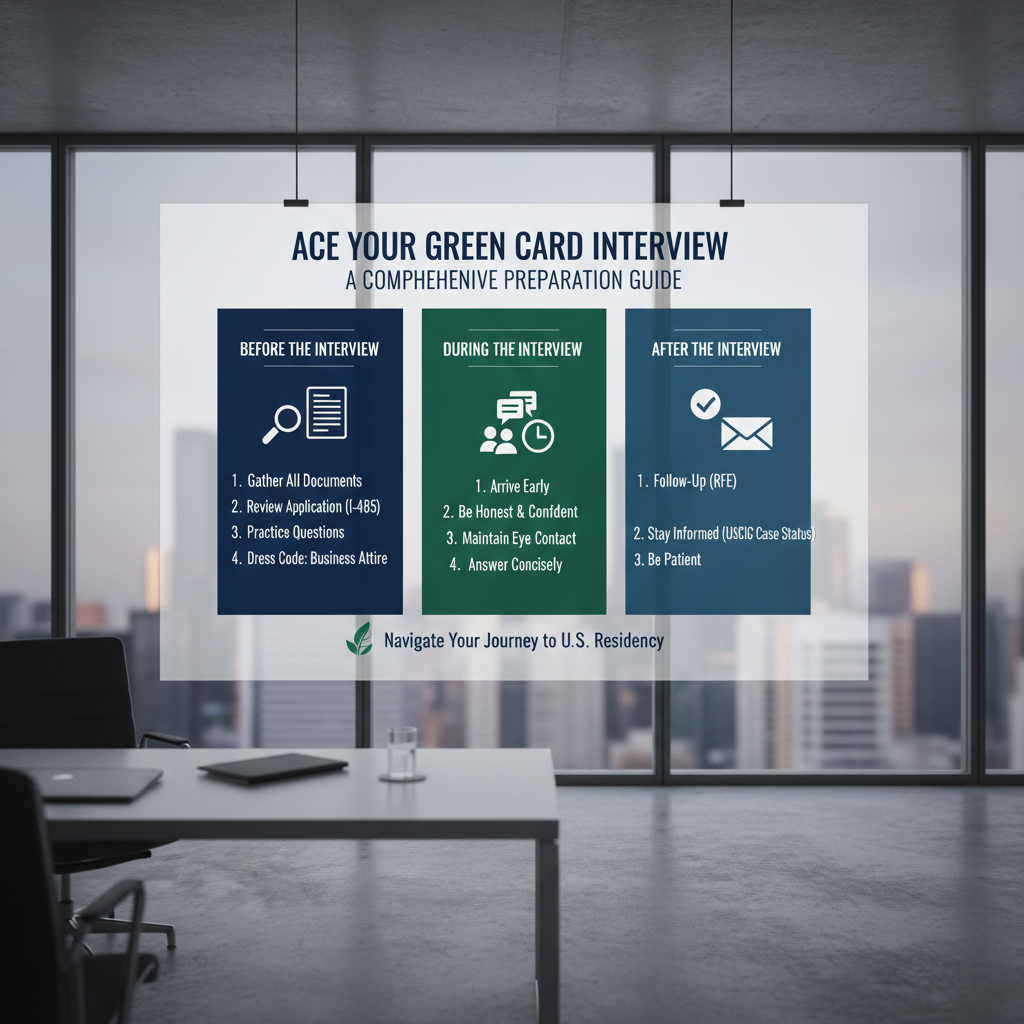
Preparing for your Green Card interview is arguably the most crucial phase of your immigration journey. A well-prepared applicant projects confidence, honesty, and competence, which can significantly influence the interview's outcome. Follow this comprehensive step-by-step guide to ensure you're ready.1) Understand Your Interview Notice (Form I-797C, Notice of Action)
Your first step upon receiving your interview notice (typically **Form I-797C**) is to read it thoroughly. This document will specify the date, time, and location of your interview (e.g., Orlando USCIS Field Office). It will also list any specific documents you must bring that day. * **Actionable Advice:** * **Confirm Details:** Double-check the date, time, and address. Mark it clearly on your calendar. * **Read Document List:** Pay close attention to any documents USCIS specifically requests you bring. This list can vary depending on your case. * **Attendees:** Note who must attend the interview. For family-based petitions, both the petitioner and beneficiary typically must attend. If you have an attorney, they should also attend. * **Rescheduling:** If you absolutely cannot make your scheduled interview, contact USCIS immediately. Rescheduling can significantly delay your case and should only be done in emergencies.2) Gather and Organize All Required Documents
This is the most labor-intensive but critical step. You must bring originals of all documents submitted with your application, plus copies, and any additional evidence that supports your case. Organize everything neatly in a binder or folder. * **General Required Documents (Bring Originals AND Copies):** * Your interview notice (Form I-797C). * Valid government-issued photo identification (passport, driver's license). * Your birth certificate (and certified English translation if applicable). * Marriage certificate (if applicable, and certified English translation). * Divorce decrees or death certificates for any previous marriages of you or your spouse (and translations). * Medical examination results (sealed envelope from civil surgeon, if not already submitted via Form I-693). * All passports, current and expired. * Travel history documents (I-94 arrival/departure records, visas). * All USCIS correspondence. * Proof of financial support (e.g., Form I-864, Affidavit of Support, with recent tax returns, W-2s, pay stubs for the petitioner and any joint sponsors). * Employment authorization document (EAD) and advance parole (AP) cards, if applicable. * Proof of identity documents for the petitioner (birth certificate, naturalization certificate, passport, Green Card). * **Specific Documents for Marriage-Based Green Cards (Proof of Bona Fide Marriage):** * Joint bank accounts statements. * Joint utility bills, lease agreements, or mortgage statements. * Joint credit card statements. * Vehicle titles showing joint ownership. * Life insurance policies naming each other as beneficiaries. * Photographs together (dating, engagement, wedding, family events, travel). * Birth certificates of children born to the marriage. * Affidavits from friends or family confirming the relationship. * Correspondence (emails, texts, social media posts) showing ongoing relationship. * **Tip:** Create a checklist based on your specific application and the interview notice. Separate originals from copies for easy access.3) Review Your Application Forms and Submitted Documents
You must be intimately familiar with every detail of your application (e.g., Form I-130, Form I-485, Form I-864, Form G-325A). The officer will refer to these documents and ask questions based on the information provided. * **Actionable Advice:** * **Read Everything:** Go through every form you submitted page by page. * **Recall Dates and Details:** Memorize important dates (e.g., date of entry, date of marriage, children's birthdates, addresses). Ensure consistency with your testimony. * **Identify Potential Discrepancies:** If there are any errors or inconsistencies, be prepared to explain them honestly. It’s better to acknowledge a minor mistake than to appear deceptive. * **Understand the "Why":** For each question on the form, understand why you answered the way you did.4) Practice for the Interview
While you can't predict every question, you can prepare for common lines of inquiry. This is especially true for marriage-based cases, where questions about the relationship's authenticity are central. * **Common Question Areas:** * **Biographical:** Your name, date of birth, place of birth, parents' names. * **Immigration History:** How and when you entered the U.S., previous visas, any prior immigration issues. * **Relationship (if applicable):** How you met, when you started dating, proposal, wedding details, daily life together, future plans. * **Inadmissibility Questions:** Questions relating to criminal history, health issues, past immigration violations, or misrepresentations. These are critical and must be answered truthfully. * **Public Charge:** Questions related to your ability to support yourself and your reliance on public benefits. * **Practice with a Partner:** Have your spouse, family member, or attorney conduct a mock interview. Practice answering clearly, concisely, and truthfully. * **Focus on Consistency:** Ensure your verbal answers align with the information in your written application.5) Prepare for Interview Day Logistics
The day of your interview can be stressful. Planning ahead for logistics will help reduce anxiety. * **Dress Code:** Dress professionally, as if for a job interview. This shows respect for the process. * **Arrive Early:** Aim to arrive at the Orlando USCIS Field Office at least 30-45 minutes before your scheduled time. This allows for parking, security checks, and finding the correct waiting area without rushing. * **Transportation:** Plan your route to the office, considering Orlando traffic, especially if you're coming from afar (e.g., from the I-4 corridor or neighboring counties). * **What to Bring:** Only bring essential documents, your phone (which will likely need to be turned off), and a small bag. Leave unnecessary valuables at home. * **Family/Friends:** Only those listed on the interview notice or your attorney will be allowed into the interview room. Other family or friends may wait in the lobby.6) What to Expect During the Interview
The interview will typically begin with the officer administering an oath, asking you to swear or affirm that your testimony will be truthful. * **The Officer's Role:** The officer's job is to verify information, assess your credibility, and determine your eligibility under immigration law. They are not there to befriend you, but to conduct a thorough inquiry. * **Questions:** The officer will go through your application forms, asking questions about your background, family, immigration history, and the basis of your Green Card application. * **Marriage-Based Interviews:** For marriage-based cases, both spouses will be interviewed. Sometimes, you may be interviewed together, or separately, or both. Be prepared for detailed questions about your relationship. * **Honesty is Key:** Always answer truthfully. If you don't understand a question, ask for clarification. If you don't know the answer, say so. Do not guess or fabricate information. * **Provide What's Asked:** Only answer the questions asked. Do not volunteer extra information unless it's directly relevant and clarifies your answer. * **Attorney's Role:** Your attorney is there to observe, ensure your rights are protected, and clarify legal points if necessary. They generally will not answer questions for you unless specifically permitted by the officer or if there's a legal issue.7) Post-Interview Actions
The interview doesn't always end with an immediate decision. * **Approval:** If approved on the spot, the officer may stamp your passport with a temporary Green Card validity stamp (I-551 stamp). Your physical Green Card will be mailed later. * **Request for Evidence (RFE):** If the officer needs more information, they will issue an RFE. Respond to this promptly and thoroughly within the specified deadline. * **Notice of Intent to Deny (NOID):** In more serious cases, you might receive a NOID. This gives you a chance to present arguments or evidence to overcome the grounds for denial. This is a critical juncture where legal counsel is essential. * **Timeline:** Processing times vary. You can check your case status and estimated processing times on the USCIS Processing Times page.Need Help? Our Orlando immigration team is ready to assist. Call +1 786-791-3106 for a free consultation, or message us online. Se Habla Español.
Practical Steps You Can Take Today for a Successful Interview
The best way to ensure a smooth Green Card interview is to start preparing well in advance. Here's an actionable checklist you can begin working on immediately. * **Review Your Entire Application Package:** Pull out copies of every form and document you submitted to USCIS. Read through them as if you were the immigration officer. This helps you identify any potential areas of concern or questions you might be asked. Pay close attention to dates, addresses, and employment history. * **Organize Your Documents Meticulously:** Create a dedicated binder or accordion folder. Label sections clearly (e.g., "Originals - Birth Certificate," "Copies - Marriage Proof," "Financial Documents"). Have a separate section for the documents specifically requested in your interview notice. This organization will save time and stress during the interview. * **Start Gathering Missing/Updated Documents:** If your interview notice asks for documents you didn't initially submit, or if you have new evidence (e.g., a new joint lease, recent photos, a new tax return), gather these immediately. Ensure all foreign language documents have certified English translations. * **Schedule a Mock Interview:** Practice answering common interview questions with a trusted friend, family member, or, ideally, an immigration attorney. Focus on clear, concise, and consistent answers. For marriage-based cases, practice separate and joint interviews with your spouse. * **Familiarize Yourself with USCIS Official Resources:** Spend time on the USCIS official website. Review the instructions for the forms you filed, read about your specific Green Card category, and check the USCIS Processing Times for an idea of when to expect a decision after your interview. * **Consult with an Immigration Attorney:** Even if you filed your application yourself, a consultation with an experienced immigration attorney can be invaluable. They can review your case, identify potential issues, help you organize documents, and provide a realistic mock interview experience. This is especially important if your case has complexities, such as previous immigration violations, criminal history, or a complicated relationship history. * **Plan Your Travel to the Interview Location:** If your interview is at the Orlando USCIS Field Office, plan your route, parking, and estimated travel time. Account for potential traffic delays, especially during peak hours on the I-4 corridor. Knowing exactly how to get there reduces stress on the day. **Timeline Expectations:** * **Interview Notice:** You typically receive your interview notice (Form I-797C) several weeks to a few months before the actual interview date. * **Interview Day:** The interview itself usually lasts between 20 minutes to an hour, though it can be shorter or longer depending on the complexity of the case. * **Decision:** Some cases are approved on the spot, with a temporary I-551 stamp placed in the passport. For others, a decision can take weeks or even months. USCIS aims to provide a decision within **120 days** of the interview, but this is not a guarantee. You can check your case status online. * **Green Card Delivery:** Once approved, your physical Green Card is usually mailed within 2-3 weeks. **Important:** Do not underestimate the importance of preparation. The interview is your chance to make a strong, positive impression and clarify any doubts the officer might have.How Imigrar Helps Immigrants in Orlando and Nationwide
At Imigrar, our mission is "Keep Families Together." We understand that the Green Card interview is a high-stakes event, and navigating the complexities of immigration law can be daunting. Our dedicated team of immigration attorneys is here to provide comprehensive support and guidance to immigrants throughout Orlando, Central Florida, and across the United States. Our experience and expertise cover a wide range of Green Card categories, including family-based petitions, employment-based applications, and more. We pride ourselves on offering personalized legal strategies tailored to each client's unique circumstances. We can assist you by: * **Case Review and Strategy:** Thoroughly reviewing your entire application package and identifying potential issues or areas that require additional documentation. * **Document Organization:** Providing clear, detailed guidance on how to gather and organize all necessary documents, ensuring you have everything required for the interview. * **Mock Interview Preparation:** Conducting realistic mock interviews, preparing you for the types of questions you might face, and helping you formulate clear, consistent, and truthful answers. * **Attorney Representation:** Accompanying you to your interview at the Orlando USCIS Field Office or other locations, advocating on your behalf, and ensuring your rights are protected throughout the process. * **Responding to RFEs and NOIDs:** If USCIS requests additional evidence or expresses an intent to deny your application, we will meticulously prepare and submit a robust response on your behalf. * **Post-Interview Support:** Guiding you through the waiting period and advising on next steps after your interview. We believe that every immigrant deserves competent and compassionate legal representation. Our goal is to empower you with the knowledge and confidence needed to succeed. We offer a **free consultation** to discuss your Green Card case and how we can assist you. Don't face the immigration process alone. **Se Habla Español.** Our bilingual team is ready to serve the Spanish-speaking community with clarity and understanding.
Frequently Asked Questions About Green Card Interviews
Q: What if my spouse (petitioner) cannot attend the marriage-based Green Card interview?
A: Generally, for marriage-based Green Card interviews, both the petitioner and the beneficiary are required to attend. If your spouse cannot attend due to an emergency (e.g., serious illness, military deployment, unavoidable travel), you must notify USCIS immediately. You will likely need to provide proof of the reason for their absence. USCIS may reschedule the interview or, in very rare circumstances, proceed with only the beneficiary if the reason is compelling and well-documented. However, it significantly complicates the case and can lead to delays or even denial. It's crucial to consult with an attorney to navigate this situation.
Q: Will my current immigration status affect the Green Card interview?
A: Your current immigration status at the time of your Adjustment of Status application is highly relevant. To adjust status in the U.S., you must generally have been inspected and admitted or paroled into the U.S. and be in a valid nonimmigrant status (or fall under specific exceptions like certain immediate relatives). If you have overstayed a visa, worked without authorization, or have other immigration violations, these issues will be thoroughly reviewed during the interview. While some violations might be waived for immediate relatives of U.S. citizens, others can lead to inadmissibility. Be prepared to discuss your entire immigration history truthfully, and seek legal advice if you have any past issues.
Q: How long does it take to get a decision after the Green Card interview?
A: The timeline for a decision after your Green Card interview can vary significantly. Some applicants receive an on-the-spot approval, where the officer may stamp their passport with a temporary I-551 stamp. For others, it can take weeks or even months. USCIS states that they strive to issue a decision within 120 days of the interview, but this is not always the case. You can monitor your case status online using the receipt number from your interview notice. If you receive a Request for Evidence (RFE) or a Notice of Intent to Deny (NOID), the decision will be further delayed until you respond.
Q: What documents are absolutely essential to bring to the interview?
A: While the interview notice (Form I-797C) will list specific documents, some are universally essential. Always bring: your passport (and any expired ones), your interview notice, your birth certificate, your marriage certificate (if applicable), all divorce decrees for you and your spouse (if applicable), your medical examination results in a sealed envelope (if not already submitted), your I-94 arrival record, and all original supporting documents you submitted with your application (e.g., financial


