


Navigating the U.S. immigration system can be a complex journey, with the Green Card interview often being one of the most pivotal steps. For many, this interview represents the culmination of years of waiting and diligent preparation. At Imigrar, we understand the stakes involved and are dedicated to empowering immigrants and their families with the knowledge and support they need to succeed.
Need Expert Guidance for Your Green Card Interview? Don't face this critical step alone. Our experienced Orlando immigration team at Imigrar is here to help you prepare thoroughly. Call +1 786-791-3106 for a free consultation, or message us online. Se Habla Español.
The reporting that sparked this guide
The continuous flow of information surrounding immigration law, particularly regarding critical steps like the Green Card interview, underscores the importance of staying informed. This guide is inspired by ongoing discussions and resources found in general immigration law news, highlighting the perennial need for comprehensive preparation. For more insights into current immigration law topics, you can explore resources like Green Card Interview Preparation Tips (Immigration Law).
What This News Means for Immigrants in Orlando and Across Florida
The Green Card interview is a critical milestone for countless individuals and families seeking to make the U.S. their permanent home. For immigrants residing in Orlando, Central Florida, and throughout the Sunshine State, understanding this process is paramount. News and updates about interview preparation are always relevant because they directly impact the success rates of applicants, offering timely advice and insights.
Why this news is showing up now
The U.S. immigration system is constantly evolving, with processing times, interview backlogs, and policy nuances shifting regularly. While the fundamental requirements for a Green Card interview remain consistent, the emphasis on thorough preparation, accurate documentation, and understanding the interviewer's focus can change. As USCIS continues to process a high volume of applications, the importance of a well-prepared interview is consistently highlighted in immigration discourse. Furthermore, with the ongoing digital transformation of government services and the adjustment to post-pandemic operational procedures, advice on interview best practices is frequently refreshed and recirculated.
How it can affect Florida residents
Florida is home to a vibrant and diverse immigrant population, with major hubs like Orlando, Miami, and Tampa seeing a high volume of Green Card applications. For Florida residents, particularly those whose cases are processed at the Orlando USCIS Field Office or other field offices across the state, robust interview preparation is not just advisable, it's essential. The outcomes of these interviews directly impact their ability to live, work, and contribute to Florida's economy and culture. A successful interview means moving closer to permanent residency, while an unsuccessful one can lead to delays, Requests for Evidence (RFEs), or even denial, causing significant stress and disruption to families. Understanding the nuances of the interview process helps Florida residents avoid common pitfalls, streamline their applications, and ultimately achieve their immigration goals.
What a Green Card Interview Is (and Why It Matters)
A Green Card interview is a formal meeting with a U.S. Citizenship and Immigration Services (USCIS) officer or, in the case of consular processing, a Consular Officer at a U.S. Embassy or Consulate abroad. The primary purpose of this interview is to verify the information provided in your Green Card application, assess your eligibility for permanent residency, and ensure that you meet all legal requirements. It's an opportunity for the immigration officer to confirm the authenticity of your relationship (if applying based on marriage or family), review your documents, and address any potential concerns or discrepancies. This interview is often the final hurdle before your Green Card is approved, making it an incredibly significant step in your immigration journey.
A plain-English definition
Think of the Green Card interview as your chance to prove, face-to-face, that everything you've stated in your application is true and that you genuinely qualify for permanent residency in the United States. It's like a detailed conversation where an immigration officer asks questions about your life, your background, and why you're applying for a Green Card. For family-based petitions, especially marriage-based ones, the officer will focus heavily on confirming the legitimacy of your relationship. For employment-based petitions, they'll verify your qualifications and the job offer. It's a formal process, but it's also a human interaction where honesty and consistency are key.
Key terms you need to know
- Green Card (Form I-551): The official name for a permanent resident card, which grants foreign nationals permanent residency in the United States.
- Adjustment of Status (AoS): The process of applying for a Green Card while physically present in the United States. The interview for AoS typically takes place at a USCIS Field Office, such as the one in Orlando.
- Consular Processing: The process of applying for a Green Card from outside the United States through a U.S. Embassy or Consulate in your home country. The interview is conducted by a Consular Officer.
- Petitioner: The U.S. citizen or lawful permanent resident who files an immigration petition (e.g., Form I-130, Petition for Alien Relative) on behalf of an eligible foreign national.
- Beneficiary: The foreign national who is seeking immigration benefits and is the subject of an immigration petition filed by a petitioner.
- Sponsor/Affiant: The person who signs Form I-864, Affidavit of Support, promising to financially support the immigrant if needed. This is often the petitioner but can also be a joint sponsor.
- Priority Date: The date USCIS or the Department of State receives your properly filed petition. This date determines your place in the visa queue for certain categories.
- Request for Evidence (RFE): A letter from USCIS asking for more information or documents to support your application. An RFE typically indicates that your application is missing something or that the officer needs clarification.
- Notice of Intent to Deny (NOID): A letter from USCIS indicating that they intend to deny your application unless you provide additional information or arguments to overcome the stated grounds for denial. This is a serious notice.
Feeling Overwhelmed by Immigration Terminology? Imigrar is here to simplify the process. Our Orlando-based legal team speaks English and Spanish, making sure you understand every step. Call us at +1 786-791-3106 for clear, concise advice. Se Habla Español.
Current Immigration Law: The Foundation
The legal framework governing Green Cards and their associated interviews is primarily found within the Immigration and Nationality Act (INA). This federal law outlines who is eligible for permanent residency, the categories under which one can apply, and the procedures involved. Understanding these foundational laws is crucial for any applicant.
Federal requirements
The Green Card interview process is governed by federal immigration law, specifically the INA. Key sections of the INA that are relevant include:
- Section 201-204 (INA): These sections define who is eligible for immigrant visas (Green Cards) through family-based and employment-based categories, including immediate relatives (spouses, minor children, parents of U.S. citizens) and preference categories.
- Section 245 (INA): This section governs Adjustment of Status for individuals already in the U.S. who wish to become lawful permanent residents without leaving the country. For example, INA Section 245(a) outlines general eligibility, while INA Section 245(i) provides a pathway for certain individuals who entered without inspection or overstayed.
- Section 212 (INA): This section details the grounds of inadmissibility, which are reasons an individual might be denied a Green Card (e.g., criminal history, certain health issues, public charge concerns, immigration violations). During the interview, the officer will assess if any inadmissibility grounds apply to your case. Waivers may be available for some grounds of inadmissibility.
- Section 213A (INA): This section mandates the requirement of an Affidavit of Support (Form I-864) for most family-based immigrants and some employment-based immigrants, ensuring they will not become a public charge.
The forms associated with Green Card applications are standard nationwide, regardless of where you live in Florida or the U.S. Common forms include:
- Form I-130, Petition for Alien Relative: Filed by a U.S. citizen or lawful permanent resident to establish a qualifying relationship with a foreign relative.
- Form I-485, Application to Register Permanent Residence or Adjust Status: Filed by the foreign national seeking a Green Card while in the U.S.
- Form I-864, Affidavit of Support: Filed by the petitioner (and sometimes a joint sponsor) to demonstrate financial ability to support the immigrant.
- Form I-693, Report of Medical Examination and Vaccination Record: Completed by a USCIS-approved civil surgeon to verify medical eligibility.
- Form I-765, Application for Employment Authorization: Often filed concurrently with Form I-485 to allow the applicant to work while their Green Card application is pending.
- Form I-131, Application for Travel Document: Often filed concurrently with Form I-485 to allow the applicant to travel internationally while their Green Card application is pending (Advance Parole).
For official forms, instructions, and up-to-date information, always refer to the USCIS official website. You can find specific forms at USCIS Forms.
Florida-specific considerations
While immigration law is federal, applying uniformly across the United States, certain practical considerations can be specific to Florida residents. For instance, if your case is in Orlando, your interview will likely be scheduled at the Orlando USCIS Field Office, located at 5449 Forbes Pl, Orlando, FL 32812. Knowing the location, understanding local transportation, and anticipating the environment of the specific field office can be part of your preparation.
There are no "Florida-specific immigration laws" that would alter the federal requirements for a Green Card interview. However, living in a state with a large immigrant population means that USCIS field offices in Florida, including Orlando, handle a high volume of diverse cases. This experience often translates into officers who are highly skilled in discerning genuine cases from fraudulent ones, especially in marriage-based interviews. Therefore, thorough preparation, especially for those along the I-4 corridor or in Orange County, is paramount to ensure all federal requirements are clearly met and presented.
How to Prepare for Your Green Card Interview: A Complete Step-by-Step Guide
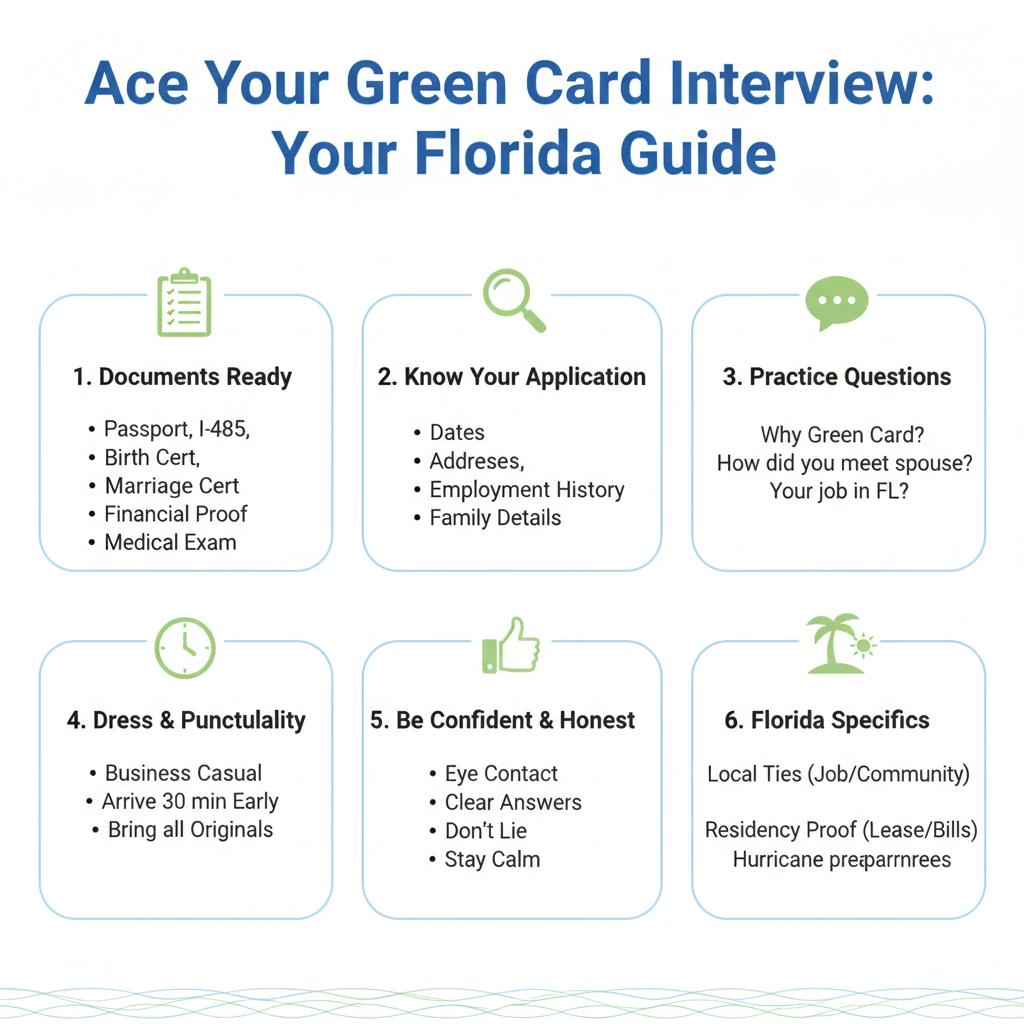
The Green Card interview is a critical moment. Proper preparation can significantly boost your confidence and increase your chances of a successful outcome. Here’s a comprehensive guide to help you get ready.
1) Thoroughly Review Your Application and Supporting Documents
Before anything else, you must be intimately familiar with every detail of your Green Card application. This includes the initial petition (e.g., Form I-130) and your application to adjust status (Form I-485), along with all supporting documents you submitted.
- Read Everything You Submitted: Go through every form, every answer, and every piece of evidence you sent to USCIS. Your interview questions will be based on this information.
- Identify Potential Discrepancies: Look for any inconsistencies or areas that might be unclear. For example, if dates or addresses don't perfectly align across different documents, be prepared to explain why.
- Understand Your History: Be ready to discuss your entry into the U.S., your immigration history, your work history, and your relationship (if applicable).
- For Marriage-Based Cases: The officer will heavily scrutinize the legitimacy of your marriage. Understand the timeline of your relationship, how you met, major milestones, and shared life experiences.
Reminder: The officer has access to all your submitted documents and will use them during the interview.
2) Gather and Organize All Required Documents (Originals and Copies)
This is arguably the most crucial step. You must bring all original documents and a complete set of photocopies to your interview. Organize them neatly in a folder or binder, clearly labeled, so you can quickly access them when asked.
General Documents (for both Petitioner and Beneficiary, as applicable):
- Interview Notice: The official letter from USCIS scheduling your interview.
- Government-Issued Photo Identification: Passport (foreign and U.S.), driver's license, state ID.
- Birth Certificates: Original and certified copies for both petitioner and beneficiary.
- Marriage Certificate: Original and certified copy (if applicable).
- Divorce Decrees/Death Certificates: For all prior marriages of both parties, if applicable.
- Medical Examination Report: Form I-693, completed by a USCIS-approved civil surgeon, in a sealed envelope (if not already submitted). If you submitted it, bring a copy of what you submitted.
- Affidavit of Support (Form I-864): The original signed form, along with all supporting financial documents (tax transcripts, W-2s, pay stubs, employment verification letters) for the petitioner and any joint sponsor.
- Police Records/Court Dispositions: For any arrests or convictions, even if expunged or dismissed.
- Travel History: Passports with all entry/exit stamps, Form I-94 (Arrival/Departure Record).
- Employment Authorization Document (EAD) & Advance Parole (AP): If you have them.
- Previous Immigration Filings: Copies of any prior petitions or applications filed on your behalf or by you.
Additional Documents for Marriage-Based Green Cards (to prove a bona fide marriage):
- Joint Financial Documents: Joint bank statements, joint credit card statements, joint utility bills, joint mortgage/lease agreements, joint insurance policies (health, life, auto, home).
- Joint Assets: Titles to jointly owned property (car, house).
- Children's Birth Certificates: If you have children together.
- Photos: A chronological collection of photos showing your relationship over time (dating, engagement, wedding, holidays, with family/friends). Do not bring hundreds, a selection of 15-20 well-curated photos is usually sufficient.
- Correspondence: Emails, texts, social media messages demonstrating ongoing communication (select key examples).
- Affidavits from Friends/Family: Letters from people who know you as a couple, attesting to the legitimacy of your marriage.
- Travel Itineraries: Evidence of joint travel.
Important: All documents not in English must be accompanied by a certified English translation.
3) Practice Answering Common Questions
While you can't predict every question, many are standard. Practicing your answers aloud will help you articulate clearly and confidently.
- Personal History: Your full name, date of birth, place of birth, parents' names, previous addresses, education, employment history.
- Immigration History: How you entered the U.S., any previous visa applications, previous immigration issues.
- Relationship (for marriage-based):
- How and when did you meet?
- Where was your first date?
- When did you get married? Where?
- Who attended the wedding?
- Describe your daily routine together.
- What are your spouse's hobbies?
- What is your spouse's job?
- Do you have joint finances?
- How do you celebrate holidays?
- Grounds of Inadmissibility: Questions about criminal history, health issues, public charge concerns, past immigration violations. Be honest and prepared to explain.
- Intent: Why do you want a Green Card? What are your plans for the future in the U.S.?
Warning: Never lie or provide misleading information. If you don't know an answer, it's okay to say so. If you're unsure about a question, ask for clarification.
4) Prepare for the Interview Day Logistics
The day of the interview can be stressful. Minimize anxiety by planning ahead.
- Location: Know exactly where the USCIS Field Office is located (e.g., Orlando USCIS Field Office). Plan your route, considering traffic (especially if coming from the I-4 corridor or neighboring counties like Seminole or Polk).
- Arrival Time: Arrive at least 30 minutes before your scheduled appointment. Security checks can take time.
- Dress Code: Dress professionally, as if attending a job interview. This shows respect for the process.
- Interpreter: If you or your spouse are not fluent in English, bring a neutral, certified interpreter. Do NOT rely on family members or friends unless explicitly permitted by USCIS, which is rare for principal applicants. Your attorney can often act as an interpreter if qualified.
- Attorney: Consider bringing your immigration attorney. Their presence can provide reassurance and ensure your rights are protected.
- Children: If you have children, especially young ones, discuss with your attorney whether they should attend. Sometimes their presence can be helpful in marriage-based cases, but they can also be a distraction.
5) During the Interview: Demeanor and Honesty
Your conduct during the interview is important.
- Be Respectful and Polite: Address the officer respectfully.
- Listen Carefully: Pay close attention to each question before answering.
- Answer Truthfully and Concisely: Provide direct answers. Do not volunteer extra information unless it's directly relevant or asked for.
- Stay Calm: It's natural to be nervous, but try to remain composed. Take a deep breath if you need to.
- Consistency: Your verbal answers should be consistent with the information in your written application.
- Refer to Your Attorney: If you have an attorney present, you can look to them for guidance or clarification if you are unsure how to answer a question or if the question is inappropriate.
- Sign Documents: You may be asked to sign documents, such as confirming the truthfulness of your application. Read them carefully before signing.
6) Follow-Up After the Interview
The interview is not always the final step for a decision.
- No Immediate Decision: It's common not to receive a decision on the spot. The officer may need to review your case further or request additional documentation.
- Request for Evidence (RFE): If the officer needs more information, they will send you an RFE. Respond promptly and thoroughly to avoid delays or denial.
- Notice of Intent to Deny (NOID): If USCIS intends to deny your case, they will send a NOID, giving you a chance to respond. This is a critical stage where legal counsel is highly recommended.
- Approval: If approved, you will typically receive a welcome notice and your Green Card will be mailed to you within a few weeks.
- Check Processing Times: You can check the general processing times for your type of application at the USCIS Processing Times website.
Don't Leave Your Green Card Interview to Chance! Imigrar provides personalized interview preparation sessions, ensuring you're ready for every question. Secure your future in Orlando and beyond. Call +1 786-791-3106 or contact us online. Se Habla Español.
Practical Steps You Can Take Today
Proactive preparation is your best defense against interview anxiety. Here’s an actionable checklist to get started right away:
Actionable Checklist (5+ items):
- Review Your Entire Application Packet: Go through every form and document you submitted to USCIS. Make sure you remember every detail.
- Create a Master Document Checklist: Based on the "Gather Documents" step, create a personalized list of every original and copy you need to bring.
- Organize Your Documents: Purchase a binder or accordion folder. Label sections for different types of documents (e.g., "Personal IDs," "Marriage Proof," "Financial," "Medical"). Place originals and copies in their respective sections.
- Practice Common Questions: Sit down with a trusted friend, family member, or your attorney and practice mock interview questions. Focus on clear, concise, and truthful answers.
- Confirm Your Appointment Details: Double-check the date, time, and location of your interview on your official notice.
- Plan Your Travel: If your interview is at the Orlando USCIS Field Office, plan your route, parking, and factor in potential traffic, especially if you're traveling from areas like Winter Park or Kissimmee.
- Schedule a Legal Consultation: If you haven't already, schedule a consultation with an experienced immigration attorney at Imigrar to review your case and receive personalized guidance.
Document Preparation Guidance
- Originals and Copies: Always bring both. The officer will likely review originals and keep copies for the file.
- Translations: Ensure all foreign-language documents have certified English translations. The translator must provide a statement certifying their competence and the accuracy of the translation.
- Proof of Relationship (Marriage-Based): Continuously collect evidence of your bona fide marriage, even after filing your application. Recent joint bills, photos, and correspondence can be very persuasive.
- Financial Documents: Ensure your Form I-864 and all supporting tax documents (transcripts preferred), W-2s, and pay stubs are current and reflect your sponsor's ability to support you.
- Medical Exam: If your Form I-693 was not submitted with your initial application or is expiring, ensure you have an updated one in a sealed envelope from a USCIS-approved civil surgeon.
Timeline Expectations
- Interview Notice: Typically, you will receive your interview notice (Form I-797C, Notice of Action) several weeks to a few months before your scheduled interview date. For those in Central Florida, notices often come from the National Benefits Center (NBC) or directly from the Orlando Field Office.
- Processing Times: After the interview, the decision timeline can vary. Some applicants receive an immediate approval, while others may wait weeks or even months for a decision, an RFE, or a NOID. You can monitor general processing times on the USCIS Processing Times website, selecting your field office (e.g., Orlando Field Office) and application type (e.g., Form I-485).
- Green Card Delivery: Once approved, your Green Card (Form I-551) is usually mailed within 2-3 weeks.
How Imigrar Helps Immigrants in Orlando
At Imigrar, we understand that the Green Card interview is a monumental step. Our mission is to "Keep Families Together," and we achieve this by providing compassionate, expert legal guidance throughout the entire immigration process, especially for crucial moments like your interview.
Our experience and expertise
Based in Orlando, Florida, Imigrar serves clients not just locally in Orange County and the wider Central Florida region, but nationwide. Our team of dedicated immigration attorneys possesses extensive experience in Green Card applications, particularly in family-based and employment-based categories. We are well-versed in the intricacies of USCIS procedures and the specific expectations of interview officers.
We provide comprehensive support that includes:
- Case Review and Strategy: A thorough review of your entire application packet to identify potential issues and strengthen your case.
- Personalized Interview Preparation: We conduct mock interview sessions, going over common questions, reviewing your documents, and advising you on how to present your case confidently and truthfully. We prepare you for the specific nuances of interviews conducted at the Orlando USCIS Field Office.
- Document Organization: Guidance on how to best organize and present your supporting evidence to the immigration officer.
- Attorney Representation: One of our experienced attorneys can accompany you to your interview, providing legal support, clarifying questions, and ensuring your rights are protected throughout the process. This can be a significant advantage, especially for complex cases or if you feel nervous.
- Post-Interview Follow-up: Assistance with responding to RFEs, NOIDs, or other post-interview communications from USCIS.
Free consultation offer
Your journey to a Green Card doesn't have to be walked alone. We offer a free consultation to discuss your specific situation, assess your needs, and outline how Imigrar can assist you in preparing for your Green Card interview. This is an opportunity to get professional insights without obligation.
Se Habla Español: We are proud to serve the diverse communities of Florida and beyond. Our team is fully bilingual, ensuring that you can communicate comfortably and clearly in your preferred language.

Frequently Asked Questions
Q: What should I wear to my Green Card interview?
A: It is highly recommended to dress in professional or business casual attire. This demonstrates respect for the immigration officer and the seriousness of the process. Think of it like a job interview. Avoid overly casual clothing like t-shirts, shorts, or flip-flops. Neat, clean, and modest clothing is always appropriate. For marriage-based interviews, both the petitioner and beneficiary should dress appropriately.
Q: Can my attorney attend the Green Card interview with me?
A: Yes, absolutely. Your immigration attorney has the right to be present at your Green Card interview. Their presence can be incredibly beneficial, providing legal counsel, clarifying questions, objecting to improper questioning, and offering reassurance. For many of our clients in Orlando and across Florida, having an Imigrar attorney by their side significantly reduces stress and ensures a smoother process.
Q: How long does the Green Card interview usually last?
A: The duration of a Green Card interview can vary significantly depending on the complexity of your case and the interviewing officer. Simple, straightforward cases, especially for immediate relatives, might last only 15-30 minutes. More complex cases, or those with potential issues, could take an hour or longer. For marriage-based interviews, officers might conduct separate interviews for the petitioner and beneficiary, which can extend the overall time. Plan to be at the USCIS Field Office, such as the one in Orlando, for at least 2-3 hours to account for waiting times, security checks, and the interview itself.
Q: What documents should I bring to my Green Card interview?
A: You should bring all original documents and a complete set of photocopies of everything you submitted with your application (e.g., Form I-130, Form I-485,


