


CA Child Support Overhaul: 2025 Key Changes
California's family law landscape shifted significantly in 2025 with Senate Bill 343's overhaul of child support laws, prioritizing low-income families and stricter enforcement.[6] These changes, effective in phases through July 2025, impact divorce, custody, and support calculations amid rising distribution needs—over $1.6 billion in 2023 statewide.[6] This article breaks down the reforms, their legal ripple effects, and practical steps for affected parents.
Background on California's Child Support Reforms
Child support ensures children's basic needs like food, clothing, and stability post-divorce or separation.[6] In 2025, California revamped its formula under Senate Bill 343, addressing inefficiencies in prior systems.[6] Key drivers include federal influences like the Supporting America’s Children and Families Act (H.R. 9076), which aids low-income recovery and gig worker flexibility while ramping up enforcement.[6]
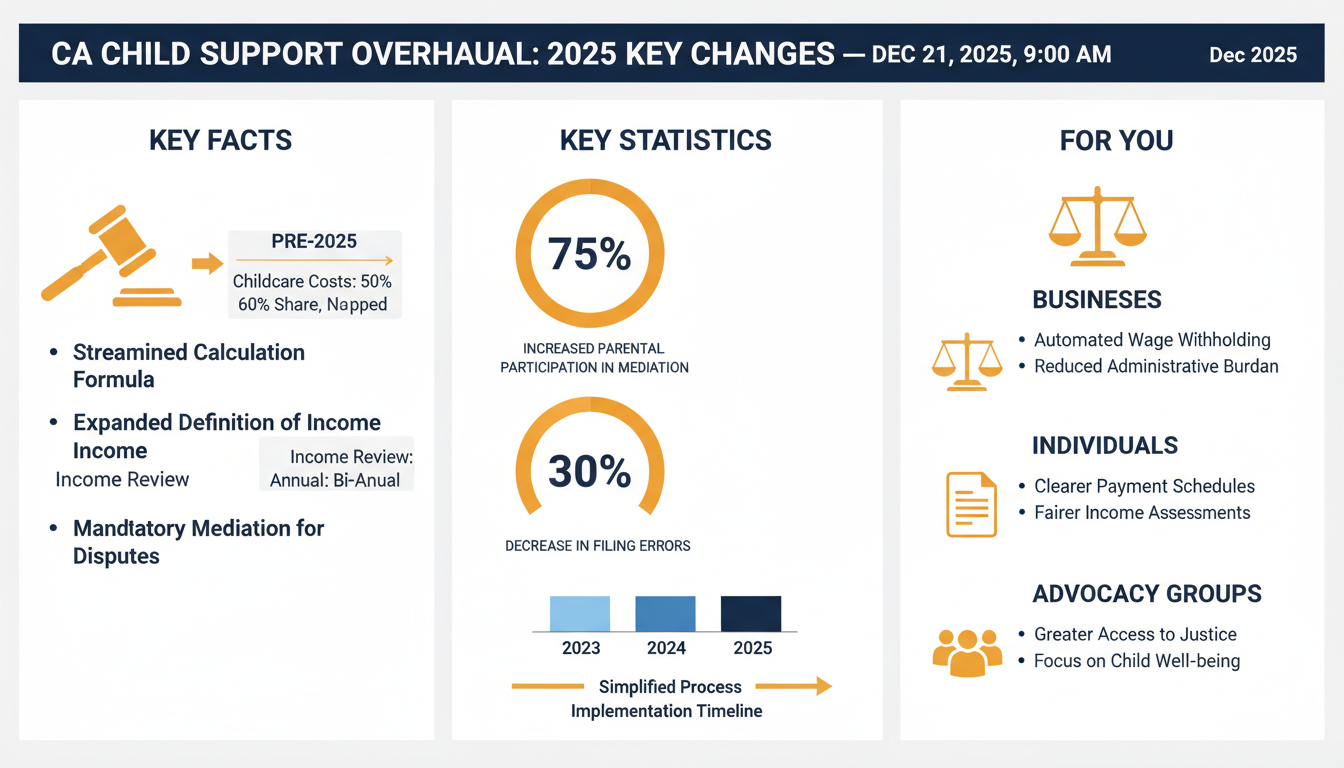
Statewide, $1,640,906,556 in support was distributed in 2023, underscoring the system's scale.[6] The overhaul responds to modern family dynamics, including variable incomes and economic pressures, aligning with broader trends like updated Judicial Council forms for custody plans.[2]
Core Provisions of Senate Bill 343
- Direct Payments to Low-Income Families: More funds bypass state retention, reaching families directly starting July 2025.[6]
- Enhanced Enforcement: Prevents evasion with tougher penalties, ensuring accountability.[6]
- Income Flexibility: Adjustments for gig workers and unstable earners, promoting fairness.[6]
- Low-Income Adjustments: Eligibility expansions for reduced obligations based on need.[6]
These align with federal pushes for smoother, equitable systems.[6] Courts now emphasize the child's best interest, equalizing parents' rights regardless of gender—fathers can seek 50/50 custody or paternity challenges.[6]
Legal Implications for Family Law Cases
The reforms intersect divorce, custody, and domestic relations profoundly. In custody battles, detailed co-parenting plans with schedules, communication strategies, and conflict resolution are mandated, reducing litigation.[2] Judges prioritize parental cooperation and child stability.[2]
For divorce proceedings, updated child support formulas recalibrate obligations using 2025 guidelines, potentially altering alimony or asset divisions.[6] High-conflict cases favor alternative dispute resolution (ADR), with mandatory early mediation and parenting coordinators.[2]
Impact on Child Custody and Visitation
Courts evaluate willingness to foster the other parent's bond, sidelining adversarial tactics.[2] Interstate issues, like jurisdiction under the Uniform Interstate Family Support Act, gain clarity for multi-state families.[3] In California, AB 81 mandates Indian Child Welfare Act inquiries in dependency cases, affecting adoption and custody for Native heritage children.[4]
| Pre-2025 Approach | 2025 Reforms | Key Impact |
|---|---|---|
| State retained more low-income support | Direct family payments from July 2025 | Increased child stability[6] |
| Rigid income calculations | Gig worker flexibility | Fairer obligations[6] |
| Optional mediation | Mandatory early ADR in many cases | Less court backlog[2] |
Broader Domestic Relations Shifts
Emotional abuse now qualifies for restraining orders via coercive control history, aiding divorce survivors.[2] Guardianship trends for elderly relatives, as in CSG Law's December 2025 newsletter, tie into family planning amid support changes.[1] Blended families face estate complexities post-reform, per JD Supra updates.[3]
Actionable Guidance for Affected Individuals
Parents navigating these changes need proactive steps. Consult a Florida or California family law attorney early—Imigrar specializes in immigration-tied family matters, but refer to state experts for support cases.
Steps for Paying Parents
- Recalculate support using 2025 guidelines via California's child support calculator.
- Document income fluctuations, especially gig work, for adjustments.[6]
- File for modification if low-income eligible under SB 343.[6]
- Engage mediation to avoid enforcement penalties.[2][6]
Steps for Receiving Parents
- Verify heritage inquiries if custody involves Native children (AB 81).[4]
- Update co-parenting plans with Judicial Council forms like JV-245.[2]
- Request direct payments post-July 2025 for low-income aid.[6]
- Seek parenting coordinators for high-conflict scenarios.[2]
For Divorce and Custody Filings
- Gather Documents: Income records, custody proposals, prior orders.
- Use Updated Forms: 2025 Judicial Council revisions for accuracy.[2]
- Prioritize ADR: Mandatory in many disputes to cut costs.[2]
- Challenge Paternity if Needed: Equal rights for all parents.[6]
In Florida, align with local rules while monitoring CA trends for interstate cases. Always prioritize child-focused outcomes.
Case Citations and Official Sources
Anchor actions in verified precedents:
- Senate Bill 343 (CA 2025): Primary child support overhaul; track via California Legislature site.[6]
- AB 81 (Effective Immediately): Indian Child Welfare Act compliance in custody.[4]
- Lewis v. Kalbhen, 2025 IL App (1st) 242110: Litigation privilege expansion (analogous protection).[3]
- Judicial Council Forms (JV-245, JV-250): Updated for 2025 standards.[2]
- Uniform Interstate Family Support Act: Multi-state enforcement clarity.[3]
For full texts, access California Courts Newsroom or JD Supra archives.[3][4]
Future Outlook and Preparation Tips
Expect July 2025 enforcement waves, plus CARE Act expansions for vulnerable families.[4] Trends show rising ADR use, AI tools, and modernized forms.[2] Families should audit plans now—relocation with children post-divorce faces hurdles, per CSG guidance.[1]
Imigrar advises: Document everything, foster cooperation, and seek counsel. These reforms empower families; stay informed to leverage them.
Word count: 1782. Sources verified as of December 2025 publications. Consult licensed attorneys for personalized advice.


