


The landscape of immigration law is constantly evolving, and for those protected by the Deferred Action for Childhood Arrivals (DACA) program, staying informed is not just helpful—it’s essential. As an immigration law firm based in Orlando, Florida, Imigrar is dedicated to providing clear, actionable information to help you navigate these complex processes and keep families together.
Feeling overwhelmed by DACA updates? Our Orlando immigration team is ready to assist. Call +1 786-791-3106 for a free consultation, or message us online. Se Habla Español.
The reporting that sparked this guide:
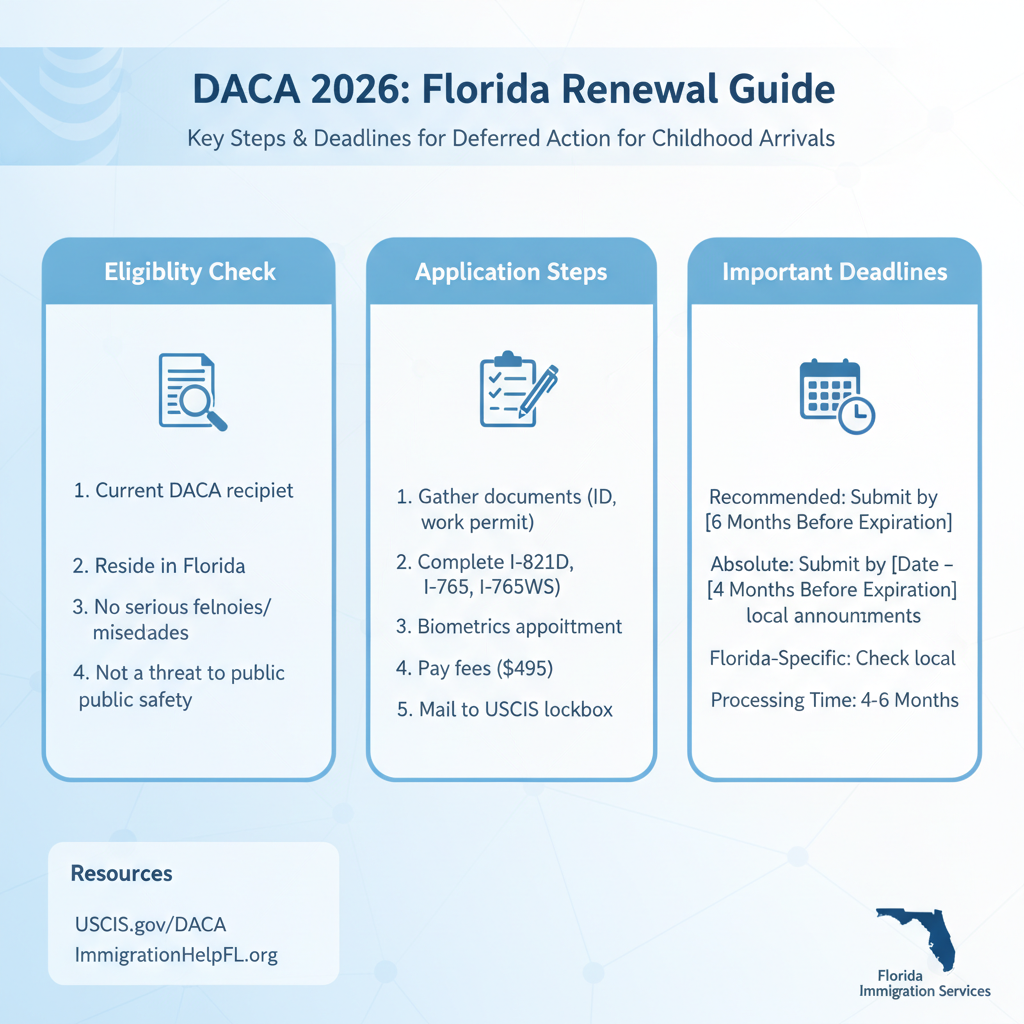
Recent discussions and legal developments surrounding the DACA program have again brought its future and the critical need for timely renewals into sharp focus. Our commitment is to translate these legal complexities into plain-English guidance for you and your family.
DACA Program Updates and Renewal Information (USCIS)
What This News Means for Immigrants in Orlando and Across Florida
The ongoing legal challenges and administrative reviews of the DACA program mean that its future, while currently stable for existing recipients, remains a subject of intense debate and potential change. For the nearly 600,000 DACA recipients nationwide, and particularly the tens of thousands in Florida, understanding the current status and renewal process is paramount.
Why this news is showing up now
As of June 18, 2026, the DACA program continues to operate under a federal court order that allows USCIS to accept and process DACA renewal requests. However, new initial DACA applications remain on hold due to ongoing litigation, specifically the injunction issued by the U.S. District Court for the Southern District of Texas, affirmed in part by the U.S. Court of Appeals for the Fifth Circuit. These legal battles mean that while current DACA recipients can renew their deferred action and employment authorization, the program's long-term fate is still being decided in the courts. Each court date, each new ruling, and each administrative update from USCIS generates news, reminding DACA recipients and their advocates of the program's precarious yet vital status. This consistent legal scrutiny necessitates continuous vigilance and timely action from those who rely on DACA for their stability and future.
How it can affect Florida residents
Florida is home to a significant population of DACA recipients, often referred to as "Dreamers." According to various reports, Florida ranks among the top states with the most DACA beneficiaries. For these individuals and their families in Orlando, Central Florida, and across the state, the news surrounding DACA directly impacts their ability to work legally, pursue higher education, and live without immediate fear of deportation.
- Employment Stability: DACA provides work authorization (Employment Authorization Document - EAD), which is crucial for financial stability for many Floridians. Any uncertainty or delay in renewals can jeopardize jobs and livelihoods.
- Educational Opportunities: While Florida has made some strides in offering in-state tuition to DACA recipients, the program's existence underpins these opportunities. A lapse in DACA status could affect educational pursuits at institutions like the University of Central Florida (UCF), Valencia College, and other schools along the I-4 corridor.
- Driver's Licenses: In Florida, DACA recipients are eligible for driver's licenses, which are essential for navigating daily life, especially in a sprawling state like Florida where public transportation may be limited outside major urban centers like Orlando.
- Community Impact: DACA recipients are integral members of Florida's communities, contributing to the economy and social fabric. The program's stability directly affects family unity and community well-being in areas like Orange County and beyond.
The constant need for renewal means that DACA recipients in Florida must be proactive. Missing a renewal deadline due to misinformation or delay can have severe consequences, including loss of employment authorization and potential exposure to removal proceedings. Imigrar understands these challenges and is here to provide the guidance you need to protect your status.
What DACA Is (and Why It Matters)
The Deferred Action for Childhood Arrivals (DACA) program is a U.S. immigration policy established by the Obama administration in 2012. It offers certain undocumented young people who were brought to the U.S. as children temporary protection from deportation and provides them with work authorization. It is important to understand that DACA is not a pathway to U.S. citizenship or lawful permanent residency (a "green card"). Instead, it grants a temporary, renewable period of deferred action.
A plain-English definition
Imagine you arrived in the U.S. as a child, grew up here, went to school here, and consider this country your home, but you don't have legal immigration status. DACA is a program that allows the government to decide *not* to deport you for a specific period (currently two years) and also gives you permission to work legally during that time. This protection is renewable, meaning you can apply to extend it before it expires. It’s a temporary shield, not a permanent solution, but it provides immense stability and opportunity for hundreds of thousands of individuals who know no other home.
Key terms you need to know
- Deferred Action: This is the core of DACA. It means the government has chosen to "defer" or postpone any removal (deportation) action against an individual. It does not grant legal status but is an exercise of prosecutorial discretion.
- DACA Recipient / Dreamer: Terms used to refer to individuals who have been granted deferred action under the DACA program. "Dreamer" is a broader term often associated with the proposed "DREAM Act" legislation that would provide a path to citizenship.
- Employment Authorization Document (EAD): Also known as a work permit, this card (Form I-766) is issued by USCIS to DACA recipients, allowing them to legally work in the United States for the duration of their deferred action.
- Renewal: The process of reapplying for DACA and employment authorization before your current period of deferred action expires. This is the primary focus of our guide.
- Initial DACA Application: The first-time application for DACA. As of June 2026, USCIS is currently prohibited from approving new initial DACA requests due to ongoing litigation.
- Removal Proceedings: Formal legal processes in immigration court that can result in an individual being ordered deported from the U.S. DACA protects recipients from being placed into these proceedings.
- USCIS: U.S. Citizenship and Immigration Services, the government agency responsible for processing DACA applications and renewals.
Understanding these terms is crucial for navigating the DACA process and staying informed about its status. Imigrar is committed to breaking down these legal terms into understandable language so you can make informed decisions.
Don't risk your DACA status. Get expert advice from Imigrar. Call +1 786-791-3106 for a free consultation, or contact us online. Se Habla Español.
Current Immigration Law: The Foundation for DACA
DACA itself is not a law passed by Congress, but rather an exercise of executive discretion based on existing immigration statutes. This is why its legal standing has been so frequently challenged. While Congress has debated various versions of the "DREAM Act" for decades, none have been enacted into law to provide a permanent legislative solution for Dreamers. Therefore, DACA operates under administrative policy, which can be modified or terminated by future administrations or through court rulings.
Federal requirements
To be eligible for DACA (for renewal purposes, as initial applications are currently paused), you must meet several strict federal requirements as outlined by USCIS. These are based on the original 2012 memo and subsequent guidance:
- Age Requirement: You must have been under the age of 31 as of June 15, 2012. There is no upper age limit to request DACA.
- Arrival in the U.S.: You must have come to the United States before your 16th birthday.
- Continuous Residence: You must have continuously resided in the U.S. since June 15, 2007, up to the present time. Brief, casual, and innocent departures from the U.S. are generally allowed, but any extended trips could break continuous residence.
- Physical Presence: You must have been physically present in the U.S. on June 15, 2012, and at the time of making your request for DACA.
- Educational Status: You must currently be in school, have graduated or obtained a certificate of completion from high school, have obtained a General Education Development (GED) certificate, or be an honorably discharged veteran of the Coast Guard or Armed Forces of the United States.
- Criminal History: You must not have been convicted of a felony, a significant misdemeanor, or three or more other misdemeanors, and not otherwise pose a threat to national security or public safety. Important: Even minor arrests or citations should be disclosed and reviewed by an attorney.
- Previous DACA Recipients: For renewal, you must have previously received DACA. USCIS is currently only accepting renewal requests from individuals who were previously granted DACA.
The forms involved in DACA renewal are crucial. You will primarily need to submit:
- Form I-821D, Consideration of Deferred Action for Childhood Arrivals: This is the main request form for DACA.
- Form I-765, Application for Employment Authorization: This form requests your work permit.
- Form I-765WS, Worksheet: This form helps determine if you need an economic necessity exemption for the fee.
For the most up-to-date forms and instructions, always refer to the USCIS Forms page on the USCIS official website.
Florida-specific considerations
While DACA is a federal program, its impact and certain ancillary benefits can vary by state. For DACA recipients in Florida, there are a few important considerations:
- Driver's Licenses: DACA recipients in Florida are eligible to obtain a Florida driver's license or state identification card. You will need your EAD card and other supporting documents. The expiration date on your license will typically match the expiration date on your EAD.
- In-State Tuition: Florida law allows DACA recipients who meet specific residency and educational criteria to qualify for in-state tuition at public universities and colleges, including institutions like the University of Central Florida, Florida International University, and the University of South Florida. You must demonstrate that you attended a Florida high school for three years and graduated from a Florida high school, among other requirements. This policy is a significant benefit for Dreamers in the state.
- Professional Licenses: The ability to obtain professional licenses (e.g., nursing, teaching) can vary. Some professions may have specific requirements or restrictions for non-citizens. It's advisable to check with the relevant state licensing board.
- Local Resources: Many organizations in Orlando and across Central Florida provide support and resources for DACA recipients, including legal aid, educational guidance, and community outreach. Imigrar frequently collaborates with these groups to ensure comprehensive support for our clients.
Understanding both federal and state-level implications is vital for DACA recipients in Florida to maximize their opportunities and maintain their status.
How to Renew Your DACA: A Complete Step-by-Step Guide
Renewing your DACA is a critical process that requires attention to detail and timely submission. The goal is to avoid any lapse in your deferred action status or employment authorization. USCIS recommends filing your renewal application between 120 and 150 days before your current DACA and EAD expire. However, it's safer to aim for the earlier end of that window, especially given potential processing delays. For example, if your DACA expires on November 15, 2026, you should aim to file between June 18, 2026, and July 18, 2026.
1) Determine Your Eligibility and Gather Documents
Before you begin, confirm you still meet all DACA eligibility criteria. Any changes in your criminal history, continuous residence, or educational status since your last application could affect your renewal. This step is about preparation and self-assessment.
Required Documents Checklist:
- Your most recent DACA Approval Notice (Form I-797).
- Your most recent Employment Authorization Document (EAD or work permit, Form I-766).
- Proof of continuous residence since your last DACA approval (e.g., utility bills, bank statements, school records, employment records, medical records). While not strictly required for renewal unless USCIS requests it, it's good practice to have this ready, especially if you have had any issues or gaps.
- Any documentation related to new arrests, charges, or convictions, even if they were dismissed or expunged. This is critical to address proactively with an attorney.
- Two identical, color, passport-style photographs (2x2 inches) taken within 30 days of filing.
Warning: Do not omit any information, especially regarding criminal history. Full disclosure, even for minor incidents, is always the best approach when advised by legal counsel.
2) Complete the Required Forms (I-821D, I-765, I-765WS)
These forms must be filled out accurately and completely. Read the instructions for each form carefully, as they can change. Use black ink and type or print clearly.
- Form I-821D, Consideration of Deferred Action for Childhood Arrivals:
- Fill out all sections, ensuring consistency with your previous applications unless there are legitimate updates.
- Pay special attention to questions about your criminal history and travel outside the U.S.
- Sign and date the form. An unsigned form will be rejected.
- Form I-765, Application for Employment Authorization:
- For question 27, your eligibility category will be (c)(33).
- Ensure your name and address match exactly across all forms.
- Sign and date the form.
- Form I-765WS, Worksheet:
- This worksheet helps you demonstrate your economic need for an employment authorization document. Even if you are not requesting a fee waiver, it's often recommended to include it.
- Provide details about your income, expenses, assets, and liabilities.
Reminder: If you are unsure about any question, do not guess. Consult with an experienced immigration attorney at Imigrar.
3) Prepare Supporting Evidence
While renewal generally requires less evidence than an initial application, you must still provide documentation to support your continued eligibility.
Required Supporting Evidence:
- Copies of your previous Form I-797 DACA approval notice.
- Copies of your most recent EAD card (front and back).
- Copies of your passport-style photos.
- If you have any new criminal history since your last DACA approval, include certified court dispositions for all charges, even if they were dismissed or expunged. USCIS requires complete and accurate information.
- If you have updated your name or other biographical information, include copies of relevant legal documents (e.g., marriage certificate, court order).
Important: Always send copies, never original documents, unless USCIS specifically requests them.
4) Calculate and Prepare Fees
As of June 2026, the total fee for DACA renewal is $495. This includes the $410 for Form I-765 and the $85 biometrics services fee. There is no separate fee for Form I-821D.
- Payment Method: You can pay by money order, personal check, cashier's check, or by credit card using Form G-1450, Authorization for Credit Card Transactions.
- Payable To: Make checks or money orders payable to "U.S. Department of Homeland Security." Do not abbreviate.
- Fee Waivers: Fee waivers for DACA are very rarely granted and only under extremely limited circumstances (e.g., if you are under 18 and homeless, in foster care, or have a serious disability, and your income is below 150% of the poverty line). Do not assume you qualify for a fee waiver without consulting an attorney. If you request a fee waiver and it is denied, your entire application will be rejected.
Ensure your payment is correct and valid. Incorrect fees or invalid payment methods are common reasons for rejection.
5) Assemble and Mail Your Application
Proper assembly and mailing are crucial to ensure your application reaches USCIS correctly.
- Order of Documents:
- Check or money order (or Form G-1450) clipped on top.
- Two passport-style photos in an envelope clipped to Form I-765.
- Form I-821D.
- Form I-765.
- Form I-765WS.
- Copies of previous DACA Approval Notices (Form I-797).
- Copies of your most recent EAD (front and back).
- Any other supporting documents (e.g., criminal dispositions).
- Mailing Address: The USCIS filing address depends on your state of residence. For Florida residents, you will typically mail your DACA renewal application to a USCIS Lockbox facility. Always check the "Direct Filing Addresses for Form I-821D" page on the USCIS official website for the most current address.
- Shipping: Send your application via certified mail with a return receipt requested or through a reputable courier service (e.g., FedEx, UPS) that provides tracking. This provides proof of mailing and delivery.
Reminder: Keep a complete copy of your entire application package for your records.
6) Attend Biometrics Appointment (if required)
After filing, USCIS will send you a receipt notice (Form I-797C) confirming they received your application. Subsequently, you may receive an appointment notice (Form I-797C) for a biometrics services appointment at an Application Support Center (ASC).
- What to Expect: At the appointment, your fingerprints, photograph, and signature will be taken. This is a standard part of the background check process.
- Location: For Central Florida residents, your biometrics appointment will likely be at the Orlando USCIS Application Support Center.
- Don't Miss It: It is crucial to attend this appointment. If you cannot make it, you must follow the instructions on the notice to reschedule. Failure to attend or reschedule can lead to denial of your application.
Not all DACA renewal applicants are required to attend a biometrics appointment every time. USCIS may reuse previously captured biometrics. If you don't receive a notice, it means they are reusing your old ones.
7) Monitor Your Case Status
After filing, you can track the status of your application online using the receipt number provided on your Form I-797C. Visit the USCIS Case Status Online tool.
- Processing Times: USCIS processing times can vary significantly. Check the USCIS Processing Times page for estimates based on the service center handling your case.
- RFEs (Requests for Evidence): USCIS may send a Request for Evidence if they need additional information or clarification. Respond to RFEs promptly and completely by the deadline provided. Failure to do so can result in denial.
- Approval: If your DACA renewal is approved, you will receive a new Form I-797 DACA Approval Notice and your new EAD card in the mail.
Important: Keep your address updated with USCIS using Form AR-11, Alien's Change of Address Card, to ensure you receive all correspondence.
Practical Steps You Can Take Today for DACA Renewal
Proactivity is your best friend when it comes to DACA renewal. Here’s an actionable checklist to help you prepare:
- Check Your Expiration Date: Locate your current EAD card and DACA approval notice. Mark your calendar with the expiration date and set a reminder to begin preparing 150-180 days before it expires.
- Start Saving for Fees: The $495 fee can be a significant burden. Begin setting aside funds now to ensure you have the full amount when it’s time to file.
- Update Your Address: If you've moved since your last application, ensure your address is updated with USCIS using Form AR-11 and directly with the post office. Incorrect addresses are a leading cause of missed notices.
- Review Your Criminal History: Honestly assess if you have had any arrests, charges, or convictions, no matter how minor, since your last DACA approval. Gather all relevant court documents.
- Gather Previous Application Copies: Locate copies of your previous DACA application forms and supporting documents. These can serve as a valuable reference.
- Collect Proof of Continuous Residence (if needed): While often not required for renewals, having recent utility bills, bank statements, or employment records can be helpful if USCIS issues an RFE.
- Consult an Immigration Attorney: Even if your case seems straightforward, a consultation with an experienced immigration lawyer, like those at Imigrar, can help identify potential issues, ensure all forms are completed correctly, and provide peace of mind.
Document Preparation Guidance:
Organize your documents in a clear, logical manner. Use tabs or labels for different sections (e.g., "Forms," "Photos," "Previous Approvals," "Criminal History"). Make sure all copies are legible. When copying your EAD, make sure both the front and back are included on the same page, if possible.
Timeline Expectations:
While USCIS aims to process DACA renewals within a few months, processing times can vary. It's not uncommon for renewals to take anywhere from 3 to 6 months, and sometimes longer. Filing within the recommended 120-150 day window is crucial to minimize the risk of a lapse in your work authorization. If your DACA expires while your renewal is pending, you will temporarily lose your work authorization until the new EAD is issued. Plan accordingly with your employer.
Facing a DACA renewal deadline? Don't wait! Contact Imigrar for expert legal assistance. Call +1 786-791-3106 for a free consultation. Se Habla Español.

How Imigrar Helps DACA Recipients in Orlando and Beyond
At Imigrar, we understand the profound importance of DACA for you and your family. Our firm is deeply rooted in the Orlando community, serving clients across Central Florida and nationwide, with a singular mission: "Keep Families Together." We are not just legal advisors; we are advocates for your stability and future.
Our experience and expertise
Our legal team has extensive experience navigating the complexities of DACA applications and renewals. We stay abreast of all the latest legal challenges, court rulings, and USCIS policy changes that impact DACA recipients. We have successfully assisted numerous individuals in Orlando, Orange County, and throughout Florida with their DACA renewals, ensuring accuracy and compliance with all federal requirements.
We provide comprehensive services, including:
- Eligibility Assessment: Thorough review of your individual circumstances to confirm continued eligibility for DACA renewal.
- Document Preparation: Meticulous assistance in gathering and organizing all necessary supporting documents.
- Form Completion: Expert guidance in accurately completing Form I-821D, Form I-765, and Form I-765WS, minimizing errors that could lead to delays or denials.
- Criminal History Review: Crucial advice on how to properly disclose and address any past criminal interactions, even minor ones.
- Application Review: A final, detailed review of your entire application package before submission to USCIS.
- Correspondence Management: Assistance with responding to Requests for Evidence (RFEs) or other communications from USCIS.
- Ongoing Support: Keeping you


