


The reporting that sparked this guide: DACA Program Updates and Renewal Information (USCIS)
What This News Means for Immigrants in Orlando and Across Florida
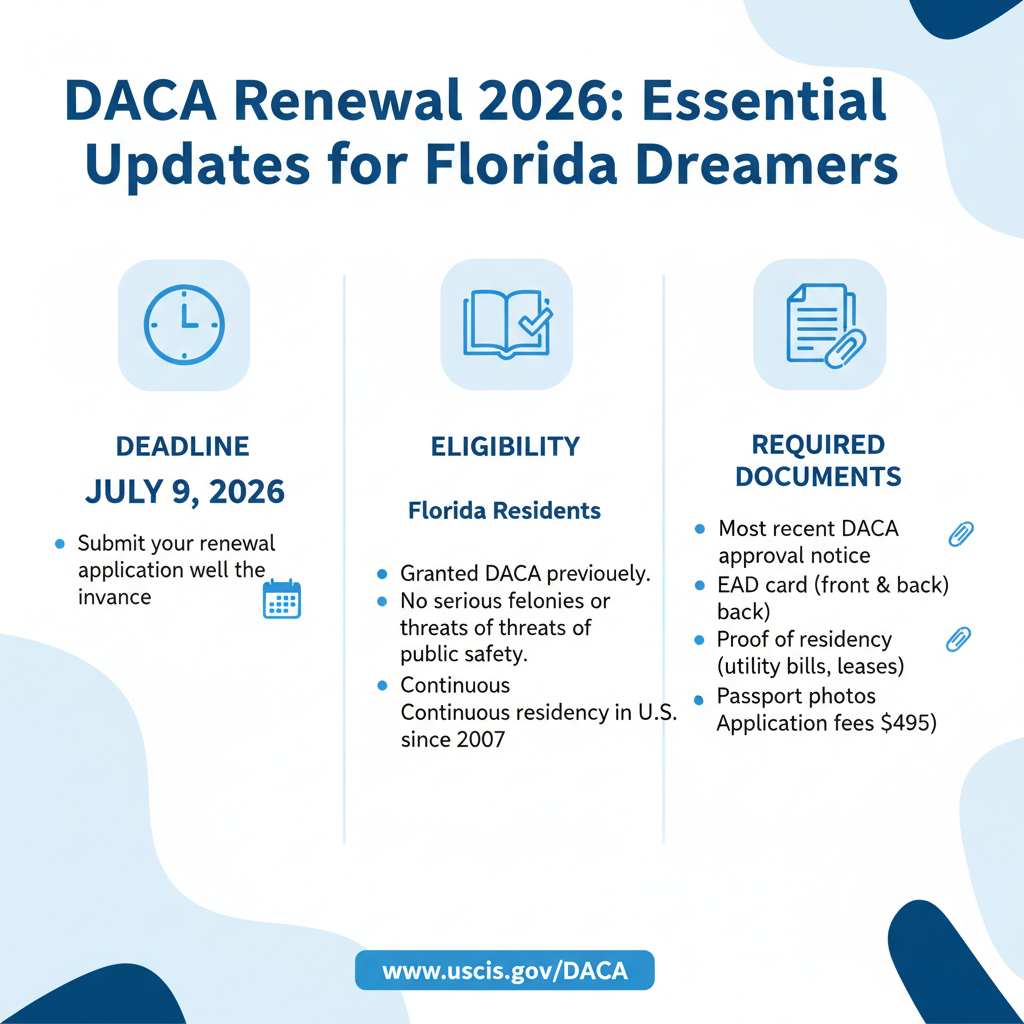
For hundreds of thousands of young immigrants across the United States, and particularly for the vibrant DACA community in Florida, news regarding the Deferred Action for Childhood Arrivals (DACA) program is always met with a mix of hope and apprehension. As of May 19, 2026, the DACA program continues to operate under a cloud of legal uncertainty, yet the ability to renew remains a critical lifeline for current recipients. This latest news from USCIS underscores the ongoing administrative processes and the imperative for eligible individuals to understand their rights and responsibilities to maintain their deferred action status.
Why this news is showing up now
The DACA program, created in 2012, has been a subject of intense legal and political debate for years. Its very existence has been challenged in federal courts, leading to injunctions, appeals, and a complex web of rulings that dictate its current operational status. The latest updates from USCIS, often highlighted in immigration news feeds, typically reflect the agency's response to these legal developments, adjustments in policy, or simply reminders about the ongoing renewal process for existing DACA recipients. While new DACA applications have largely been halted due to court orders, the Department of Homeland Security (DHS) is generally permitted to process DACA renewal applications. This means that USCIS regularly communicates information about eligibility, filing procedures, and any changes to forms or processing. For instance, recent news might focus on the impact of specific court decisions on the future of the program, or practical guidance on how to navigate the renewal process amidst the legal landscape. The continuous legal battles, such as the ongoing litigation in the Fifth Circuit Court of Appeals, keep DACA in the news cycle, prompting USCIS to issue clarifications and instructions for the DACA population.
How it can affect Florida residents
Florida is home to one of the largest populations of DACA recipients in the nation, with thousands of individuals living, working, and studying across the state, from Miami to Jacksonville, and especially here in Central Florida, including Orlando. For these individuals, DACA offers protection from deportation and the ability to legally work in the U.S. through an Employment Authorization Document (EAD). Any news regarding DACA directly impacts their lives and futures. For Florida residents, specific considerations include:
- Economic Stability: DACA recipients contribute significantly to Florida's economy. Maintaining their work authorization through renewal is crucial for their financial well-being and their ability to support their families.
- Educational Opportunities: Many DACA recipients in Florida rely on their status to pursue higher education, with some qualifying for in-state tuition under specific state policies. Continued DACA status is vital for them to complete their studies and build careers.
- Community Impact: DACA recipients are deeply embedded in Florida's communities. Updates that affect their status can create anxiety and uncertainty not just for them, but for their families, employers, and schools.
- Legal Complexities: Florida's DACA recipients must navigate not only federal immigration law but also state-specific policies that may interact with their DACA status, such as driver's license eligibility or professional licensing.
- Geographic Proximity to USCIS Resources: For those in Orlando and the wider Central Florida area, understanding the location and services of the Orlando USCIS Field Office can be important for biometrics appointments or interviews, although most DACA applications are processed by mail at specific lockbox facilities.
The bottom line for Florida’s DACA community is this: vigilance and proactive action are key. Regardless of the broader legal challenges, eligible individuals must continue to renew their DACA status and work authorization diligently to maintain their protections. Imigrar understands these unique challenges and is committed to helping Florida's Dreamers navigate this complex landscape.
Need Help? Our Orlando immigration team is ready to assist. Call +1 786-791-3106 for a free consultation, or message us online. Se Habla Español.
What DACA Is (and Why It Matters)
The Deferred Action for Childhood Arrivals (DACA) program is a critical U.S. immigration policy that has provided a temporary reprieve for hundreds of thousands of young undocumented immigrants who were brought to the United States as children. Understanding DACA, its purpose, and its limitations is crucial for anyone impacted by it.
A plain-English definition
At its core, Deferred Action for Childhood Arrivals (DACA) is an exercise of prosecutorial discretion by the U.S. government. This means that instead of actively pursuing deportation, the government defers, or delays, any removal action against eligible individuals for a specific period, typically two years. This deferral is renewable. Importantly, DACA is not a pathway to citizenship, nor does it grant lawful permanent resident status (a green card). It is a temporary protection measure. In addition to protection from deportation, DACA recipients are eligible to apply for an Employment Authorization Document (EAD), which allows them to legally work in the United States and, in many states, obtain a driver's license.
The program was established by the Obama administration in 2012 after the failure of the DREAM Act to pass Congress. It was intended to allow young people who met specific criteria – often referred to as "Dreamers" – to live and work in the U.S. without fear of immediate deportation. While it provides significant benefits, its temporary nature and reliance on executive action rather than legislative statute have made it vulnerable to legal challenges and political shifts.
Key terms you need to know
Navigating the DACA landscape requires understanding specific terminology:
- Deferred Action: This is the core benefit of DACA. It's a discretionary determination by USCIS to defer removal proceedings against an individual for a specific period. It does not confer any legal immigration status but provides temporary protection.
- DACA Recipient (or "Dreamer"): An individual who has been granted Deferred Action for Childhood Arrivals.
- Employment Authorization Document (EAD): Also known as a work permit, this card is issued by USCIS to individuals authorized to work in the U.S., including DACA recipients. It is typically valid for two years, coinciding with the DACA grant.
- USCIS (U.S. Citizenship and Immigration Services): The government agency responsible for overseeing lawful immigration to the United States. They process DACA applications and renewals.
- Initial DACA Application: An application from someone who has never been granted DACA before. Important: Due to federal court injunctions, USCIS is currently prohibited from granting initial DACA requests. Only renewal applications are being processed.
- DACA Renewal: An application by a current or previous DACA recipient to extend their deferred action and work authorization for another two years.
- Continuous Residence: A key eligibility requirement for DACA, meaning the applicant has resided continuously in the U.S. for a specified period (e.g., since June 15, 2007, for DACA). Brief, casual, and innocent absences are generally permitted, but longer or unauthorized absences can break continuity.
- Significant Misdemeanor/Felony: DACA eligibility requires applicants not to have been convicted of certain criminal offenses. Understanding what constitutes a "significant misdemeanor" or a "felony" is critical, as these can lead to denial.
- Advance Parole: A document allowing a DACA recipient to travel outside the U.S. and return legally. This is granted on a case-by-case basis for humanitarian, educational, or employment purposes. Warning: Traveling without advance parole can lead to serious immigration consequences, including being barred from re-entry and DACA termination.
Understanding these terms is fundamental to comprehending the DACA program and its implications for you or your loved one. Imigrar is dedicated to demystifying these complexities for the Orlando and Florida immigrant community.
Current Immigration Law: The Foundation for DACA
Unlike most immigration benefits, DACA was not established by an act of Congress. Instead, it was implemented through an executive memorandum by the Secretary of Homeland Security. This origin is central to understanding its ongoing legal fragility. While it is not codified in federal statute, its operation relies on the existing framework of immigration law and the discretionary authority granted to the executive branch.
The legal basis for DACA stems from the Department of Homeland Security's (DHS) inherent authority to exercise prosecutorial discretion in immigration enforcement. This authority allows the agency to decide whom to prioritize for removal and whom to grant temporary relief. However, this discretionary power has been the subject of numerous legal challenges, primarily arguing that DACA exceeds the executive branch's authority and encroaches on Congress's legislative power over immigration.
Federal requirements
As of May 19, 2026, while initial DACA applications are not being accepted, individuals who previously received DACA may apply for renewal. The federal requirements for DACA renewal, as outlined by USCIS, are stringent and must be met precisely. To be eligible for a DACA renewal, you generally must:
- Have previously been granted DACA.
- Not have departed the United States on or after August 15, 2012, without first obtaining advance parole.
- Have continuously resided in the United States since the date you submitted your most recent DACA request that was approved.
- Not have been convicted of a felony, a significant misdemeanor, or three or more other misdemeanors, and not otherwise pose a threat to national security or public safety.
These requirements are strictly enforced by USCIS. Any deviation or misrepresentation can lead to denial. It's crucial to be aware that the legal landscape surrounding DACA can change rapidly due to ongoing litigation. Always refer to the USCIS DACA website for the most current information.
Florida-specific considerations
While DACA is a federal program, its effects ripple through state and local communities. For DACA recipients in Florida, there are specific state-level considerations:
- Driver's Licenses: In Florida, DACA recipients with a valid Employment Authorization Document (EAD) are generally eligible to apply for a Florida driver's license or identification card. This is a significant practical benefit for daily life, work, and transportation across the I-4 corridor and beyond.
- In-State Tuition: Under specific Florida statutes, certain undocumented students, including some DACA recipients, may be eligible for in-state tuition rates at public colleges and universities if they meet specific residency and high school attendance requirements. This can significantly reduce the cost of higher education for eligible individuals in Orlando, Gainesville, Tallahassee, and other university towns.
- Professional Licensing: The ability of DACA recipients to obtain professional licenses (e.g., for nursing, teaching, engineering) varies by profession and state. Florida has specific requirements, and DACA status with an EAD is often a prerequisite for certain licenses.
- Local Enforcement: While DACA provides federal protection from deportation, interaction with local law enforcement in Orange County or other Florida jurisdictions can still occur. It is vital for DACA recipients to understand their rights and responsibilities in such encounters.
The forms typically associated with DACA are:
- Form I-821D, Consideration of Deferred Action for Childhood Arrivals
- Form I-765, Application for Employment Authorization
- Form I-765 Worksheet, Instructions for Form I-765, Part 2, Question 27
You can find these and other related forms on the USCIS Forms page. Always download the latest version of the forms directly from the USCIS website to ensure you are using the correct and most up-to-date editions.
How to Renew Your DACA: A Complete Step-by-Step Guide
Renewing your DACA status is a critical process that requires attention to detail and timely action. For DACA recipients in Orlando and across Florida, ensuring your renewal application is complete and accurate is paramount to maintaining your protection and work authorization.
1) Determine Your Eligibility and When to Apply
Before initiating the renewal process, confirm you meet all current eligibility requirements for DACA renewal. This includes continuous residence since your last DACA approval and no disqualifying criminal history. The most crucial aspect of renewal is timing. USCIS recommends filing your renewal application within 120 to 150 days before your current DACA and EAD expire. Filing too early (more than 150 days) can lead to rejection, and filing too late (less than 120 days) significantly increases the risk of your DACA and EAD expiring before a new one is approved, leaving you without protection and work authorization.
- Recommended Action: Mark your calendar with your DACA and EAD expiration dates. Set a reminder for the 150-day and 120-day marks.
- Practical Tip: Begin gathering documents and consulting with legal counsel at least 6 months before your expiration date.
2) Gather Required Documents and Information
Thorough documentation is key to a successful DACA renewal. While much of the information may be similar to your previous application, you must provide updated evidence. Gather the following:
- Copies of Your Previous DACA Approval Notices: Include your most recent Form I-797, Approval Notice for Form I-821D, and your EAD card.
- Proof of Continuous Residence: Provide evidence that you have maintained continuous residence in the U.S. since your last DACA approval. This includes documents from the past two years, such as:
- School records (transcripts, report cards)
- Employment records (pay stubs, W-2s, employment verification letters)
- Bank statements
- Utility bills (electricity, water, gas, internet)
- Rental agreements or mortgage statements
- Medical records
- Tax returns
- Any other dated documents showing your physical presence in the U.S.
- Proof of Identity: A copy of your birth certificate with translation, passport, or other government-issued identification.
- Passport-Style Photos: Two identical, unmounted, passport-style color photographs taken within 30 days of filing. Write your name and Alien Registration Number (A-Number) lightly on the back of each photo.
- Criminal History Records: If you have had any arrests, charges, or convictions (even if dismissed or expunged) since your last DACA approval, you must include certified court dispositions for each incident. This is extremely important and often a point of denial if not handled correctly.
Important: Keep original documents safe. Always submit copies unless USCIS specifically requests originals. If any documents are not in English, they must be accompanied by a complete English translation and a translator's certification.
Feeling overwhelmed by paperwork? Imigrar's Orlando team can help you organize and prepare your DACA renewal application. Contact us at +1 786-791-3106 for expert guidance. Se Habla Español.
3) Complete and Assemble Your Forms
You will need to complete three forms for your DACA renewal:
- Form I-821D, Consideration of Deferred Action for Childhood Arrivals: This is the main request for DACA. Fill it out completely and accurately. Do not leave any fields blank; if a question does not apply, write "N/A" (Not Applicable).
- Form I-765, Application for Employment Authorization: This form requests your work permit. For DACA renewals, under Part 2, Question 27, you should enter eligibility category (c)(33).
- Form I-765 Worksheet: This accompanies Form I-765 and provides additional information for Question 27.
Reminder: Always use the latest version of the forms available on the USCIS Forms page. Review all forms meticulously for errors or omissions. Sign and date all forms in blue ink.
4) Pay the Required Fees
As of May 19, 2026, the current filing fee for a DACA renewal application is $495. This fee covers both the Form I-821D (which has no fee itself) and the Form I-765 ($410), plus the biometrics services fee ($85). This fee must be paid by money order, personal check, cashier's check, or credit card using Form G-1450, Authorization for Credit Card Transactions. Make checks payable to "U.S. Department of Homeland Security." Do not send cash.
- Fee Waivers: Fee waivers are generally not available for DACA renewals, except in very limited circumstances involving extreme hardship. Consult with an attorney if you believe you might qualify for an exception.
5) Mail Your Application Package
Once all forms are completed, signed, and dated, all supporting documents are gathered, and the fee is prepared, assemble your application package. USCIS has specific lockbox facilities for DACA applications, which vary based on your mailing address. It is crucial to send your application to the correct lockbox. You can find the correct address on the USCIS Direct Filing Addresses for Form I-821D page.
- Sending Method: Always use a mailing service that provides tracking and delivery confirmation, such as USPS Certified Mail with a return receipt, FedEx, or UPS. This provides proof that you sent your application and that USCIS received it.
- Copies: Make a complete copy of your entire application package (all forms, documents, and payment proof) before mailing it. This copy is your record.
6) Attend Your Biometrics Appointment (If Required)
After USCIS receives your application, you will typically receive a receipt notice (Form I-797C, Notice of Action). Within a few weeks or months, you may receive an appointment notice for biometrics (fingerprints, photograph, and signature) at an Application Support Center (ASC). For Central Florida residents, this often means visiting the ASC in Orlando or a nearby city.
- What to Bring: Bring your appointment notice, a valid photo ID (like your current EAD or driver's license), and any other documents specified in the notice.
- Importance: Attending this appointment is mandatory. Failure to attend without rescheduling can lead to your application being considered abandoned and denied.
7) Monitor Your Case Status and Respond to RFEs
You can monitor the status of your DACA renewal application online using the receipt number provided on your Form I-797C. Visit the USCIS Case Status Online tool.
- RFEs (Requests for Evidence): USCIS may send you a Request for Evidence (RFE) if they need more information or documents to make a decision on your case. Respond to RFEs promptly and completely by the deadline specified in the notice. Failure to respond can result in denial.
- Interviews: While most DACA renewals do not require an interview, USCIS reserves the right to request one. If you receive an interview notice, it is highly recommended to seek legal counsel from an experienced immigration attorney.
- Processing Times: DACA renewal processing times vary. You can check current estimates on the USCIS Processing Times page.
Following these steps carefully will significantly increase the likelihood of a successful DACA renewal. Imigrar is here to guide you through each stage of this vital process.
Practical Steps You Can Take Today for DACA Renewal
Proactive planning is crucial for a smooth DACA renewal process. Don't wait until the last minute. Here's an actionable checklist to start today, especially for DACA recipients in Orlando and the surrounding Florida areas:
- 1. Mark Your Calendar: Note your DACA and EAD expiration dates. Set reminders for 150 days, 120 days, and 90 days before expiration. This is your critical filing window.
- 2. Create a Dedicated DACA Folder: Start a physical and/or digital folder for all DACA-related documents. This should include your previous applications, approval notices, EADs, and any new supporting documents.
- 3. Gather Continuous Residence Evidence: Begin collecting documents from the past two years that prove your continuous physical presence in the U.S. (e.g., utility bills, pay stubs, bank statements, school records). Organize them chronologically.
- 4. Review Your Criminal History: Honestly assess if you've had any encounters with law enforcement since your last DACA approval. If so, immediately obtain certified court dispositions for every incident, no matter how minor it seemed. This is non-negotiable.
- 5. Check Current USCIS Forms and Fees: Visit the USCIS Forms page to download the latest versions of Form I-821D, Form I-765, and the Form I-765 Worksheet. Confirm the current filing fee.
- 6. Update Your Address with USCIS: If you've moved since your last DACA approval, file Form AR-11, Alien's Change of Address Card, online or by mail with USCIS within 10 days of moving. This ensures you receive all critical notices.
- 7. Consult with an Immigration Attorney: Even if your case seems straightforward, a consultation with an experienced DACA attorney at Imigrar can help identify potential issues, ensure accuracy, and provide peace of mind.
Document preparation guidance
- Organization: Arrange all supporting documents in a logical order, corresponding to the forms. Use cover sheets to clearly label sections (e.g., "Proof of Continuous Residence," "Criminal History Dispositions").
- Copies: Submit clear, legible copies of all documents. Never send original birth certificates, passports, or EADs unless specifically requested by USCIS.
- Translations: Any document not in English must be accompanied by a full English translation and a certification from the translator stating they are competent to translate and that the translation is accurate.
- Notarization: Generally, DACA renewal documents do not need to be notarized unless specifically requested by USCIS.
Timeline expectations
- Filing Window: Aim to file between 120 and 150 days before your DACA and EAD expire.
- Receipt Notice: Expect to receive a Form I-797C receipt notice from USCIS within 2-4 weeks of mailing your application.
- Biometrics Appointment: If required, an appointment notice for biometrics typically arrives within 1-2 months after filing. The actual appointment is usually 3-6 weeks after the notice.
- Processing Time: Processing times for DACA renewals can vary significantly, from a few weeks to several months. Check the USCIS Processing Times page for the latest estimates.
- Decision: You will receive a notice of approval or denial. If approved, your new EAD card will arrive separately.
Warning: Be prepared for potential delays. USCIS processing times are estimates and can fluctuate. Filing early provides a buffer against these delays.
How Imigrar Helps DACA Recipients in Orlando and Beyond
At Imigrar, we understand the profound impact that DACA has on the lives of young immigrants and their families. Our firm is founded on the principle of "Keep Families Together," and we recognize that DACA is a vital tool for achieving that goal for many in our community. Based in Orlando, Florida, we serve clients nationwide, providing compassionate and expert legal guidance through the complexities of U.S. immigration law.
Our experience and expertise
Our team of dedicated immigration attorneys has extensive experience navigating the challenging and ever-evolving DACA landscape. We have assisted countless DACA recipients in Orlando, throughout Central Florida, and across the country with their renewal applications, ensuring accuracy and compliance with all USCIS requirements. We stay abreast of the latest court decisions and policy changes affecting DACA, allowing us to provide up-to-date and reliable advice.
We help clients with:


