


The landscape of immigration law is constantly shifting, and few programs embody this dynamic more than the Deferred Action for Childhood Arrivals (DACA). For hundreds of thousands of young people across the United States, including a significant population right here in Florida, DACA offers a vital lifeline – protection from deportation and the ability to work legally. As of 2026, the program continues to operate under significant legal scrutiny, making it more crucial than ever for recipients to stay informed about renewals and potential changes.
At Imigrar, an immigration law firm based in Orlando, Florida, we understand the anxieties and uncertainties that DACA recipients and their families face. Our mission, "Keep Families Together," drives us to provide clear, actionable guidance to help you navigate these complex waters. This comprehensive guide is designed to cut through the noise, offering you the most up-to-date information on DACA renewals, practical steps, and expert advice to protect your deferred action status.
The reporting that sparked this guide: DACA Program Updates and Renewal Information (USCIS)
What This News Means for Immigrants in Orlando and Across Florida
Why this news is showing up now
The Deferred Action for Childhood Arrivals (DACA) program remains a focal point in the national immigration debate, constantly subject to legal challenges and administrative reviews. As of March 30, 2026, DACA continues to exist in a state of legal limbo, primarily due to ongoing litigation. The most significant development stems from a July 2021 ruling by a federal judge in Texas, which declared the 2012 DACA memorandum unlawful. This ruling was largely upheld by the Fifth Circuit Court of Appeals in October 2022, which affirmed that the original DACA memorandum was not lawfully created. The courts subsequently remanded the case back to the district court for further review of the DACA final rule issued by the Biden administration in August 2022.
What this means in practical terms is that while USCIS is currently prohibited from approving new, initial DACA requests, it is permitted to continue accepting and processing DACA renewal requests. This distinction is critical. The news you're seeing from USCIS and other sources often revolves around updates regarding these legal battles, the consistent processing of renewals, and the agency's efforts to clarify its operational procedures under these court-imposed restrictions. Every few months, there are developments or court filings that reinforce the precarious nature of the program, making it a recurring topic in immigration news cycles.
For DACA recipients, this consistent flow of news underscores the ongoing need for vigilance, especially regarding renewal deadlines and potential changes in policy or legal outcomes. The program’s future is still debated in Congress and the courts, ensuring that DACA remains a trending and critical topic for immigrant communities nationwide.
How it can affect Florida residents
Florida is home to one of the largest populations of DACA recipients in the United States, with tens of thousands of individuals contributing to our economy and communities. For these individuals and their families, the legal uncertainties surrounding DACA have profound implications. The inability to file new DACA applications means that many young people who would otherwise be eligible are left without protection, facing the constant fear of deportation and limited opportunities for legal employment or education.
For current DACA recipients in Central Florida, particularly those in Orlando and surrounding areas like Orange County, the primary impact is the absolute necessity of timely renewals. Missing a renewal deadline could lead to a lapse in your deferred action status and employment authorization, which can have devastating consequences for your job, your ability to drive (Florida issues driver's licenses to DACA recipients), and your overall stability. The Orlando USCIS Field Office serves a vast area, and while most renewal applications are processed at USCIS service centers, local support and information are crucial.
Furthermore, the ongoing legal challenges create an environment of stress and anxiety. Families often live with the constant worry that a court ruling could suddenly terminate the program, impacting their loved ones' ability to work, study, and live without fear. Navigating these complexities requires accurate information and, often, experienced legal counsel. Imigrar, situated along the I-4 corridor in Orlando, is uniquely positioned to assist DACA recipients in Florida, offering guidance that is tailored to both federal requirements and local considerations.
Feeling Anxious About Your DACA Renewal? Don't face the uncertainty alone. Our Orlando immigration team at Imigrar specializes in DACA renewals and can help ensure your application is strong and timely. Call +1 786-791-3106 for a free consultation, or message us online. Se Habla Español.
What DACA Is (and Why It Matters)
A plain-English definition
DACA stands for Deferred Action for Childhood Arrivals. In plain language, it's an immigration policy that provides certain young undocumented immigrants with temporary protection from deportation (known as "deferred action") and grants them eligibility for a work permit (officially called an Employment Authorization Document, or EAD). DACA is not a pathway to a green card or U.S. citizenship, nor does it provide lawful immigration status. Instead, it offers a temporary, renewable two-year period during which eligible individuals are granted a reprieve from removal proceedings and can legally work in the United States. It was implemented in 2012 by the Department of Homeland Security (DHS) under the Obama administration to address the plight of young people, often referred to as "Dreamers," who were brought to the U.S. as children and have grown up here.
Key terms you need to know
- Deferred Action: This is a discretionary decision by the government to postpone deportation proceedings against an individual. It does not confer legal status but allows an individual to remain in the U.S. for a specified period.
- Employment Authorization Document (EAD): Also known as a work permit, this card allows DACA recipients to legally work in the U.S. for the duration of their deferred action period.
- Dreamers: A term commonly used to refer to young undocumented immigrants who were brought to the U.S. as children, often associated with the proposed "DREAM Act" legislation.
- Initial DACA: Refers to the first time an individual applies for DACA. As of March 30, 2026, USCIS is generally not accepting or processing new initial DACA applications due to court orders.
- DACA Renewal: Refers to the process of reapplying for deferred action and work authorization before the current DACA period expires. This is the primary focus for current DACA recipients.
- Injunction: A court order that requires or forbids a party from performing a specific act. In the context of DACA, injunctions have largely prevented USCIS from processing initial applications.
- Circuit Court: A federal appellate court that hears appeals from the district courts within its geographical circuit. The Fifth Circuit Court of Appeals has played a significant role in DACA litigation.
- USCIS: U.S. Citizenship and Immigration Services, the federal agency responsible for administering immigration and naturalization benefits.
- DHS: Department of Homeland Security, the federal department that oversees USCIS and other immigration enforcement agencies.
Understanding these terms is crucial for anyone navigating the DACA program, especially given its constantly evolving legal status. While the program’s future remains uncertain, its significance for those who rely on it for stability and opportunity cannot be overstated.
Current Immigration Law: The Foundation for DACA
It's important to clarify that DACA itself is not a statute passed by Congress, but rather an exercise of prosecutorial discretion by the executive branch, specifically the Department of Homeland Security (DHS). It was established through a memorandum issued by then-Secretary of Homeland Security Janet Napolitano on June 15, 2012. This memorandum outlined the criteria for deferred action, drawing on the inherent authority of the executive branch to set enforcement priorities and grant deferred action on a case-by-case basis. The legal challenges to DACA have largely focused on whether DHS had the authority to implement such a broad policy without congressional approval and whether the procedures for its implementation were lawful.
As of March 30, 2026, the program operates under a final rule published by DHS in August 2022, which codified the DACA policy into federal regulations. However, this rule is also subject to ongoing litigation. The Fifth Circuit Court of Appeals affirmed a lower court's finding that the original 2012 DACA memorandum was unlawful. While the court sent the case back to the district court to review the 2022 DACA final rule, the existing injunction from the district court remains in effect. This injunction prevents USCIS from granting initial DACA requests, but allows the agency to continue processing and approving DACA renewal requests, as well as associated applications for employment authorization and advance parole.
Federal requirements for DACA Renewal
To be eligible for DACA renewal, you must meet the following criteria, which are largely consistent with the original DACA requirements, with updates reflecting the current legal landscape:
- You must have previously received DACA.
- You must not have departed the United States on or after August 15, 2012, without advanced parole.
- You must have continuously resided in the United States since you submitted your most recent DACA request that was approved.
- You must not have been convicted of a felony, a significant misdemeanor, or three or more other misdemeanors, and not pose a threat to national security or public safety.
Important: USCIS emphasizes that DACA is a discretionary determination. Even if you meet all the criteria, USCIS can deny your request if they determine that deferred action is not appropriate in your case.
The forms required for DACA renewal are specific and must be completed accurately:
- Form I-821D, Consideration of Deferred Action for Childhood Arrivals
- Form I-765, Application for Employment Authorization
- Form I-765 Worksheet (often needed to supplement Form I-765)
You can find these forms and detailed instructions on the USCIS Forms page. Always download the latest version of the forms directly from the USCIS official website to ensure you are using the correct edition.
Florida-specific considerations
For DACA recipients in Florida, meeting federal requirements is paramount, but it's also important to understand how DACA status impacts your life within the state. Florida has a large DACA population, and the state generally recognizes the federal authorization provided by DACA for certain benefits:
- Driver's Licenses: DACA recipients in Florida are eligible to apply for a Florida driver's license, provided they meet all other state requirements (e.g., passing written and driving tests, providing proof of identity and residency). Your Employment Authorization Document (EAD) serves as proof of your legal presence for this purpose.
- Employment: With an approved DACA and EAD, you are legally authorized to work in Florida. This opens doors to a wide range of employment opportunities across the state, from the tourism and hospitality sectors of Orlando to agricultural industries and professional services.
- Education: While DACA does not automatically grant eligibility for in-state tuition at Florida public universities and colleges, some institutions may have policies that consider DACA recipients for certain tuition rates or scholarships. It's crucial to check with individual educational institutions for their specific policies.
- Local Support: Organizations and legal aid groups across Central Florida, including in Orlando and Orange County, often provide resources and support for DACA recipients. Imigrar is part of this network, offering professional legal assistance to navigate the renewal process.
It's crucial to remember that state laws and policies regarding DACA can evolve, so staying informed about both federal and state-level developments is essential. Consulting with an immigration attorney ensures you have the most current and accurate advice for your specific situation in Florida.
Confused by DACA's Legal Status? The laws are complex, but our Orlando immigration lawyers can provide clarity. Get expert advice on your DACA renewal and protect your future. Call +1 786-791-3106 for a free consultation. Se Habla Español.
How to Renew Your DACA: A Complete Step-by-Step Guide
Renewing your DACA is a critical process that requires careful attention to detail and timing. A lapse in your DACA status can lead to loss of employment authorization and protection from deportation. Follow these steps meticulously to ensure a successful renewal.
1) Determine Your Eligibility and Gather Documents
Before you begin, confirm your eligibility for renewal. You must have previously been granted DACA and continue to meet the guidelines regarding continuous residence and criminal history. The most important rule is that you must not have departed the U.S. without advance parole since August 15, 2012.
Required Documents (Checklist):
- Your most recent DACA approval notice (Form I-797C).
- Your current Employment Authorization Document (EAD).
- Proof of identity (e.g., passport from your country of origin, national identity card, school ID with photo).
- Two identical, recent passport-style photographs (2x2 inches, white background, taken within 30 days of filing). Write your name and A-number lightly on the back of each photo.
- Proof of continuous residence since your last DACA approval. This is crucial if you have had significant gaps in documentation or if USCIS requests additional evidence. Examples include:
- School records (transcripts, diplomas).
- Employment records (pay stubs, W-2 forms, employment letters).
- Medical records (vaccination records, hospital bills).
- Utility bills (electricity, water, gas) in your name.
- Bank statements.
- Rental agreements or mortgage statements.
- Dated personal mail.
- Any documents related to criminal history (even minor offenses), if applicable. This includes certified court dispositions for any arrests or convictions since your last DACA approval.
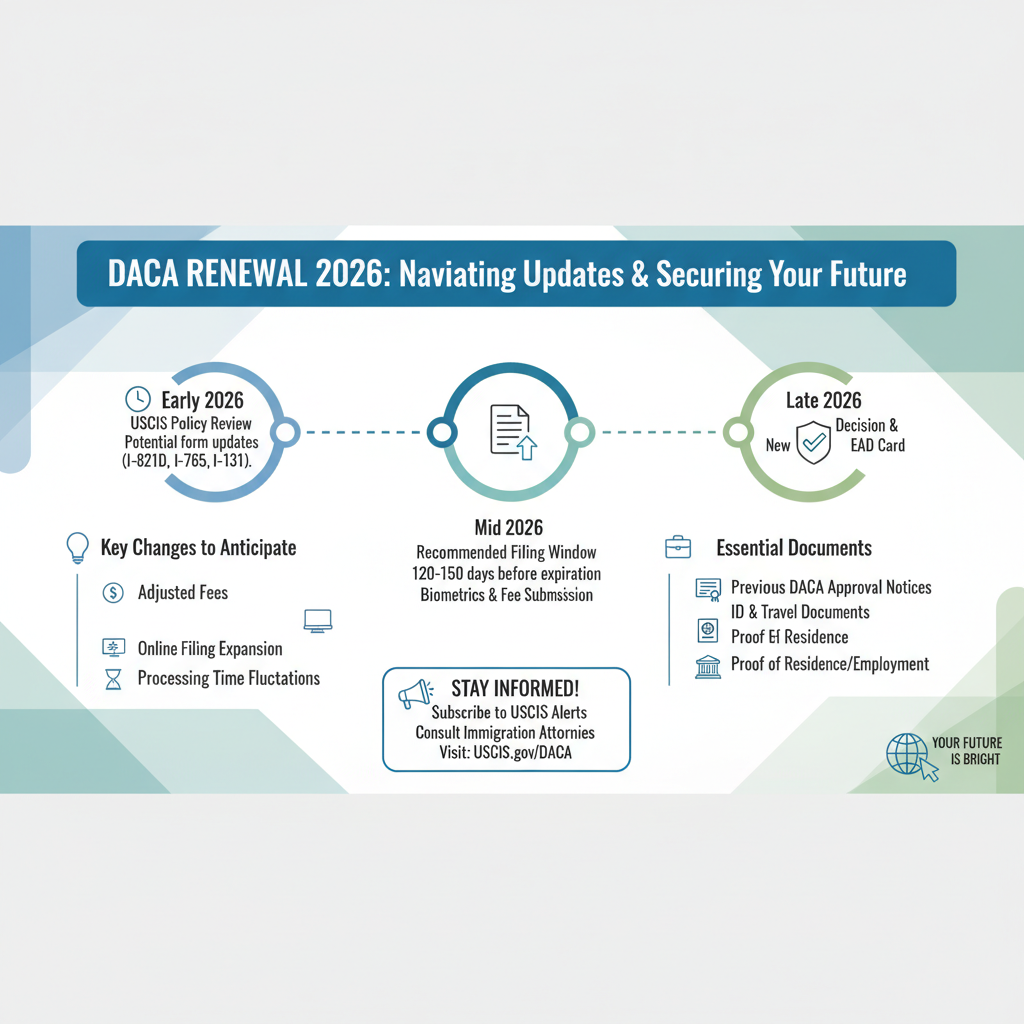
Important: Start gathering these documents well in advance. USCIS recommends filing your renewal application between 120 to 150 days (approximately 4 to 5 months) before your current DACA and EAD expire. This proactive approach helps avoid any lapse in your work authorization.
2) Complete Required USCIS Forms
You will need to complete the following forms. Always download the latest versions from the USCIS official website.
- Form I-821D, Consideration of Deferred Action for Childhood Arrivals: Fill out every section completely and accurately. If a question does not apply to you, write "N/A" (not applicable) or "None." Do not leave blank spaces.
- Form I-765, Application for Employment Authorization: For DACA renewals, your eligibility category will typically be (c)(33). Ensure your name, address, and A-number match exactly across all forms.
- Form I-765 Worksheet: This form helps you calculate the period of continuous residence for DACA purposes. It's often required alongside Form I-765 for DACA applicants.
Warning: Any inconsistencies or errors can lead to delays or denial. Double-check all dates, names, and addresses. If you have moved, ensure your address with USCIS is updated using Form AR-11, Alien's Change of Address Card.
3) Prepare Your Application Package
Once your forms are completed and documents gathered, assemble your application package in a clear, organized manner. USCIS recommends the following order:
- Payment (check or money order) clipped to the top.
- Form I-765.
- Form I-765 Worksheet.
- Form I-821D.
- Copies of your two passport-style photos, placed in a small plastic bag labeled with your name and A-number.
- Copy of your current EAD (front and back).
- Copy of your most recent DACA approval notice (Form I-797C).
- All supporting documents (proof of continuous residence, criminal history dispositions, etc.). If you are submitting copies of documents, ensure they are clear and legible. Do not send original documents unless specifically requested by USCIS.
Reminder: Make a complete copy of your entire application package for your records before mailing it. This includes all forms, supporting documents, and the check/money order for fees.
4) Calculate and Submit Fees
The total fee for a DACA renewal application is typically $495 as of March 30, 2026. This includes:
- $410 for Form I-765, Application for Employment Authorization.
- $85 for the biometrics services fee.
There is currently no fee for Form I-821D. You must pay the fee with a personal check, money order, or cashier's check made payable to "U.S. Department of Homeland Security." Do not abbreviate. Write your A-number on the memo line of your payment. Cash is not accepted.
Fee Waivers: Fee waivers for DACA renewals are rarely granted and are only available under extremely limited circumstances, typically for individuals who are homeless, receiving public benefits, or have an income below 150% of the Federal Poverty Guidelines. If you believe you qualify, you would submit Form I-912, Request for Fee Waiver, along with your application and supporting documentation. However, consult an attorney before attempting a fee waiver for DACA renewal, as denials are common and can delay your application.
5) Mail Your Application to USCIS
The correct mailing address depends on your state of residence and the specific forms you are filing. For DACA renewals, USCIS typically directs applications to a Lockbox facility. Always verify the correct Lockbox address on the USCIS Direct Filing Addresses for Form I-821D page before mailing. As of March 30, 2026, for Florida residents, DACA renewal applications are usually sent to the USCIS Chicago Lockbox:
For U.S. Postal Service (USPS):
USCIS
Attn: DACA
P.O. Box 805284
Chicago, IL 60680-1208
For FedEx, UPS, and DHL deliveries:
USCIS
Attn: DACA (Box 805284)
131 South Dearborn Street, 3rd Floor
Chicago, IL 60603-5517
Important: Use a shipping method that provides tracking and delivery confirmation, such as USPS Certified Mail with Return Receipt, FedEx, or UPS. This provides proof that you mailed your application and when it was received.
6) Attend Your Biometrics Appointment (If Required)
After USCIS accepts your application, you will receive a receipt notice (Form I-797C) and, typically, an appointment notice for biometrics (fingerprints, photograph, and signature). This appointment will be at an Application Support Center (ASC) near you. For Central Florida residents, this could be the Orlando USCIS Application Support Center or another location depending on scheduling.
- Bring your appointment notice and a valid photo ID (e.g., passport, state ID).
- Be on time. If you cannot make your appointment, you must request to reschedule immediately, providing a valid reason.
- The biometrics data is used for background checks and to verify your identity.
7) Monitor Your Case Status
Once you receive your receipt notice, you can track the status of your application online using the receipt number provided. Visit the USCIS Case Status Online tool. You can also sign up for email and text alerts.
Timeline Expectations: DACA renewal processing times vary. You can check current processing times for Form I-821D and Form I-765 at the USCIS Processing Times page. While USCIS aims to process renewals efficiently, delays can occur. Plan ahead and renew early to avoid a lapse in your work authorization.
If you receive a Request for Evidence (RFE) or a Notice of Intent to Deny (NOID), respond promptly and comprehensively. This is where legal counsel can be invaluable.

Practical Steps You Can Take Today for DACA Renewal
Being proactive is the best strategy for DACA renewal, especially given the program's uncertain future. Here’s an actionable checklist to help you get started:
- Check Your Expiration Date: Locate your current EAD and DACA approval notice. Note the expiration date. Mark your calendar for 120-150 days before this date to begin your renewal process.
- Gather Past DACA Documents: Collect all previous DACA approval notices, EAD cards, and any records of past applications. These will serve as foundational evidence.
- Review Your Criminal History: Obtain certified court dispositions for any arrests or convictions, no matter how minor, since your last DACA approval. Be honest and transparent; USCIS will find out.
- Collect Proof of Continuous Residence: Start compiling documents that show you have continuously resided in the U.S. since your last DACA approval. Aim for at least one document per year, if possible. (See Step 1 for examples).
- Update Your Address with USCIS: If you've moved since your last application, file Form AR-11, Alien's Change of Address Card, online or by mail within 10 days of moving. This ensures you receive all USCIS correspondence.
- Save Money for Fees: The current fee is $495. Start saving now so you have the funds ready when it's time to renew.
- Consult an Immigration Attorney: Even for a renewal, an attorney can review your eligibility, catch potential issues, and ensure your application is perfectly prepared. This is especially important if you have any changes in your life since your last approval (e.g., arrests, significant travel).
- Educate Yourself on Current Events: Stay informed about DACA news and legal developments from reliable sources like USCIS or reputable immigration law firms.
Document preparation guidance
Organization is key to a smooth DACA renewal process:
Related Articles
You may also be interested in:
-
Family-Based Immigration Petitions: Your Step-by-Step Guide
Navigate family-based immigration with Imigrar's expert guide. Learn eligibility, forms, and steps to keep your family together in Orlando and beyond....
-
Pressley-Led Effort Forces Haiti TPS Vote in 2026
Rep. Ayanna Pressley secured 218 signatures to force a House vote on Haiti TPS protections. Learn what this means for Florida immigrants. Call +1 786-...
-
Family-Based Green Card: Your Complete Guide to Keeping Families
Navigate the family-based immigration petition process with Imigrar's expert guide. Learn eligibility, steps, and how to reunite with loved ones in Or...
-
H-1B Visa Lottery FY2027: Navigating the New Rules & Keeping
Understand the critical H-1B visa lottery changes for FY2027, including the beneficiary-centric selection process and fee increases. Imigrar helps Orl...


