


For hundreds of thousands of young people across the United States, including countless individuals and families here in Florida, the Deferred Action for Childhood Arrivals (DACA) program represents hope, stability, and the ability to contribute fully to the communities they call home. As of 2026, DACA continues to navigate complex legal and political landscapes, making it more crucial than ever for recipients to stay informed about the latest updates and ensure their deferred action status and work authorization remain current.
At Imigrar, an immigration law firm based in Orlando, Florida, we are committed to helping DACA recipients and their families understand these evolving circumstances. Our mission is to "Keep Families Together," and that includes empowering Dreamers with the knowledge and legal support they need to maintain their status and plan for their future.
This comprehensive guide provides a deep dive into the current state of DACA, focusing on renewal requirements, practical steps, and critical advice for those living in Orlando, Central Florida, and nationwide. We’ll break down the process, highlight important deadlines, and address common concerns to help you navigate your DACA journey with confidence.
Need Help with Your DACA Renewal? Don't navigate the complexities alone. Our Orlando immigration team at Imigrar is ready to assist. Call +1 786-791-3106 for a free consultation, or message us online. We serve clients nationwide. Se Habla Español.
The reporting that sparked this guide
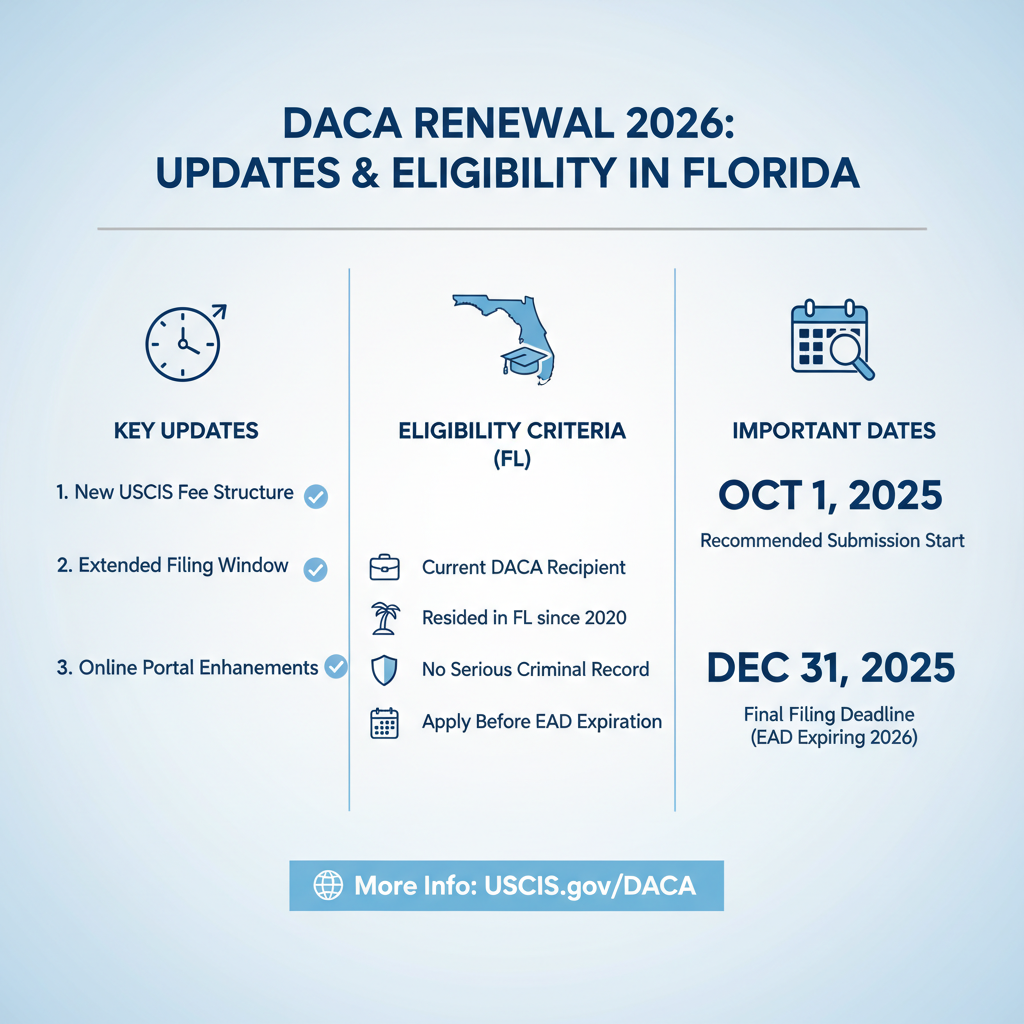
The ongoing discussions and legal challenges surrounding DACA consistently generate news and updates from official sources like USCIS. Staying abreast of these developments is key for every DACA recipient. The information in this guide is informed by the latest guidance and public statements from U.S. Citizenship and Immigration Services (USCIS) regarding the DACA program and its renewal process.
DACA Program Updates and Renewal Information (USCIS)
What This News Means for Immigrants in Orlando and Across Florida
For DACA recipients and their families in Florida, particularly those in vibrant communities like Orlando, Tampa, Miami, and along the I-4 corridor, news about DACA is always significant. It directly impacts their ability to work, study, and live without constant fear of deportation. The continuous legal battles and administrative changes mean that vigilance and proactive renewal are paramount.
Why this news is showing up now
The DACA program has been subject to various legal challenges and policy shifts since its inception in 2012. While DACA is currently ordered to be maintained on its original terms for existing recipients, federal courts continue to hear arguments regarding its legality. This means that while USCIS is still accepting and processing DACA renewal requests, and employment authorization documents (EADs) for DACA recipients, the program is not accepting initial DACA applications. Each court ruling, administrative update, or even the lack thereof, becomes news because it affects the stability and future planning of hundreds of thousands of individuals. In 2026, the ongoing litigation continues to be a primary driver of headlines, reminding everyone that DACA remains a temporary, albeit crucial, form of relief.
Additionally, USCIS periodically releases operational updates, processing time adjustments, and policy clarifications that directly affect the renewal process. These updates are vital for ensuring applicants submit correct and timely documentation, avoid delays, and understand any new requirements or recommendations.
How it can affect Florida residents
Florida is home to a significant population of DACA recipients, often referred to as "Dreamers." These individuals are deeply integrated into the state's economy, educational institutions, and cultural fabric. For Central Florida residents, especially those living in Orlando and surrounding Orange County, the implications of DACA news are direct and personal:
- Employment Stability: DACA provides work authorization, allowing recipients to hold jobs, contribute to the tax base, and support their families. Any uncertainty or delay in renewal can jeopardize employment and financial stability.
- Educational Opportunities: Many DACA recipients are pursuing higher education in Florida's colleges and universities. While Florida state law has specific provisions regarding in-state tuition for certain undocumented students, maintaining DACA status often facilitates access to scholarships, internships, and professional licenses upon graduation.
- Driver's Licenses: In Florida, DACA recipients are generally eligible to obtain a driver's license, which is essential for daily life, commuting to work or school, and accessing services in a spread-out state like Florida.
- Community Integration: DACA allows recipients to live with less fear of deportation, fostering stronger community ties and allowing them to participate more fully in civic life.
- Local USCIS Office: The Orlando USCIS Field Office processes various immigration applications. While DACA renewals are primarily handled by USCIS service centers, local offices may be involved in biometrics appointments or interviews for other related applications. Understanding the broader immigration landscape and how it interfaces with local operations is key.
The constant evolution of DACA underscores the importance of seeking expert legal counsel. Imigrar understands the unique challenges faced by DACA recipients in Florida and is dedicated to providing up-to-date, accurate, and actionable advice.
What DACA Is (and Why It Matters)
The Deferred Action for Childhood Arrivals (DACA) program has been a lifeline for hundreds of thousands of young people across the United States. Established in 2012 by the Obama administration, DACA provides temporary relief from deportation and grants work authorization to eligible undocumented immigrants who were brought to the U.S. as children.
A plain-English definition
Simply put, DACA is a U.S. immigration policy that allows certain undocumented immigrants who entered the country as minors to receive a renewable two-year period of deferred action from deportation and eligibility for a work permit (an Employment Authorization Document, or EAD). "Deferred action" means that the government agrees to postpone any action to remove (deport) an individual from the country. It does not provide a path to permanent residency or citizenship, but it offers a critical measure of stability and allows recipients to legally work and obtain a driver's license in most states, including Florida.
Important: DACA is not a law passed by Congress, but rather an administrative policy. This distinction is crucial because it means DACA can be, and has been, challenged in courts and modified by different presidential administrations, leading to its current complex status where renewals are accepted but new applications are generally not.
Key terms you need to know
Navigating immigration processes often involves specific terminology. Here are some key terms related to DACA that you should understand:
- Deferred Action: An exercise of prosecutorial discretion to defer removal action against an individual. It does not confer lawful status but prevents deportation for a specified period.
- DACA Recipient / Dreamer: An individual who has been granted deferred action under the DACA program. "Dreamer" is a term often used to refer to young undocumented immigrants, many of whom are DACA recipients, in reference to the DREAM Act (Development, Relief, and Education for Alien Minors Act), a legislative proposal that would provide a pathway to permanent residency.
- Employment Authorization Document (EAD): Also known as a work permit, this card allows DACA recipients to legally work in the United States. It typically has a validity period of two years, matching the DACA deferred action period.
- USCIS (U.S. Citizenship and Immigration Services): The government agency responsible for administering the DACA program, processing applications, and issuing EADs. You will interact with USCIS for your renewal application.
- ICE (U.S. Immigration and Customs Enforcement): The federal agency responsible for enforcing immigration laws within the United States. Deferred action under DACA means ICE has agreed not to pursue removal proceedings against you for the duration of your DACA period.
- Removal Proceedings: Formal legal processes initiated by the Department of Homeland Security (DHS) to deport an individual from the United States. DACA provides protection from these proceedings.
- Advance Parole: A document issued by USCIS that allows certain non-citizens to travel outside the U.S. and return without jeopardizing their immigration status. While DACA does not provide a path to lawful status, some DACA recipients have been able to apply for advance parole for humanitarian, educational, or employment purposes. This is a complex area and requires careful legal advice.
Understanding these terms is fundamental to comprehending your rights, responsibilities, and the nuances of the DACA program.
Navigating DACA Terms and Requirements? Imigrar's team provides clear, easy-to-understand guidance. Call +1 786-791-3106 for a free consultation. We are here to help you in English or Spanish. Se Habla Español.
Current Immigration Law: The Foundation for DACA
It is important to reiterate that DACA is not a statutory law passed by Congress, but rather an exercise of prosecutorial discretion by the Department of Homeland Security (DHS) through various memoranda. This distinction is critical because it means DACA's existence and scope are vulnerable to legal challenges and changes in administrative policy, rather than being enshrined in federal statute like the Immigration and Nationality Act (INA).
The original DACA policy was announced via a memorandum from then-Secretary of Homeland Security Janet Napolitano on June 15, 2012. This memorandum outlined the criteria for deferred action for certain young undocumented immigrants. Subsequent legal challenges and court orders have shaped its current status:
- As of 2026, due to various court injunctions and rulings (such as the July 2021 Southern District of Texas ruling and subsequent appeals), USCIS is generally prohibited from approving new DACA applications.
- However, USCIS is currently permitted to accept and process DACA renewal requests, as well as associated applications for employment authorization documents (EADs) and advance parole requests for DACA recipients.
This means that while the program's long-term future remains uncertain, current DACA recipients are still able to renew their status and continue benefiting from its protections, provided they meet the established criteria.
For the most authoritative and up-to-date information, always refer to the USCIS official website.
Federal requirements for DACA renewal
To be eligible to renew your DACA, you must meet the following criteria, which generally mirror the original requirements, with some adjustments for continuous residence:
- You must have received DACA previously. This guide focuses on renewals, as new applications are generally not being accepted.
- You must not have departed the United States on or after August 15, 2012, without first having obtained advance parole.
- You must have continuously resided in the United States since you submitted your most recent DACA request that was approved.
- You must not have been convicted of a felony, a significant misdemeanor, or three or more other misdemeanors, and not otherwise pose a threat to national security or public safety.
Reminder: It is crucial to be truthful and provide complete information on your application. Any misrepresentation can lead to denial and potential legal consequences.
Florida-specific considerations for DACA recipients
While DACA is a federal program, its impact and certain benefits can vary by state. For DACA recipients in Florida, here are some key considerations:
- Driver's Licenses: The Florida Department of Highway Safety and Motor Vehicles (FLHSMV) generally issues driver's licenses to DACA recipients whose Employment Authorization Documents (EADs) are valid for at least 30 days. You will need your EAD and other identifying documents.
- In-State Tuition: Florida Statute 1009.26(12)(a) allows certain undocumented students, including some DACA recipients, to qualify for in-state tuition at public universities and colleges in Florida if they meet specific residency requirements and attended a Florida secondary school for at least three consecutive years immediately before graduating from a Florida high school. This is a significant benefit for Dreamers pursuing higher education in the state.
- Professional Licenses: Eligibility for professional licenses (e.g., nursing, teaching, real estate) in Florida can vary. While DACA provides work authorization, specific state boards may have additional requirements regarding immigration status. It's advisable to check with the relevant licensing board in Florida for detailed information.
- Local Resources: Communities across Florida, including Orlando, have non-profit organizations and legal aid groups that may offer additional support, workshops, or resources for DACA recipients. Imigrar frequently collaborates with and refers to these organizations as part of our commitment to the community.
The Orlando USCIS Field Office, located at 5440 Diplomat Cir, Orlando, FL 32810, primarily handles interviews for other immigration benefits, but its presence underscores the federal government's role in the region. Your DACA renewal application will typically be sent to a USCIS Service Center, not the local field office, but you may attend biometrics appointments at an Application Support Center (ASC) in Orlando or a nearby city.
How to Renew Your DACA: A Complete Step-by-Step Guide
Renewing your DACA is a critical process that requires attention to detail and timely submission. USCIS recommends filing your DACA renewal request 120 to 150 days before your current DACA and EAD expire. Filing too early (more than 150 days) could lead to rejection, while filing too late risks a lapse in your work authorization and deferred action status.
1) Determine Your Eligibility for DACA Renewal
Before you begin, confirm you meet the federal eligibility requirements for renewal:
- You were previously granted DACA.
- You have not departed the United States on or after August 15, 2012, without first having obtained advance parole.
- You have continuously resided in the United States since you submitted your most recent DACA request that was approved.
- You have not been convicted of a felony, a significant misdemeanor, or three or more other misdemeanors, and do not otherwise pose a threat to national security or public safety.
- You are physically present in the United States at the time of filing your renewal request.
Warning: If you have any new criminal convictions, even minor ones, or have traveled outside the U.S. without advance parole since your last DACA approval, you should consult with an experienced immigration attorney immediately before filing your renewal. These issues can significantly impact your eligibility.
2) Gather Required Documents for Your Renewal Application
Even for renewals, it's essential to submit a complete package. While less documentation is typically needed than for an initial application, you must still provide proof of identity and continuous residence if there have been any changes or gaps. Always keep copies of everything you send to USCIS.
Here's a checklist of documents you should prepare:
- Copy of your most recent DACA approval notice (Form I-797).
- Copy of your current Employment Authorization Document (EAD card).
- Copies of any previous DACA approval notices and EADs.
- Proof of continuous residence: While not always explicitly required for renewals if you haven't moved, it's good practice to have recent documents (e.g., utility bills, bank statements, pay stubs, school records, rental agreements) that show you have resided in the U.S. since your last DACA approval. This is especially important if you've moved or had any gaps.
- Identification documents: Copy of your birth certificate with translation, passport, or other government-issued ID.
- Two passport-style photos: Taken within 30 days of filing, with a white background. Write your name and Alien Registration Number (A-Number) lightly on the back of each photo.
- Documentation of any new criminal history (if applicable): If you've had any encounters with law enforcement since your last DACA approval, you must provide certified court dispositions for every incident, even if charges were dropped or expunged. Consult an attorney for guidance.
- Documentation of any travel outside the U.S. with Advance Parole (if applicable): If you traveled, provide copies of your advance parole document and stamps in your passport.
3) Complete USCIS Forms
You will need to complete three forms for your DACA renewal request:
- Form I-821D, Consideration of Deferred Action for Childhood Arrivals: This is the primary form for requesting DACA. Fill it out carefully and completely. Pay close attention to all questions, especially those regarding criminal history and travel.
- Form I-765, Application for Employment Authorization: This form requests your work permit. For DACA renewals, you will typically check box 1.c. for "renewal of my permission to accept employment." In Part 2, Item 27, enter eligibility category (c)(33).
- Form I-765 Worksheet: This worksheet helps you determine if you need to submit the fee for Form I-765. Most DACA renewal applicants will need to pay the fee unless they qualify for a fee waiver (which is very rare for DACA).
Important: Use the most current versions of these forms, available on the USCIS Forms page. Always check the edition date before filling them out. If you're unsure about any question, leave it blank and discuss it with your attorney rather than guessing.
4) Prepare Your Application Package
Once your forms are completed and documents gathered, assemble your package in the correct order:
- Check or money order for the filing fees (on top of the package).
- Form I-821D
- Form I-765
- Form I-765 Worksheet
- Supporting documents (copies, not originals, unless specifically requested by USCIS), organized in the order they are referenced in the forms.
- Two passport-style photos (placed in a small envelope and stapled to the upper left corner of Form I-765).
Recommendation: Create a cover letter listing all the contents of your application package. This helps USCIS process your application and provides you with a clear record. Make a complete copy of the entire application package for your records before mailing it.
5) Pay Filing Fees
As of March 11, 2026, the fees for DACA renewal are:
- Form I-821D: No fee.
- Form I-765: $410 (Application for Employment Authorization).
- Biometrics Services Fee: $85 (for fingerprinting and background checks).
The total fee for a DACA renewal application is typically $495. You must submit one check or money order for the total amount ($495) made payable to "U.S. Department of Homeland Security." Do not abbreviate. Write your name and A-Number on the memo line of the check.
Warning: USCIS rarely grants fee waivers for DACA applications. Do not assume you qualify for a fee waiver unless you have received explicit legal advice to pursue one under very specific, documented circumstances. Incorrect fees or requests for unwarranted fee waivers are common reasons for application rejection.
6) Mail Your Application to the Correct USCIS Lockbox Facility
The mailing address for your DACA renewal depends on the state where you live. For applicants residing in Florida, you will generally mail your application to the USCIS Chicago Lockbox facility. Always double-check the "Where to File" section on the USCIS website for Form I-821D instructions.
As of this date (2026-03-11), for Florida residents, the mailing address is typically:
- For U.S. Postal Service (USPS):
USCIS
Attn: DACA
P.O. Box 805887
Chicago, IL 60680-4120 - For FedEx, UPS, and DHL deliveries:
USCIS
Attn: DACA
131 S. Dearborn St., 3rd Floor
Chicago, IL 60603-5517
Recommendation: Use a mailing service that provides tracking and delivery confirmation (e.g., USPS Certified Mail with Return Receipt, FedEx, UPS). This provides proof of submission and delivery.
7) Attend Biometrics Appointment and Monitor Your Case
After USCIS receives your application, they will send you a receipt notice (Form I-797C) within a few weeks. This notice will contain a receipt number that you can use to check your case status online. Shortly after, you will receive an appointment notice for biometrics (fingerprinting and photos) at an Application Support Center (ASC) near you. For Orlando residents, this will likely be at the Orlando ASC.
- Biometrics Appointment: This appointment is mandatory. Bring your appointment notice, a valid photo ID (such as your EAD or passport), and any other documents requested.
- Monitor Your Case: Regularly check your case status online using the receipt number. USCIS may send Requests for Evidence (RFEs) if they need more information, or an interview notice in rare cases. Respond to any RFEs promptly and accurately.
- Processing Times: DACA renewal processing times can vary. You can check current USCIS Processing Times online. It's common for processing to take several months.
Once approved, you will receive a new DACA approval notice and your new EAD card by mail. Keep these documents safe and secure.

Practical Steps You Can Take Today for DACA Renewal
Proactive planning is your best defense against processing delays and potential lapses in your DACA status. Here's an actionable checklist:
- Mark Your Calendar: Note your DACA and EAD expiration dates. Set reminders for 120-150 days before expiration as your target filing window.
- Review Your Documents: Gather all previous DACA notices, EADs, and any documents related to your continuous residence (e.g., leases, utility bills, school records, pay stubs).
- Check Your Criminal Record: If you've had any interactions with law enforcement since your last DACA approval, obtain certified court dispositions for every incident. Even minor infractions can impact eligibility.
- Verify Travel History: Confirm you have not traveled outside the U.S. without a valid advance parole document since August 15, 2012.
- Update Your Address with USCIS: If you've moved, ensure your address is updated with USCIS using Form AR-11, Alien's Change of Address Card. This prevents missed notices.
- Budget for Fees: The current filing fee is $495. Start saving now to ensure you have the funds available.
- Seek Legal Advice: If you have any doubts about your eligibility, criminal history, travel, or any part of the application, schedule a consultation with an experienced immigration attorney.
Document preparation guidance
- Organize Everything: Create a dedicated folder for your DACA documents. Keep originals safe and send only copies to USCIS unless specifically requested otherwise.
- Translations: Any document not in English must be accompanied by a complete English translation certified by a competent translator. The translator must sign a statement affirming their competence and the accuracy of the translation.
- Clarity and Legibility: Ensure all copies are clear and easy to read. If a document is difficult to read, try to obtain a better copy.
- No Staples or Paperclips (unless necessary): USCIS prefers minimal stapling. Use binder clips to keep sections together if needed, but avoid excessive use.
Timeline expectations
- Filing Window: Apply 120-150 days before your DACA/EAD expires.
- Receipt Notice: Expect a receipt notice (I-797C) within 2-4 weeks after filing.
- Biometrics Appointment Notice: Typically received 3-8 weeks after filing. The appointment itself is usually scheduled 2-4 weeks after the notice date.
- Processing Time: DACA renewal processing can take anywhere from 3 to 6 months, or sometimes longer. Check USCIS Processing Times for the latest estimates for your service center.
- Approval and EAD Delivery: Once approved, you'll receive your approval notice and EAD card within 1-2 weeks.
Important: Do not let your DACA and EAD expire! A lapse in status can lead to loss of employment, driving privileges, and even potential removal proceedings


