

The landscape of immigration law is constantly evolving, and for hundreds of thousands of Deferred Action for Childhood Arrivals (DACA) recipients, staying informed is not just helpful—it's essential for their future. Today, we delve into the latest DACA program updates and provide a comprehensive guide to the renewal process, ensuring Dreamers in Florida and nationwide have the accurate, actionable information they need.
Need Help with Your DACA Renewal? Don't navigate the complexities alone. Our Orlando immigration team at Imigrar is ready to assist you every step of the way. Call +1 786-791-3106 for a free consultation, or message us online. Se Habla Español.
The reporting that sparked this guide
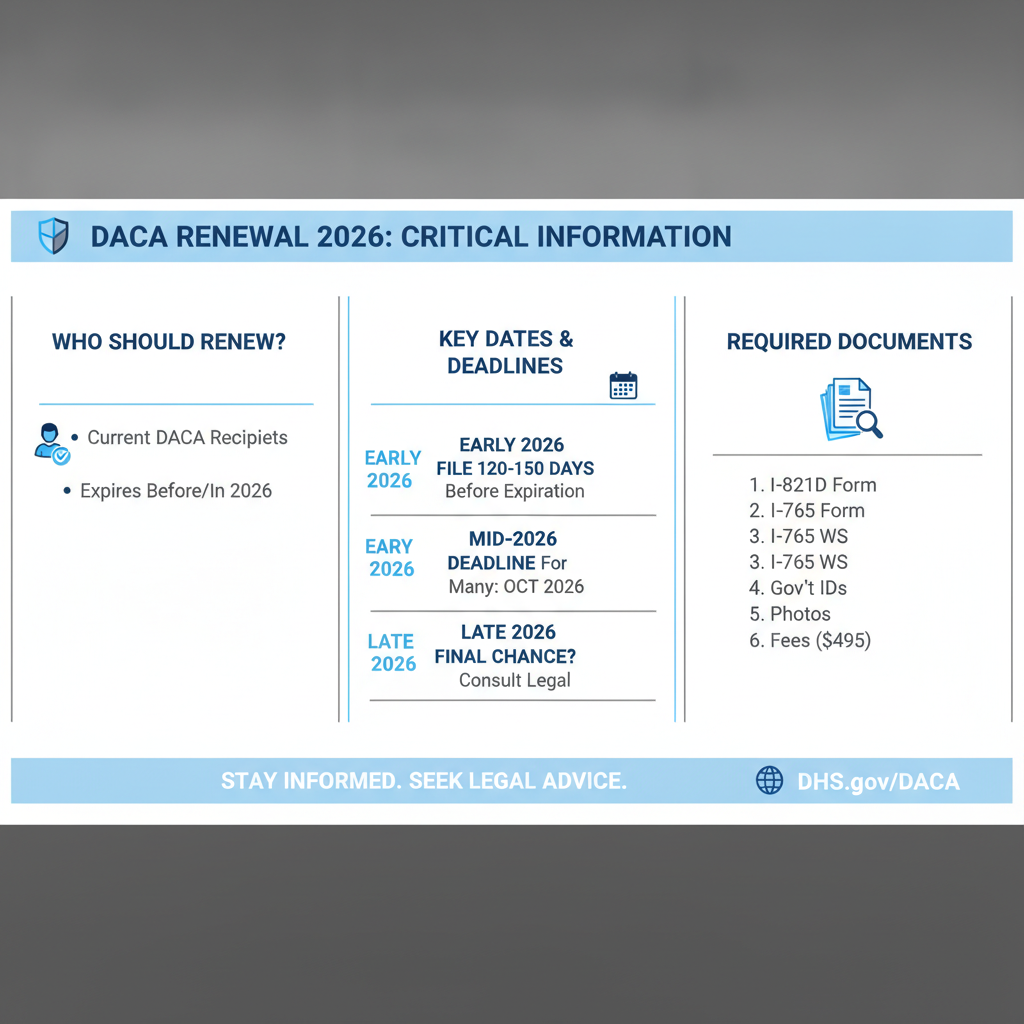
Recent reports from USCIS, often highlighted in broader immigration news, continue to underscore the critical importance of timely DACA renewals. These updates serve as a regular reminder that while the program faces ongoing legal and political challenges, the process for current recipients to maintain their status remains active. Keeping abreast of these announcements is vital for individuals relying on DACA for work authorization and protection from deportation.
DACA Program Updates and Renewal Information (USCIS)
What This News Means for Immigrants in Orlando and Across Florida
For the thousands of DACA recipients who call Florida home, particularly those in vibrant communities like Orlando, Tampa, and Miami, news surrounding the DACA program carries significant weight. While initial DACA applications have largely been blocked by court orders, the ability for current recipients to renew their deferred action and employment authorization remains intact. This ongoing process is a lifeline for many, allowing them to work legally, pursue education, and plan their futures without immediate fear of deportation.
Why this news is showing up now
The Deferred Action for Childhood Arrivals (DACA) program has been a subject of continuous legal and political debate since its inception in 2012. The reason this news is consistently showing up now, in 2026, is multifaceted:
- Ongoing Legal Challenges: DACA's legal standing has been repeatedly challenged in federal courts, most notably in Texas v. United States. While court orders have generally allowed renewals to continue, these cases introduce uncertainty and require USCIS to issue guidance based on the latest judicial rulings. Even as of 2026, the program's long-term future is still being litigated, making any administrative update or court development newsworthy.
- Administrative Updates from USCIS: As the agency responsible for processing DACA applications, USCIS regularly issues guidance, policy alerts, and processing statistics. These updates can relate to fee changes, form revisions, processing times, or clarifications on eligibility criteria for renewals.
- Political Discussions: DACA remains a prominent topic in congressional discussions regarding comprehensive immigration reform. Lawmakers frequently propose solutions, debate legislative fixes, or comment on the program's status, keeping it in the public eye.
- Expiration Cycles: DACA is granted for a two-year period, meaning a significant number of recipients are always approaching their renewal window. This creates a continuous cycle of applications, renewals, and the need for up-to-date information.
- Advocacy and Awareness: Immigrant rights organizations and advocacy groups consistently work to raise awareness about DACA, its beneficiaries, and the need for a permanent legislative solution. Their efforts keep the program in the news and ensure that DACA recipients and their families remain informed.
For DACA recipients, this constant flow of information means a perpetual need to stay vigilant and ensure they are following the most current guidance from USCIS to protect their status.
How it can affect Florida residents
Florida is home to one of the largest populations of DACA recipients in the United States. For these individuals, the DACA program is not an abstract policy; it directly impacts their daily lives and futures:
- Employment Opportunities: DACA provides an Employment Authorization Document (EAD), which allows recipients to legally work in the U.S. This is crucial for economic stability for individuals and their families, contributing significantly to Florida's economy. Without a valid EAD, DACA recipients cannot legally work, potentially leading to job loss and financial hardship.
- Educational Access: While DACA does not grant federal financial aid, many Florida colleges and universities offer in-state tuition rates to DACA recipients, significantly reducing the cost of higher education. Maintaining DACA status is often a prerequisite for these benefits, enabling Dreamers to pursue degrees and contribute to Florida's skilled workforce.
- Driving Privileges: In Florida, DACA recipients can obtain a driver's license, which is essential for commuting to work, school, and everyday life, especially in a state where public transportation options can be limited outside major urban centers. Loss of DACA status can jeopardize this privilege.
- Protection from Deportation: The primary benefit of DACA is the deferral of deportation proceedings. For Florida residents, this means they can live, work, and study without immediate fear of removal from the country they consider home. A lapse in DACA status can expose individuals to potential detention and deportation.
- Community and Family Stability: DACA recipients are deeply integrated into Florida communities. They are students, workers, entrepreneurs, and family members. The stability provided by DACA helps keep families together and strengthens the social fabric of cities like Orlando, which are known for their diverse populations.
Understanding these impacts underscores why staying informed about DACA updates and diligently managing the renewal process is critically important for Dreamers in Orlando and across the Sunshine State.
What DACA Is (and Why It Matters)
The Deferred Action for Childhood Arrivals (DACA) program, established in 2012, has provided a measure of stability and opportunity for hundreds of thousands of young undocumented immigrants who were brought to the United States as children. Understanding what DACA is, and why it holds such significance, is crucial for anyone impacted by current immigration policies.
A plain-English definition
At its core, DACA is a U.S. immigration policy that allows certain undocumented immigrants who entered the country as minors to receive a renewable two-year period of deferred action from deportation and eligibility for a work permit. Important: DACA is not a path to U.S. citizenship or lawful permanent residency (a Green Card). It is a temporary form of immigration relief that allows individuals to legally live and work in the United States without immediate fear of being removed.
The program was created to protect young individuals, often referred to as "Dreamers," who grew up in the U.S., attended American schools, and often know no other home. It recognizes that these individuals, through no fault of their own, are deeply integrated into American society and contribute significantly to its economy and culture.
Key terms you need to know
Navigating DACA requires familiarity with several key terms:
- Deferred Action: This is the central concept of DACA. It means that the U.S. government (specifically, the Department of Homeland Security) has decided to "defer" or postpone any action to remove an individual from the country. It does not grant a legal immigration status but rather provides a temporary stay of deportation.
- Dreamers: This term refers to young undocumented immigrants who were brought to the U.S. as children. The term originated from the "DREAM Act" (Development, Relief, and Education for Alien Minors Act), a legislative proposal that would have provided a pathway to legal status for these individuals. While the DREAM Act has never passed, DACA provides some of the benefits envisioned by the Act.
- Employment Authorization Document (EAD): Often referred to as a work permit or "work authorization card," this document (Form I-766) is issued to DACA recipients, allowing them to legally work in the United States for the duration of their deferred action. This is a critical component of DACA, enabling economic self-sufficiency.
- USCIS (U.S. Citizenship and Immigration Services): This is the federal agency responsible for administering the DACA program, including processing initial applications (when permitted) and renewals, issuing EADs, and handling related forms. You will interact with USCIS for almost all aspects of your DACA process.
- Advance Parole: While not a direct part of DACA eligibility, advance parole (Form I-131, Application for Travel Document) allows DACA recipients to request permission from USCIS to travel outside the United States and lawfully re-enter. It is typically granted for humanitarian, educational, or employment purposes. Travel without advance parole can lead to the termination of DACA and potential inadmissibility upon return.
Understanding these terms is vital for DACA recipients and their families as they navigate the application and renewal processes. For more detailed information, always refer to the USCIS official website.
Current Immigration Law: The Foundation
DACA, while a significant policy, operates within the broader framework of U.S. immigration law. It's important to understand that DACA itself is not a law passed by Congress, but rather an exercise of prosecutorial discretion by the executive branch. This distinction is key to why its legal status has been so contested.
The authority for DACA stems from the Department of Homeland Security's (DHS) inherent power to decide which cases to pursue for deportation and which to defer. This power, known as prosecutorial discretion, is a long-standing principle in immigration enforcement. However, the scope and implementation of this discretion have been challenged in courts, most notably in Texas v. United States. As of 2026, court injunctions have largely halted the processing of *new* DACA applications, but critically, they have allowed USCIS to continue accepting and adjudicating DACA renewal requests for individuals who have previously been granted deferred action.
Federal requirements
To be eligible for DACA renewal, individuals must continue to meet the original DACA requirements, with a few crucial updates. While initial DACA applications are generally not being accepted as of 2026, understanding the foundational criteria is still important for renewals:
- Age Requirement: You must have been under the age of 31 as of June 15, 2012.
- Entry into the U.S.: You must have come to the United States before your 16th birthday.
- Continuous Residence: You must have continuously resided in the U.S. since June 15, 2007, up to the present time. Brief, casual, and innocent departures from the U.S. do not break continuous residence.
- Physical Presence: You must have been physically present in the U.S. on June 15, 2012, and at the time of making your request for DACA.
- Education/Military Status: You must currently be in school, have graduated or obtained a certificate of completion from high school, have obtained a general education development (GED) certificate, or be an honorably discharged veteran of the Coast Guard or Armed Forces of the United States.
- Criminal History: You must not have been convicted of a felony, a significant misdemeanor, or three or more other misdemeanors, and must not otherwise pose a threat to national security or public safety.
For renewals, USCIS primarily checks for any disqualifying events since your last DACA approval, such as new criminal convictions or unauthorized travel outside the U.S. without Advance Parole. It is imperative to be truthful and provide all requested information. USCIS forms central to the DACA renewal process include:
- Form I-821D, Consideration of Deferred Action for Childhood Arrivals
- Form I-765, Application for Employment Authorization
- Form I-765WS, Worksheet (required to accompany Form I-765)
These forms must be completed accurately and submitted with the appropriate fees and supporting documentation. You can find the latest versions of these forms and detailed instructions on the USCIS Forms page.
Florida-specific considerations
While DACA is a federal program, its impact and certain benefits can vary by state. For Dreamers in Florida, specific considerations include:
- In-State Tuition: Florida Statute § 1009.26 allows DACA recipients who meet certain criteria (such as attending high school in Florida for three years and graduating from a Florida high school) to qualify for in-state tuition rates at public colleges and universities. This provides a significant financial advantage for pursuing higher education in the state.
- Driver's Licenses: DACA recipients in Florida are eligible to apply for a Florida driver's license, provided they meet all other state requirements. Your valid EAD and DACA approval notice are key documents for this process.
- Local Resources: Communities throughout Florida, including Orlando, Tampa, and Miami, have non-profit organizations and legal aid groups that offer assistance to DACA recipients. These organizations can provide help with application preparation, legal advice, and community support.
- Processing Locations: While USCIS processes DACA applications centrally, if you are required to attend a biometrics appointment, you will likely be scheduled at a local Application Support Center (ASC), such as the one serving the Orlando area.
Reminder: Always consult with an immigration attorney to understand how federal DACA policies and state-specific regulations apply to your individual circumstances. Imigrar is deeply familiar with the nuances for Florida residents.
How to Renew Your DACA: A Complete Step-by-Step Guide
Renewing your Deferred Action for Childhood Arrivals (DACA) status is a critical process that ensures your continued protection from deportation and eligibility for work authorization. It's essential to approach this with precision and timeliness. Below is a comprehensive, step-by-step guide for DACA renewal.
1) Confirm Your Eligibility for DACA Renewal
Before you begin assembling your application, you must confirm that you still meet the DACA renewal eligibility criteria. USCIS will review your case to ensure no disqualifying events have occurred since your last approval.
- Maintain Continuous Residence: You must have continuously resided in the U.S. since you last received DACA.
- No Disqualifying Criminal History: You must not have been convicted of a felony, a significant misdemeanor, or three or more other misdemeanors, and must not otherwise pose a threat to national security or public safety.
- No Unauthorized Travel: You must not have departed the United States without first obtaining Advance Parole (Form I-131) since your last DACA approval. Unauthorized travel automatically terminates your deferred action.
- Previous DACA Grant: You must have previously been granted deferred action under DACA.
Important: If any of these conditions have changed, especially regarding criminal history or travel, it is imperative to consult with an immigration attorney immediately before filing your renewal application. Honesty and full disclosure are paramount.
2) Gather All Required Documents
Thorough documentation is key to a successful renewal. Start gathering these items well in advance:
- Previous DACA Approval Notices: Copies of all previous Form I-797C, Notice of Action, for your DACA and EAD approvals.
- Previous EAD Card: A clear copy of the front and back of your most recent Employment Authorization Document (Form I-766).
- Identity Documents: A copy of your birth certificate, passport, or other government-issued identification.
- Photos: Two recent, identical passport-style photographs (2x2 inches) taken within 30 days of filing. Write your name and A-Number lightly on the back of each photo.
- Proof of Continuous Residence (since last DACA): While often not strictly required if your circumstances haven't changed, it's wise to have documents ready, especially if you've had gaps in employment or education. Examples include:
- School transcripts or diplomas
- Employment records (pay stubs, W-2s)
- Bank statements
- Rental agreements, utility bills
- Medical records
- Passport entry/exit stamps (if you traveled with Advance Parole)
- Criminal History Records (if applicable): If you have any arrests or convictions since your last DACA approval, you MUST provide certified court dispositions and police records. Failure to disclose this can lead to denial and serious immigration consequences.
Organize these documents clearly. Make sure all copies are legible.
3) Complete the Necessary USCIS Forms
You will need to complete three forms for your DACA renewal:
- Form I-821D, Consideration of Deferred Action for Childhood Arrivals: This is the primary form for DACA itself. Fill out every section accurately and completely. If a section does not apply, write "N/A."
- Form I-765, Application for Employment Authorization: This form requests your work permit. For DACA renewals, your eligibility category is (c)(33).
- Form I-765WS, Worksheet: This worksheet must accompany your Form I-765. It asks for information about your current income and expenses.
Tip: Download the latest versions of these forms directly from the USCIS Forms page. Read the instructions for each form carefully. Do not sign forms until you are ready to mail the complete package.
4) Prepare Your Supporting Evidence and Fees
Once your forms are complete and documents gathered, prepare the final components:
- Copies of All Documents: Do NOT send original documents unless specifically requested by USCIS. Send clear, legible copies of all supporting evidence.
- Application Fees: As of August 2026, the total fee for DACA renewal is $495. This includes the Form I-765 fee ($410) and the biometrics services fee ($85).
- You can pay by money order, personal check, cashier's check, or credit card using Form G-1450, Authorization for Credit Card Transactions.
- Make checks or money orders payable to "U.S. Department of Homeland Security." Do not abbreviate.
- Warning: Fee waivers are generally NOT available for DACA applications.
- Organize Your Package: Place your forms and supporting documents in a logical order. USCIS often recommends placing the check/money order on top, followed by Form I-821D, then Form I-765 (with I-765WS attached), and finally your supporting evidence. Use paper clips, not staples, to attach documents unless otherwise specified.
5) Assemble and Mail Your Application Package
The mailing address for DACA renewal applications depends on your current state of residence. For Florida residents, you will generally mail your application to the USCIS Chicago Lockbox facility.
- USCIS Lockbox Address for Florida Residents:
- For U.S. Postal Service (USPS):
USCIS Attn: DACA P.O. Box 805288 Chicago, IL 60680-5288 - For FedEx, UPS, DHL deliveries:
USCIS
                Attn: DACA
                131 S. Dearborn Street, 3rd Floor
                Chicago, IL 60603-5517
- For U.S. Postal Service (USPS):
- Sign Forms: Double-check that all required signatures are present on Form I-821D and Form I-765. An unsigned form will be rejected.
- Mail with Tracking: Always send your application via certified mail with a return receipt, or through a courier service (FedEx, UPS, DHL) that provides tracking information. This provides proof of mailing and delivery.
6) Attend Biometrics Appointment (If Required)
After USCIS receives your application, they will send you a Form I-797C, Notice of Action, acknowledging receipt and providing a receipt number. You may also receive a separate notice for a biometrics appointment (fingerprints, photograph, signature) at a local Application Support Center (ASC).
- Attend on Time: It is crucial to attend your biometrics appointment at the scheduled time and date.
- Bring Documents: Bring the appointment notice (Form I-797C) and a valid photo ID (like your current EAD card, passport, or driver's license).
- Rescheduling: If you absolutely cannot make your appointment, follow the instructions on the notice to reschedule, but be aware this may delay your application processing.
For Central Florida residents, your biometrics appointment will likely be at the Orlando USCIS Application Support Center or another nearby location.
7) Monitor Your Case Status and Respond to RFEs
After your application is submitted, you can track its progress:
- USCIS Online Case Status: Use the receipt number provided on your Form I-797C to check your case status online at USCIS Case Status Online.
- Request for Evidence (RFE): USCIS may send you an RFE if they need additional information or documents to process your application. Respond to RFEs promptly and completely by the specified deadline. Failure to do so can lead to a denial.
- Approval: If your renewal is approved, you will receive a new Form I-797C for your DACA approval and a new EAD card (Form I-766) in the mail.
Confused about the DACA renewal forms or required documents? Let Imigrar simplify the process for you. Our experienced immigration attorneys in Orlando can ensure your application is accurate and complete. Call us today at +1 786-791-3106 for a free consultation. Se Habla Español.

Practical Steps You Can Take Today
Staying organized and proactive is key to a smooth DACA renewal process. Here are practical steps you can take starting today to prepare for your upcoming renewal, especially if you're a DACA recipient in Orlando or anywhere in Florida:
<

