


The landscape of immigration law is constantly evolving, and for hundreds of thousands of young people across the United States, few policies are as critical as the Deferred Action for Childhood Arrivals (DACA) program. As an immigration law firm dedicated to keeping families together, Imigrar understands the profound impact that DACA has on individuals, families, and communities, especially here in Orlando and across Florida.
Today, we delve into the latest updates regarding DACA, offering a comprehensive guide to understanding the program, its current status, and the essential steps for renewal in 2026. Our goal is to provide clarity, practical advice, and actionable steps to help DACA recipients navigate this vital process with confidence.
The reporting that sparked this guide:
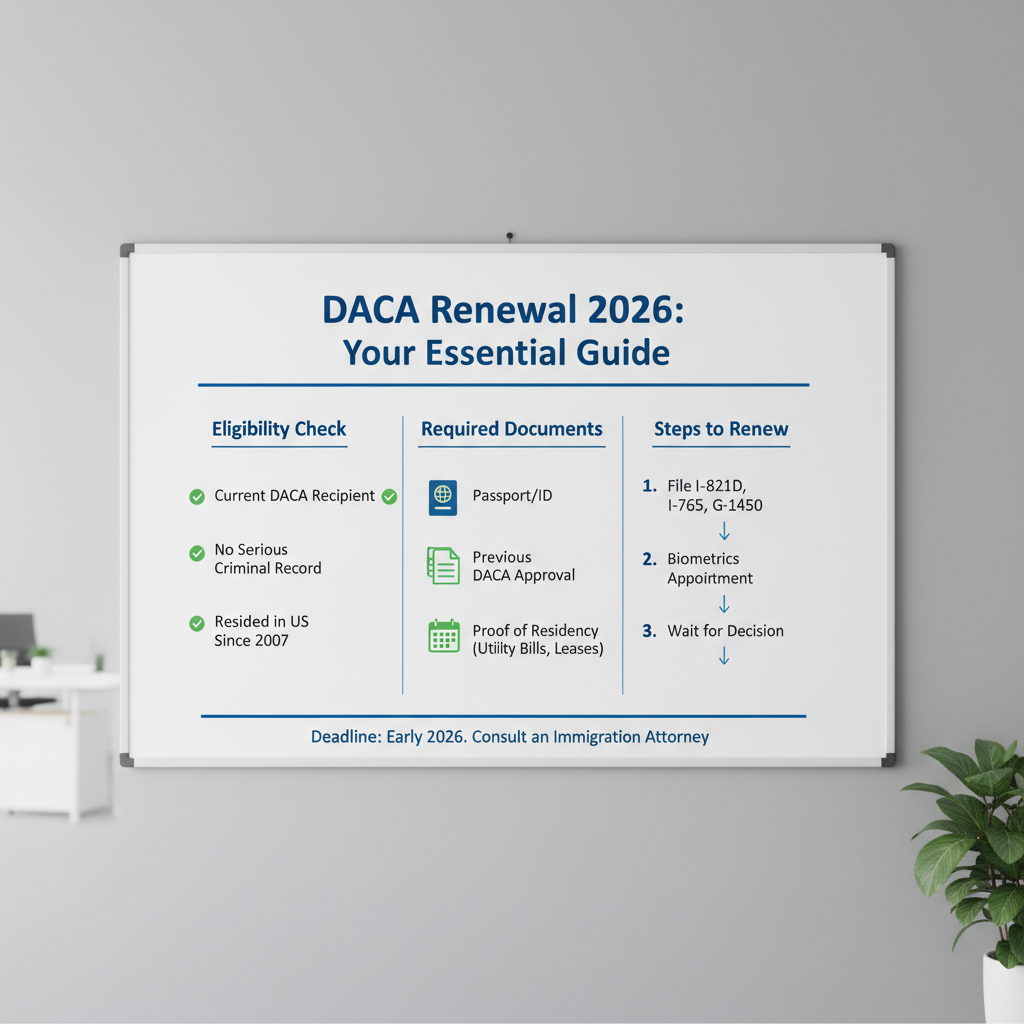
DACA Program Updates and Renewal Information (USCIS)
What This News Means for Immigrants in Orlando and Across Florida
The DACA program, first implemented in 2012, has provided a measure of stability and opportunity for eligible young undocumented immigrants who were brought to the U.S. as children. However, its future has been subject to ongoing legal challenges and policy debates, making updates from sources like USCIS incredibly important for planning and peace of mind.
Why this news is showing up now
DACA’s existence has been a continuous battleground in the courts. While new initial DACA applications have been halted by federal court orders since July 2021, the program continues to allow for renewals for those who previously held DACA status. The "news" around DACA is often a reflection of ongoing litigation, administrative clarifications from USCIS, or political discussions surrounding potential legislative solutions. As of March 31, 2026, the program remains in a state of flux for initial applicants, but crucial for renewals. USCIS regularly issues guidance and updates regarding processing procedures, fee changes, or policy interpretations that impact existing DACA recipients, making it essential to stay informed about their official announcements.
How it can affect Florida residents
Florida is home to a significant number of DACA recipients, often referred to as "Dreamers." For these individuals and their families in Orlando, Tampa, Miami, and throughout the Sunshine State, the ability to renew DACA means maintaining their work authorization, protecting them from deportation, and allowing them to continue contributing to our economy and communities. Without DACA, many would face immediate threats to their livelihoods and stability. Updates from USCIS directly impact their ability to work, drive, pursue higher education, and plan for their futures in Florida. Changes in processing times, required documents, or even the underlying legal framework can have immediate, tangible consequences for thousands of Floridians who rely on DACA.
Need Help? Our Orlando immigration team is ready to assist. Navigating DACA renewals can be complex, and we’re here to simplify the process for you. Call +1 786-791-3106 for a free consultation, or message us online. Se Habla Español.
What DACA Is (and Why It Matters)
To fully grasp the significance of DACA updates, it's crucial to understand the program itself. DACA is not a law passed by Congress, nor does it provide a pathway to U.S. citizenship or lawful permanent residency. Instead, it is a discretionary policy established by the Department of Homeland Security (DHS) in 2012.
A plain-English definition
DACA, or Deferred Action for Childhood Arrivals, is an immigration policy that allows certain undocumented immigrants who entered the United States as children to receive a renewable two-year period of deferred action from deportation and to be eligible for a work permit (Employment Authorization Document, or EAD). Essentially, it means the government agrees not to pursue deportation against you for a specific period, and you can legally work in the U.S. This provides a temporary reprieve and the ability to live and work without constant fear of removal, but it is not a permanent solution to immigration status.
Key terms you need to know
- Deferred Action: This is a discretionary determination by U.S. Citizenship and Immigration Services (USCIS) to defer removal action against an individual. It does not confer lawful status but rather indicates that the government will not pursue deportation for a specific period.
- DACA Recipient: An individual who has been granted deferred action under the DACA program.
- Dreamers: A term often used to refer to young undocumented immigrants who were brought to the U.S. as children, many of whom are eligible for or have received DACA.
- Employment Authorization Document (EAD): Also known as a work permit, this card allows DACA recipients to legally work in the United States. It is typically valid for two years, matching the DACA deferral period.
- USCIS: U.S. Citizenship and Immigration Services. This is the government agency responsible for administering immigration and naturalization benefits, including DACA.
- ICE: U.S. Immigration and Customs Enforcement. This agency is responsible for enforcing immigration laws and is involved in deportation proceedings.
- Advance Parole: A travel document that allows certain non-citizens to leave the U.S. and return without jeopardizing their immigration process or DACA status. DACA recipients can apply for advance parole under specific circumstances.
Current Immigration Law: The Foundation for DACA
While DACA itself is a policy, not a statute, its existence and administration are deeply intertwined with broader immigration law. The challenges to DACA have primarily focused on whether the Executive Branch has the authority to implement such a program without explicit Congressional authorization.
Federal requirements
The DACA policy was established via a memorandum from the Secretary of Homeland Security. The current legal status, as of March 31, 2026, is that the program continues for renewals, but new initial applications are not being processed. This is due to a federal court order in Texas v. United States. The policy draws its authority from the executive branch’s prosecutorial discretion in immigration matters, which is a long-standing principle in U.S. immigration law. The primary legal statute governing immigration is the Immigration and Nationality Act (INA), which outlines who can enter, reside, and work in the U.S. DACA provides a temporary reprieve from certain aspects of the INA, specifically deportation, through the exercise of discretionary authority by DHS.
To be eligible for DACA renewal, you must meet the initial DACA criteria and not have departed the U.S. without advance parole since August 15, 2012, or committed certain crimes or poses a threat to national security or public safety. The key forms for renewal are Form I-821D, Consideration of Deferred Action for Childhood Arrivals, Form I-765, Application for Employment Authorization, and Form I-765WS, Worksheet for Form I-765, Application for Employment Authorization.
For the most up-to-date information and official forms, always refer to the USCIS official website.
Florida-specific considerations
While DACA is a federal program, its impact on Florida residents involves state-level considerations:
- Driver's Licenses: DACA recipients in Florida are generally eligible to obtain a Florida driver's license upon presentation of their EAD and other required identification documents. This is a critical aspect of daily life, particularly in areas like Central Florida where public transportation options may be limited outside of major cities.
- In-State Tuition: Florida has a specific law (Florida Statute 1009.26) that allows certain undocumented students, including DACA recipients, to qualify for in-state tuition at public universities and colleges if they meet specific residency requirements and attended a Florida high school for at least three consecutive years. This is a huge benefit for Dreamers pursuing higher education in Orlando, Gainesville, Tallahassee, and beyond.
- Professional Licenses: DACA recipients may be eligible for certain professional licenses in Florida, depending on the specific profession and state regulations. It's essential to check with the relevant state licensing board.
- Local Engagement: Organizations in Orlando and across Orange County, such as community centers and non-profits, often provide resources and support for DACA recipients, including legal aid clinics and educational workshops.
How to Renew Your DACA: A Complete Step-by-Step Guide
Renewing your DACA is a critical process that requires attention to detail and timely submission. Here’s a comprehensive guide to help you navigate it.
1) Determine Your Eligibility for Renewal
Before you begin, confirm you are eligible for DACA renewal. USCIS generally requires that you meet the initial DACA guidelines and have continuously resided in the U.S. since receiving your most recent DACA grant. You must not have departed the United States on or after August 15, 2012, without advance parole, and you must not have been convicted of a felony, a significant misdemeanor, or three or more other misdemeanors, and not otherwise pose a threat to national security or public safety.
Reminder: If you have any new criminal history, even minor infractions, it is crucial to consult with an immigration attorney before applying for renewal. This could impact your eligibility.
2) Gather Required Documents and Information
Preparation is key. Begin collecting all necessary documents well in advance of your DACA expiration date. This typically includes:
- Your most recent DACA approval notice (Form I-797).
- Your current Employment Authorization Document (EAD).
- Copies of all previous DACA-related applications (Form I-821D, Form I-765).
- Proof of continuous residence in the U.S. since your last DACA approval (e.g., utility bills, bank statements, school records, employment records, rent receipts).
- Any documents related to criminal history (even if charges were dismissed or expunged).
- Documentation of any travel outside the U.S. with Advance Parole since your last DACA grant.
- Two passport-style photos taken within 30 days of filing.
3) Complete the Necessary USCIS Forms
You will need to accurately complete three specific forms:
- Form I-821D, Consideration of Deferred Action for Childhood Arrivals: This is the primary form for DACA itself. Ensure all questions are answered truthfully and completely.
- Form I-765, Application for Employment Authorization: This form requests your work permit. On this form, you must indicate your eligibility category as (c)(33).
- Form I-765WS, Worksheet for Form I-765, Application for Employment Authorization: This worksheet requires you to detail your economic need for the EAD. Provide clear and concise explanations.
Important: Always use the latest version of these forms, available on the USCIS Forms page. Outdated forms will be rejected.
4) Prepare Your Supporting Evidence
Organize your gathered documents as supporting evidence. This typically involves making copies of everything and compiling them in a clear, logical order. Do not send original documents unless specifically requested by USCIS, except for the two passport photos. Clearly label each piece of evidence.
Examples of supporting evidence:
- Copies of your previous DACA approval notices and EADs.
- School transcripts or diplomas.
- Employment verification letters or pay stubs.
- Bank statements showing transactions in the U.S.
- Medical records.
- Lease agreements or utility bills in your name.
- Court dispositions for any arrests or citations, even minor ones.
5) Calculate and Pay the Required Fees
As of March 31, 2026, the DACA renewal application fee is typically $495. This includes the Form I-765 fee ($410) and the biometrics services fee ($85). The Form I-821D does not have a separate fee. You can pay with a money order, personal check, cashier’s check, or by credit card using Form G-1450, Authorization for Credit Card Transactions. Make checks payable to "U.S. Department of Homeland Security." Do not abbreviate.
Warning: USCIS does not accept fee waiver requests for DACA applications. If you cannot afford the fees, you may need to seek assistance from community organizations or explore payment plans if available through legal aid services.
6) Mail Your Application Package
Once all forms are completed, signed, and all supporting documents are prepared and organized, assemble your package. We recommend sending your application via certified mail with a return receipt requested. This provides proof of mailing and delivery. The mailing address depends on your state of residence. For Florida residents, you will typically mail your application to a USCIS Lockbox facility. Always check the USCIS website for the most current filing addresses.
Important: File your renewal application approximately 120 to 150 days before your current DACA and EAD expire. Filing too early (more than 150 days) may result in rejection, and filing too late risks a lapse in your work authorization.
7) Attend Biometrics Appointment and Monitor Status
After USCIS receives your application, they will send you a receipt notice (Form I-797C). Subsequently, you may receive an appointment notice for biometrics (fingerprints and photos) at an Application Support Center (ASC). It is crucial to attend this appointment. Finally, you can monitor the status of your application online using the receipt number provided on your Form I-797C at USCIS Case Status Online. You can also check average processing times for Form I-821D and Form I-765 at USCIS Processing Times.
Confused by the DACA renewal process? Don't risk delays or denials. Let the experienced immigration attorneys at Imigrar guide you. We serve clients nationwide from our Orlando office. Call us today for a free consultation: +1 786-791-3106. Se Habla Español.
Practical Steps You Can Take Today for DACA Renewal
Being proactive is the best strategy for a smooth DACA renewal process. Here's what you can do right now:
- Check Your Expiration Date: Locate your current EAD card and DACA approval notice. Note the expiration date and mark your calendar for 120 to 150 days before it expires.
- Start Gathering Documents Early: Don't wait until the last minute. Begin collecting all necessary documents, including proof of continuous residence, previous application copies, and any relevant legal documents.
- Update Your Address with USCIS: If you've moved since your last DACA approval, file Form AR-11, Alien's Change of Address Card, online or by mail within 10 days of moving. This ensures you receive all USCIS correspondence, including biometrics notices.
- Review Your Criminal History: Be honest with yourself and, if applicable, with an attorney about any past arrests or convictions, no matter how minor. Even expunged records can impact eligibility.
- Organize Your Files: Create a dedicated folder (physical or digital) for all your DACA-related documents. This will make future renewals much easier.
- Consult an Immigration Attorney: If you have any doubts about your eligibility, continuous residence, criminal history, or simply want professional assistance, schedule a consultation with a qualified immigration lawyer. This is especially true if your case has any complexities.
Document preparation guidance
When preparing your documents, remember these tips:
- Keep Originals Safe: Never send original documents unless specifically requested. Always send clear, legible copies.
- Organize Logically: Arrange documents in the order they are referenced on the forms or by category (e.g., identity, continuous residence, employment).
- Label Clearly: If you have many supporting documents, use cover sheets or sticky notes to label sections for clarity.
- Make Copies: Make a complete copy of your entire application package before mailing it. This serves as your personal record.
Timeline expectations
While USCIS processing times can vary, here's a general timeline to expect:
- Filing Window: Submit your renewal application 120 to 150 days before your current DACA and EAD expire.
- Receipt Notice: Expect to receive a Form I-797C receipt notice within 2-4 weeks after USCIS receives your application.
- Biometrics Appointment: A biometrics appointment notice typically arrives 4-8 weeks after your application is received. The appointment itself is usually scheduled 2-4 weeks after the notice. For Central Florida residents, your appointment will likely be at the Orlando USCIS Application Support Center.
- Decision/New EAD: USCIS aims to process DACA renewals within 3-5 months. However, processing times can fluctuate significantly. Check the USCIS Processing Times page for the most current estimates.
- Lapse in EAD: If you file too late, there is a risk of your EAD expiring before your new one arrives, leading to a temporary inability to work.
How Imigrar Helps DACA Recipients in Orlando and Beyond
At Imigrar, our mission is to "Keep Families Together." We understand the unique challenges faced by DACA recipients and their families, especially with the ongoing legal and political uncertainties surrounding the program. Our dedicated team of immigration attorneys is committed to providing expert, compassionate, and effective legal representation.
Our experience and expertise cover all aspects of DACA renewals, ensuring that your application is meticulously prepared, accurately filed, and submitted on time. We guide you through every step, from gathering documents and completing complex forms to addressing any potential complications that may arise. We stay abreast of the latest USCIS policies and court decisions affecting DACA, so you don't have to.
For DACA recipients in Orlando, across the I-4 corridor, and throughout Florida, we are your trusted legal partner. We provide personalized attention, tailoring our advice to your specific circumstances, and helping you understand your rights and options. We also assist with related immigration matters, such as applications for Advance Parole for DACA recipients who need to travel for educational, employment, or humanitarian reasons.
We are proud to serve our diverse community, and we believe that everyone deserves clear, accessible legal guidance. That's why we offer a free consultation to discuss your DACA renewal or any other immigration concerns. We speak your language – Se Habla Español.
Frequently Asked Questions About DACA Renewal
Q: Am I still eligible for DACA renewal if I had a minor traffic ticket or misdemeanor since my last approval?
A: It depends on the nature and severity of the offense. USCIS reviews each case individually. A minor traffic ticket typically won't disqualify you, but any misdemeanor, even if seemingly minor (like shoplifting or DUI), can pose a significant risk. Certain misdemeanors are considered "significant," and three or more other misdemeanors will lead to disqualification. It is absolutely critical to disclose all arrests, charges, and convictions, even if they were dismissed, expunged, or occurred when you were a juvenile. Consult with an experienced immigration attorney at Imigrar immediately to assess your eligibility and develop a strategy before filing.
Q: Does DACA provide a pathway to a Green Card or U.S. citizenship?
A: No, DACA itself does not provide a direct pathway to a Green Card (lawful permanent residency) or U.S. citizenship. It only provides temporary protection from deportation and work authorization. However, some DACA recipients may become eligible for other immigration benefits through different avenues, such as marriage to a U.S. citizen or a qualifying employment-based petition, if they meet all other specific criteria. For example, some DACA recipients who entered the U.S. lawfully (even if their status later expired) or who travel with Advance Parole and re-enter lawfully may be able to adjust their status if they have an immediate relative petition. This is a complex area, and legal advice is essential.
Q: How long does DACA renewal typically take, and what if my EAD expires during processing?
A: USCIS processing times for DACA renewals can vary, but generally range from 3 to 5 months. It's crucial to file your renewal application within the recommended 120 to 150-day window before your current DACA and EAD expire. If your EAD expires while your renewal is pending, you will temporarily lose your authorization to work. Your employer is legally required to terminate your employment until you receive your new EAD. There is no automatic extension for DACA EADs. Planning ahead and filing on time is the best way to avoid a lapse.
Q: What documents are absolutely essential for a DACA renewal application?
A: The most essential documents include your most recent DACA approval notice and EAD, copies of all previous DACA applications, two passport-style photos, and comprehensive proof of continuous residence in the U.S. since your last DACA approval. This proof can include school records, employment records, bank statements, utility bills, and tax returns. If you've traveled with Advance Parole, include those documents. And, crucially, any and all court dispositions for any arrests or citations you've had. Failing to include these critical documents can lead to delays or even a denial.
Q: What are the costs associated with DACA renewal, and are there any fee waivers available?
A: As of March 31, 2026, the total fee for a DACA renewal application is typically $495, which covers the Form I-765 fee ($410) and the biometrics services fee ($85). The Form I-821D itself does not have a fee. Unfortunately, USCIS does not accept fee waiver requests for DACA applications. If you are facing financial hardship, you may need to seek assistance from community organizations or legal aid services that sometimes offer pro bono or low-cost assistance, or discuss payment options with your legal representative.
Q: What happens if my DACA renewal application is denied? Can I reapply?
A: If your DACA renewal application is denied, USCIS will send you a written explanation for the denial. The ability to reapply depends entirely on the reason for the denial. If the denial was due to a correctable issue (e.g., missing documents, incorrect fees), you might be able to reapply after addressing the problem. However, if the denial was due to eligibility concerns (e.g., criminal history, failure to meet continuous residence), reapplying without addressing the underlying issue or without new evidence would likely result in another denial. In any denial situation, it is paramount to consult with an immigration attorney immediately to understand the reasons for the denial and explore any potential recourse or alternative options. Do not attempt to reapply without legal guidance.
Common Mistakes in DACA Renewal Applications (and How to Avoid Them)
Even for those who have renewed DACA multiple times, mistakes can happen. Avoiding these common pitfalls can save you time, stress, and potential denial.
Mistake #1: Filing Too Late or Too Early
Description: Many DACA recipients either file their renewal application too close to their expiration date, risking a lapse in their work authorization, or too early (more than 150 days before expiration), which can lead to rejection by USCIS. A lapse in EAD means you cannot legally work during the processing period, which can cause significant financial hardship.
How to Avoid: Mark your calendar! Aim to file your renewal application within the 120 to 150-day window before your current DACA and EAD expire. Set reminders on your phone, email, or a physical calendar. Begin preparing your documents 6 months out to ensure you have everything ready for timely submission.
Mistake #2: Incomplete or Inaccurate Forms
Description: Leaving questions blank, providing inconsistent information, or making typographical errors on Form I-821D, Form I-765, or Form I-765WS. This is a common reason for USCIS to send a Request for Evidence (RFE) or even deny an application. Even a seemingly minor error can cause delays.
How to Avoid: Read all instructions carefully. Answer every question truthfully and completely. If a question does not apply, write "N/A" (Not Applicable). Review your forms multiple times before mailing. Better yet, have an experienced immigration attorney review your completed forms for accuracy and completeness. Ensure your name and address are consistent across all forms and documents.
Mistake #3: Lack of Sufficient Supporting Documentation
Description: Not providing enough evidence to prove continuous residence or failing to include necessary copies of previous DACA approvals and EADs. USCIS requires clear evidence for all eligibility criteria, and simply stating you meet them is not enough


