

For hundreds of thousands of young people across the United States, including many here in Orlando and throughout Florida, the Deferred Action for Childhood Arrivals (DACA) program represents a lifeline. It provides temporary protection from deportation and the ability to work legally, offering a sense of stability and opportunity that many have never known. As of April 7, 2026, DACA continues to be a subject of ongoing legal and political discussion, making it more critical than ever for recipients to stay informed about its status and renewal process.
At Imigrar, an immigration law firm based in Orlando, Florida, we understand the profound impact DACA has on families and individuals. Our mission is to "Keep Families Together," and that commitment extends to supporting our DACA community. This comprehensive guide will break down the latest updates, provide a detailed step-by-step renewal process, and offer practical advice to help you navigate this complex landscape.
The reporting that sparked this guide
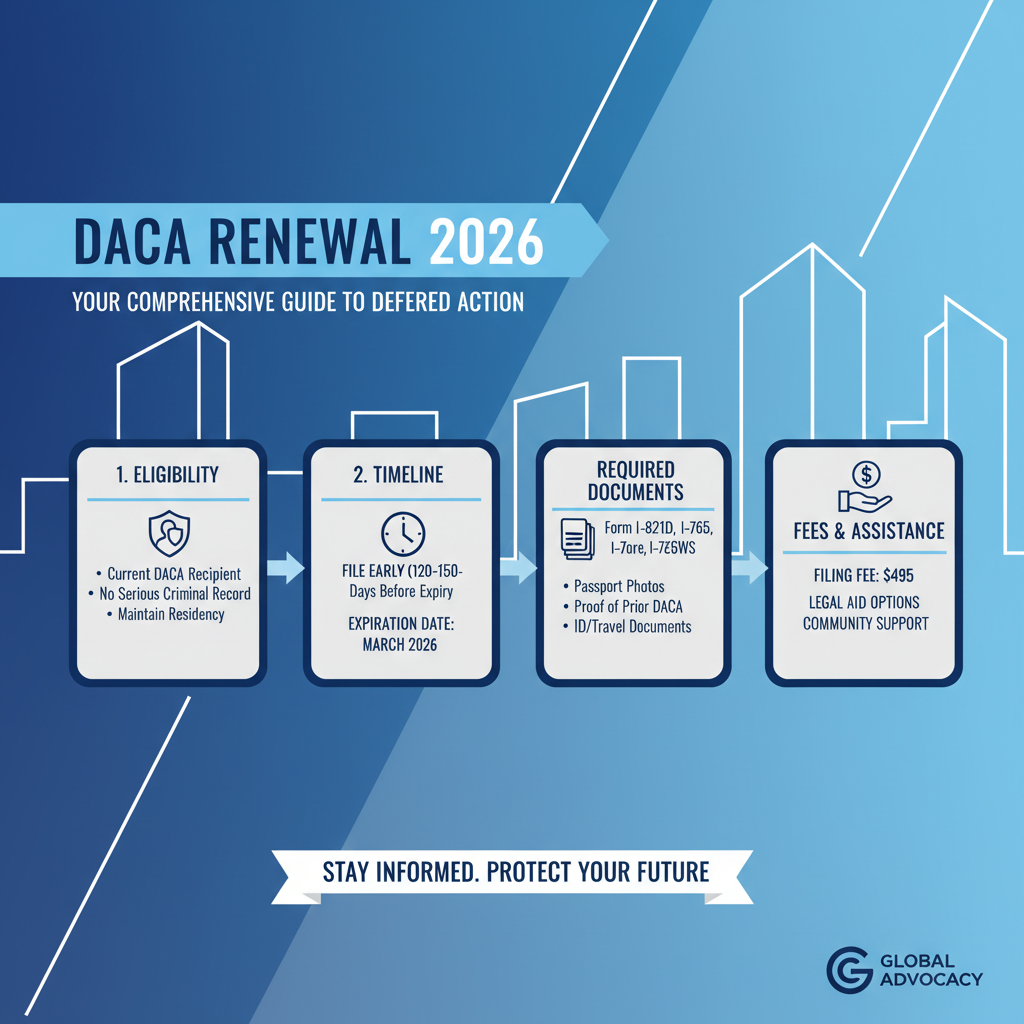
This guide is inspired by the ongoing national conversation and updates surrounding the Deferred Action for Childhood Arrivals (DACA) program, as highlighted by reports from official government sources and news outlets covering immigration law.
DACA Program Updates and Renewal Information (USCIS)
What This News Means for Immigrants in Orlando and Across Florida
The continuous flow of news regarding DACA can be a source of anxiety and confusion for many, especially for the approximately 20,000 DACA recipients currently residing in Florida. Understanding the nuances of these updates is crucial for planning your future and ensuring your continued protection.
Why this news is showing up now
The DACA program, established in 2012, has been embroiled in legal battles and political debates almost since its inception. Several key factors contribute to the ongoing news cycle:
- Ongoing Legal Challenges: DACA has faced multiple lawsuits challenging its legality. While the Supreme Court initially blocked the Trump administration's attempt to end DACA, subsequent rulings from lower courts, particularly the U.S. Fifth Circuit Court of Appeals, have found the program unlawful. These rulings have generally allowed DACA renewals to continue but prohibit new initial applications. The legal landscape is constantly shifting, with appeals and new court orders emerging regularly.
- Administrative Updates from USCIS: The U.S. Citizenship and Immigration Services (USCIS) is the agency responsible for processing DACA applications. As court orders evolve, USCIS issues new guidance, forms, and processing instructions. These updates are vital for current DACA recipients to understand the precise requirements for renewal.
- Political Discussions: DACA remains a central topic in congressional debates about comprehensive immigration reform. Lawmakers frequently propose legislative solutions, though none have passed. The political climate surrounding immigration, especially in an election year or during periods of significant policy changes, keeps DACA in the headlines.
- Impact on DREAMers: The lives of hundreds of thousands of DACA recipients, often referred to as DREAMers, are directly affected by these developments. Their ability to work, study, and live without fear of deportation is tied to the program's status, making every update profoundly personal and newsworthy.
As of April 7, 2026, the current situation, stemming from a September 2023 ruling by U.S. District Judge Andrew Hanen and upheld by the Fifth Circuit, is that USCIS can continue to accept and process DACA renewal applications, but it cannot process initial DACA requests. This legal limbo means that while current recipients can maintain their status, the program remains vulnerable to future legal challenges and offers no pathway for new applicants.
How it can affect Florida residents
The implications of these DACA updates are particularly significant for Florida residents:
- Employment Stability: DACA provides work authorization (Employment Authorization Document - EAD), allowing recipients to contribute to Florida’s economy. Any disruption to the renewal process or the program's existence would jeopardize thousands of jobs in Orlando, Tampa, Miami, and other cities across the state. Many DACA recipients work in critical sectors, including healthcare, education, and technology.
- Educational Opportunities: DACA recipients in Florida may be eligible for in-state tuition at public colleges and universities, a crucial benefit for pursuing higher education. Uncertainty around DACA can impact enrollment decisions and financial planning for students across Central Florida and beyond.
- Family Unity: Many DACA recipients are integral members of mixed-status families, often with U.S. citizen spouses, children, or parents. The potential loss of DACA protection could mean family separation, directly contradicting Imigrar's mission to "Keep Families Together."
- Local Economy: DACA recipients contribute significantly to the tax base and consumer spending in Florida. A stable DACA program means a stable workforce and a stronger local economy in areas like Orlando, a hub for diverse communities.
- Access to Driver's Licenses: With a valid EAD, DACA recipients in Florida can obtain a driver's license, enabling them to commute to work, school, and fulfill daily responsibilities. Losing DACA status would remove this privilege, impacting mobility and independence.
For DACA recipients in Orlando, staying informed and taking proactive steps for renewal is paramount. The Orlando USCIS Field Office typically handles interviews for certain immigration benefits, but DACA renewals are primarily adjudicated at service centers. However, local resources and legal counsel remain vital for navigating the process.
Need Help? Our Orlando immigration team is ready to assist. Call +1 786-791-3106 for a free consultation, or message us online. Se Habla Español.
What DACA Is (and Why It Matters)
To fully grasp the significance of DACA updates, it's essential to understand the program itself and the key terminology associated with it.
A plain-English definition
DACA stands for Deferred Action for Childhood Arrivals. It is an immigration policy established by the Obama administration in June 2012. DACA provides a temporary form of immigration relief to eligible undocumented immigrants who came to the United States as children. It is not a path to citizenship or legal permanent residency, but rather a temporary measure that offers two primary benefits:
- Deferred Action: This means that for a specific period (typically two years), the U.S. government agrees not to initiate removal (deportation) proceedings against the individual. This "deferred action" can be renewed.
- Work Authorization: Along with deferred action, DACA recipients are eligible to apply for an Employment Authorization Document (EAD), commonly known as a work permit. This allows them to legally work in the United States.
In essence, DACA allows eligible young people, often referred to as DREAMers, to live and work in the U.S. without immediate fear of deportation, enabling them to pursue education, employment, and contribute more fully to society. It offers a crucial, albeit temporary, sense of security and opportunity.
Key terms you need to know
- Deferred Action: An exercise of prosecutorial discretion to defer removal action against an individual for a certain period. It does not confer lawful status but prevents deportation during the deferral period.
- Employment Authorization Document (EAD): Also known as a work permit, this card (Form I-766) is issued by USCIS to individuals authorized to work in the United States. DACA recipients receive an EAD valid for the period of their deferred action.
- USCIS: The U.S. Citizenship and Immigration Services is the government agency within the Department of Homeland Security (DHS) that oversees lawful immigration to the United States. They process DACA applications.
- DREAMer: A term often used to refer to young undocumented immigrants who were brought to the U.S. as children. It originated from the proposed "Development, Relief, and Education for Alien Minors Act" (DREAM Act), which aimed to provide a pathway to legal status for these individuals.
- Initial Application: The first time an individual applies for DACA. Important: As of April 7, 2026, USCIS is *not* accepting or processing initial DACA applications due to ongoing court orders.
- Renewal Application: The process by which current DACA recipients apply to extend their deferred action and employment authorization for another period, typically two years. This process *is* currently being accepted and processed by USCIS.
- Form I-821D: The specific USCIS form, "Consideration of Deferred Action for Childhood Arrivals," used for DACA requests.
- Form I-765: The USCIS form, "Application for Employment Authorization," submitted alongside Form I-821D to request a work permit.
- Form I-765WS: The USCIS form, "Worksheet for Form I-765, Application for Employment Authorization," used to demonstrate economic need for employment.
- Biometrics Appointment: A required appointment at an Application Support Center (ASC) where USCIS collects fingerprints, photographs, and signatures for background checks.
Current Immigration Law: The Foundation for DACA
DACA operates in a unique space within immigration law, as it is a program created through executive action rather than an act of Congress. This distinction is at the heart of the legal challenges it faces. While not a statute itself, its implementation and continued existence are governed by executive authority and judicial review.
Federal requirements
To be eligible for DACA (for renewal purposes, as initial applications are not currently accepted), you must meet several federal requirements. These criteria were established in the original 2012 memo and have largely remained consistent:
- Age: You must have been under the age of 31 as of June 15, 2012.
- Entry into U.S.: You must have come to the United States before your 16th birthday.
- Continuous Residence: You must have continuously resided in the United States since June 15, 2007, up to the present time. Brief, casual, and innocent departures from the U.S. do not break continuous residence.
- Physical Presence: You must have been physically present in the United States on June 15, 2012, and at the time of making your request for deferred action.
- Education Status: You must currently be in school, have graduated or obtained a certificate of completion from high school, have obtained a general education development (GED) certificate, or be an honorably discharged veteran of the Coast Guard or Armed Forces of the United States.
- Criminal History: You must not have been convicted of a felony, a significant misdemeanor, or three or more other misdemeanors, and must not otherwise pose a threat to national security or public safety.
For renewals, USCIS mainly focuses on ensuring you continue to meet the original criteria, particularly continuous residence and the absence of new disqualifying criminal convictions. It’s crucial to use the latest versions of the required forms: Form I-821D, Form I-765, and Form I-765WS. You can always find the most up-to-date forms and instructions on the USCIS official website.
Florida-specific considerations
While DACA is a federal program, its impact and certain ancillary benefits can vary by state. For DACA recipients in Florida, there are several important considerations:
- Driver's Licenses: With a valid EAD and DACA approval, DACA recipients in Florida are eligible to apply for a Florida driver's license or state identification card. This is critical for daily life, employment, and navigating Central Florida's expansive road networks.
- In-State Tuition: Under Florida law, DACA recipients who meet certain residency requirements may be eligible for in-state tuition at Florida public colleges and universities. This provides a significant financial advantage for pursuing higher education at institutions like the University of Central Florida in Orlando.
- Professional Licenses: The ability to obtain professional licenses (e.g., nursing, teaching) for DACA recipients can vary based on state regulations and individual board requirements. It's essential to check with the relevant Florida licensing board.
- Local Resources: Many community organizations and non-profits in Orlando, Orange County, and other parts of Florida offer support, legal aid referrals, and educational resources specifically for DACA recipients. Imigrar frequently collaborates with these organizations to ensure comprehensive support for the community.
Reminder: DACA does not provide a direct pathway to U.S. citizenship or lawful permanent residency. However, in some limited circumstances, a DACA recipient might be eligible for other immigration benefits through a U.S. citizen spouse, parent, or employer, depending on their entry into the U.S. and other factors. These situations are highly complex and require expert legal advice.

How to Renew Your DACA: A Complete Step-by-Step Guide
Renewing your DACA is a critical process that requires meticulous attention to detail and adherence to specific timelines. Missing a deadline or making errors can lead to a lapse in your work authorization and deferred action, potentially impacting your employment and putting you at risk of removal proceedings. Follow this detailed guide carefully.
1) Determine Your Eligibility and When to Apply
Before you begin, confirm you still meet the DACA eligibility criteria. The most common reasons for potential ineligibility for renewal include significant criminal convictions or extended unauthorized departures from the U.S. If you have any new arrests or convictions since your last DACA approval, consult with an attorney immediately.
When to Apply: USCIS recommends filing your DACA renewal application between 120 and 150 days before your current Form I-765 (EAD) expires. This window allows ample time for processing without your DACA expiring. Filing too early (more than 150 days) may result in your application being rejected. Filing too late risks a lapse in your employment authorization and deferred action. If your DACA has already expired, you can still file a renewal, especially if it expired less than a year ago. If it expired more than a year ago, USCIS may still accept it, but you should strongly consider consulting with an attorney to explain the delay.
- Key Action: Check the expiration date on your current EAD card immediately. Mark your calendar for the 120- to 150-day window.
2) Gather Required Documents
Having all your documents ready before you start filling out forms will streamline the process and reduce the chance of errors. For renewals, the required documentation is generally less extensive than for an initial application, but still crucial.
Required Documents (Copies Only, Unless Original Requested):
- Previous DACA Approval Notice: A copy of your most recent Form I-797, Notice of Action, showing your DACA approval.
- Current Employment Authorization Document (EAD): A copy of the front and back of your most recent Form I-766 (work permit).
- Two Passport-Style Photos: Taken within 30 days of filing your application, white background, unretouched. Write your name and A-number lightly on the back of each photo.
- Proof of Identity: A copy of a government-issued photo ID (e.g., driver's license, state ID, passport).
- Criminal History Records (if applicable): If you have been arrested or convicted of any crime since your last DACA approval, you *must* include certified court dispositions and police reports. Failure to disclose can lead to denial and serious immigration consequences. Even minor offenses should be disclosed.
- Proof of Continuous Residence (Optional for most renewals): For renewals, you generally do not need to resubmit extensive proof of continuous residence unless there has been a significant change in your living situation or if USCIS specifically requests it. However, it's wise to have documents like utility bills, bank statements, school records, or employment records readily available, especially if you have had any issues or gaps in your previous residence proofs.
Important: Never send original documents unless USCIS specifically requests them. Always keep copies of everything you submit.
3) Complete Forms I-821D, I-765, and I-765WS
These are the core forms for your DACA renewal. Ensure you download the absolute latest versions from the USCIS Forms page. Instructions often change, so using an outdated form can lead to rejection.
- Form I-821D, Consideration of Deferred Action for Childhood Arrivals:
- Fill out every applicable field completely and accurately. If a question does not apply, write "N/A" (not applicable).
- Ensure all dates, names, and addresses match your previous applications and supporting documents.
- Sign the form in blue ink.
- Form I-765, Application for Employment Authorization:
- Complete all sections. For DACA renewals, your eligibility category is usually (c)(33).
- Ensure your name and address match Form I-821D.
- Sign the form in blue ink.
- Form I-765WS, Worksheet for Form I-765, Application for Employment Authorization:
- This form helps USCIS determine if there is an economic need for employment. Fill it out truthfully.
- Ensure all information is consistent with your other forms.
Warning: Any inaccuracies or omissions can cause delays or even a denial. If you are unsure about any question, seek legal advice.
4) Prepare Your Application Packet
Organizing your application packet correctly can prevent processing delays. USCIS has specific recommendations for how to assemble documents.
- Cover Letter (Optional but Recommended): A simple cover letter listing the contents of your application can be helpful. Include your name, A-number, and a list of all forms and supporting documents enclosed.
- Order of Documents: USCIS generally prefers documents in the following order:
- Payment (check or money order clipped to the top)
- Form I-821D
- Form I-765
- Form I-765WS
- Supporting documents (e.g., EAD copy, DACA approval notice, photos, criminal records)
- Tabs and Separators: Use tabs or labels to clearly separate sections, especially if you have many supporting documents.
- Copies: Make a complete copy of the *entire* application packet for your records before mailing it. This includes all forms, supporting documents, and the payment method.
5) Calculate and Submit Fees
The DACA renewal fee is a combination of the Form I-765 fee and the biometrics services fee. USCIS fees can change, so always verify the current amounts on the USCIS official website.
- Current Total Fee: As of April 7, 2026, the fee for DACA renewal is $495. This includes:
- Form I-765 Application Fee: $410
- Biometrics Services Fee: $85
- Payment Method: You can pay by money order, personal check, cashier's check, or by credit card using Form G-1450, Authorization for Credit Card Transactions.
- If paying by check or money order, make it payable to "U.S. Department of Homeland Security." Do not abbreviate.
- Staple the check/money order to the top of Form I-821D.
- Fee Waivers: Fee waivers for DACA applications are extremely rare and generally only granted in very limited circumstances based on extreme financial hardship. It is best to plan on paying the full fee. If you believe you qualify for a waiver, consult an attorney.
6) Mail Your Application to USCIS
The correct mailing address depends on where you live. USCIS uses specific Lockbox facilities to receive applications. Sending your application to the wrong address will cause delays.
- USCIS Lockbox Addresses: Check the "Where to File" section on the USCIS Form I-821D page (or the general USCIS forms page) for the precise Lockbox address for DACA applications based on your state of residence. For Florida residents, it typically goes to the Dallas Lockbox facility.
- Shipping Method: Always use a mailing service that provides tracking and delivery confirmation, such as USPS Certified Mail with Return Receipt, FedEx, or UPS. This provides proof that you sent your application and that USCIS received it.
7) Attend Biometrics Appointment and Monitor Your Case
After USCIS receives


