


The landscape of immigration law is constantly shifting, and few programs embody this dynamic more than the Deferred Action for Childhood Arrivals (DACA). For nearly a decade and a half, DACA has provided a lifeline for hundreds of thousands of young people, offering them temporary protection from deportation and the ability to work legally in the United States. As we navigate 2026, understanding the latest updates and the precise steps for renewal is more critical than ever.
Need Help? Our Orlando immigration team is ready to assist. Call +1 786-791-3106 for a free consultation, or message us online. Se Habla Español.
At Imigrar, we understand the anxiety and uncertainty that can accompany these changes. Our mission is to "Keep Families Together" by providing clear, accurate, and actionable legal guidance. This comprehensive guide aims to demystify the DACA renewal process for 2026, offering peace of mind and empowering you with the knowledge you need to protect your status.
Whether you’re in Orlando, Central Florida, or anywhere nationwide, the information contained here will help you understand the current state of DACA, its requirements, and how to successfully renew your deferred action and work authorization.
The reporting that sparked this guide: DACA Program Updates and Renewal Information (USCIS)
What This News Means for Immigrants in Orlando and Across Florida
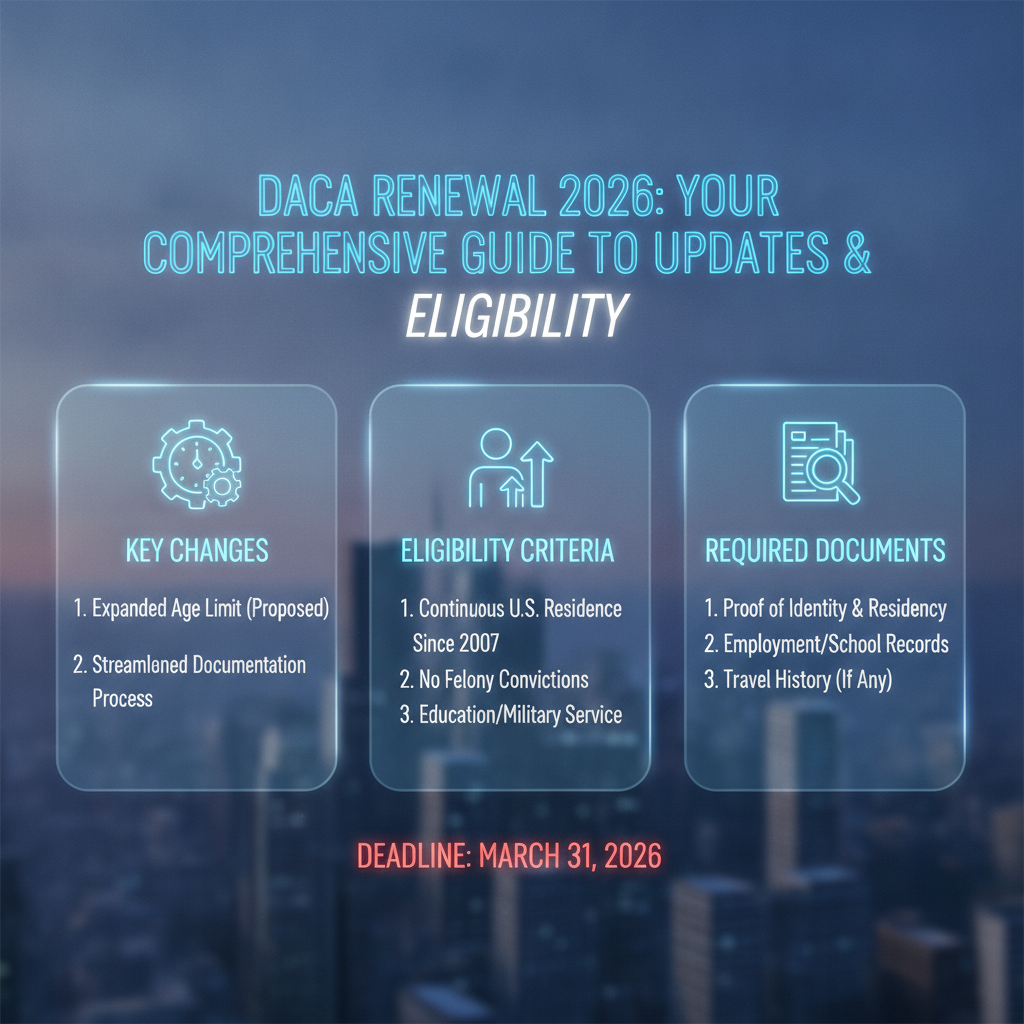
Recent reports from USCIS and ongoing discussions highlight the continued importance of adhering to established procedures for DACA renewals. While the program remains under legal scrutiny, the ability to renew continues to be a crucial aspect of many lives. For DACA recipients in Florida, staying informed and acting proactively is not just advisable, it’s essential.
Why this news is showing up now
The DACA program, originally established in 2012, has faced numerous legal challenges and administrative policy shifts throughout its existence. Despite attempts to terminate it, court orders have largely kept the program alive, specifically allowing for renewals. However, new applications have generally been halted for years, following a 2021 federal court ruling that found the program unlawful. This means that for individuals who have never held DACA, applying for the first time is still not possible as of June 2026.
The current news cycle often reflects the ongoing legal battles, administrative updates from USCIS regarding processing times or policy clarifications, and the advocacy efforts pushing for a permanent legislative solution. Each update, no matter how small, reinforces the need for existing DACA recipients to understand their ongoing obligations for renewal to maintain their protections. The legal status of DACA is often described as being in a state of "limbo," making continuous monitoring of official sources like the USCIS official website and seeking legal counsel paramount.
How it can affect Florida residents
Florida is home to a significant number of DACA recipients who contribute vibrantly to our communities, economy, and culture. For those living in Orlando, Central Florida, and across the state, the ability to renew DACA directly impacts their lives in profound ways:
- Employment Stability: DACA provides work authorization (via Form I-765, Employment Authorization Document or EAD), allowing individuals to legally work and contribute to Florida's workforce. Without renewal, this authorization expires, potentially leading to job loss and economic hardship.
- Educational Opportunities: While Florida does not offer in-state tuition benefits to all DACA recipients universally, some institutions or specific programs may have provisions. Maintaining DACA status ensures continued eligibility for any such opportunities and access to higher education.
- Driver's Licenses: In Florida, DACA recipients are generally eligible to apply for a driver's license, which requires a valid EAD and proof of deferred action. Renewal is crucial to maintain this essential privilege, facilitating daily life, commuting along the busy I-4 corridor, and accessing services.
- Family Security: DACA status provides a measure of stability and protection from deportation, allowing families to remain united. The fear of separation is a constant concern for many mixed-status families in Orange County and beyond. Timely renewal helps "Keep Families Together."
- Community Engagement: DACA recipients are active members of their communities, running businesses, volunteering, and participating in civic life. Maintaining DACA allows them to continue these contributions without fear of sudden disruption.
The Orlando USCIS Field Office processes various immigration applications, and while DACA renewals are typically handled through specific Lockbox facilities, the local office remains a resource for other related immigration matters. Being informed about DACA updates ensures that Florida residents can plan their futures with greater certainty, despite the program's uncertain long-term future.
What DACA Is (and Why It Matters)
The Deferred Action for Childhood Arrivals (DACA) program is a U.S. immigration policy that allows certain undocumented immigrants who entered the country as minors to receive a renewable two-year period of deferred action from deportation and eligibility for a work permit.
A plain-English definition
Think of DACA as a temporary legal shield. It doesn't grant you a green card or a path to U.S. citizenship. Instead, it tells the government, "For now, we won't actively try to deport you, and we'll let you work legally." This "deferred action" is essentially a promise not to pursue removal proceedings against you for a specified period, typically two years. It's renewable, meaning you can apply to extend this protection every two years, provided you continue to meet the eligibility criteria.
The program was created by the Obama administration in June 2012 via a memorandum from the Secretary of Homeland Security. It was designed to address the unique situation of "Dreamers" – individuals brought to the U.S. as children who have grown up here and often know no other home.
Key terms you need to know
- Deferred Action: This is the core benefit of DACA. It means that U.S. Citizenship and Immigration Services (USCIS) has chosen to delay removal proceedings against an individual for a specific period. It is a discretionary act and can be terminated at any time.
- DACA Recipient: An individual who has been granted Deferred Action for Childhood Arrivals.
- Employment Authorization Document (EAD): Also known as a work permit or work authorization card, this document (Form I-766) allows DACA recipients to legally work in the United States. It is granted for the same two-year period as the deferred action.
- USCIS: U.S. Citizenship and Immigration Services, the federal agency responsible for administering the country's lawful immigration system, including DACA applications.
- Childhood Arrivals: Refers to the requirement that individuals must have been under the age of 16 when they entered the United States.
- Continuous Residence: A crucial eligibility requirement for DACA, meaning the applicant has resided continuously in the U.S. since a specific date (typically June 15, 2007, for initial applications, and since the last DACA approval for renewals).
- Lawful Presence: Although DACA grants deferred action and work authorization, it does not grant "lawful presence" for all purposes, nor does it provide a direct path to a green card or U.S. citizenship.
Understanding these terms is vital for accurately navigating your DACA renewal and understanding the scope and limitations of the program.
Need Help? Our Orlando immigration team is ready to assist. Call +1 786-791-3106 for a free consultation, or message us online. Se Habla Español.
Current Immigration Law: The Foundation
The DACA program operates under specific administrative guidelines and is not a statutory law passed by Congress. Its legal basis stems from a 2012 memorandum issued by then-Secretary of Homeland Security Janet Napolitano. This memo outlined the criteria for exercising prosecutorial discretion in immigration cases involving certain young people. While not a law, subsequent administrations have either sought to rescind, maintain, or codify the program, leading to a complex legal history.
As of June 2026, DACA continues to exist largely due to various court injunctions. A key development was the July 2021 ruling by a federal judge in *Texas v. United States*, which found the 2012 DACA memorandum unlawful. This ruling prohibited USCIS from approving new DACA applications. However, the court allowed USCIS to continue processing renewal applications for individuals who previously received DACA. This distinction is critical: if you’ve never had DACA, you cannot apply now; if you have, you can renew.
Federal requirements for DACA renewal
To be eligible for DACA renewal, you must meet the following federal requirements:
- You must have received DACA previously.
- You must have not departed the United States on or after August 15, 2012, without advance parole.
- You must have continuously resided in the United States since you submitted your most recent DACA request that was approved.
- You must not have been convicted of a felony, a significant misdemeanor, or three or more other misdemeanors, and not otherwise pose a threat to national security or public safety.
Important: USCIS explicitly states that if you meet these criteria, you should file your renewal application. The agency recommends filing your renewal request between 120 and 150 days before your current DACA and EAD expire. Filing too early (more than 150 days) might lead to rejection, while filing too late could result in a lapse in your work authorization and deferred action.
The primary forms for DACA renewal are:
- Form I-821D, Consideration of Deferred Action for Childhood Arrivals
- Form I-765, Application for Employment Authorization
- Form I-765W, Worksheet for Form I-765 (used to determine eligibility for certain EAD categories related to DACA)
These forms, along with detailed instructions and current filing fees, are available on the USCIS Forms page. Always use the most current version of the forms.
Florida-specific considerations
While DACA is a federal program, its impact on daily life is often shaped by state and local policies. For DACA recipients in Florida, here are some key considerations:
- Driver's Licenses: The Florida Department of Highway Safety and Motor Vehicles (FLHSMV) generally allows DACA recipients to obtain a driver's license, provided they present a valid Employment Authorization Document (EAD) (Form I-766) and proof of deferred action. Warning: Allowing your DACA and EAD to expire will mean your Florida driver's license will also become invalid, potentially leading to serious legal issues if you continue to drive.
- In-State Tuition: Florida state law generally ties in-state tuition eligibility to lawful permanent residency or other specific immigration statuses that DACA does not confer. However, some individual colleges or universities may have specific policies or scholarships for DACA recipients. It's crucial to check with the financial aid and admissions offices of specific institutions if you plan to pursue higher education in Florida.
- Professional Licenses: Eligibility for professional licenses (e.g., nursing, real estate, cosmetology) in Florida often depends on lawful presence and, in some cases, U.S. citizenship or specific immigration statuses. While DACA grants work authorization, it does not guarantee eligibility for all professional licenses. Research specific state board requirements for your chosen profession.
- Local Community Support: Orlando and surrounding Central Florida communities have various non-profit organizations and legal aid groups that offer support, resources, and sometimes even assistance with DACA renewals. Imigrar is proud to be part of this network, providing expert legal services to our neighbors.
Reminder: The legal landscape for DACA recipients in Florida, especially regarding state-level benefits, can be complex and subject to change. Consulting with an experienced immigration attorney is always recommended to understand your specific rights and options.
How to Renew Your DACA: A Complete Step-by-Step Guide
Renewing your DACA is a critical process that requires attention to detail and timely action. Follow this step-by-step guide to help ensure a smooth application process.
1) Confirm Your Eligibility and Gather Essential Documents
Before you begin, re-confirm that you meet the renewal criteria. You must have continuously resided in the U.S. since your last DACA approval and have not been convicted of any disqualifying crimes. Start gathering all necessary documents well in advance. Losing precious time searching for documents can lead to late filing.
Required Documents (Checklist):
- Your most recent DACA approval notice (Form I-797).
- Your current Employment Authorization Document (EAD card, Form I-766).
- Copies of any previous DACA approval notices and EADs.
- Proof of continuous residence since your last DACA approval. This can include:
- Bank statements
- Utility bills (electricity, water, gas)
- Lease agreements or rent receipts
- School transcripts or diplomas
- Employment records, pay stubs, W-2s
- Medical records
- Affidavits from friends, family, or employers (with supporting documents)
- Two recent, identical passport-style photographs (2x2 inches, white background, taken within the last 30 days). Write your A-number on the back lightly in pencil.
- Copies of all pages of your passport, if available.
- Copies of any prior travel documents (e.g., advance parole).
- Proof of identity (e.g., birth certificate with translation, national ID card).
- If applicable, certified court dispositions for any arrests or convictions, even if dismissed or expunged. Important: Do NOT omit any criminal history, no matter how minor. Consult an attorney if you have any criminal record.
2) Complete Forms I-821D, I-765, and I-765W
These forms are the core of your renewal application. Download the latest versions from the USCIS Forms page. Fill them out accurately and completely. You can type or print clearly in black ink.
- Form I-821D, Consideration of Deferred Action for Childhood Arrivals:
- Pay close attention to Part 1 (Information About You), Part 2 (Eligibility Requirements), and Part 3 (Biographic Information).
- Ensure all dates, addresses, and criminal history questions are answered truthfully and precisely.
- If you have traveled outside the U.S. since your last DACA approval, ensure you provide details, especially if you had advance parole.
- Sign and date the form.
- Form I-765, Application for Employment Authorization:
- This form requests your personal information, reason for applying (renewal), and immigration history.
- For question 27, "Eligibility Category," enter (c)(33).
- Sign and date the form.
- Form I-765W, Worksheet for Form I-765:
- This worksheet helps USCIS determine your eligibility for the fee exemption for Form I-765. While most DACA renewals require the fee, this form is still required for category (c)(33) filers.
- Fill it out completely, even if you don't believe you qualify for a fee waiver.
Warning: Any inconsistencies or missing information can lead to a Request for Evidence (RFE) or even a denial. If you're unsure about any question, do not guess; seek legal advice.
3) Prepare the Filing Fees
As of June 2026, the total filing fee for a DACA renewal is typically $495. This includes:
- $410 for Form I-765 (Application for Employment Authorization).
- $85 for the biometric services fee.
Form I-821D does not have a separate filing fee. You must submit both fees together. Acceptable payment methods include money order, personal check, cashier's check, or credit card using Form G-1450, Authorization for Credit Card Transactions. Make checks or money orders payable to "U.S. Department of Homeland Security." Do NOT send cash.
Reminder: Fee waivers for DACA renewal are extremely rare and only granted in very specific circumstances (e.g., severe financial hardship that meets specific poverty guidelines). If you intend to request a fee waiver, consult an attorney as the criteria are stringent, and an incorrect request can delay or jeopardize your application.
4) Assemble and Submit Your Application Package
Organize your application meticulously. This step is crucial for ensuring USCIS receives and processes your documents correctly.
- Stack Order: While USCIS doesn't mandate a strict order for DACA applications, a common and recommended order is:
- Payment (check/money order or Form G-1450 on top).
- Two passport-style photos in a small envelope stapled to the upper left corner of Form I-765.
- Form I-765.
- Form I-765W.
- Form I-821D.
- Supporting documents for Form I-821D (proof of continuous residence, previous DACA notices, etc.).
- Supporting documents for Form I-765 (EAD copies, identity).
- Any criminal history documentation.
- Copies: Make a complete copy of your entire application package for your records before mailing it.
- Mailing Address: Send your application to the correct USCIS Lockbox facility. The address depends on your state of residence. For Florida residents, check the USCIS Direct Filing Addresses for Form I-821D page.
- Shipping: Use a reputable mail service that provides tracking and delivery confirmation (e.g., USPS Certified Mail, FedEx, UPS). This provides proof of mailing and delivery.
5) Attend Your Biometrics Appointment
After USCIS accepts your application, you will receive an appointment notice (Form I-797C, Notice of Action) for a biometrics services appointment at an Application Support Center (ASC). This typically happens within a few weeks to a few months after filing.
- What to Bring: Your appointment notice, a valid photo ID (e.g., passport, state driver's license), and any other requested documents.
- What Happens: At the ASC, your fingerprints, photograph, and signature will be collected. This information is used for background checks.
- No Interview: For DACA renewals, an interview is generally not required unless there are specific issues with your application.
Important: Do not miss your biometrics appointment. If you have an unavoidable conflict, follow the instructions on your notice to reschedule, but be aware this can delay your application.
6) Monitor Your Case Status and Receive Decision
Once your application is submitted, you can track its progress online. USCIS will send you a receipt notice (Form I-797C) with a 13-character receipt number.
- Online Tracking: Use your receipt number to check your case status on the USCIS Case Status Online tool.
- Processing Times: Check the USCIS Processing Times page for an estimate of how long your application might take. Processing times for DACA renewals can vary significantly.
- Requests for Evidence (RFEs): If USCIS needs more information or clarification, they will send you an RFE. Respond promptly and thoroughly, preferably with legal assistance.
- Decision: If approved, you will receive a new DACA approval notice (Form I-797) and your new EAD card (Form I-766) in the mail. If denied, you will receive a denial letter explaining the reasons.
Reminder: Keep all notices and your new EAD card in a safe place. Your EAD card is your proof of work authorization and deferred action.
Need Help? Our Orlando immigration team is ready to assist. Call +1 786-791-3106 for a free consultation, or message us online. Se Habla Español.
Practical Steps You Can Take Today for DACA Renewal
Proactive preparation is key to a successful DACA renewal. Here’s an actionable checklist to help you stay on track:
- Mark Your Calendar: Note your DACA and EAD expiration dates. Set reminders for the 150-day window before expiration to start preparing your renewal application. USCIS recommends filing between 120 and 150 days before your current DACA expires.
- Organize Your Documents: Create a dedicated folder (physical and/or digital) for all your immigration documents. Keep copies of everything USCIS has sent you, previous applications, and supporting evidence of continuous residence.
- Financial Planning: Set aside the $495 filing fee. If you anticipate financial hardship, research potential legal aid organizations or non-profits that might offer assistance or guidance on fee waivers (though rare for DACA).
- Review Your History: Reflect on any arrests or interactions with law enforcement since your last DACA approval, even minor incidents. Gather certified court dispositions for any such events. Be honest and comprehensive.
- Update Your Address: If you have moved, ensure you update your address with USCIS immediately by filing Form AR-11, Alien's Change of Address Card, or updating it online. Failure to do so can result in missed notices and critical delays.
- Seek Legal Counsel Early: If you have any concerns about your eligibility, criminal history, or gaps in your continuous residence, schedule a consultation with an experienced immigration attorney well before your renewal window.
Document preparation guidance
When preparing your documents, remember these tips:
- Clarity: Provide clear, legible copies of all documents. If an original document is not in English, you must include a complete English translation certified by the translator.
- Organization: Use tabs or labels for different sections of your application (e.g., "Form I-821D," "Form I-765," "Supporting Documents for Continuous Residence").
- No Originals (Unless Requested): Never send original documents unless USCIS specifically requests them. Always keep your originals.
- Photo Requirements: Ensure your passport photos meet USCIS specifications (2x2 inches, white background, no glasses, neutral expression). Write your A-number lightly on the back of each photo.
Timeline expectations
Understanding the typical timeline can help manage expectations:
- Preparation Phase: Start 6 months before your DACA expiration. This gives you ample time to gather documents, complete forms, and seek legal advice.
- Filing Window: Submit your application between 120 and 150 days before your DACA and EAD expire.
- Receipt Notice: Expect a receipt notice (Form I-797C) from USCIS within 2-4 weeks of filing.
- Biometrics Appointment:


