


In the evolving landscape of U.S. immigration policy, the Deferred Action for Childhood Arrivals (DACA) program remains a critical lifeline for hundreds of thousands of young immigrants across the nation, including many here in Florida. As an immigration law firm dedicated to keeping families together, Imigrar understands the constant questions and concerns surrounding DACA updates and the renewal process.
This comprehensive guide is designed to provide DACA recipients and their families with clear, actionable information regarding the latest updates from USCIS and a detailed roadmap for successful renewal. We’ll cover everything from eligibility and required documents to common pitfalls and how Imigrar can support you through every step.
The reporting that sparked this guide
The information and guidance in this article are inspired by ongoing discussions and official communications from USCIS regarding the DACA program. For the most recent administrative updates and policy statements, we refer to the DACA Program Updates and Renewal Information (USCIS) regularly provided by the U.S. Citizenship and Immigration Services.
What This News Means for Immigrants in Orlando and Across Florida
The DACA program, while facing continuous legal challenges, remains operational for renewals. For DACA recipients in Florida, staying informed about the latest USCIS guidance is not just important—it's essential for maintaining your deferred action status and work authorization.
Why this news is showing up now
As of August 8, 2026, the DACA program continues to operate under existing court orders that allow USCIS to accept and process DACA renewal requests. However, new DACA applications from individuals who have not previously been granted DACA remain paused. This ongoing legal and administrative situation means that USCIS frequently issues updates, reminders, and clarifications regarding the renewal process to ensure recipients are aware of their responsibilities and the current operational guidelines.
The "news" often revolves around processing times, fee updates, or reiterations of the documentation requirements, all aimed at helping current DACA recipients successfully navigate their renewals. These updates are crucial because any lapse in DACA status can have severe consequences, including loss of employment authorization and increased risk of removal proceedings. The focus is consistently on ensuring that those who currently have DACA can maintain their status without interruption, emphasizing the critical importance of timely and accurate renewal applications.
How it can affect Florida residents
Florida is home to a significant population of DACA recipients, many of whom contribute substantially to our state’s economy, culture, and communities. From the bustling hospitality sector in Orlando to the agricultural fields across Central Florida, DACA recipients are integral to the fabric of our society.
For these individuals and their families, the ability to renew DACA means:
- Continued Work Authorization: DACA provides an Employment Authorization Document (EAD), allowing recipients to legally work and contribute to Florida’s economy. A lapse in DACA status can mean losing one’s job and livelihood.
- Protection from Deportation: Deferred action status offers temporary protection from removal from the United States, providing a sense of security for individuals and their families.
- Educational and Professional Opportunities: With DACA, many recipients can pursue higher education, obtain professional licenses, and advance their careers, which directly benefits Florida's workforce development.
- Community Stability: Keeping DACA recipients in Florida allows families to remain together and communities to thrive, strengthening the social and economic foundations of cities like Orlando and surrounding areas in Orange County.
Understanding the renewal process and adhering to deadlines is paramount. For Central Florida residents, navigating immigration matters can be complex, but with the right guidance, securing your DACA renewal is achievable.
Need Help? Our Orlando immigration team is ready to assist. Call +1 786-791-3106 for a free consultation, or message us online. Se Habla Español.
What DACA Is (and Why It Matters)
The Deferred Action for Childhood Arrivals (DACA) program was established by the Department of Homeland Security (DHS) in June 2012. It offers temporary relief from deportation and work authorization to eligible young undocumented immigrants who came to the United States as children.
A plain-English definition
DACA is an administrative policy that allows certain undocumented immigrants who entered the U.S. before their 16th birthday and meet other specific criteria to receive a renewable two-year period of deferred action from deportation. This deferred action means that the government agrees not to pursue their removal from the country. Critically, DACA also grants eligibility for an Employment Authorization Document (EAD), which allows recipients to legally work in the United States. It's important to understand that DACA is not a path to U.S. citizenship or a green card; it is a temporary, renewable status.
Key terms you need to know
- Deferred Action: A discretionary determination by DHS to defer removal action against an individual. This does not confer lawful status but rather a period during which removal proceedings will not be initiated.
- Employment Authorization Document (EAD): Also known as a work permit, this card proves your authorization to work legally in the U.S. It is issued for a two-year period for DACA recipients.
- DACA Recipient: An individual who has been granted deferred action under the DACA program.
- Removal Proceedings: Formal legal processes through which the U.S. government seeks to deport an individual from the country. DACA offers protection from these proceedings.
- Advance Parole: A travel document issued by USCIS that allows certain non-citizens, including some DACA recipients, to travel outside the U.S. and return without jeopardizing their immigration status. (Important: Eligibility for Advance Parole for DACA recipients is very limited and requires careful legal guidance. It is typically only granted for humanitarian, educational, or employment purposes and must be approved *before* travel.)
- USCIS: U.S. Citizenship and Immigration Services, the federal agency responsible for administering immigration and naturalization benefits.
For hundreds of thousands of young people, DACA has been transformative. It has allowed them to pursue higher education, secure stable employment, start businesses, and contribute more fully to their communities. For families, DACA provides a measure of stability and hope, reinforcing Imigrar’s mission to "Keep Families Together." Without DACA, many would face significant barriers to education and employment, and live under the constant fear of deportation, impacting not just individuals but entire families and communities across Florida.
Current Immigration Law: The Foundation
It is crucial to understand that DACA is not a federal law enacted by Congress, but rather an administrative policy. It originated from a memorandum issued by then-Secretary of Homeland Security Janet Napolitano in June 2012. This distinction is key to understanding its vulnerability to legal challenges and changes in presidential administrations.
While DACA itself is a policy, its implementation and any legal challenges are governed by existing administrative law and federal court rulings. Currently, DACA operates under an injunction that allows USCIS to accept and process DACA renewal requests but prohibits the approval of initial DACA applications. This means if you have never had DACA before, you cannot apply for it at this time.
Federal requirements for DACA Renewal
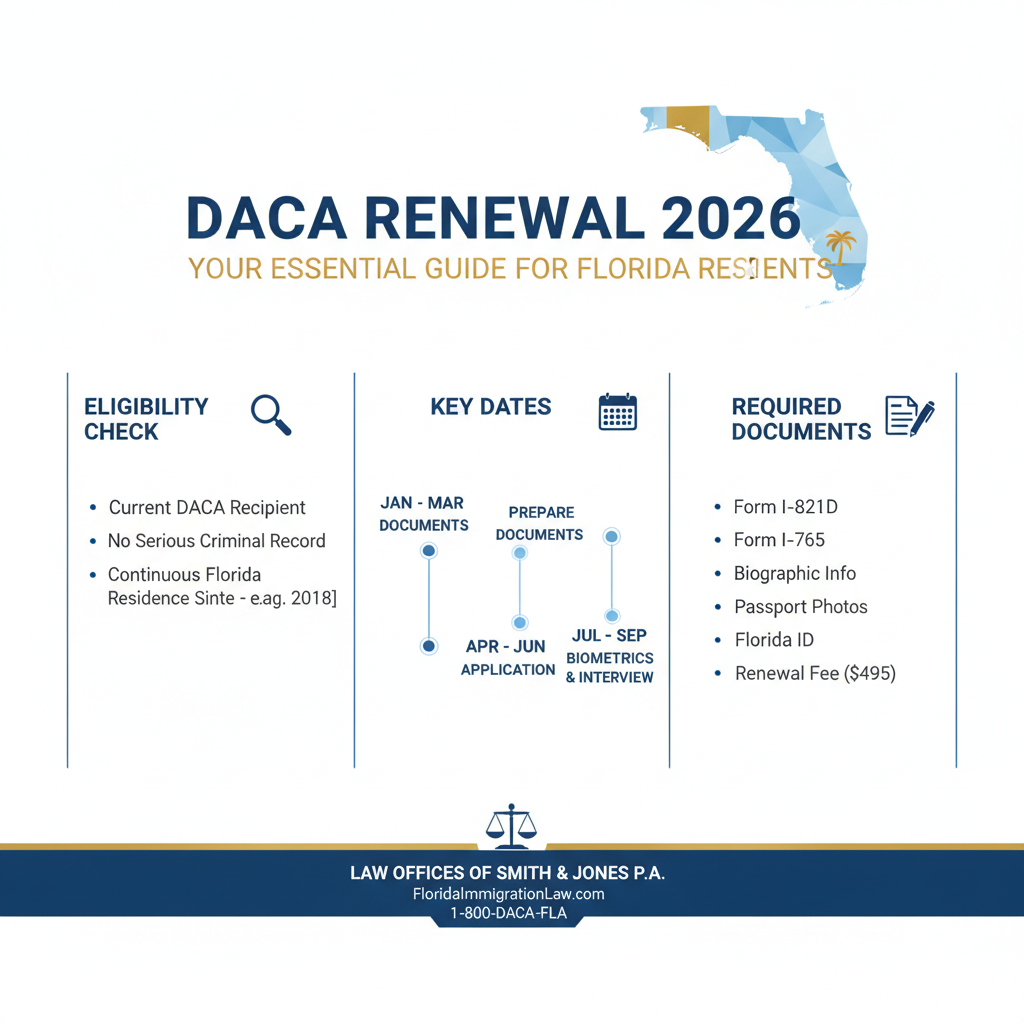
To be eligible for DACA renewal, you must continue to meet the original DACA criteria, as well as specific renewal requirements. These include:
- You must have previously been granted DACA.
- You must not have departed the United States on or after August 15, 2012, without first obtaining Advance Parole.
- You must have continuously resided in the United States since the date you submitted your most recent DACA request that was approved.
- You must not have been convicted of a felony, a significant misdemeanor, or three or more other misdemeanors, and not otherwise pose a threat to national security or public safety. (Reminder: Even minor brushes with the law can impact eligibility. Consult an attorney.)
The forms required for DACA renewal are:
- Form I-821D, Consideration of Deferred Action for Childhood Arrivals
- Form I-765, Application for Employment Authorization
- Form I-765 Worksheet (Supplement C)
For detailed instructions and to download these forms, always refer to the USCIS Forms page on the USCIS official website.
Florida-specific considerations
While DACA is a federal program, its impact is felt locally. In Florida, DACA recipients benefit from the federal work authorization, allowing them to contribute to our diverse economy. There are no Florida-specific laws that directly govern DACA eligibility or benefits beyond federal policy, but there are practical implications:
- Driver's Licenses: DACA recipients in Florida are generally eligible to obtain a Florida driver's license upon presenting their EAD and other required identification documents.
- In-State Tuition: Eligibility for in-state tuition at Florida's public colleges and universities for DACA recipients can vary and is often debated. It's crucial to check with individual institutions for their specific policies.
- Community Resources: Local non-profits and community organizations in Orlando and across Florida often provide support, legal aid referrals, and educational resources for DACA recipients.
Navigating these considerations requires attention to detail and, often, local expertise. The Orlando USCIS Field Office primarily handles interviews for certain immigration benefits, but DACA applications are processed by service centers. However, understanding the local context and available resources is always beneficial.
How to Renew Your DACA: A Complete Step-by-Step Guide
Renewing your DACA is a critical process that requires meticulous attention to detail and timely submission. A lapse in your deferred action status can lead to loss of employment authorization and potential exposure to removal proceedings. Follow these steps carefully to ensure a successful renewal.
1) Determine Your Eligibility and When to File
Before beginning the renewal process, confirm that you meet all current DACA renewal criteria. This includes having previously been granted DACA and not having left the U.S. without Advance Parole since August 15, 2012. You must also have continuously resided in the U.S. since your last DACA approval and have no disqualifying criminal history.
When to File: USCIS recommends filing your renewal request 120 to 150 days (approximately 4 to 5 months) before your current DACA and EAD expire. Filing within this window helps prevent a lapse in your work authorization. Do not file more than 150 days in advance, as USCIS may reject your application. Filing too late risks your DACA expiring before your renewal is approved, which could mean a period without work authorization.
- Required Documents for Eligibility Check:
- Your current Employment Authorization Document (EAD) (Form I-766)
- Your most recent DACA Approval Notice (Form I-797)
- Any records of travel outside the U.S. since your last DACA approval
- Any records of arrests, charges, or convictions, no matter how minor, since your last DACA approval
2) Gather All Necessary Documents
While USCIS typically does not require you to resubmit all the supporting documentation you provided for your initial DACA request (such as proof of continuous residence or entry before age 16), it is crucial to submit any documents related to new information that might affect your eligibility. This primarily includes updated identity documents and any records of criminal history since your last approval.
- Required Documents for Renewal:
- Copies of your previous DACA approval notices (Form I-797).
- Copy of your current EAD card (front and back).
- Two identical, color passport-style photographs taken within 30 days of filing. Write your name and A-number lightly on the back of each photo.
- Copy of your birth certificate (if you changed your name).
- Copy of your passport identity page or other government-issued photo ID (e.g., state driver's license or ID card from Florida DMV).
- Any and all certified court dispositions for any arrests, charges, or convictions, even if they were dismissed, expunged, or occurred outside the U.S., since your last DACA approval.
- Proof of continuous residence since your last DACA approval (e.g., utility bills, school records, employment records, bank statements) – Important: While not always required, having these ready is wise, especially if there are gaps in your work history or residence.
3) Complete Required Forms Accurately
You will need to complete three forms for your DACA renewal. Fill them out neatly, preferably typed, or in black ink if handwritten. Do not leave any sections blank; if a question does not apply, write "N/A" (not applicable).
- Form I-821D, Consideration of Deferred Action for Childhood Arrivals:
- This is the primary form for requesting deferred action.
- Ensure all personal information matches your previous applications and current documents.
- Pay close attention to Part 2, Question 5 ("Since you last filed Form I-821D... have you departed the United States...?"). Answer truthfully and provide details if applicable.
- Part 2, Question 6 asks about continuous residence.
- Part 3 details the criminal history section. Be completely honest and disclose all arrests, charges, or convictions, no matter how minor. Failure to disclose can lead to denial.
- Form I-765, Application for Employment Authorization:
- This form requests your work permit.
- For Question 27, "Eligibility Category," enter (c)(33) for DACA recipients.
- For Question 28, enter your A-Number from your previous DACA approval or EAD.
- Ensure your mailing address is current.
- Form I-765 Worksheet (Supplement C):
- This worksheet is required for DACA applicants to provide additional information related to their eligibility.
- It helps USCIS determine if you meet the specific criteria for DACA.
- Ensure all questions are answered accurately and completely, particularly those related to your entry into the U.S. and continuous residence.
Review all forms multiple times for accuracy and consistency. Any discrepancies or errors can cause delays or even a denial.
4) Prepare Your Supporting Evidence
Organize your application packet meticulously. Make copies of everything you send to USCIS for your records. Do not send original documents unless specifically requested by USCIS, except for the photos.
- Organizing Your Packet:
- Place your check or money order on top.
- Then, Form I-821D.
- Next, Form I-765 with the two passport photos stapled to the front (lightly, as per instructions).
- Then, Form I-765 Worksheet.
- Follow with copies of your EAD, DACA approval notices, and any new supporting evidence (e.g., court documents).
- Use cover sheets to label different sections of documents (e.g., "Criminal History Documents," "Identity Documents").
- Ensure all copies are clear and legible.
5) Pay the Filing Fees
As of the date of this article, the total filing fee for a DACA renewal is $495. This includes the $85 biometrics fee and the $410 Form I-765 filing fee. There is no separate fee for Form I-821D.
- Payment Methods:
- Personal check, cashier's check, or money order payable to "U.S. Department of Homeland Security."
- Do not send cash.
- Write your A-number on the memo line of your check or money order.
- Important: The fee must be for the exact amount. Incorrect fees will result in your application being rejected.
- Fee Waivers: Fee waivers are generally not available for DACA applications, except in extremely limited circumstances for individuals who can prove they are unable to pay. This is very rare for DACA renewals. Consult an attorney if you believe you might qualify for an exception.
Feeling overwhelmed by DACA renewal paperwork? Imigrar is here to simplify the process. Contact our Orlando office at +1 786-791-3106 for expert assistance and peace of mind. Se Habla Español.
6) File Your Application
Once your application packet is complete and thoroughly reviewed, mail it to the correct USCIS lockbox facility. The mailing address depends on where you live.
- Mailing Addresses:
- For Florida residents, your mailing address will typically be to a USCIS Lockbox. You must check the specific "Direct Filing Addresses for Form I-821D" page on the USCIS official website.
- Use a reliable mail service that provides tracking, such as USPS Certified Mail with a return receipt, FedEx, or UPS. This provides proof of mailing and delivery.
- What to Expect After Filing:
- Receipt Notice: Within 2-3 weeks, you should receive a Form I-797C, Notice of Action, confirming that USCIS has received your application. This notice will include a receipt number, which you can use to track your case status online at USCIS Case Status Online.
- Biometrics Appointment Notice: Shortly after the receipt notice, you will receive an appointment notice for biometrics (fingerprints, photos, and signature) at an Application Support Center (ASC). For Orlando residents, this will likely be at the Orlando ASC. Attend this appointment as scheduled.
7) Attend Your Biometrics Appointment and Await Decision
Your biometrics appointment is mandatory. Bring your appointment notice, a valid photo ID (like your Florida driver's license or passport), and any previous EADs. The process is usually quick and straightforward.
- After Biometrics:
- USCIS will process your application. You can check the estimated processing times for Form I-821D and Form I-765 on the USCIS Processing Times page.
- Decision: If approved, you will receive an approval notice (Form I-797) for both your DACA and EAD, followed by your new EAD card (Form I-766) in the mail. This usually arrives within 7-10 days of approval.
- Request for Evidence (RFE): USCIS may send an RFE if they need more information or clarification. Respond promptly and thoroughly to any RFE.
Remember, the entire process can take several months. Timely filing and diligent follow-up are key to a seamless DACA renewal.
Practical Steps You Can Take Today
Don't wait until the last minute to begin your DACA renewal process. Proactive planning can prevent unnecessary stress and potential lapses in your status. Here’s an actionable checklist:
Actionable Checklist (5+ items):
- Check Your Expiration Dates: Locate your current DACA approval notice and EAD card. Note the expiration dates for both. Set reminders in your calendar for 150 days and 120 days before expiration.
- Review Eligibility: Re-familiarize yourself with the DACA renewal criteria. Think about any changes in your life since your last approval, especially regarding travel, arrests, or changes of address.
- Start Gathering Documents: Begin collecting all necessary documents, particularly any new court dispositions or identity documents. Make sure your passport photos are recent.
- Calculate Fees: Confirm the current USCIS filing fees on the official website. Ensure you have the exact amount available for your check or money order.
- Update Your Address with USCIS: If you have moved since your last DACA approval, file a Form AR-11, Alien’s Change of Address Card, online or by mail within 10 days of moving. This is crucial for receiving all USCIS correspondence, including your biometrics appointment notice and approval. For Central Florida residents, ensure your address is accurate for any correspondence from the Orlando USCIS Field Office or service centers.
- Consult with an Attorney: Especially if you have any arrests, convictions, or complex issues, schedule a consultation with an experienced immigration attorney at Imigrar.
- Make Copies: Before mailing anything, make complete copies of your entire application packet for your personal records.
Document Preparation Guidance
Proper document preparation is vital. Organize your materials logically. Use tabs or labels for different sections (e.g., "Form I-821D," "Form I-765," "Identity Documents," "Criminal History"). Ensure all copies are clear and easy to read. If a document is not in English, it must be accompanied by a complete and accurate English translation certified by a translator's statement.
Timeline Expectations
While USCIS aims to process DACA renewals efficiently, processing times can vary. As of 2026-08-08, current processing times can range from 3 to 7 months, sometimes longer. You can check the most up-to-date estimates on the USCIS Processing Times page. Filing within the 120-150 day window is essential to avoid a lapse. If you are approaching the 90-day mark before expiration and haven't filed, consider seeking urgent legal advice.
Warning: If your EAD expires before your renewal is approved, you will lose your legal authorization to work. This means your employer cannot legally continue to employ you until you receive your new EAD. Plan accordingly with your employer if this situation arises.
How Imigrar Helps Immigrants in Orlando
At Imigrar, we understand that the DACA program, while immensely beneficial, operates within a complex and often uncertain legal framework. For DACA recipients and their families in Orlando and across Florida, navigating renewals can be a source of significant anxiety. Our firm is founded on the principle of "Keep Families Together," and we apply this commitment to every DACA case we handle.
Our experienced immigration attorneys possess a deep understanding of DACA policy, USCIS procedures, and the specific challenges that may arise during the renewal process. We stay current with all legal developments and administrative updates, ensuring that our advice is always accurate and effective.
Here’s how Imigrar can assist you:
- Eligibility Assessment: We will thoroughly review your individual circumstances to confirm your eligibility for DACA renewal, paying close attention to any changes since your last approval.
- Comprehensive Application Preparation: Our team will guide you through gathering all necessary documents, meticulously complete all required forms (Form I-821D, Form I-765, Form I-765 Worksheet), and ensure your application packet is perfectly organized. We focus on accuracy to minimize the risk of RFEs or denials.
- Addressing Complex Issues: If you have any arrests, convictions, travel history, or other complex issues, we will provide expert legal analysis and strategize the best approach to present your case to USCIS.
- Timely Filing and Follow-up: We will ensure your application is filed within the optimal window to prevent any lapse in your deferred action and EAD. We also help


