

The landscape of immigration policy is constantly evolving, and for Deferred Action for Childhood Arrivals (DACA) recipients, staying informed is not just important—it's essential for maintaining their status and continuing to build their lives in the United States. As an immigration law firm deeply committed to helping families stay together, Imigrar understands the anxieties and questions that arise with every new development. This comprehensive guide provides the latest information on DACA in 2026, focusing on the critical renewal process for individuals in Orlando, throughout Florida, and across the nation.
Need Help with Your DACA Renewal? Don't risk a lapse in your status. Our experienced Orlando immigration team at Imigrar is ready to assist you through every step. Call +1 786-791-3106 for a free consultation, or message us online. Se Habla Español.
The reporting that sparked this guide
Recent discussions and reports from official government sources like USCIS continue to highlight the ongoing legal challenges and the critical importance of timely DACA renewals. While the program's future remains subject to judicial review, the directives for current recipients are clear: continue to renew your deferred action and employment authorization document to maintain your protections. We monitor these developments closely to provide the most accurate and up-to-date guidance.
DACA Program Updates and Renewal Information (USCIS)
What This News Means for Immigrants in Orlando and Across Florida
For hundreds of thousands of individuals across the country, including a significant population right here in Florida, the DACA program represents a lifeline. It allows them to work legally, pursue higher education, and contribute to their communities without the constant fear of deportation. The ongoing legal battles surrounding DACA mean that its status is always subject to change, making vigilance and timely action paramount for recipients.
Why this news is showing up now
As of February 2026, DACA continues to operate under the shadow of persistent legal challenges. The program, established in 2012, has faced numerous attempts to terminate it, as well as efforts to codify it into law. The "news" around DACA is often a reflection of ongoing court proceedings, appeals, or administrative policy clarifications from the Department of Homeland Security (DHS) and USCIS. For instance, recent judicial rulings, while often allowing renewals to continue, have consistently barred USCIS from approving new initial DACA requests. This creates an environment where DACA recipients must always be aware of the latest court decisions and USCIS guidance to ensure they don't miss crucial deadlines or misinterpret policy changes. The current political climate also frequently brings DACA into discussions about comprehensive immigration reform, keeping it in the public and legal spotlight.
How it can affect Florida residents
Florida is home to a substantial DACA population, with many residing in metropolitan areas like Orlando, Miami, and Tampa. For these individuals, the stability provided by DACA is crucial for their daily lives and economic contributions. Any changes to the program, even seemingly minor ones, can have profound impacts:
- Employment Stability: DACA provides an Employment Authorization Document (EAD), allowing recipients to work legally. A lapse in DACA status due to an untimely renewal can lead to job loss, financial hardship, and the inability to support families.
- Educational Opportunities: Many DACA recipients in Florida are pursuing higher education. While Florida law allows DACA recipients to receive in-state tuition at public universities and colleges, maintaining DACA status is often a prerequisite for accessing these benefits and continuing their studies without interruption.
- Driving Privileges: In Florida, DACA recipients are eligible to obtain a driver's license. A valid DACA status and EAD are typically required for this, making renewal critical for personal mobility and daily necessities, especially in sprawling areas like Central Florida where public transportation may be limited.
- Community Integration: DACA recipients are integral members of their communities, often with deep roots, families, and businesses. The uncertainty surrounding DACA can create significant stress and anxiety, impacting their ability to plan for the future, purchase homes, or fully integrate without fear.
- Legal Complexities: Florida's unique legal and political landscape can sometimes add layers of complexity. Having experienced legal counsel familiar with both federal immigration law and its implications for Florida residents is invaluable.
For Central Florida residents, the Orlando USCIS Field Office processes various immigration applications, and while DACA renewals are primarily handled by service centers, local resources and legal aid are vital for navigating the process effectively. Imigrar is strategically positioned in Orlando to serve these needs directly.
What DACA Is (and Why It Matters)
Deferred Action for Childhood Arrivals, or DACA, is a U.S. immigration policy that allows certain undocumented immigrants who entered the country as minors to receive a renewable two-year period of deferred action from deportation and eligibility for a work permit. While it is not a path to citizenship or permanent legal status, it offers significant protections and opportunities.
A plain-English definition
Imagine DACA as a temporary legal shield. It doesn't grant you full immigration status, but it tells the government, "For now, we won't try to deport you, and we'll let you apply for a work permit." This protection lasts for two years and can be renewed if you continue to meet the eligibility criteria. It was created for young people who were brought to the U.S. as children and have grown up considering America their home. The goal was to allow them to live, work, and study here without the constant fear of being sent to a country they barely remember.
Key terms you need to know
- Deferred Action: This is a discretionary determination by USCIS to defer removal action against an individual. It does not confer lawful immigration status but means the individual will not be placed in removal proceedings.
- DACA Recipient (or "Dreamer"): An individual who has been granted deferred action under the DACA program. The term "Dreamer" refers to individuals who would have been eligible for the DREAM Act, a legislative proposal that inspired DACA.
- Employment Authorization Document (EAD): Also known as a work permit, this card allows DACA recipients to legally work in the United States. It is typically valid for two years, matching the DACA deferred action period.
- Unlawful Presence: The time an individual spends in the United States without being admitted or paroled, or after the expiration of a period of authorized stay, or in violation of any law. DACA protects against the accrual of unlawful presence.
- Advance Parole: A document that allows certain non-citizens to travel abroad and return to the U.S. without abandoning their application for adjustment of status or DACA status. For DACA recipients, advance parole can be granted for educational, employment, or humanitarian reasons, but it is currently difficult to obtain and carries risks.
- USCIS: U.S. Citizenship and Immigration Services, the federal agency responsible for administering immigration and naturalization benefits.
- DHS: Department of Homeland Security, the federal executive department responsible for public security, which oversees USCIS.
Important: DACA is a discretionary policy, not a federal law passed by Congress. This is why it has been subject to continuous legal challenges and policy changes. As of early 2026, USCIS continues to accept and process DACA renewal requests but is generally prohibited from approving initial DACA requests for individuals who have never before been granted deferred action under the program.
Current Immigration Law: The Foundation
DACA itself is not a law but an administrative policy. Its legal foundation, and the challenges it faces, are rooted in the Immigration and Nationality Act (INA) and administrative law principles. The program was established under the executive authority of the Secretary of Homeland Security to exercise prosecutorial discretion.
Federal requirements
The core eligibility criteria for DACA, as initially outlined and maintained for renewals, include:
- You must have been under the age of 31 as of June 15, 2012.
- You must have come to the United States before reaching your 16th birthday.
- You must have continuously resided in the United States since June 15, 2007, up to the present time.
- You must have been physically present in the United States on June 15, 2012, and at the time of making your request for deferred action.
- You must have had no lawful status on June 15, 2012.
- You must currently be in school, have graduated or obtained a certificate of completion from high school, have obtained a general education development (GED) certificate, or be an honorably discharged veteran of the Coast Guard or Armed Forces of the United States.
- You must not have been convicted of a felony, a significant misdemeanor, or three or more other misdemeanors, and not otherwise pose a threat to national security or public safety.
For renewals, the continuous residence and physical presence requirements are slightly different, requiring continuous residence since the date you submitted your most recent DACA request that was approved. Any travel outside the U.S. without advance parole could break this continuity and complicate your renewal. The exact legal standing of DACA continues to be debated in federal courts, particularly the U.S. Court of Appeals for the Fifth Circuit and potentially the Supreme Court. While these legal battles proceed, USCIS is directed to continue processing renewal requests for existing DACA recipients.
The primary forms for DACA renewal are: Form I-821D, Consideration of Deferred Action for Childhood Arrivals, and Form I-765, Application for Employment Authorization, along with its supplement, Form I-765WS, Worksheet for Form I-765. These forms are crucial for maintaining your deferred action status and work authorization.
For the most current forms and instructions, always refer to the USCIS official website.
Florida-specific considerations
While DACA is a federal program, its impact and certain benefits can vary at the state level. In Florida:
- In-State Tuition: Florida Statute 1009.26(12) generally allows DACA recipients who meet specific residency requirements (having attended a Florida high school for three consecutive years immediately before graduation and applied to a state university or community college within 24 months of graduation) to be eligible for in-state tuition rates at Florida public colleges and universities. Maintaining DACA status is typically a prerequisite for this.
- Driver's Licenses: The Florida Department of Highway Safety and Motor Vehicles (FLHSMV) issues driver's licenses to DACA recipients who present a valid EAD and other required identification documents. Timely DACA renewal ensures uninterrupted driving privileges.
- Professional Licenses: DACA recipients in Florida may be eligible for certain professional licenses, such as nursing or teaching, provided they meet the educational and professional requirements and maintain a valid EAD.
These state-level benefits underscore the importance of continuous DACA status for Florida residents. A lapse in DACA can lead to the loss of these privileges, impacting education, employment, and daily life.
How to Renew Your DACA: A Complete Step-by-Step Guide
Renewing your DACA is a critical process that requires attention to detail and timely submission. Here’s a step-by-step guide to help you navigate it.
1) Assess Your Eligibility for Renewal
Before gathering documents, confirm you still meet the DACA renewal criteria. Generally, you must not have departed the U.S. without advance parole since your last DACA approval, and you must not have been convicted of a felony, a significant misdemeanor, or three or more other misdemeanors. You must also continue to meet the continuous residence requirement since your last DACA request was approved.
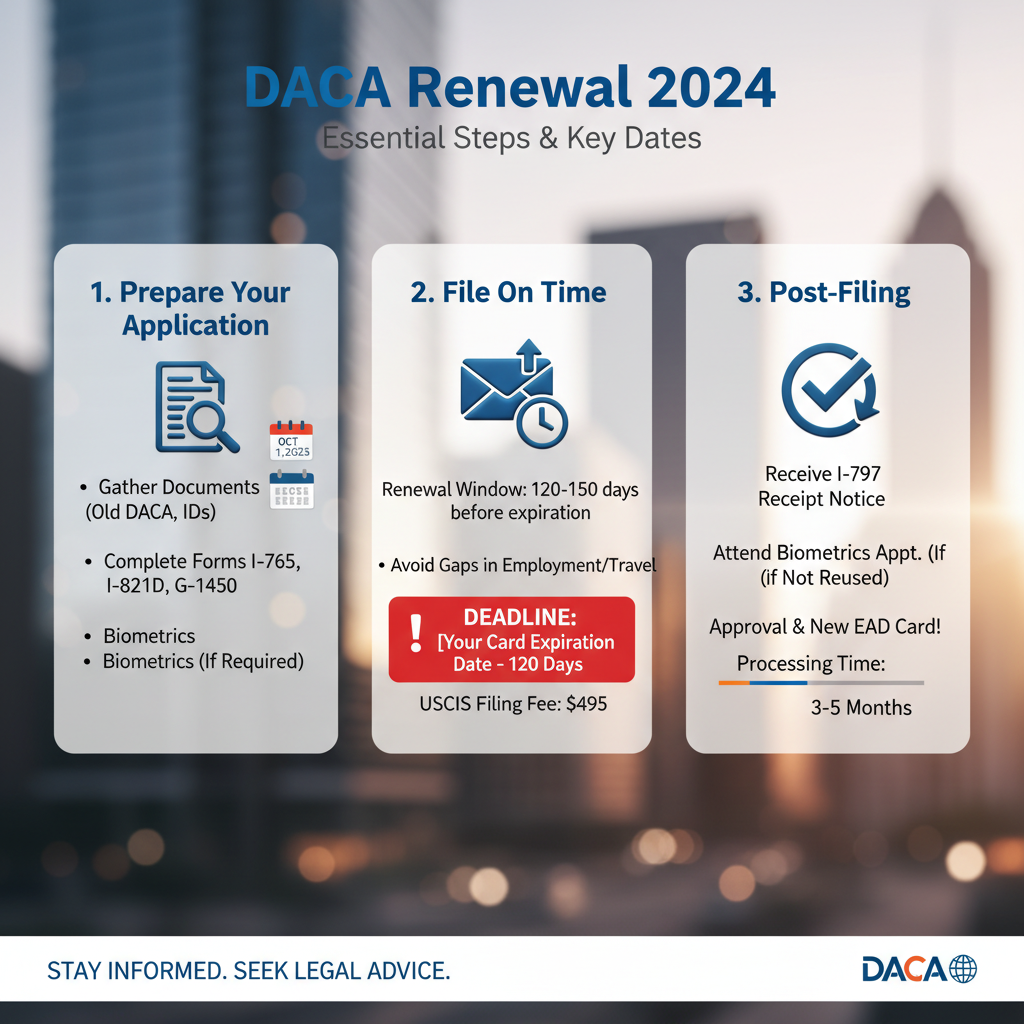
Reminder: USCIS recommends filing your renewal application between 120 and 150 days before your current DACA and EAD expire. Filing too early (more than 150 days) can lead to rejection, and filing too late (less than 120 days) significantly increases the risk of a lapse in your work authorization and deferred action.
2) Gather Required Documents
You’ll need to provide specific documents to support your renewal application. While you generally don't need to resubmit documents already provided in a previous accepted DACA request (unless there's a change or a new request from USCIS), it's always best to have them ready. If you've had a criminal conviction, even a minor one, since your last DACA approval, you must include certified court dispositions.
- Copy of Your Most Recent EAD: Both front and back.
- Copy of Your Most Recent Form I-797 Approval Notice: For DACA (Notice of Action).
- Copies of Identity Documents: Such as your passport, birth certificate with photo ID, or state-issued ID.
- Proof of Continuous Residence (if applicable): If you have had any breaks in residence or if USCIS requests it, provide documents like school transcripts, employment records, utility bills, bank statements, or rental agreements covering the period since your last DACA approval.
- Criminal History Records (if applicable): Certified court dispositions for any arrests, charges, or convictions, even if expunged, since your last DACA approval. This is crucial.
- Photographs: Two identical, passport-style color photographs taken within 30 days of filing your application. Write your name and A-Number lightly on the back of each photo.
Important: Always keep original documents and submit only copies unless specifically instructed otherwise by USCIS. Ensure all copies are clear and legible.
3) Complete the Forms
You will need to accurately complete three forms:
- Form I-821D, Consideration of Deferred Action for Childhood Arrivals: Fill out all sections completely. For renewal, pay close attention to Part 1 (Information About You), Part 2 (Basis for Requesting DACA), and Part 3 (Eligibility Information). Ensure you answer truthfully about your continuous residence, physical presence, and criminal history.
- Form I-765, Application for Employment Authorization: This form is for your work permit. In Part 2, Item 27, select "(c)(33)" as your eligibility category for DACA.
- Form I-765WS, Worksheet for Form I-765: This worksheet helps USCIS determine if you have an economic need to work. Be sure to provide clear and truthful information about your income, expenses, and assets.
Warning: Any inaccuracies or omissions can lead to delays or even denial. If you're unsure about any question, especially regarding your criminal history or travel, consult with an immigration attorney.
4) Prepare Your Application Packet
Organize your forms and supporting documents clearly. USCIS provides specific filing instructions, often recommending a particular order. A common order is:
- Check or money order for fees (on top)
- G-1145 (optional but recommended for e-notification)
- Two passport-style photos
- Form I-821D
- Form I-765
- Form I-765WS
- Copy of your most recent EAD (front and back)
- Copy of your most recent I-797 DACA approval notice
- Copies of other supporting documents (identity, continuous residence, criminal history, etc.)
Create a cover letter listing all the contents of your application packet, and make a complete copy of the entire packet for your records before mailing it.
5) Pay the Filing Fees
The current filing fee for DACA renewal is a combined fee for Form I-765 and the biometrics services fee. As of early 2026, this typically amounts to $495 (subject to change). You must include a check or money order made payable to "U.S. Department of Homeland Security." Do not send cash. Write your A-Number on the memo line of your payment. Fee waivers are generally not available for DACA applications, though limited exceptions may apply for specific humanitarian reasons.
Important: Always verify the most current fees on the USCIS website before submitting your application, as fees can change without prior notice.
6) Submit Your Application
Mail your complete application packet to the USCIS Lockbox facility designated for DACA filings. The correct mailing address depends on your state of residence. For Florida residents, check the USCIS Direct Filing Addresses for Form I-821D to ensure you send it to the correct lockbox. Use a mailing service that provides tracking and delivery confirmation, such as USPS Certified Mail with Return Receipt, FedEx, or UPS. This provides proof of timely submission.
For Central Florida residents: Your mailing address will be the same as for other Florida residents, directed to the designated USCIS Lockbox. You will not file directly with the Orlando USCIS Field Office.
7) What to Expect After Filing
- Receipt Notice: Within 2-4 weeks, you should receive a Form I-797C, Notice of Action, confirming that USCIS has received your application. This notice will include a receipt number, which you can use to track your case status online at USCIS Case Status Online.
- Biometrics Appointment: You will receive a separate notice for a biometrics (fingerprinting) appointment at an Application Support Center (ASC). This typically occurs a few weeks after the receipt notice. It is crucial to attend this appointment.
- Decision: Processing times vary but can range from a few months to longer, especially with current backlogs. You can check estimated processing times on the USCIS Processing Times page. If approved, you will receive an approval notice for your DACA and a new EAD card.
- Request for Evidence (RFE) or Notice of Intent to Deny (NOID): USCIS may send an RFE if they need more information or a NOID if they intend to deny your application. Respond promptly and thoroughly to these notices, ideally with legal assistance.
Confused about the DACA renewal forms or requirements? Imigrar can help simplify the process and ensure your application is accurate and complete. Contact us today for a free consultation. Call +1 786-791-3106 or reach out online. Se Habla Español.
Practical Steps You Can Take Today for DACA Renewal
Don't wait until the last minute to start your DACA renewal process. Proactive planning can prevent unnecessary stress and potential lapses in your status.
Actionable checklist:
- Check Your Expiration Date: Locate your current EAD card and Form I-797 approval notice. Mark your calendar for the 150-day and 120-day deadlines before expiration.
- Create a DACA Renewal Folder: Designate a physical and/or digital folder to keep all DACA-related documents organized, including previous applications, approval notices, and supporting evidence.
- Review Your Personal History: Reflect on any changes since your last DACA approval, especially regarding travel outside the U.S., arrests, or interactions with law enforcement. Gather any relevant documentation.
- Verify USCIS Fees: Visit the USCIS website to confirm the current filing fees for Form I-765 and biometrics.
- Update Your Address with USCIS: If you've moved since your last application, update your address with USCIS immediately by filing Form AR-11, Alien's Change of Address Card, or online through your USCIS online account.
- Seek Legal Counsel: If you have any doubts about your eligibility, any criminal history, or if you traveled outside the U.S. without advance parole, consult with an experienced immigration attorney.
Document preparation guidance
- Clarity is Key: Ensure all copies of documents are clear, legible, and full-page. Do not cut, staple, or otherwise alter documents unnecessarily.
- Translations: If any supporting documents are not in English, you must include a complete English translation certified by a competent translator. The translator must attest that they are proficient in both English and the foreign language, and that the translation is accurate.
- Self-Prepared Documents: If you're submitting documents like a personal affidavit or a list of residences, ensure they are typed, signed, and dated.
- Photographs: Make sure your photos meet USCIS specifications (2x2 inches, white background, no glasses, recent). Many drugstores or photo studios offer "passport photos" that meet these requirements.
Timeline expectations
The DACA renewal process can take several months. While USCIS aims to process renewals efficiently, backlogs are common. Here’s a general timeline:
- 150-120 days before expiration: This is the ideal window to file your renewal application.
- 2-4 weeks after filing: Expect to receive a receipt notice (Form I-797C).
- 4-8 weeks after filing: Expect to receive a biometrics appointment notice.
- 1-6 months after biometrics: USCIS typically processes the application and issues a decision. Some cases may take longer, especially if an RFE is issued.
Important: Keep copies of everything you send, and monitor your case status online regularly. If your DACA and EAD expire while your renewal application is pending, you will temporarily lose your deferred action and work authorization. This is why timely filing is paramount.
How Imigrar Helps DACA Recipients in Orlando and Beyond
At Imigrar, we understand the unique challenges faced by DACA recipients and their families. Our mission is to "Keep Families Together," and that includes protecting the status of Dreamers who are integral to our communities.
Our experience and expertise
Our legal team has extensive experience navigating the complexities of DACA renewals, including cases with criminal history issues, travel outside the U.S., or other complicating factors. We stay abreast of the latest court rulings and USCIS policy changes to provide accurate and effective legal counsel. We are familiar with the specific requirements for Florida residents and can offer tailored advice for those in Orlando, Orange County, and the wider Central Florida region.
We assist with:
- Thorough eligibility assessments for DACA renewal.
- Detailed guidance on gathering all necessary supporting documents.
- Accurate completion and review of Form I-821D, Form I-765, and Form I-765WS.
- Preparation of cover letters and organized application packets.
- Responding to Requests for Evidence (RFEs) or Notices of Intent to Deny (NOIDs).
- Advising on potential risks, especially concerning criminal history or travel.
- Strategic planning for long-term immigration goals, where applicable.
Free consultation offer
The uncertainty surrounding DACA can be overwhelming. We offer a free consultation to help you understand your options, assess your specific situation, and determine the best course of action for your DACA renewal. There's no obligation, just clear, professional advice from attorneys who care.
Se Habla Español. We are proud to serve the diverse immigrant communities in Florida, and our bilingual team ensures that language is never a barrier to receiving expert legal assistance.

Frequently Asked Questions About DACA Renewal
Q: What if my DACA expires before USCIS processes my renewal application?
A: If your DACA and EAD expire while your renewal is pending, you will temporarily lose your deferred action and employment authorization. This means you cannot legally work, and you will be considered to be accruing unlawful presence during that gap. While you won't immediately be subject to deportation proceedings solely because of a pending renewal, it's a vulnerable period. It is critical to file within the 120-150 day window to minimize this risk. If your EAD expires, you may need to inform your employer and cease working until your new EAD arrives. Imigrar can advise you on how to communicate with your employer during this time.
Q: Can I travel outside the U.S. with DACA?
A: Generally, DACA recipients must apply for and be granted Advance Parole (Form I-131


