


For hundreds of thousands of young people across the United States, including countless individuals in Orlando and throughout Florida, the Deferred Action for Childhood Arrivals (DACA) program represents a lifeline. It offers protection from deportation and the ability to work legally, allowing them to contribute meaningfully to their communities and build brighter futures. However, DACA has been a program under constant scrutiny and legal challenge since its inception, leading to frequent updates and, at times, significant uncertainty.
At Imigrar, an immigration law firm based in Orlando, Florida, our mission is to Keep Families Together. We understand the anxieties and hopes tied to DACA, and we are committed to providing the most accurate, up-to-date, and actionable information to help you navigate its complexities. This comprehensive guide is designed to clarify the current state of DACA, particularly focusing on the critical renewal process as of April 2026.
The reporting that sparked this guide:
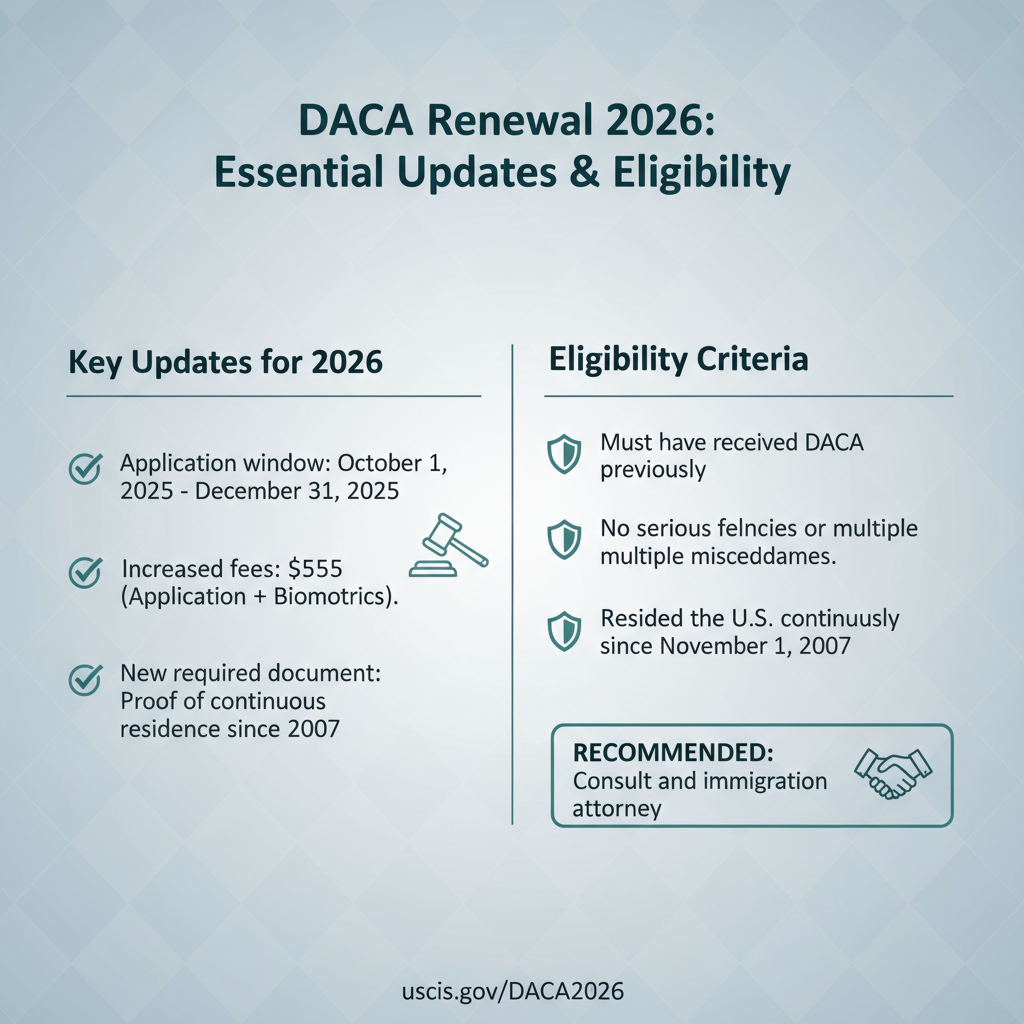
The information and guidance in this article are informed by ongoing developments and reports from official government sources, particularly those concerning the Deferred Action for Childhood Arrivals program. For the latest official announcements and policy updates from the United States Citizenship and Immigration Services (USCIS), we encourage you to consult their official channels:
DACA Program Updates and Renewal Information (USCIS)
What This News Means for Immigrants in Orlando and Across Florida
The DACA program, which provides deferred action from deportation and work authorization to eligible undocumented immigrants who came to the U.S. as children, remains a crucial, albeit precarious, program. As of early 2026, the program continues to operate under the shadow of ongoing legal challenges, primarily stemming from a federal court ruling that declared DACA unlawful. While this ruling prevents USCIS from approving new DACA applications, it currently allows for the processing of DACA renewal requests for existing recipients.
Why this news is showing up now
The DACA program has been a subject of continuous litigation and policy debate since its creation in 2012. The "news" around DACA is rarely a single, definitive announcement but rather a series of legal decisions, appeals, and administrative guidance that shapes its operational reality. Currently, the most significant legal development is the ongoing case in the Fifth Circuit Court of Appeals, which has affirmed a Texas federal judge's ruling that DACA is unlawful. This legal battle means that DACA's long-term future remains uncertain, and its legal standing is constantly being re-evaluated. Every few months, there are updates, new court filings, or statements from government agencies, keeping DACA in the headlines. For DACA recipients, this translates into a need for constant vigilance and understanding of the latest directives, especially concerning renewals.
How it can affect Florida residents
Florida is home to a significant population of DACA recipients, often referred to as Dreamers. For these individuals and their families, the ongoing uncertainty surrounding DACA is a source of immense stress. The ability to renew DACA means maintaining protection from deportation, retaining an Employment Authorization Document (EAD), and often, the opportunity to hold a driver's license in Florida. Losing DACA status could mean losing jobs, educational opportunities, and the stability that comes with legal work authorization.
- Employment Impact: Many DACA recipients are integral parts of Florida's workforce, contributing to various sectors, from healthcare to hospitality. The ability to renew DACA directly impacts their job security and economic contributions to the state.
- Educational Access: While Florida has some provisions for in-state tuition for certain undocumented students, DACA status often provides a more secure pathway to higher education and professional licensing.
- Community Stability: DACA recipients are deeply embedded in Florida's communities. They are parents, students, business owners, and active community members. The potential disruption of DACA affects not just individuals but entire families and neighborhoods.
- Driver's Licenses: In Florida, DACA recipients are generally eligible for a driver's license, which is crucial for daily life, commuting to work or school, and supporting families, especially in sprawling areas like Central Florida and along the I-4 corridor.
The legal landscape means that while renewals are currently permitted, the program could face further changes or even termination depending on future court rulings. This makes understanding the renewal process more critical than ever for Florida residents whose lives depend on DACA.
Need Help? Navigating DACA renewals can be complex, especially with ongoing legal challenges. Our Orlando immigration team is ready to assist. Call +1 786-791-3106 for a free consultation, or message us online. Se Habla Español.
What DACA Is (and Why It Matters)
The Deferred Action for Childhood Arrivals (DACA) program was established by the Obama administration in June 2012. It was a response to the legislative gridlock surrounding comprehensive immigration reform and the inability to pass the DREAM Act, which sought to provide a pathway to legal status for young undocumented immigrants.
A plain-English definition
At its core, DACA is an exercise of "prosecutorial discretion" by the Department of Homeland Security (DHS). It allows certain individuals who came to the United States as children, meet specific criteria, and lack lawful immigration status, to receive deferred action from deportation. This means the government agrees not to pursue their removal from the U.S. for a renewable period, typically two years. Importantly, DACA is *not* a pathway to citizenship or a form of legal status itself; it is a temporary administrative relief. Along with deferred action, approved DACA recipients are eligible to apply for an Employment Authorization Document (EAD), which allows them to work legally in the U.S.
Key terms you need to know
- Deferred Action: A discretionary determination by the U.S. government to defer removal action against an individual. It does not confer lawful status but provides temporary protection from deportation.
- Dreamer: A commonly used term for young undocumented immigrants who were brought to the U.S. as children, often associated with the proposed DREAM Act and DACA recipients.
- Employment Authorization Document (EAD): Also known as a work permit, this card (Form I-766) allows non-citizens to legally work in the United States for a specified period.
- USCIS: United States Citizenship and Immigration Services, the federal agency responsible for administering the country's lawful immigration system, including DACA applications and renewals.
- DHS: Department of Homeland Security, the cabinet department under which USCIS operates.
- Advance Parole: A document issued by USCIS that allows certain non-citizens, including DACA recipients in limited circumstances, to travel outside the U.S. and return without jeopardizing their immigration status.
- Status Quo: Refers to the current state of DACA, where renewals are processed, but new applications are not accepted due to court injunctions.
DACA matters because it has enabled hundreds of thousands of young people to pursue higher education, build careers, start businesses, and contribute to the American economy and society without the constant fear of deportation. It has allowed families to stay together and provided a measure of stability for individuals who have known no other home than the United States. For many in Orlando and across Florida, DACA is the difference between living in the shadows and actively participating in their communities.
Current Immigration Law: The Foundation for DACA
DACA itself is not a law passed by Congress but rather an executive action based on the Secretary of Homeland Security's inherent authority to exercise prosecutorial discretion. This discretion allows the government to decide whom to prioritize for removal and whom to grant temporary relief. The legal challenges to DACA have centered on whether the executive branch exceeded its authority in creating the program, rather than on the specific merits of deferred action.
As of April 2026, the DACA program continues to exist under a complex legal framework. Following a July 2021 ruling by a federal judge in Texas, USCIS is prohibited from granting initial DACA requests. This means that individuals who have never before received DACA are currently unable to apply for it. However, the ruling allowed USCIS to continue accepting and processing DACA renewal requests for individuals who have previously been granted DACA.
Federal requirements for DACA Renewal
To be eligible for DACA renewal, you must meet the original DACA requirements, in addition to maintaining continuous residence. These include:
- You must have previously been granted DACA.
- You must not have departed the United States on or after August 15, 2012, without first obtaining advance parole.
- You must have continuously resided in the United States since the date you submitted your most recent DACA request that was approved.
- You must not have been convicted of a felony, a significant misdemeanor, or three or more other misdemeanors, and not otherwise pose a threat to national security or public safety.
Important: USCIS conducts a thorough background check for every renewal application. Any changes in your criminal record since your last DACA approval could impact your eligibility.
The primary forms for DACA renewal are:
- Form I-821D, Consideration of Deferred Action for Childhood Arrivals
- Form I-765, Application for Employment Authorization
- Form I-765WS, Worksheet for Form I-765
It is crucial to use the most current versions of these forms, which can be found on the USCIS Forms page. Always refer to the USCIS official website for the latest instructions and updates.
Florida-specific considerations
While DACA is a federal program, its impact and certain ancillary benefits can vary by state. For DACA recipients in Florida:
- Driver's Licenses: DACA recipients in Florida are eligible to apply for a Florida driver's license or identification card. Renewing your DACA and EAD is essential to maintaining this privilege.
- In-State Tuition: Florida Statute 1009.26 allows certain undocumented students, including some DACA recipients, to qualify for in-state tuition at public colleges and universities if they attended a Florida high school for three years and graduated, among other requirements. Maintaining DACA status can strengthen one's position in qualifying for these benefits, though it's not always a strict requirement for the tuition waiver itself.
- Professional Licenses: DACA recipients in Florida may be eligible for certain professional licenses, depending on the specific profession and state regulations. Renewal of DACA and EAD is critical for maintaining these licenses.
Reminder: State laws and policies can change, so it's always advisable to check with relevant Florida state agencies (e.g., DMV, Department of Education, professional licensing boards) regarding specific benefits for DACA recipients.
Need Help? Don't risk a lapse in your DACA status. Our Orlando immigration team provides expert guidance for DACA renewals. Call +1 786-791-3106 for a free consultation, or message us online. Se Habla Español.
How to Renew Your DACA: A Complete Step-by-Step Guide
The DACA renewal process, while seemingly straightforward, requires meticulous attention to detail and adherence to specific timelines. Missing a deadline or submitting an incomplete application can lead to significant delays or even denial, potentially resulting in a lapse of your deferred action and work authorization. Follow this comprehensive guide to ensure a smooth renewal process.
1) Check Your Eligibility and Renewal Timeline
First and foremost, confirm your eligibility. You must have previously been granted DACA and continue to meet the original eligibility criteria, especially concerning criminal history and continuous residence. The most critical aspect of renewal is timing.
- When to Apply: USCIS recommends filing your DACA renewal request 120 to 150 days (approximately 4 to 5 months) before your current DACA and EAD expire. This window allows ample time for processing and helps prevent a lapse in your work authorization.
- Why the Window Matters: Filing too early (more than 150 days) may result in USCIS rejecting your application. Filing too late (less than 120 days) significantly increases the risk of your DACA expiring before your renewal is approved, leaving you without work authorization and potentially vulnerable to deportation.
- Continuous Residence: You must have continuously resided in the United States since the date you submitted your most recent DACA request that was approved. Brief, authorized travel with advance parole does not break continuous residence.
Actionable Tip: Mark your calendar with your DACA and EAD expiration dates and set reminders for the 150-day and 120-day marks. Begin preparing at least 6 months in advance.
2) Gather Required Documents
A well-organized application package is crucial. While DACA renewals typically require less documentation than initial requests, having everything ready saves time and reduces stress. Ensure all documents are clear, legible copies, as you should never send original documents unless specifically requested by USCIS.
- Previous DACA Approval Notices: Include copies of your most recent Form I-797C, Notice of Action, for your DACA approval and EAD.
- Current Employment Authorization Document (EAD): A clear copy of the front and back of your current EAD card.
- Identity Documents: Copies of your passport, birth certificate with photo ID, or state-issued ID (like a Florida driver's license).
- Proof of Continuous Residence: While not always explicitly requested for renewals if your residence has been continuous and undisputed, it's wise to have documents ready, especially if you've had gaps in employment or education, or moved frequently. Examples include utility bills, bank statements, school transcripts, employment records, tax returns, and medical records.
- Passport-Style Photos: Two identical, color passport-style photos taken within 30 days of filing. Write your name and A-Number lightly in pencil on the back of each photo.
- Criminal History Documentation (if applicable): If you have had any arrests, charges, or convictions since your last DACA approval, you must include certified court dispositions for *all* incidents, even if dismissed or expunged. Failure to disclose can lead to denial.
Warning: Be completely transparent about any criminal history. USCIS has access to federal databases, and discrepancies will lead to significant problems.
3) Complete USCIS Forms I-821D, I-765, and I-765WS
These forms must be filled out accurately and completely. Using the latest versions available on the USCIS Forms page is paramount.
- Form I-821D, Consideration of Deferred Action for Childhood Arrivals:
- Fill out every field. If a question does not apply, write "N/A" (not applicable).
- Ensure all information matches your previous DACA application and supporting documents.
- Part 2, Item 2: Provide your A-Number (Alien Registration Number) accurately.
- Part 3: Answer all eligibility questions truthfully.
- Sign and date the form. Unsigned forms will be rejected.
- Form I-765, Application for Employment Authorization:
- This form is for your work permit.
- Item 27: For DACA renewals, your eligibility category is (c)(33).
- Ensure your name, address, and date of birth match Form I-821D exactly.
- Sign and date the form.
- Form I-765WS, Worksheet for Form I-765:
- This worksheet helps USCIS determine if your economic need for an EAD is sufficient.
- Provide details about your current income, expenses, and assets.
- Be honest and thorough in your responses.
Recommendation: Use black ink only. If filling out by hand, write clearly and legibly. Typing the forms online and then printing is often preferred for clarity.
4) Prepare Filing Fees
The DACA renewal process involves a combined filing fee for Form I-821D and Form I-765.
- Total Fee: As of April 2026, the fee is $495. This includes the $410 fee for Form I-765 and the $85 biometrics services fee. There is no separate fee for Form I-821D.
- Payment Method: You can pay by money order, personal check, cashier's check, or by credit card using Form G-1450, Authorization for Credit Card Transactions.
- Payable To: Make checks or money orders payable to "U.S. Department of Homeland Security." Do not abbreviate.
- Fee Waivers: Fee waivers for DACA renewals are extremely rare and generally only granted in very limited circumstances, such as if you are under 18, homeless, or have a severe disability, and your income is below 150% of the federal poverty line. Consult with an attorney if you believe you qualify.
Financial Planning: Start saving for the fee well in advance. Consider the total cost and plan accordingly.
5) Assemble Your Application Package
Proper assembly ensures USCIS can process your application efficiently. Organize your documents in a logical order.
- Cover Letter (Optional but Recommended): A brief letter listing the forms enclosed and the supporting documents. This acts as a checklist for USCIS.
- Payment: Place the check/money order or Form G-1450 on top of the forms.
- Forms: Form I-821D, then Form I-765, then Form I-765WS.
- Supporting Documents: Attach copies of your EAD, DACA approval notices, identity documents, and any criminal history documents.
- Photos: Place your two passport-style photos in a small, clear plastic baggie and staple it to the top left corner of Form I-765.
- Copies: Make a complete copy of the *entire* application package for your records before mailing. This is a critical step.
Organization Tip: Use paper clips, not staples, to attach supporting documents to individual forms, unless otherwise instructed. Avoid binding the entire package.
6) Mail Your Application and Track Its Progress
Once assembled, it's time to mail your application. The correct mailing address depends on where you live.
- Mailing Address: For DACA renewal, USCIS generally directs applications to a specific Lockbox facility. The correct address will be listed in the "Where to File" section of the Form I-821D instructions. For Florida residents, this is usually the USCIS Dallas Lockbox.
- Shipping Method: Always send your application via certified mail with a return receipt requested, or through a courier service that provides tracking (e.g., FedEx, UPS). This provides proof of mailing and delivery.
- Online Tracking: Once USCIS receives your application, they will send you a Form I-797C, Notice of Action, with a receipt number. You can use this number to track the status of your case online via the USCIS Case Status Online tool.
- Biometrics Appointment: After your application is accepted, USCIS will send you a notice (Form I-797C) scheduling a biometrics appointment at your local Application Support Center (ASC). For Central Florida residents, this would likely be the Orlando ASC. This appointment is mandatory.
Important: Do not miss your biometrics appointment. If you have a legitimate reason to reschedule, follow the instructions on the notice immediately.
7) Respond to RFEs or Attend Biometrics Appointment
The final steps involve responding to USCIS requests and attending your appointment.
- Request for Evidence (RFE): USCIS may send an RFE if they need additional documents or clarification. Respond promptly and thoroughly by the deadline provided. Failure to respond can lead to denial.
- Biometrics Appointment: At your biometrics appointment, your fingerprints, photograph, and signature will be collected. This data is used for background checks. Bring your appointment notice, a valid photo ID (e.g., driver's license, passport), and a copy of your application.
- Decision: After biometrics and background checks are complete, USCIS will make a decision. If approved, you will receive an approval notice and your new EAD card in the mail.
Persistence Pays: Processing times can vary. Check the USCIS Processing Times page for estimates. If your case goes beyond the posted processing times, you can submit an inquiry.

Practical Steps You Can Take Today for DACA Renewal
Proactive preparation is key to a successful DACA renewal. Don't wait until the last minute!
Actionable Checklist:
- Check Your Expiration Date: Locate your DACA approval notice and EAD card. Note the expiration date of your deferred action and work permit. Set reminders for 150 days and 120 days before this date.
- Start Gathering Documents: Begin collecting copies of your previous DACA approvals, EAD card, and any documents that prove continuous residence, especially if you've moved or changed jobs. If you have any new criminal history, obtain certified court dispositions immediately.
- Consult an Immigration Attorney: This is especially crucial if you have any changes in your personal information, criminal history, or questions about eligibility. An experienced attorney, like those at Imigrar in Orlando, can review your case and ensure your application is strong.
- Save for Fees: The $495 filing fee is mandatory. Start setting aside funds now to avoid financial strain when it's time to file.
- Update Your Address with USCIS: If you have moved since your last DACA approval, file Form AR-11, Alien's Change of Address Card, with USCIS online or by mail. This ensures you receive all important notices.
- Review Your Previous Application: If you have a copy of your last DACA application, review it to ensure consistency in your new application.
Document Preparation Guidance:
- Make Copies: Always keep a complete copy of your entire application package for your records.
- Organize: Use folders or binders to keep your documents organized.
- Accuracy: Double-check all information for typos, misspellings, and inaccuracies. Even small errors can cause delays.
- Translation: If any supporting documents are not in English, you must include a certified English translation along with a copy of the original document.
Timeline Expectations:
While USCIS aims to process renewals efficiently, actual processing times can vary. As of early 2026, DACA renewal processing times can range from 3 to 8 months, or sometimes longer, depending on the service center and case complexity. Always check


