


The landscape of immigration law is constantly shifting, and few programs embody this more than Deferred Action for Childhood Arrivals (DACA). For hundreds of thousands of individuals across the United States, including countless Floridians, DACA is not just a policy; it’s a lifeline providing temporary protection from deportation and the ability to work lawfully. As we navigate 2026, staying informed about the latest DACA updates and understanding the meticulous renewal process is more critical than ever.
At Imigrar, an immigration law firm based in Orlando, Florida, our mission is to Keep Families Together. We understand the anxieties and uncertainties that DACA recipients and their families face. This comprehensive guide is designed to cut through the complexity, providing you with clear, actionable information about DACA renewals, current requirements, and crucial steps to protect your future.
NEWS SOURCE REFERENCE SECTION
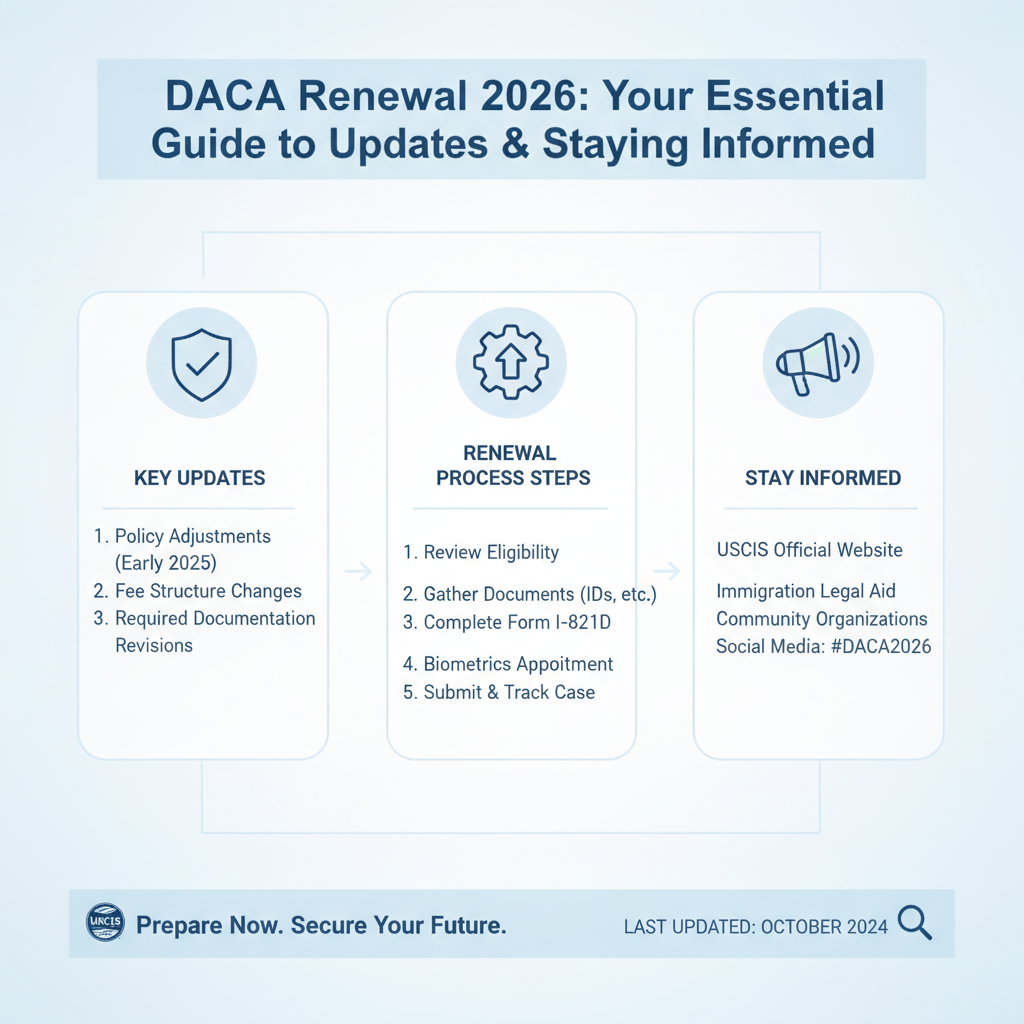
The reporting that sparked this guide: DACA Program Updates and Renewal Information (USCIS)
What This News Means for Immigrants in Orlando and Across Florida
The news surrounding DACA is a constant flow of legal challenges, court rulings, and administrative guidance from USCIS. For DACA recipients and their families, these updates aren't abstract legal discussions; they directly impact their daily lives, their ability to work, study, and plan for the future.
Why this news is showing up now
The Deferred Action for Childhood Arrivals (DACA) program has been the subject of intense legal and political debate since its inception in 2012. While the program continues to permit renewals, its future remains uncertain due to ongoing litigation, particularly the case of Texas v. United States. This case has led to injunctions that prevent USCIS from approving new initial DACA applications, though renewals are permitted to continue under specific terms.
As of August 4, 2026, the program remains in a state of administrative limbo, with each court decision, no matter how minor, triggering a wave of news and concern. USCIS periodically releases updates, often in response to these legal developments or to clarify existing policies for renewals. These updates are crucial because they can affect processing times, specific documentation requirements, or even the underlying eligibility criteria for continued deferred action. The constant legal scrutiny means that DACA’s status is perpetually trending in immigration news cycles, demanding vigilance from recipients and legal advocates alike.
How it can affect Florida residents
For the tens of thousands of DACA recipients living in Florida, these updates have tangible consequences. Florida is home to a significant population of "Dreamers" who contribute to our economy, serve our communities, and enrich our diverse culture. The uncertainty surrounding DACA can lead to immense stress, impacting mental health, educational pursuits, and career stability.
- Employment Stability: A lapse in DACA status means a lapse in employment authorization (EAD). For those working in Orlando's tourism industry, healthcare, or any other sector, this can lead to job loss and financial hardship. Keeping your DACA and EAD current is paramount.
- Educational Opportunities: While Florida does not currently offer in-state tuition for DACA recipients at public universities, the ability to work and live without immediate fear of deportation allows many to pursue higher education or vocational training, often supported by private scholarships or out-of-state tuition.
- Driver's Licenses: DACA recipients in Florida are eligible for a driver's license. A lapse in DACA status can lead to the inability to renew this essential document, affecting daily commutes along the I-4 corridor, access to employment, and general mobility in Central Florida.
- Family Unity: The core of Imigrar's mission is to Keep Families Together. DACA allows families to remain united, providing a degree of stability that is absent without it. Any threat to DACA is a threat to family unity for thousands of Florida families.
Being informed allows you to take proactive steps to protect your status. This guide will provide the practical advice you need to navigate the renewal process successfully.
Need Help? Our Orlando immigration team is ready to assist. Call +1 786-791-3106 for a free consultation, or message us online. Se Habla Español.
What Deferred Action for Childhood Arrivals (DACA) Is (and Why It Matters)
Deferred Action for Childhood Arrivals, or DACA, is a U.S. immigration policy established by the Obama administration in June 2012. It offers certain eligible undocumented individuals who came to the United States as children temporary relief from deportation and a renewable two-year work permit. It is crucial to understand that DACA is not a pathway to U.S. citizenship, nor does it grant lawful permanent resident status (a Green Card). Instead, it is a form of prosecutorial discretion, meaning the government chooses to defer (postpone) removal action against an individual.
Why does DACA matter so profoundly? Because it transforms lives. For DACA recipients, often referred to as "Dreamers," it means the ability to pursue higher education, obtain driver's licenses, work legally to support themselves and their families, and live without the constant fear of deportation. It allows them to contribute more fully to their communities and the economy, bringing their talents and ambitions to light. For families, it means a measure of stability and hope.
A plain-English definition
Imagine you're facing a difficult situation, but someone in authority decides to temporarily put a pause on it, allowing you to live and work without immediate threat. That's essentially what DACA does. It's a temporary program that says, "For now, we won't try to deport you, and we'll let you apply for a work permit." This protection lasts for two years and can be renewed if you continue to meet the eligibility criteria.
It's important to reiterate: DACA does not provide a legal immigration status or a path to a Green Card. It provides temporary administrative relief from deportation and employment authorization. This distinction is critical for understanding its limitations and the ongoing need for legislative action.
Key terms you need to know
Navigating DACA requires understanding specific terminology. Here are some essential terms:
- Deferred Action: This is the core of DACA. It means the government is deferring (postponing) any action to remove an individual from the U.S. It does not confer legal status.
- Dreamers: A widely used term for young undocumented immigrants who were brought to the U.S. as children, often associated with the proposed "DREAM Act" legislation that would provide a pathway to citizenship. Many DACA recipients identify as Dreamers.
- USCIS (U.S. Citizenship and Immigration Services): The government agency responsible for overseeing lawful immigration to the United States. USCIS processes DACA applications and renewals. You will interact with USCIS for all aspects of your DACA case.
- EAD (Employment Authorization Document): Also known as a work permit, this is the card (Form I-766) that DACA recipients receive, allowing them to legally work in the U.S. for the period of their deferred action.
- Advance Parole: A document (Form I-131) that allows certain non-citizens to travel outside the U.S. and return lawfully. For DACA recipients, Advance Parole is extremely limited and generally only granted for humanitarian, educational, or employment purposes under very specific circumstances. It is currently very difficult to obtain for DACA recipients due to the ongoing legal challenges.
- Good Moral Character: A crucial eligibility requirement for DACA. It generally means you have not committed certain crimes, especially felonies or significant misdemeanors, and have not posed a threat to national security or public safety.
- Continuous Residence: Another key eligibility factor, requiring that you have continuously resided in the U.S. for a specified period (e.g., since June 15, 2007, for initial DACA applicants, and since your last DACA approval for renewals).
- Physical Presence: Means you were physically present in the U.S. on specific dates, such as June 15, 2012, when DACA was announced.
Current Immigration Law: The Foundation of DACA
The legal basis for DACA stems from the executive branch's inherent authority to exercise prosecutorial discretion in immigration enforcement. While not codified directly in statute, the Secretary of Homeland Security has the discretion to grant deferred action on a case-by-case basis. This discretion is what allowed the creation of DACA in 2012.
However, DACA has been embroiled in legal battles, primarily in Texas v. United States. A federal court in Texas, affirmed by the Fifth Circuit Court of Appeals, has ruled that DACA is unlawful. This ruling has led to an injunction that prevents USCIS from granting initial DACA requests. This means that individuals who have never before been granted DACA are generally unable to apply for it at this time. The case is currently awaiting further review, potentially by the Supreme Court, ensuring continued uncertainty for the program's long-term future.
Despite these legal challenges, current DACA policies, as of August 4, 2026, allow individuals who were previously granted DACA to apply for renewal. USCIS continues to accept and process DACA renewal requests and associated applications for employment authorization.
Federal requirements
To be eligible for DACA renewal, you must demonstrate that you continue to meet the initial DACA guidelines, with specific updates:
- Previously Granted DACA: You must have received DACA at some point in the past. New applicants are generally not being accepted.
- Not Departed the U.S. Without Advance Parole: You must not have departed the United States on or after August 15, 2012, without first obtaining Advance Parole (Form I-131).
- Continuous Residence: You must have continuously resided in the United States since the date you submitted your most recent DACA request that was approved.
- No Disqualifying Criminal History: You must not have been convicted of a felony, a significant misdemeanor, or three or more other misdemeanors, and must not otherwise pose a threat to national security or public safety. This is the "good moral character" requirement.
- Physical Presence: You must be physically present in the United States at the time of filing your DACA renewal request.
The forms required for DACA renewal are primarily Form I-821D, Consideration of Deferred Action for Childhood Arrivals; Form I-765, Application for Employment Authorization; and Form I-765 Worksheet. These forms must be completed accurately and truthfully. Any misrepresentation or omission can lead to denial and potentially serious immigration consequences.
For the most up-to-date information on DACA policy and forms, always refer to the USCIS official DACA website.
Florida-specific considerations
While DACA is a federal program, its effects ripple through state policies, including here in Florida. For DACA recipients in the Sunshine State:
- Driver's Licenses: The Florida Department of Highway Safety and Motor Vehicles (FLHSMV) issues driver's licenses to DACA recipients whose Employment Authorization Documents (EADs) are valid for at least 30 days. Renewal of your DACA and EAD is essential to maintain your driving privileges. The Orlando USCIS Field Office is a key facility for many Central Florida residents, but DACA applications are mailed to specific Lockbox facilities, not local field offices.
- Employment: DACA recipients with valid EADs can work legally in Florida. This allows individuals to contribute to the local economy, from Orlando's vibrant hospitality sector to various professional services across Orange County. A lapse in DACA status directly impacts this ability.
- Education: As mentioned, Florida does not currently offer in-state tuition for DACA recipients at public colleges and universities. However, DACA status allows many to pursue higher education by removing the immediate threat of deportation, providing a foundation for their future.
- Local Resources: Various non-profit organizations and legal aid groups in Orlando and throughout Florida offer assistance and resources to DACA recipients. Imigrar works closely with many community partners to ensure comprehensive support.
It's vital for Florida residents to stay informed about both federal DACA updates and any relevant state-level policy changes that might affect them.
Feeling overwhelmed? The DACA renewal process can be intricate. Let Imigrar guide you. Call +1 786-791-3106 for a free consultation. Se Habla Español.

How to Renew Your DACA: A Complete Step-by-Step Guide
Renewing your DACA is a critical process that requires precision, attention to detail, and timely action. Missing deadlines or making errors can lead to a lapse in your deferred action and employment authorization, which can have severe consequences for your life in the U.S. Follow this comprehensive guide to navigate the DACA renewal process.
Important: This guide is for DACA *renewal* applicants. As of August 4, 2026, USCIS is generally not accepting initial DACA requests due to ongoing litigation.
1) Determine Your Eligibility for Renewal
Before you begin gathering documents, confirm you still meet the DACA renewal criteria. This is the foundational step.
- Previous DACA Grant: You must have been previously granted deferred action under DACA.
- Continuous Residence: You must have continuously resided in the United States since the date you submitted your most recent DACA request that was approved. Brief, casual, and innocent departures from the U.S. that occurred prior to August 15, 2012, are generally not considered to have broken continuous residence. However, any departure on or after August 15, 2012, without a valid Advance Parole document, will break your continuous residence and make you ineligible for renewal.
- Criminal History: You must not have been convicted of a felony, a significant misdemeanor, or three or more other misdemeanors. A "significant misdemeanor" includes domestic violence, sexual abuse or exploitation, burglary, unlawful possession or use of a firearm, drug distribution or trafficking, or driving under the influence (DUI). It also includes any misdemeanor where the individual was sentenced to time in custody for more than 90 days. Minor traffic offenses are generally not considered disqualifying. If you have any arrests or convictions, consult with an immigration attorney immediately.
- Threat to National Security/Public Safety: You must not otherwise pose a threat to national security or public safety.
- Physical Presence: You must be physically present in the United States at the time of filing your DACA renewal request and at the time of adjudication.
Reminder: If you've had any encounters with law enforcement since your last DACA approval, no matter how minor, it is imperative to discuss this with an attorney before filing. Do not assume it won't impact your eligibility.
2) Gather Required Documents
Thorough documentation is key to a successful renewal. Organize your documents carefully and make copies of everything you send to USCIS.
- Current and Expiring DACA Documents:
- Copy of your most recent DACA approval notice (Form I-797).
- Copy of your current Employment Authorization Document (EAD) (Form I-766).
- Proof of Continuous Residence (since your last DACA approval): You need to show you've lived in the U.S. continuously.
- School records (transcripts, diplomas).
- Employment records (pay stubs, W-2 forms, employment letters).
- Utility bills (electricity, water, gas, internet).
- Bank statements.
- Rental agreements, lease agreements, mortgage statements.
- Medical records.
- Tax returns (federal and state).
- Affidavits from individuals who can attest to your continuous residence (e.g., family, friends, employers, teachers).
- Receipts, money order stubs, or other dated transactions.
- Identity Documents:
- Copy of your passport biographical page.
- Copy of your birth certificate (with translation if not in English).
- State-issued identification (driver's license or ID card from Florida).
- Two identical passport-style photographs (taken within 30 days of filing). Write your name and Alien Registration Number (A-Number) lightly on the back of each photo.
- Criminal History Records (if applicable):
- Certified court dispositions for any arrests or convictions, even if expunged or dismissed.
- Police reports.
- Proof of completion of probation or community service.
- Previous Application Documents (for reference): While not strictly required to submit, having copies of your previous DACA application forms and supporting documents can be helpful for consistency.
3) Complete Required Forms Accurately
The accuracy of your forms is paramount. Any missing information, errors, or inconsistencies can cause delays or even a denial.
- Form I-821D, Consideration of Deferred Action for Childhood Arrivals:
- Answer all questions truthfully and completely.
- Pay close attention to Section 2, Part 2, "Information About Your Request," specifically question 1.c. which asks if you are requesting renewal.
- Ensure your signature and date are present.
- Form I-765, Application for Employment Authorization:
- This form is for your work permit.
- For question 27, "Eligibility Category," you should write (c)(33).
- Ensure your signature and date are present.
- Form I-765 Worksheet:
- This form is mandatory when filing Form I-765 as a DACA renewal applicant.
- It collects information about your current employment and income.
- Complete it thoroughly.
- G-1145, E-Notification of Application/Petition Acceptance (Optional but Recommended): This form allows USCIS to send you an email or text message when they accept your application. It's a quick way to get confirmation.
Warning: Never leave any questions blank. If a question does not apply to you, write "N/A" (not applicable). If a numerical answer is zero, write "None" or "0." Always use black ink.
4) Prepare Your Filing Fee
The filing fee is a combined fee for Form I-821D and Form I-765. As of August 4, 2026, the current fee is $495, which includes a $410 fee for Form I-765 and an $85 biometrics services fee. Always check the USCIS website for current fees before filing, as they can change.
- Payment Method: You can pay by money order, personal check, cashier's check, or credit card using Form G-1450, Authorization for Credit Card Transactions.
- Payable To: Make checks or money orders payable to "U.S. Department of Homeland Security." Do NOT abbreviate.
- Fee Waivers: Fee waivers for DACA renewals are extremely rare and generally only granted in very limited circumstances, such as if you are homeless, in foster care, or have an income below 150% of the poverty line and have a serious disability. It is generally advisable to pay the full fee if possible. Consult an attorney if you believe you qualify for a fee waiver.
5) Assemble and Mail Your Application Package
The way you assemble and mail your application can impact its processing. Organized submissions are less likely to be returned or delayed.
- Order of Documents:
- Cover letter (optional, but recommended, listing contents).
- Payment (check/money order or Form G-1450 clipped to the top).
- Form G-1145 (if used).
- Form I-821D.
- Form I-765.
- Form I-765 Worksheet.
- Supporting documents (copies, organized by category, e.g., proof of residence, identity, criminal history).
- Passport photos (placed in a small, clear envelope and stapled to the upper left corner of Form I-765).
- Mailing Address: The mailing address depends on your state of residence and the type of service you use (U.S. Postal Service or private courier). For Florida residents, check the "Direct Filing Addresses for Form I-821D" section on the USCIS website.
- Mailing Method: Always send your application via certified mail with a return receipt requested, or through a courier service that provides tracking (e.g., FedEx, UPS). This provides proof of mailing and delivery.
Reminder: Keep a complete copy of your entire application package for your records, including all forms, supporting documents, and proof of mailing.


