

The landscape of U.S. immigration law is constantly shifting, and few programs embody this more than the Deferred Action for Childhood Arrivals (DACA) initiative. For hundreds of thousands of individuals who call America home, DACA offers a vital, albeit temporary, sense of security and the ability to work legally. As an immigration law firm dedicated to keeping families together, Imigrar understands the critical importance of staying informed about every development related to DACA.
We believe in empowering our clients with accurate, timely, and actionable information. This comprehensive guide is designed to clarify the current status of DACA, particularly focusing on the renewal process, and provide a clear roadmap for recipients in Orlando, across Florida, and nationwide.
The reporting that sparked this guide
Recent discussions and ongoing legal proceedings surrounding immigration policy, specifically those touching upon the future of programs like DACA, frequently surface in national news. While the core status of DACA – that new applications are generally not being processed but renewals continue – has remained consistent for some time due to federal court orders, these news cycles serve as a critical reminder for current DACA recipients to remain vigilant and proactive about their status.
The continued legal challenges and political discussions keep DACA in the public eye, emphasizing the need for reliable information regarding renewal requirements and processes. Our commitment is to distill these broader conversations into practical advice for you and your family.
DACA Program Updates and Renewal Information (USCIS)
What This News Means for Immigrants in Orlando and Across Florida
For DACA recipients and their families, any news related to the program can evoke a mix of hope, anxiety, and a renewed sense of urgency. Understanding the nuances of these developments is crucial for planning your future and maintaining your status.
Why this news is showing up now
The DACA program has been the subject of intense legal and political debate since its inception in 2012. As of April 1, 2026, the program continues to operate under a federal court order that allows U.S. Citizenship and Immigration Services (USCIS) to accept and process DACA renewal requests but generally prohibits the agency from approving new, initial DACA requests. This ongoing legal battle, particularly the case originating in Texas, means that DACA's long-term future remains uncertain, fueling continuous news coverage and public discussion.
Additionally, administrative updates, processing time fluctuations, and the sheer volume of renewals constantly present new information and challenges that DACA recipients need to navigate. The regular news cycle serves as a persistent reminder of the program's precarious but vital status.
How it can affect Florida residents
For the tens of thousands of DACA recipients living in Florida, including a significant population in Orlando and the Central Florida region, these updates have direct and profound impacts:
- Maintaining Employment: DACA provides an Employment Authorization Document (EAD), allowing recipients to work legally. Any disruption to DACA, such as a delayed renewal, could jeopardize their ability to maintain employment and support their families.
- Driver's Licenses: In Florida, DACA recipients are eligible for a driver's license. The validity of this license is tied to their DACA and EAD expiration. Timely renewal is essential to avoid lapsing driving privileges.
- In-State Tuition: While DACA does not automatically grant in-state tuition benefits in Florida, some DACA recipients may qualify for specific state programs or institutional policies. Staying informed about DACA's status ensures they can continue to pursue higher education opportunities.
- Community Stability: DACA recipients are integral members of Florida's communities, contributing economically and culturally. The stability of their DACA status directly impacts the stability of their families and communities, from Orange County to the entire I-4 corridor.
- Planning for the Future: The uncertainty surrounding DACA makes long-term planning difficult. Staying abreast of updates allows recipients to make informed decisions about their education, careers, and potential pathways to more permanent immigration solutions, should they arise.
Important: The legal landscape can change rapidly. Consulting with an experienced immigration attorney is the best way to understand how specific DACA developments affect your individual situation in Florida.
Need Clarity on DACA Updates? Our Orlando immigration team at Imigrar specializes in DACA renewals and can help you navigate the complexities. Call +1 786-791-3106 for a free consultation, or message us online. Se Habla Español.
What DACA Is (and Why It Matters)
To fully grasp the importance of DACA updates and renewals, it's essential to understand the program itself, its purpose, and the critical terms associated with it.
A plain-English definition
Deferred Action for Childhood Arrivals (DACA) is a U.S. immigration policy that allows certain undocumented immigrants who entered the country as children to receive a renewable two-year period of deferred action from deportation and eligibility for a work permit (Employment Authorization Document, EAD). DACA was established by the Obama administration in June 2012.
In simpler terms, DACA provides temporary protection from deportation and the ability to work legally for individuals who meet specific criteria. It is not a path to U.S. citizenship or a green card, nor does it provide lawful immigration status. Instead, it grants a temporary exercise of prosecutorial discretion, meaning the government agrees not to pursue removal proceedings against the individual for a set period.
The program was designed to offer relief to young people, often referred to as "Dreamers," who were brought to the U.S. as children, grew up here, and often know no other home. It recognizes their significant contributions to American society and economy.
Key terms you need to know
Navigating immigration processes requires understanding specific terminology. Here are some key terms related to DACA:
- Deferred Action: A discretionary determination by the government to defer removal action against an individual. Deferred action does not confer lawful status, but it does allow an individual to remain in the U.S. for a specific period and may lead to eligibility for an EAD.
- Employment Authorization Document (EAD): Often called a "work permit," this card allows non-citizens to work legally in the United States. DACA recipients receive an EAD valid for two years, which must be renewed.
- Dreamers: A term commonly used to refer to young undocumented immigrants who were brought to the U.S. as children. It originates from the DREAM Act, a legislative proposal that would have provided a pathway to citizenship for these individuals.
- USCIS (U.S. Citizenship and Immigration Services): The government agency responsible for overseeing lawful immigration to the United States. USCIS processes DACA applications and renewals.
- ICE (U.S. Immigration and Customs Enforcement): The federal law enforcement agency responsible for enforcing immigration laws within the U.S. and at its borders.
- Removal Proceedings: Formal legal proceedings in immigration court to determine whether a non-citizen should be deported from the United States. Deferred action protects individuals from these proceedings.
- Advance Parole: A document that allows certain non-citizens to travel outside the U.S. and lawfully return. While DACA recipients were previously eligible for advance parole, USCIS has largely ceased approving these requests for DACA recipients since 2017, except in very limited circumstances.
- Biometrics Appointment: An appointment at a USCIS Application Support Center (ASC) where fingerprints, photographs, and signatures are collected for background checks. This is typically required for DACA renewals.
Current Immigration Law: The Foundation for DACA
Understanding the current legal framework is paramount for DACA recipients. While DACA itself is an executive action, its implementation and challenges are deeply intertwined with established immigration law and federal court rulings.
As of April 1, 2026, the DACA program continues under the shadow of ongoing litigation. A federal court ruling in Texas in 2021, affirmed by the Fifth Circuit Court of Appeals, found DACA unlawful. While the case is still under appeal (currently before the Supreme Court or a higher appellate review depending on the latest developments), the practical effect of the injunction issued by the Texas court is that USCIS is generally prohibited from approving initial DACA requests for individuals who have never before been granted DACA. However, importantly, USCIS is permitted to continue accepting and processing DACA renewal requests for individuals who have previously been granted deferred action under DACA.
This means that for existing DACA recipients, the focus remains squarely on timely and accurate renewals to maintain their temporary protection and work authorization.
Federal requirements for DACA Renewal
To be eligible for DACA renewal, you must meet the original DACA eligibility criteria and have previously been granted DACA. The key requirements for renewal, based on the original DACA guidelines, include:
- You must have previously been granted DACA.
- You must not have departed the United States on or after August 15, 2012, without first obtaining advance parole. (Warning: As noted above, advance parole for DACA recipients is extremely limited now.)
- You must have continuously resided in the United States since the date you submitted your most recent DACA request that was approved.
- You must not have been convicted of a felony, a significant misdemeanor, or three or more other misdemeanors, and not otherwise pose a threat to national security or public safety.
It is crucial that you continue to meet these criteria. Any change in your criminal record or residency status since your last DACA approval could impact your renewal eligibility.
The forms required for DACA renewal are:
- Form I-821D, Consideration of Deferred Action for Childhood Arrivals
- Form I-765, Application for Employment Authorization
- Form I-765WS, Worksheet for Form I-765
These forms, along with supporting documentation and fees, must be submitted to USCIS. You can always find the latest versions of these forms and detailed instructions on the USCIS Forms page or the dedicated USCIS DACA page.
Florida-specific considerations for DACA recipients
While DACA is a federal program, its impact is felt locally. For DACA recipients in Florida, there are specific state-level considerations:
- Driver's Licenses: The Florida Department of Highway Safety and Motor Vehicles (FLHSMV) issues driver's licenses to DACA recipients whose Employment Authorization Documents (EADs) are valid for at least 30 days. Renewing your DACA and EAD promptly is critical to maintaining your driving privileges.
- Professional Licenses: DACA recipients may be eligible for certain professional licenses in Florida, depending on the specific profession and state regulations. Eligibility often hinges on having a valid EAD and Social Security number.
- Educational Opportunities: While Florida generally does not grant in-state tuition to DACA recipients, some institutions or private scholarships may offer support. The ability to enroll in college and pursue higher education is often tied to the validity of your DACA status and EAD.
- Legal Support: For Central Florida residents, the Orlando USCIS Field Office may be involved in certain immigration matters, including biometrics appointments for DACA renewals. Having local legal representation, like Imigrar, can provide invaluable assistance with understanding local procedures and resources.
Stay updated on state-specific policies by checking official Florida government websites or consulting with an immigration attorney familiar with Florida's regulations.
For more detailed information on DACA and other immigration processes, visit the USCIS official website.
How to Renew Your DACA: A Complete Step-by-Step Guide
Renewing your DACA is a critical process that requires attention to detail and timely submission. Here’s a complete step-by-step guide to help you navigate the renewal process.
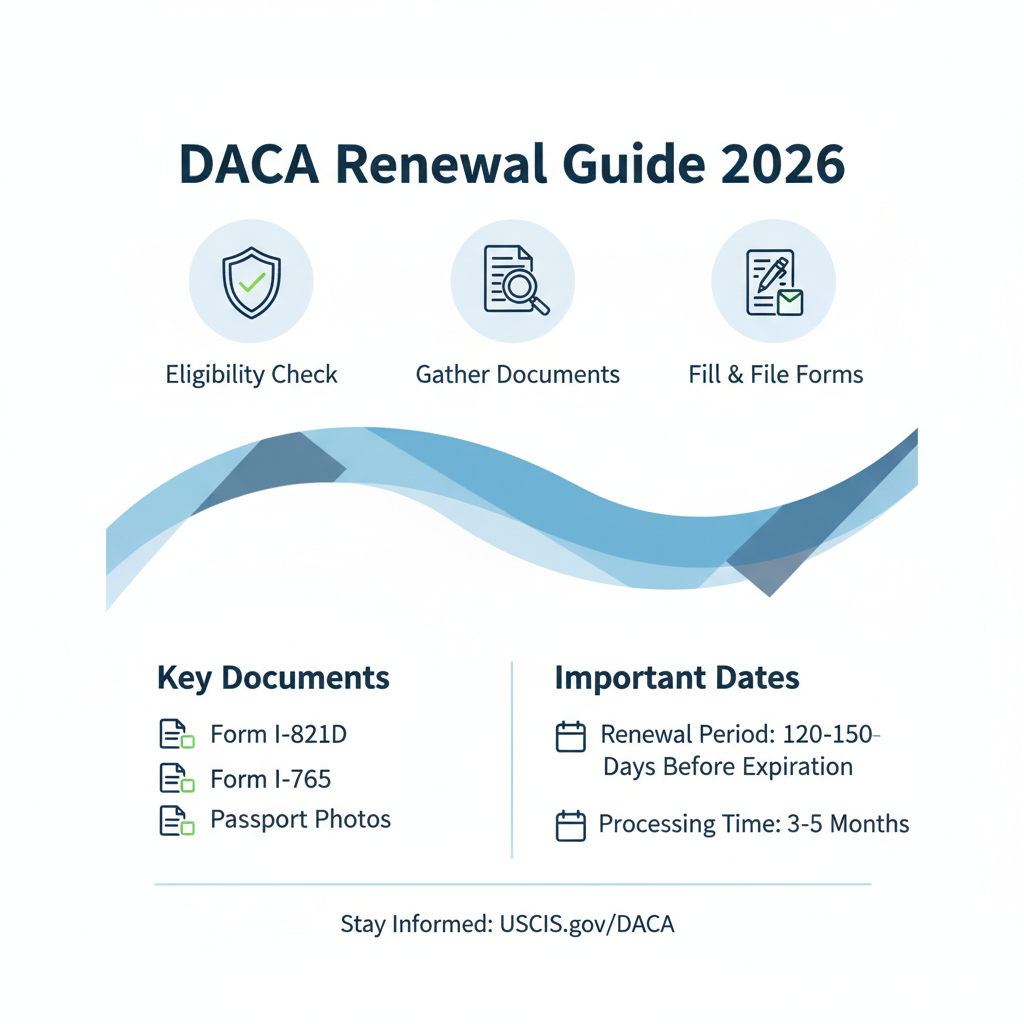
Reminder: USCIS recommends submitting your DACA renewal application 120 to 150 days before your current DACA and EAD expire. Do not submit your application more than 150 days before expiration, as USCIS may reject it. Submitting too late risks a lapse in your work authorization.
1) Determine Your Eligibility for Renewal
Before you begin gathering documents, confirm that you meet the renewal criteria. You must have:
- Previously been granted DACA.
- Not departed the United States on or after August 15, 2012, without first obtaining advance parole.
- Continuously resided in the United States since the date you submitted your most recent DACA request that was approved.
- Not been convicted of a felony, a significant misdemeanor, or three or more other misdemeanors, and not otherwise pose a threat to national security or public safety.
Important: If you have any new arrests, charges, or convictions since your last DACA approval, or if you left the U.S. without advance parole, you should consult an immigration attorney immediately. These issues can jeopardize your renewal.
2) Gather All Required Documents
Careful document preparation is key to a successful renewal. You will need:
- Proof of Identity:
- Copy of your current EAD card (front and back).
- Copy of your current DACA approval notice (Form I-797C, Notice of Action).
- Copy of your birth certificate (with certified translation if not in English).
- Copy of your passport or national identity document from your country of origin.
- Proof of Continuous Residence (if applicable):
- While generally not required if you haven't left the U.S. and meet the continuous residence criteria, USCIS may request additional proof if there are gaps or questions. Examples include: school records, employment records, utility bills, bank statements, medical records, or rent receipts.
- Proof of No Disqualifying Criminal History:
- If you have any arrests, charges, or convictions since your last DACA approval, you must include certified court dispositions for each case. Even if charges were dropped or you were found not guilty, you must disclose them.
- Previous DACA Application Copies:
- It's highly recommended to keep a copy of your previously approved DACA application for reference.
Recommendation: Organize your documents meticulously. Create a checklist and make copies of everything you send to USCIS for your own records.
3) Complete the Necessary USCIS Forms
You must complete three forms for your DACA renewal:
- Form I-821D, Consideration of Deferred Action for Childhood Arrivals: This form requests information about your eligibility for DACA. Fill out every section accurately and completely. If a section does not apply, write "N/A" (not applicable).
- Form I-765, Application for Employment Authorization: This form is for your work permit. For DACA renewals, your eligibility category will be (c)(33). Ensure your name matches your previous applications and identification.
- Form I-765WS, Worksheet for Form I-765: This worksheet requires you to detail your current annual income, expenses, and assets. It helps USCIS determine if you meet the economic need criteria, though this is primarily for initial DACA applications and is less scrutinized for renewals unless there are significant changes.
All forms can be downloaded from the USCIS Forms page. Always use the most current version of the forms available.
Worried About Forms? The forms can be complex. Let Imigrar's expert legal team in Orlando ensure your DACA renewal application is perfectly prepared. Call +1 786-791-3106 for a free consultation, or message us online. Se Habla Español.
4) Prepare Your Application Packet
Once your forms are completed and documents gathered, assemble your application packet in the correct order:
- Payment (check or money order) for the total fees.
- Form I-821D.
- Form I-765.
- Form I-765WS.
- Copy of your current EAD (front and back).
- Copy of your current DACA approval notice.
- Any supporting documentation (e.g., certified court dispositions if applicable).
- Two passport-style photos (taken within 30 days of filing). Write your name and A-number lightly on the back of each photo. Place them in a small plastic bag or envelope and staple it to the top left corner of Form I-765.
Important: Do not use staples to attach documents to each other within the packet, except for the photos. Use paper clips. Make sure all copies are clear and legible.
5) Submit Your Application to USCIS
Mail your complete application packet to the correct USCIS Lockbox Facility. The mailing address depends on where you live. For most DACA renewals, you will mail to a specific Lockbox based on your state of residence. You can find the correct mailing address on the USCIS DACA page under "Where to File."
Warning: Sending your application to the wrong address can cause significant delays or even rejection. Double-check the Lockbox address for your state (e.g., Florida residents typically send to a Chicago Lockbox). Use a reliable mailing service that provides tracking, such as USPS Certified Mail with return receipt, FedEx, or UPS.
Fees: As of April 1, 2026, the DACA renewal filing fee is $495, which includes the Form I-765 fee and the biometrics services fee. There is no separate fee for Form I-821D. You must submit a single check or money order for the total amount, payable to "U.S. Department of Homeland Security." Do NOT send cash.
6) Attend Biometrics Appointment (If Required)
After USCIS receives your application, they will send you a receipt notice (Form I-797C). Within a few weeks, you will likely receive a biometrics appointment notice (Form I-797C) instructing you to appear at a local Application Support Center (ASC) for fingerprinting and a photo. For Central Florida residents, this will typically be the Orlando USCIS Field Office ASC.
- Bring your appointment notice, a valid photo ID (e.g., driver's license, passport, EAD), and a copy of your application to the appointment.
- Do not miss your biometrics appointment. If you have an unavoidable conflict, follow the instructions on your notice to reschedule, but be aware this can delay your case.
7) Monitor Your Case Status and Respond to RFEs
You can monitor the status of your DACA renewal application online using the receipt number provided on your Form I-797C notice. Visit the USCIS Case Status Online tool.
Request for Evidence (RFE): USCIS may send you a Request for Evidence (RFE) if they need additional information or documents to make a decision on your case. Respond to RFEs promptly and completely by the deadline provided. Failure to respond can lead to denial.
Approval: If your renewal is approved, you will receive an approval notice and your new EAD card in the mail. Keep these documents safe.
For current processing times, refer to the USCIS Processing Times page, selecting Form I-821D and your service center.

Practical Steps You Can Take Today for DACA Renewal
Being proactive is the best strategy for a smooth DACA renewal process. Here's a checklist of practical steps you can take starting today:
- Mark Your Calendar: Note your DACA and EAD expiration dates. Set reminders for 150 days, 120 days, and 90 days before expiration.
- Organize Your Documents: Start compiling all necessary documents now. This includes your previous DACA approval notices, EAD cards, and any records of new arrests or criminal charges (even minor ones or those that were dismissed).
- Review Your Criminal History: Obtain certified court dispositions for any arrests or convictions since your last DACA approval. This is non-negotiable and must be disclosed.
- Update Your Address with USCIS: If you've moved since your last application, file Form AR-11, Alien's Change of Address Card, online or by mail within 10 days of moving. This ensures you receive all USCIS notices.
- Save for Fees: The DACA renewal fee is $495. Start saving well in advance to ensure you have the funds ready when it's time to apply.
- Consult with an Attorney: Especially if you have any questions about eligibility, travel, or criminal history, schedule a consultation with an experienced immigration attorney at Imigrar. This can prevent costly mistakes.
- Keep Copies of Everything: Make a complete copy of your entire application packet before mailing it. This includes all forms, supporting documents, and the check/money order.
- Stay Informed: Regularly check the official USCIS DACA page for any policy updates or changes to the renewal process.
Document preparation guidance
When preparing your documents:
- Ensure all copies are clear and legible.
- If any document is not in English, it must be accompanied by a complete and accurate English translation and a certification by the translator that they are competent to translate and that the translation is accurate.
- Do not submit original documents


