


Welcome to Imigrar's comprehensive guide on the Deferred Action for Childhood Arrivals (DACA) program. As an immigration law firm based in Orlando, Florida, we understand the critical importance of staying informed about DACA updates, especially for Dreamers and their families across the nation. Today, March 8, 2026, we’re addressing the latest news and providing crucial information to help you navigate the DACA renewal process with confidence.
The DACA program has been a lifeline for hundreds of thousands of young people, allowing them to work, study, and contribute to the only country many of them have ever known. However, its future remains a subject of ongoing legal and political debate. Our goal with this guide is to cut through the noise, providing clear, actionable advice grounded in the most current information available from official sources like USCIS.
The reporting that sparked this guide
The continuous flow of news regarding DACA, from court rulings to administrative updates, underscores the need for constant vigilance and accurate information. The reports that prompted this detailed guide highlight the program's enduring relevance and the ongoing necessity for eligible individuals to understand their renewal options and responsibilities.
DACA Program Updates and Renewal Information (USCIS)
What This News Means for Immigrants in Orlando and Across Florida
For DACA recipients and their families, news related to the program is never just a headline – it’s a direct reflection of their ability to live, work, and plan for their futures. Understanding the nuances of DACA updates is essential, particularly in a state like Florida, which is home to a significant Dreamer population.
Why this news is showing up now
The DACA program, established in 2012, has faced persistent legal challenges since its inception. While the program currently remains open for renewals, new applications have been paused due to various court orders. The news you’re seeing today, on March 8, 2026, is likely a continuation of these legal battles or administrative updates from U.S. Citizenship and Immigration Services (USCIS) regarding processing procedures, policy clarifications, or responses to judicial mandates. The legal landscape surrounding DACA is dynamic, with cases like Texas v. United States continuously shaping its operational parameters. Each court decision, whether from federal district courts, circuit courts, or potentially the Supreme Court, triggers a wave of analysis and clarification from immigration agencies and legal experts. These developments necessitate ongoing communication to ensure DACA recipients are aware of any shifts that could impact their status. Furthermore, USCIS routinely releases updated guidance on forms, fees, and filing locations, all of which contribute to the 'news' cycle for DACA recipients.
How it can affect Florida residents
Florida is a vibrant and diverse state, and its population includes tens of thousands of DACA recipients who contribute significantly to our economy and communities. For those residing in Orlando, Central Florida, and across the I-4 corridor, any DACA news carries particular weight:
- Uncertainty and Stress: The continuous legal challenges create immense stress and uncertainty for DACA recipients and their families. This can impact mental health, educational pursuits, and career planning. Staying informed through reliable sources like Imigrar and USCIS is crucial to mitigate anxiety and make informed decisions.
- Renewal Vigilance: With new DACA applications on hold, the absolute priority for eligible individuals in Florida is to ensure timely and accurate renewals. A lapse in DACA status can lead to loss of employment authorization and potential removal proceedings.
- Educational Opportunities: Florida has made strides in providing in-state tuition equity for DACA recipients who graduate from Florida high schools. (Under Florida Statute 1009.26, a DACA recipient who attends a Florida high school for three years and graduates is eligible for in-state tuition at public universities). Any changes to DACA's legal standing could potentially impact these crucial educational benefits, though state laws often have their own legislative processes.
- Economic Impact: DACA recipients are vital to Florida’s workforce, contributing billions in taxes and spending power. Disruptions to DACA could have a significant negative ripple effect on local economies, including Orlando and Orange County, where many DACA recipients work and own businesses.
- Access to Legal Support: Given the complexities, access to experienced immigration legal counsel in Orlando is paramount. Imigrar is uniquely positioned to assist DACA recipients in Central Florida, providing guidance on renewals, addressing specific challenges, and exploring potential alternative pathways if they become available.
Staying informed and proactively managing your DACA status is the best defense against the program's evolving landscape. Our team at Imigrar is dedicated to helping Florida's Dreamers navigate these challenges.
Need Help? Navigating DACA renewals can be complex. Our Orlando immigration team is ready to assist. Call +1 786-791-3106 for a free consultation, or message us online. Se Habla Español.
What DACA Is (and Why It Matters)
The Deferred Action for Childhood Arrivals (DACA) program is a critical immigration policy that has impacted the lives of hundreds of thousands of young people across the United States. Understanding its core components is the first step in appreciating its significance.
A plain-English definition
DACA is a U.S. immigration policy that allows certain undocumented immigrants who entered the country as minors to receive a renewable period of deferred action from deportation and eligibility for a work permit. In simple terms, "deferred action" means that the government agrees to temporarily postpone any deportation proceedings against an individual. It does not grant legal status, nor does it provide a pathway to U.S. citizenship or a green card. Instead, it offers temporary protection from removal and the ability to legally work in the U.S. for a renewable two-year period. DACA recipients are often referred to as "Dreamers," a term that originates from the DREAM Act, a legislative proposal that would have provided a pathway to permanent residency for similar individuals but which never passed Congress.
Important: As of today, March 8, 2026, USCIS is accepting DACA renewal requests, but generally not initial DACA requests. This means if you have never had DACA before, you currently cannot apply for it. This guide focuses primarily on the renewal process for existing DACA recipients.
Key terms you need to know
To fully understand DACA and its implications, it’s helpful to be familiar with several key terms:
- Deferred Action: This is the core benefit of DACA. It's a discretionary decision by USCIS not to pursue removal proceedings against an individual for a specific period. It is not an immigration status, but rather a temporary exercise of prosecutorial discretion.
- Employment Authorization Document (EAD): Often referred to as a "work permit," this is a card issued by USCIS that proves an individual is authorized to work legally in the United States. DACA recipients receive an EAD, typically valid for two years, concurrently with their deferred action. The relevant form for this is Form I-765.
- Dreamer: A term commonly used to describe young undocumented immigrants who were brought to the U.S. as children. While originally tied to the DREAM Act, it's now widely associated with DACA recipients.
- USCIS (U.S. Citizenship and Immigration Services): The federal agency responsible for administering the country's lawful immigration system, including processing DACA applications and renewals. You will interact primarily with USCIS throughout your DACA journey. USCIS official website
- Advance Parole: A document issued by USCIS that allows certain non-citizens, including DACA recipients in specific circumstances, to travel abroad and return to the U.S. without jeopardizing their immigration status. This is a complex area and requires careful legal consultation.
- Notice of Action (I-797): An official notice from USCIS acknowledging receipt of your application, approving your application, or requesting additional evidence.
- Removal Proceedings: Legal proceedings in immigration court that can result in a non-citizen being ordered to leave the United States (deported). Deferred action temporarily protects individuals from these proceedings. Executive Office for Immigration Review
DACA matters because it has enabled hundreds of thousands of young people, many of whom have lived in the U.S. since early childhood, to pursue education, build careers, contribute to their communities, and live without the constant fear of deportation. It has allowed individuals to obtain driver's licenses, open bank accounts, and integrate more fully into American society, all while waiting for a more permanent legislative solution.
Current Immigration Law: The Foundation for DACA
It's crucial to understand that DACA itself is not a law passed by Congress, but rather a prosecutorial discretion policy implemented by the Executive Branch. However, it operates within the broader framework of existing immigration law, primarily the Immigration and Nationality Act (INA).
The INA sets forth the conditions for who may enter, reside in, and be removed from the United States. DACA's legal basis has been challenged on grounds that it exceeds the Executive Branch's authority under the INA and violates the Administrative Procedure Act (APA). Despite these ongoing legal battles, the consistent message from courts has allowed for the continuation of DACA renewals while new applications remain halted.
Federal requirements
To be considered for DACA, applicants (initially) and renewal applicants (currently) must meet a specific set of federal requirements. These criteria were established by the Department of Homeland Security (DHS) in 2012 and have remained largely consistent for renewals:
- Age Requirement: You must have been under the age of 31 as of June 15, 2012.
- Entry into the U.S.: You must have come to the United States before your 16th birthday.
- Continuous Residence: You must have continuously resided in the United States since June 15, 2007, up to the present time. Brief, innocent departures do not necessarily break continuous residence, but prolonged absences can.
- Physical Presence: You must have been physically present in the United States on June 15, 2012, and at the time of making your request for deferred action.
- No Lawful Status: You must not have been in a lawful immigration status on June 15, 2012.
- Education or Military Service: You must currently be in school, have graduated or obtained a certificate of completion from high school, have obtained a general education development (GED) certificate, or be an honorably discharged veteran of the Coast Guard or Armed Forces of the United States.
- Criminal Record: You must not have been convicted of a felony, a significant misdemeanor, or three or more other misdemeanors, and not otherwise pose a threat to national security or public safety. Warning: Any interaction with law enforcement, even minor, should be discussed with an attorney before filing.
For renewals, you must also demonstrate that you have continued to meet the initial DACA guidelines and have not departed the U.S. without advance parole since your last DACA approval.
The primary USCIS forms involved in the DACA renewal process are: Form I-821D, Consideration of Deferred Action for Childhood Arrivals; Form I-765, Application for Employment Authorization; and the Form I-765 Worksheet. These forms, along with detailed instructions, are available on the USCIS Forms page.
Florida-specific considerations
While DACA is a federal program, its impact and certain related benefits can have state-specific nuances. For DACA recipients in Florida, particularly those in Orlando and the surrounding areas, there are a few key considerations:
- In-State Tuition: Florida Statute 1009.26 allows certain undocumented students, including DACA recipients, to qualify for in-state tuition at Florida public colleges and universities. To be eligible, students must have attended a Florida high school for at least three years immediately before graduation and have graduated from a Florida high school or obtained a GED in Florida. This is a significant benefit that helps make higher education more accessible.
- Driver's Licenses: DACA recipients in Florida are eligible to apply for a Florida driver's license upon receiving their Employment Authorization Document (EAD). This is crucial for mobility, employment, and daily life in a state where public transportation can be limited outside of major urban centers.
- Local Resources: Communities in Central Florida, including Orlando, have various non-profit organizations and legal aid groups that offer support, resources, and sometimes even financial assistance for DACA renewal fees. Imigrar frequently collaborates with these organizations to ensure comprehensive support for our clients.
- Orlando USCIS Field Office: While DACA applications are processed at specific USCIS service centers, residents of Orlando and Central Florida may interact with the Orlando USCIS Field Office for biometrics appointments, if required. Understanding the location and procedures of this office can be helpful.
It's important to remember that DACA does not establish lawful status, and therefore, DACA recipients are not eligible for federal public benefits such as federal housing assistance or most federal student aid (though they can apply for state aid or institutional aid in some cases, like Florida's in-state tuition). Always consult with an experienced attorney to understand the full scope of your rights and limitations.
Need Help? Our Orlando immigration team is ready to assist. Call +1 786-791-3106 for a free consultation, or message us online. Se Habla Español.

How to Renew Your DACA: A Complete Step-by-Step Guide
Renewing your DACA is a critical process that requires meticulous attention to detail and adherence to specific timelines. A timely and accurate renewal ensures the continuity of your deferred action and employment authorization. Here’s a comprehensive step-by-step guide:
1) Determine Your Eligibility and When to Apply
Before beginning the renewal process, confirm your continued eligibility. You must meet the original DACA criteria, including continuous residence in the U.S. since June 15, 2007, and have not committed any disqualifying crimes. The most crucial aspect of renewal is timing.
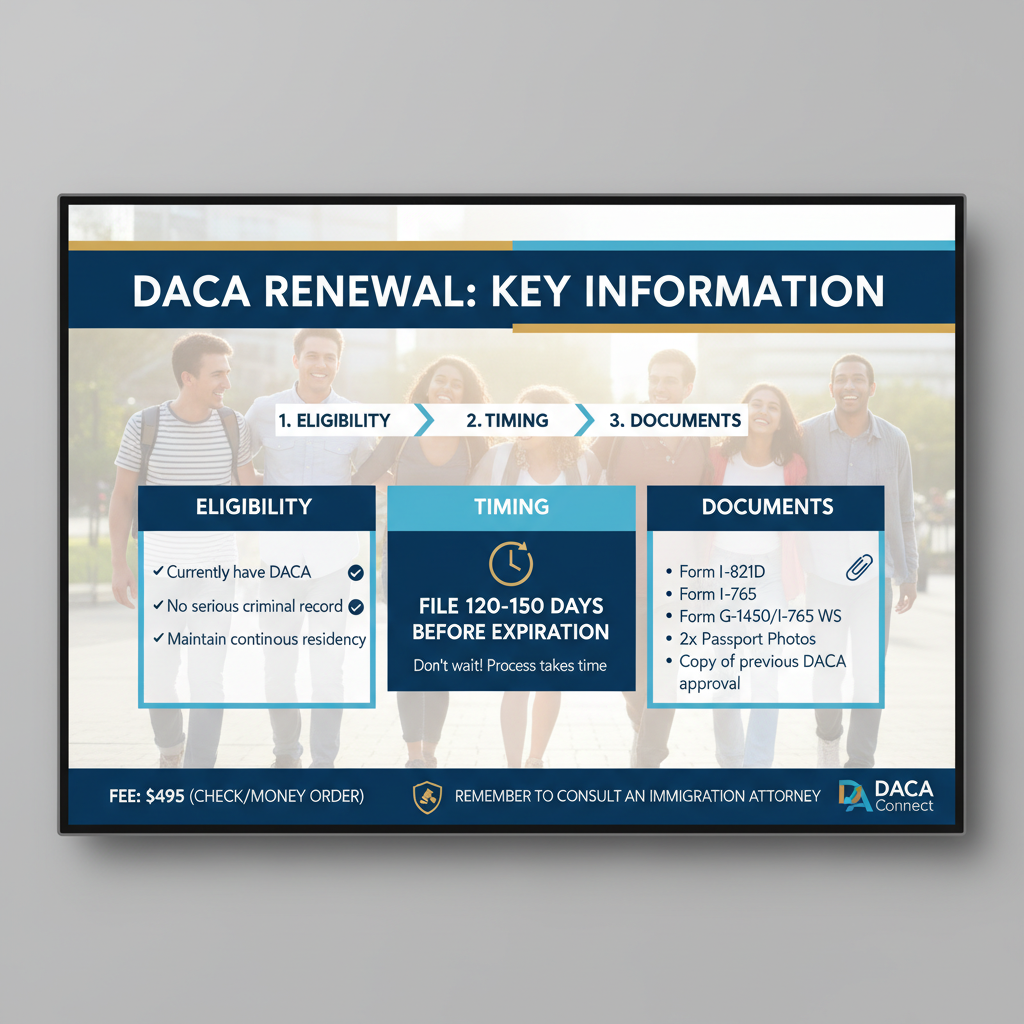
- When to Apply: USCIS recommends filing your DACA renewal request (Form I-821D and Form I-765) between 120 and 150 days before your current DACA and EAD expire. You can apply as early as 150 days before expiration.
- Why the Window Matters: Filing too early (more than 150 days) may result in USCIS rejecting your application. Filing too late (less than 90 days) significantly increases the risk of your DACA and EAD expiring before your renewal is approved, leading to a lapse in work authorization and potential loss of your driver’s license.
- Monitor Your Expiration Date: Keep track of the expiration date on your current Form I-797 Approval Notice and your EAD card.
Reminder: If your DACA expired more than a year ago, or if your last DACA was terminated, you should consult with an attorney immediately, as your case may be treated as an initial request, which USCIS is currently not accepting. However, USCIS has previously allowed renewals for those whose DACA expired less than a year ago.
2) Gather Required Documents
Thorough documentation is key to a successful DACA renewal. While much of your information is already on file with USCIS, you must provide updated evidence and reaffirm previous claims. Here's what you typically need:
- Previous DACA Approval Notices: Copies of your most recent Form I-797 Approval Notice for Form I-821D and Form I-765.
- Employment Authorization Document (EAD): A clear copy of the front and back of your most recent EAD card.
- Proof of Identity: Copies of government-issued identification, such as your passport, birth certificate with photo ID, or state ID/driver's license (if applicable).
- Passport-Style Photos: Two identical, unmounted, passport-style color photographs taken within 30 days of filing. Write your A-Number (Alien Registration Number) lightly on the back of each photo.
- Proof of Continuous Residence (if applicable): While not always required for renewals if no changes, if you have new evidence or if there's any doubt about your continuous residence since your last approval, include documents like utility bills, school transcripts, employment records, tax returns, or medical records.
- Criminal History Records (if applicable): If you have had any arrests, citations, or convictions since your last DACA approval, you must include certified court dispositions and police reports. Warning: Disclose ALL interactions with law enforcement, no matter how minor. Failure to do so can lead to denial and serious immigration consequences.
Organize these documents neatly. Create digital copies and keep them in a secure location, separate from your physical copies.
3) Complete Forms I-821D, I-765, and I-765 Worksheet
These are the official forms required for DACA renewal. Download the latest versions directly from the USCIS Forms page. Do not use old versions of the forms, as they may be rejected.
- Form I-821D, Consideration of Deferred Action for Childhood Arrivals:
- Fill out every section completely and accurately. If a question does not apply, write "N/A" (Not Applicable) or "None."
- Pay close attention to Part 1, Question 3 (A-Number) and Part 1, Question 4 (USCIS Online Account Number, if you have one).
- Ensure all biographical information matches your previous applications and supporting documents.
- In Part 2, Question 5, indicate "Renewal Request."
- Carefully review the criminal history section (Part 3) and be truthful and complete.
- Sign and date the form. An unsigned form will be rejected.
- Form I-765, Application for Employment Authorization:
- This form requests your work permit.
- In Part 2, Question 27, enter the eligibility category: (c)(33) for DACA recipients.
- Fill in all other required information, ensuring consistency with Form I-821D.
- Sign and date the form.
- Form I-765 Worksheet:
- This worksheet is mandatory for DACA renewal requests and helps USCIS verify your eligibility.
- It asks for information about your last entry into the U.S., your continuous residence, and education/military status.
- Complete it thoroughly.
Important: It is highly recommended to type the information into the forms. If you must handwrite, use black ink and print clearly. Make a copy of all completed forms for your records.
4) Prepare Your Filing Fee
The DACA renewal process requires a filing fee, which covers both the Employment Authorization Document (EAD) and the biometrics services fee. As of March 8, 2026, the fee is generally $495.
- Fee Breakdown: This includes $410 for Form I-765 (Application for Employment Authorization) and an $85 biometrics services fee. There is no separate fee for Form I-821D.
- Payment Method: You must submit a single payment for the total amount ($495). This can be a money order, personal check, cashier's check, or credit card (using Form G-1450, Authorization for Credit Card Transactions).
- Payable To: Make checks or money orders payable to "U.S. Department of Homeland Security." Do NOT abbreviate.
- Fee Waivers: Generally, fee waivers are NOT available for DACA renewal requests, except in very limited circumstances demonstrating extreme financial hardship (e.g., homeless, receiving public benefits, or income below 150% of the poverty line). Consult an attorney if you believe you qualify for a fee waiver.
Warning: An incorrect fee amount or improperly prepared payment will lead to your application being rejected and returned, causing significant delays.
5) Assemble Your Application Package
The order in which you assemble your documents is important to help USCIS process your application efficiently. While USCIS does not mandate a specific order, this is a widely accepted best practice:
- Cover Letter (Optional but Recommended): A brief letter listing the forms enclosed, the payment amount, and the supporting documents. Include your A-Number.
- Payment: Check, money order, or Form G-1450 on top.
- Two Passport-Style Photos: Placed in a small, clear envelope and stapled to the upper left corner of Form I-765.
- Form I-821D: Completed and signed.
- Form I-765: Completed and signed.
- Form I-765 Worksheet: Completed.
- Copies of Supporting Documents:
- Copy of current EAD (front and back).
- Copy of last Form I-797 approval notice for Form I-821D.
- Copy of last Form I-797 approval notice for Form I-765.
- Copies of any criminal dispositions, if applicable.
- Any other requested or relevant supporting documentation (e.g., continuous residence proof if you've had gaps or changes).


