


The landscape of immigration law is constantly shifting, and few programs embody this more than Deferred Action for Childhood Arrivals (DACA). For thousands of young people across the United States, including a significant population right here in Florida, DACA offers a measure of stability and the ability to work legally. However, the program remains subject to ongoing legal challenges, making it crucial for recipients to stay informed about the latest updates and, most importantly, how to protect their status through timely renewals.
At Imigrar, an immigration law firm based in Orlando, Florida, we are committed to helping DACA recipients and their families navigate these complexities. Our mission is to "Keep Families Together," and that includes ensuring that those who rely on DACA understand their rights, responsibilities, and the precise steps required to maintain their deferred action.
The reporting that sparked this guide
This guide is inspired by the continuous coverage surrounding the DACA program, particularly updates from official sources like USCIS and ongoing legal developments that shape its future. For the latest general immigration news, you can refer to: DACA Program Updates and Renewal Information (USCIS)
What This News Means for Immigrants in Orlando and Across Florida
The persistent legal and political discussions surrounding DACA are not just abstract headlines; they have very real, tangible consequences for individuals and families. For DACA recipients in Orlando, throughout Central Florida, and across the entire state, these updates directly impact their daily lives, their employment, and their future planning.
Why this news is showing up now
DACA has been a subject of intense debate and litigation since its inception in 2012. The program, established via executive action, has faced numerous legal challenges regarding its legality and implementation. In recent years, federal courts have played a significant role in shaping DACA's operational status. Specifically, a ruling by the Fifth Circuit Court of Appeals in 2022 declared DACA unlawful, halting the processing of new, initial DACA applications. However, crucially, that same ruling allowed current DACA recipients to continue renewing their deferred action and employment authorization. This ongoing legal battle means that DACA's future remains uncertain, with potential for further appeals, legislative action, or new administrative rules. As of early 2026, the program continues to operate under this injunction, which permits renewals but bars new applications. This continuous legal scrutiny and the periodic issuance of court orders or administrative guidance from USCIS are why DACA news is consistently in the spotlight, demanding attention from beneficiaries and legal professionals alike.
How it can affect Florida residents
Florida is home to a substantial population of DACA recipients, often referred to as "Dreamers." These individuals contribute significantly to our state's economy, culture, and communities. For them, DACA means the ability to work legally, pursue higher education, obtain a driver's license, and live without the constant fear of deportation. The current legal status of DACA, allowing renewals but not new applications, creates a dual reality:
- For current DACA recipients: The ability to renew provides a pathway to continued stability, but the looming uncertainty means they must be diligent about timely renewals and stay informed about any changes. Any delay or error in the renewal process could jeopardize their status. For those working in Orlando's tourism, healthcare, or service industries, maintaining their Employment Authorization Document (EAD) is vital for their livelihoods and their ability to support their families.
- For those who never applied or whose DACA expired long ago: The inability to file an initial application or to reapply if their DACA lapsed means they are currently excluded from the program's benefits. This creates significant anxiety and limits their opportunities in Florida.
Furthermore, Florida-specific considerations exist. For instance, DACA recipients in Florida can obtain a driver's license, which is essential for commuting, working, and daily life in a state heavily reliant on vehicle transportation. Access to in-state tuition at Florida colleges and universities for DACA recipients varies and can be a complex issue, making the status of DACA critical for educational aspirations. The uncertainty surrounding DACA also impacts family unity, as many DACA recipients have U.S. citizen or lawful permanent resident family members who depend on their stability and contributions. At Imigrar, we understand these local impacts deeply and are here to provide tailored guidance for our neighbors in Orlando and across the Sunshine State.
Need Help? Our Orlando immigration team is ready to assist. Call +1 786-791-3106 for a free consultation, or message us online. Se Habla Español.
What DACA Is (and Why It Matters)
To fully understand the current news and renewal process, it's essential to grasp the fundamentals of DACA itself. The program, while widely known, is often misunderstood, particularly concerning its legal standing and what it actually provides.
A plain-English definition
Deferred Action for Childhood Arrivals (DACA) is a U.S. immigration policy that was established by the Obama administration in June 2012. It allows certain undocumented immigrants who came to the United States as children to receive a renewable two-year period of deferred action from deportation and eligibility for a work permit (Employment Authorization Document or EAD). Put simply, DACA provides temporary protection from deportation and the legal right to work in the U.S. It is NOT a pathway to U.S. citizenship or lawful permanent residency, nor does it grant a specific immigration status. It's a discretionary exercise of prosecutorial discretion by the Department of Homeland Security (DHS).
Key terms you need to know
- Deferred Action: This is the core benefit of DACA. It means that the Department of Homeland Security (DHS) chooses to "defer" or postpone any action to remove an individual from the U.S. for a specific period. It does not grant lawful status.
- DACA Recipient (or Dreamer): An individual who has been granted deferred action under the DACA program. The term "Dreamer" refers to those who would have benefited from the proposed but never passed "DREAM Act."
- Employment Authorization Document (EAD): Often referred to as a "work permit," this card (Form I-766) allows DACA recipients to legally work in the United States. It is granted for the same two-year period as deferred action and must be renewed concurrently.
- Initial Application: This refers to the first time an individual applies for DACA. Important: As of early 2026, USCIS is generally NOT accepting initial DACA applications due to federal court orders.
- Renewal Application: This refers to the process by which current DACA recipients apply to extend their deferred action and EAD for another two-year period. USCIS IS currently accepting and processing DACA renewal applications.
- USCIS (U.S. Citizenship and Immigration Services): The government agency responsible for processing DACA applications and renewals, among other immigration benefits.
- DHS (Department of Homeland Security): The parent department that oversees USCIS and is responsible for immigration enforcement and policy.
- Injunction: A legal order issued by a court that requires or prohibits a specific action. The current DACA program operates under an injunction that allows renewals but blocks initial applications.
DACA matters immensely because it provides a measure of stability and opportunity for hundreds of thousands of individuals who grew up in the U.S., know no other home, and contribute significantly to American society. Without DACA, these individuals would face the constant threat of deportation, be unable to work legally, and have their lives and futures thrown into profound uncertainty. For families in Orlando and across Florida, DACA has allowed parents to provide for their children, young adults to pursue careers, and communities to thrive.
Current Immigration Law: The Foundation
While DACA itself is not a statutory law passed by Congress, it operates within the framework of existing immigration law, specifically the Immigration and Nationality Act (INA), by exercising the Secretary of Homeland Security's discretion. The authority to grant deferred action stems from the executive branch's inherent authority to set enforcement priorities and exercise prosecutorial discretion.
The original DACA policy was implemented through a memorandum issued by former Secretary of Homeland Security Janet Napolitano. However, its legality has been challenged under the Administrative Procedure Act (APA), which governs how federal agencies develop and issue regulations. The core legal argument against DACA has been that it constitutes a substantive rule that should have gone through a formal notice-and-comment rulemaking process, and/or that it exceeds the executive branch's statutory authority under the INA.
As of early 2026, DACA's legal status is defined by a series of court rulings. The most significant is the September 2022 decision by the U.S. Court of Appeals for the Fifth Circuit, which affirmed a lower court's finding that the 2012 DACA memorandum was unlawful. The Fifth Circuit remanded the case back to the district court to consider the legality of a new DACA regulation issued by DHS in August 2022. While this legal battle continues, the injunction remains in place: USCIS is prohibited from granting initial DACA requests but can continue to accept and process DACA renewal requests.
Federal requirements
To be eligible for DACA renewal, applicants must meet the following federal requirements:
- Be a current DACA recipient or have had DACA that expired less than one year ago. (If your DACA expired more than one year ago, or if your DACA was terminated, you might be required to file a new initial DACA request, which USCIS is currently not accepting. Consult an attorney immediately in this scenario.)
- Have continuously resided in the United States since the date you submitted your most recent DACA request that was approved.
- Not have departed the United States on or after August 15, 2012, without advance parole.
- Not have been convicted of a felony, a significant misdemeanor, or three or more other misdemeanors, and not otherwise pose a threat to national security or public safety.
DACA recipients must maintain these eligibility criteria throughout their deferred action period and at the time of renewal. Any changes to criminal history or residency can impact renewal eligibility.
The primary USCIS forms involved in the DACA renewal process are:
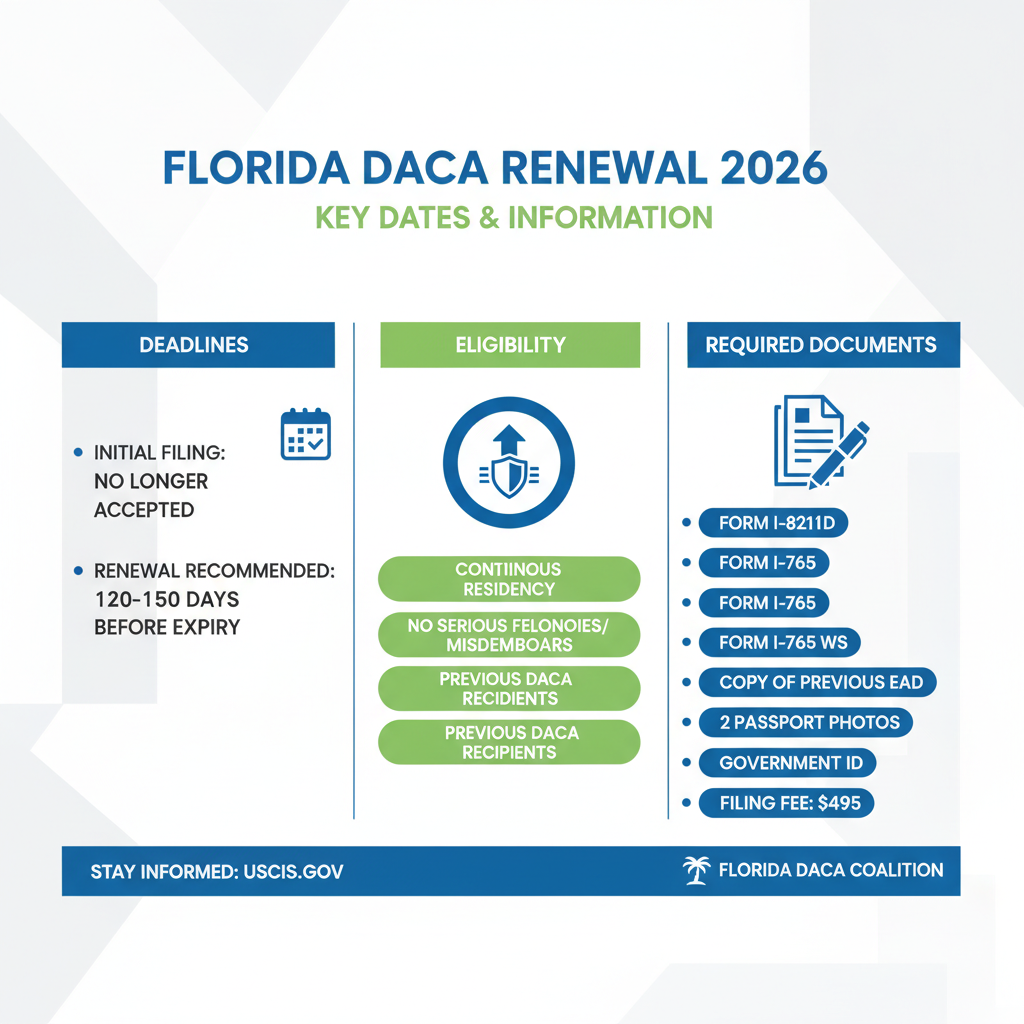
- Form I-821D, Consideration of Deferred Action for Childhood Arrivals
- Form I-765, Application for Employment Authorization
- Form I-765WS, Worksheet for Form I-765, Eligibility Category (c)(33)
You can always find the latest versions of these forms and detailed instructions on the USCIS official website, specifically at USCIS Forms.
Florida-specific considerations
While DACA is a federal program, its impact and certain practical aspects can vary by state. In Florida:
- Driver's Licenses: DACA recipients in Florida are eligible to apply for a Florida driver's license or identification card, which is critical for daily life, employment, and personal mobility, especially in sprawling areas like Orlando and its surrounding communities along the I-4 corridor. This requires a valid EAD and other identity documents.
- In-State Tuition: DACA recipients in Florida generally do not qualify for in-state tuition at public colleges and universities unless they meet specific criteria under Florida law that are separate from DACA status (e.g., attending a Florida high school for three years and applying for admission within 24 months of graduation). It's crucial for students to verify their eligibility with the specific educational institution.
- Local Resources: Communities in Central Florida, including Orlando and Orange County, often have non-profit organizations and legal aid services that assist DACA recipients. Imigrar also serves as a vital resource for legal guidance.
- Advocacy: Florida has a strong immigrant advocacy community that actively monitors DACA developments and works to support Dreamers at both state and federal levels.
Understanding these Florida-specific nuances, in addition to federal requirements, is key to navigating life as a DACA recipient in our state.
How to Renew Your DACA: A Complete Step-by-Step Guide
Renewing your DACA is a critical process that requires meticulous attention to detail and adherence to specific timelines. Missing deadlines or submitting an incomplete application can lead to significant delays or even termination of your deferred action. Here is a comprehensive guide to help you through the DACA renewal process.
1) Understand the Renewal Timeline and Confirm Eligibility
When to Apply: USCIS recommends filing your DACA renewal application 120 to 150 days before your current DACA and EAD expire. Filing too early (more than 150 days) may result in USCIS rejecting your application, while filing too late (less than 120 days) risks your DACA and EAD expiring before your renewal is processed, which could lead to a lapse in employment authorization and potential issues with your status.
- Check Expiration Dates: Locate your current DACA approval notice (Form I-797) and your EAD card (Form I-766) to confirm the exact expiration dates. Mark these dates on your calendar.
- Continuous Residency: Ensure you have continuously resided in the U.S. since your last DACA approval. Brief, authorized travel with advance parole typically does not break continuous residency.
- Criminal History Review: Re-evaluate your criminal history since your last DACA approval. Any new arrests, charges, or convictions, even minor ones, could affect your eligibility. It is paramount to consult with an immigration attorney if you have any new criminal history, regardless of how minor it seems.
- No Unauthorized Departures: Confirm you have not departed the U.S. without advance parole on or after August 15, 2012.
Reminder: If your DACA expired more than one year ago, or if it was terminated, you generally cannot file a renewal application. You would need to file a new initial DACA request, which USCIS is currently not accepting. Seek immediate legal counsel from Imigrar if you are in this situation.
2) Gather Required Documents
Preparing your documents thoroughly is perhaps the most critical step. While renewals often require less documentation than initial applications, it's still essential to provide everything necessary.
- Identification Documents:
- Copy of your current EAD (front and back).
- Copy of your most recent DACA approval notice (Form I-797).
- Copy of your passport biographical page (if available) or other government-issued photo ID.
- Proof of Continuous Residence: You generally do not need to resubmit extensive proof of continuous residence unless there has been a significant gap in your previous records or you have traveled outside the U.S. with advance parole. However, USCIS reserves the right to request this information. It's wise to have some recent documents ready, such as:
- Bank statements
- Utility bills
- Lease agreements or rent receipts
- School transcripts or diplomas
- Employment records (pay stubs, W-2s)
- Medical records
- Criminal History Documents (if applicable):
- Certified court dispositions for any arrests or convictions since your last DACA approval.
- Police reports (if requested by USCIS).
- Passport-Style Photographs: Two identical, color passport-style photos taken within 30 days of filing your application. Write your name and A-number (Alien Registration Number) lightly in pencil on the back of each photo.
Tip: Create a checklist and make copies of *everything* you send to USCIS for your records.
3) Complete the Forms
You will need to complete three forms for your DACA renewal. Ensure you use the most current versions, available on the USCIS Forms page.
- Form I-821D, Consideration of Deferred Action for Childhood Arrivals:
- Fill out all sections accurately and completely. If a question does not apply to you, write "N/A" (not applicable).
- Pay close attention to Part 2, "Information About Your Request," and check the box indicating you are requesting "Renewal of Deferred Action."
- Review all biographical information and address history for consistency with previous applications.
- Sign and date the form.
- Form I-765, Application for Employment Authorization:
- Complete all sections. For question 27, "Eligibility Category," enter (c)(33).
- Ensure your name, address, and biographical information match Form I-821D.
- Sign and date the form.
- Form I-765WS, Worksheet for Form I-765, Eligibility Category (c)(33):
- This worksheet is required for DACA applicants to demonstrate economic necessity for employment authorization.
- Provide a detailed explanation of your income, expenses, and assets. Be honest and thorough.
- Sign and date the form.
Warning: Any inconsistencies or false information can lead to denial and potentially severe immigration consequences. If you are unsure about any question, contact Imigrar for assistance.
Need Help? Our Orlando immigration team is ready to assist. Call +1 786-791-3106 for a free consultation, or message us online. Se Habla Español.
4) Prepare Your Application Package
Organizing your application package correctly can prevent delays.
- Order of Documents: While USCIS doesn't mandate a strict order, a logical arrangement helps. A common order is:
- Payment (checks/money orders) clipped to the top.
- Form G-1450, Authorization for Credit Card Transactions (if paying by credit card).
- Cover letter (optional, but recommended if you have specific explanations or an unusual case).
- Form I-821D.
- Form I-765.
- Form I-765WS.
- Two passport-style photos in a small envelope, clipped to Form I-765.
- Copies of supporting documents (EAD, approval notices, proof of residence, criminal dispositions, etc.).
- No Staples: Do not staple documents together. Use paper clips to secure related documents.
- One-Sided Copies: Submit only one-sided copies of all documents.
- Make Copies: Before mailing, make a complete copy of your entire application package for your records. This is invaluable if USCIS requests additional information or if your original package is lost.
5) Pay the Fees
The DACA renewal application requires a fee. As of early 2026, the total fee for a DACA renewal is $495. This includes:
- $85 for the biometric services fee (for fingerprinting).
- $410 for the Form I-765 (Application for Employment Authorization).
Note: There is no fee for Form I-821D itself. The fee is exclusively for the EAD and biometrics.
- Payment Method: You can pay by money order, personal check, cashier's check, or by credit card using Form G-1450, Authorization for Credit Card Transactions.
- Payable To: Make checks or money orders payable to "U.S. Department of Homeland Security." Do NOT abbreviate.
- Fee Waivers: Fee waivers for DACA are extremely limited and rarely granted. USCIS generally does not accept fee waiver requests for DACA renewals. If you believe you might qualify under exceptional circumstances, consult an attorney.
6) Submit Your Application
Once your package is complete and reviewed, it's time to mail it. The mailing address depends on where you live. For applicants residing in Florida, your DACA renewal package should be mailed to the USCIS Chicago Lockbox facility. Important: Always verify the correct mailing address on the USCIS Direct Filing Addresses for Form I-821D page, as these addresses can change.
- USPS P.O. Box Address:
USCIS Attn: DACA P.O. Box 805887 Chicago, IL 60680-4120 - USPS Express Mail and Courier Deliveries (e.g., FedEx, UPS):
USCIS Attn: DACA 131 South Dearborn Street, 3rd Floor Chicago, IL 60603-5517 - Shipping Method: Use a method that provides tracking and delivery confirmation (e.g., USPS Certified Mail with Return Receipt, FedEx, UPS). This provides proof that you sent your application and when it was received.
7) What Happens After Submission
After you mail your application, here's what to expect:
- Receipt Notice: Within a few weeks, you should receive a Form I-797C, Notice of Action, confirming that USCIS has received your application. This notice will include a receipt number, which you can use to track your case status online at USCIS Case Status Online.
- Biometrics Appointment: You will receive a biometric services appointment notice (Form I-797C) scheduling you for fingerprinting at an Application Support Center (ASC). For Central Florida residents, this might be at the Orlando USCIS Field Office or another nearby ASC. Attend this appointment as scheduled, bringing the notice and a valid photo ID.
- Request for Evidence (RFE) or Interview: USCIS may send an RFE if they need more information or clarification. Respond promptly and completely. Interviews for DACA renewals are rare but can happen.
- Decision: If approved, you will receive an approval notice (Form I-797) for your deferred action and your new EAD card (Form I-766) in the mail.
- Processing Times: Processing times vary but can be monitored on the USCIS Processing Times page. It's crucial to apply within the recommended 120-150 day window to avoid a lapse in work authorization.
Practical Steps You Can Take Today
Even with the ongoing legal challenges, DACA renewal remains a crucial protection for many. Here are practical steps you can take right now to prepare and protect your status:
- Check Your Expiration Dates: Immediately locate your current DACA approval notice and EAD card. Note their expiration dates and set reminders for the 120-150 day renewal window. Don't procrastinate!
- Organize Your Documents: Start gathering all necessary documents, including your current EAD, approval notices, and any new criminal history records. Ensure you have two recent passport-style photos.
- Review Your Criminal History: Seriously assess any arrests or interactions with law enforcement since your last DACA approval. Even minor incidents can have significant implications. If anything has occurred, contact Imigrar immediately.
- Save for Fees: The $495 renewal fee is a significant cost. Start saving now so you're not caught off guard when it's time to apply.
- Consult with an Attorney: If you have any doubts about your eligibility, any changes in your life circumstances (e.g., travel, criminal history), or simply want peace of mind, schedule a consultation with an experienced immigration attorney at Imigrar.
- Keep Copies of Everything: Before sending anything to USCIS, make a complete, organized copy of your entire application package. Store it in a safe place.
- Stay Informed: Regularly check official USCIS announcements and reliable legal news sources. Imigrar's blog is a great place to find current, accurate information.
Document Preparation Guidance
- Accuracy is Key: Ensure all information on your forms is truthful and matches your supporting documents. Discrepancies can lead to RFEs or denials.
- Legibility: If handwriting, use black ink and print clearly. Typed forms are preferred.
- Translations: Any documents not in English must be accompanied by a complete English translation and a translator's certification.
- No Originals: Unless specifically requested, never send original documents. Always send clear, legible copies.
Timeline Expectations
- Filing Window: Apply 120 to 150 days before expiration.
- Receipt Notice: Expect within 2-4 weeks after mailing.
- Biometrics Appointment: Typically scheduled 3-8 weeks after receipt notice.
- Decision: Can vary significantly. Check USCIS Processing Times for current estimates. Some renewals are processed quickly, others can take several months.
- Lapse in EAD: If you apply too late, your EAD may expire before you receive your new one, leading to a temporary inability to work. Plan accordingly with your employer.
Need Help? Our Orlando immigration


Have Questions About Your Case?
Schedule a free consultation with our attorney-reviewed team today