


The reporting that sparked this guide: DACA Program Updates and Renewal Information (USCIS)
What This News Means for Immigrants in Orlando and Across Florida
As an immigration law firm dedicated to helping families in Orlando and nationwide, Imigrar understands that news surrounding the Deferred Action for Childhood Arrivals (DACA) program can bring a mix of hope, anxiety, and confusion. For hundreds of thousands of young immigrants, often referred to as DREAMers, DACA represents stability, work authorization, and protection from deportation. Staying informed about the latest updates and understanding the renewal process is not just helpful—it's absolutely critical for maintaining your status and future.
Why this news is showing up now
The DACA program, established in 2012, has been a subject of continuous legal and political debate. Its very existence has been challenged in federal courts for years, leading to periods of uncertainty, pauses on initial applications, and ongoing administrative reviews. As of April 24, 2026, DACA continues to operate under specific court orders, meaning that while USCIS is generally prohibited from approving new, initial DACA requests, it is still authorized to accept and process DACA renewal requests.
This constant state of legal flux means that any new court ruling, administrative policy change, or even a statement from government officials can trigger a wave of news and concern. The ongoing discussions about DACA's future in Congress and the courts mean that updates are frequent, and recipients must remain vigilant. Our goal at Imigrar is to cut through the noise and provide clear, actionable information so you can navigate this complex landscape with confidence.
How it can affect Florida residents
Florida is home to a significant population of DACA recipients, with thousands of young individuals relying on the program for their ability to work, study, and contribute to our communities. For those living in Orlando, Central Florida, and across the state, DACA updates directly impact their daily lives and long-term plans. From employment opportunities in Orlando's thriving tourism and tech sectors to pursuing higher education at local universities like UCF, DACA status is fundamental.
Changes or delays in the renewal process can mean job loss, inability to drive, and increased fear of deportation. Florida residents also face specific considerations, such as the state's policies on driver's licenses for DACA recipients and in-state tuition eligibility. Imigrar is strategically located in Orlando, making us easily accessible to those in Orange County and along the I-4 corridor who need expert legal guidance on their DACA status.
Need Clarity on DACA? Don't navigate the legal complexities alone. Our Orlando immigration team is ready to assist. Call +1 786-791-3106 for a free consultation, or message us online. Se Habla Español.
What DACA Is (and Why It Matters)
The Deferred Action for Childhood Arrivals (DACA) program is a critical, albeit temporary, immigration policy that has impacted the lives of hundreds of thousands of young individuals in the United States. Understanding its origins, purpose, and limitations is paramount for anyone directly or indirectly affected by it.
A plain-English definition
At its core, Deferred Action for Childhood Arrivals (DACA) is an immigration policy that allows certain undocumented immigrants who entered the United States as children to receive a renewable two-year period of deferred action from deportation and eligibility for a work permit. In simpler terms, it provides temporary protection from being removed from the country and grants permission to work legally in the U.S.
Important: DACA is not a path to U.S. citizenship or lawful permanent residency (a "green card"). It does not change your immigration status; rather, it provides a temporary administrative reprieve from deportation proceedings. It must be renewed every two years to maintain its benefits.
Key terms you need to know
- Deferred Action: This is an exercise of prosecutorial discretion to defer removal action against an individual. It does not confer lawful status but rather indicates that the government will not pursue deportation for a specific period.
- Employment Authorization Document (EAD): Also known as a work permit, this card proves that you are authorized to work legally in the United States. DACA recipients receive an EAD valid for two years, matching their deferred action period.
- DREAMers: This term refers to young undocumented immigrants who were brought to the U.S. as children. It originates from the proposed "DREAM Act" legislation, which aimed to provide a pathway to citizenship for these individuals. While DACA is not the DREAM Act, the terms are often used interchangeably to describe DACA recipients.
- USCIS: The U.S. Citizenship and Immigration Services is the federal agency responsible for administering immigration and naturalization benefits, including DACA. You will interact with USCIS for your DACA applications and renewals.
- Advance Parole: This is a travel document that allows certain non-citizens, including some DACA recipients, to travel abroad and return to the U.S. legally. It is applied for separately using Form I-131. Traveling without Advance Parole can lead to serious immigration consequences, including being barred from returning to the U.S. and potentially losing DACA status.
- Renewal: The process of reapplying for DACA and employment authorization before your current period expires. As of 2026, renewals are the primary activity within the DACA program.
- Initial Application: The first-time application for DACA. Due to ongoing court orders, USCIS is generally prohibited from approving initial DACA requests as of April 24, 2026.
Current Immigration Law: The Foundation
The DACA program was established through an executive memorandum issued by the Secretary of Homeland Security on June 15, 2012. It was not created by an act of Congress but rather through the executive branch's exercise of prosecutorial discretion. This administrative origin has been the source of many legal challenges over the years, leading to its current, somewhat precarious, status.
As of April 24, 2026, federal courts have maintained an injunction that prevents USCIS from approving new, initial DACA applications. However, the courts have generally allowed USCIS to continue processing DACA renewal requests for individuals who have previously been granted deferred action under the program. This means that while the door for new applicants remains largely closed, current DACA recipients can still maintain their status.
Federal requirements for DACA renewal
To be eligible for DACA renewal, you must continue to meet the original DACA guidelines, with specific emphasis on continuous residence and good moral character. The key federal requirements include:
- Met Original DACA Guidelines: You must have met the original criteria when your DACA was first granted.
- Continuous Residence: You must have continuously resided in the United States since you submitted your most recent DACA request that was approved. Brief, casual, and innocent departures from the U.S. will not interrupt continuous residence, but you must not have departed the U.S. on or after August 15, 2012, without obtaining Advance Parole.
- No Disqualifying Criminal Record: You must not have been convicted of a felony, a significant misdemeanor, or three or more other misdemeanors. Significant misdemeanors include offenses like domestic violence, sexual abuse or exploitation, burglary, drug distribution or trafficking, unlawful possession or use of a firearm, driving under the influence (DUI), or any felony for which the individual was sentenced to time in custody for more than 90 days.
- No Other Threats to National Security or Public Safety: You must not otherwise pose a threat to national security or public safety.
It's crucial to remember that these are federal guidelines. Any interaction with law enforcement, even if charges were dropped or expunged, must be disclosed and can potentially impact your renewal. For detailed information, always refer to the USCIS official website.
Florida-specific considerations
For DACA recipients residing in Florida, there are important state-level considerations that enhance the benefits of maintaining your deferred action status:
- Driver's Licenses: In Florida, DACA recipients are eligible to apply for a driver's license upon presentation of their valid Employment Authorization Document (EAD) and other required identification. This is a crucial benefit for mobility, employment, and daily life in a state heavily reliant on vehicle transportation.
- In-State Tuition: Under Florida law (specifically, HB 851, passed in 2014), DACA recipients who meet certain criteria are eligible to pay in-state tuition at Florida public colleges and universities. This provides a significant financial advantage for pursuing higher education for Central Florida residents looking to attend institutions like the University of Central Florida (UCF), Valencia College, or Rollins College in the Orlando area.
- Professional Licenses: DACA recipients in Florida may be eligible to apply for certain professional licenses, depending on the specific occupation and state regulations. This allows DREAMers to pursue careers in various fields, contributing to Florida's economy and diverse workforce.
Maintaining your DACA status is essential to access these state-specific benefits. Any lapse in your deferred action could jeopardize your ability to hold a driver's license, qualify for in-state tuition, or maintain professional licenses.
Worried about your DACA renewal? Imigrar has extensive experience guiding Florida DACA recipients. Call +1 786-791-3106 for a free consultation and ensure your future is protected. Se Habla Español.
How to Renew Your DACA: A Complete Step-by-Step Guide
Renewing your DACA is a critical process that requires meticulous attention to detail and timely action. Missing deadlines or submitting an incomplete application can lead to a lapse in your deferred action and employment authorization. This guide outlines the essential steps for a successful DACA renewal.
1) Understand Your Eligibility and Timing
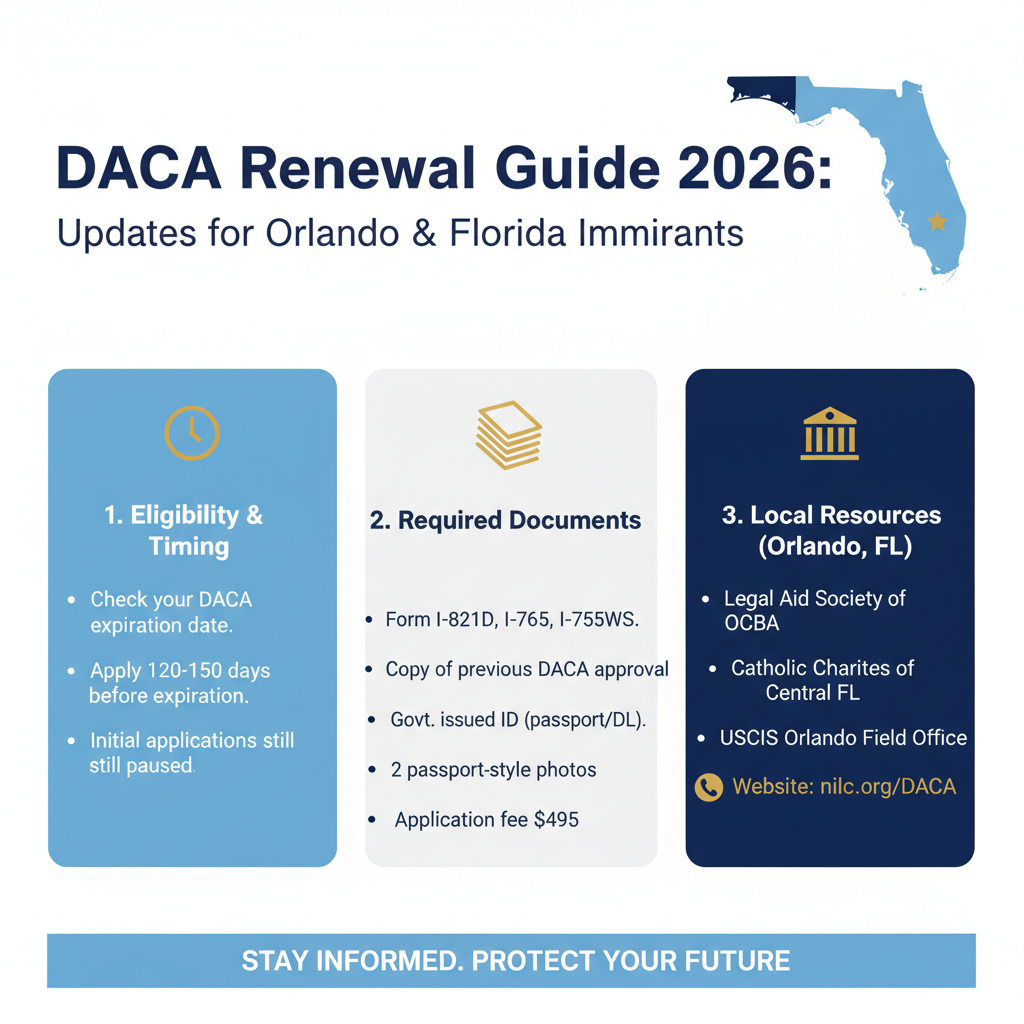
The first step is to confirm your continued eligibility for DACA and to understand the optimal filing window. USCIS recommends filing your renewal application between 120 and 150 days before your current DACA and Employment Authorization Document (EAD) expire. Filing too early can result in your application being rejected, while filing too late risks a lapse in your status.
- Review Eligibility: Ensure you still meet all DACA criteria: continuous residence since your last approval, no new disqualifying criminal convictions (felonies, significant misdemeanors, or three or more other misdemeanors), and no other threats to national security or public safety.
- Check Expiration Dates: Locate your current I-797 DACA Approval Notice and your EAD card to confirm their expiration dates. Mark your calendar for the 120-150 day window.
- Continuous Residence: Confirm you have not left the U.S. without Advance Parole since your last DACA approval.
Required Documents (for review):
- Previous DACA Approval Notice (Form I-797)
- Current Employment Authorization Document (EAD card)
2) Gather Required Forms
For a DACA renewal, you typically need to complete three specific forms. Ensure you download the most current versions directly from the USCIS Forms page to avoid delays caused by outdated forms.
- Form I-821D, Consideration of Deferred Action for Childhood Arrivals: This is the primary form for requesting deferred action. Complete every section accurately. If a question does not apply to you, write "N/A" (not applicable) or "None."
- Form I-765, Application for Employment Authorization: This form requests your work permit. For DACA renewals, under Part 2, Item 27, you should select "Renewal of my permission to work." For Item 27, provide the eligibility category "(c)(33)".
- Form I-765 Worksheet: This worksheet provides additional information required for the Form I-765, particularly regarding your employment history.
Reminder: Do not leave any fields blank. If a question is not applicable, write "N/A." If a numerical response is "0," write "0." Sign and date each form in blue or black ink.
3) Collect Supporting Documentation
Thorough and accurate documentation is key to a smooth renewal process. Provide copies of all requested documents; never send originals unless specifically instructed by USCIS.
- Proof of Identity:
- Copy of your birth certificate (with certified English translation if applicable)
- Copy of your passport (if available)
- Copy of any government-issued photo identification (e.g., driver's license, if you have one)
- Proof of Previous DACA Status:
- Copy of your most recent DACA Approval Notice (Form I-797)
- Copy of your current EAD card (front and back)
- Copy of any previous EAD cards (front and back)
- Proof of Continuous Residence: Provide documents for the entire period since your last DACA approval. USCIS wants to see evidence that you have continuously resided in the U.S. Acceptable documents include:
- School records (transcripts, report cards)
- Employment records (pay stubs, W-2 forms, employment letters)
- Bank statements
- Utility bills (electricity, water, gas, internet)
- Medical records
- Tax returns
- Rental agreements or mortgage statements
- Affidavits from others who can attest to your presence (with supporting documentation)
- Passport-Style Photos: Two identical, unmounted, color passport-style photos taken within 30 days of filing your application. Write your name and Alien Registration Number (A-Number) lightly on the back of each photo.
- Court Disposition Documents (if applicable): If you have ever been arrested, charged, or convicted of any crime (even if dismissed, expunged, or minor), you MUST include certified copies of all court dispositions and police reports. Failure to disclose any interaction with law enforcement is a significant mistake that can lead to denial.
- Copy of your most recent Advance Parole document (if you have one).
Warning: Be completely honest about your criminal history. USCIS conducts background checks, and any undisclosed information will likely be discovered and could lead to a denial, potentially putting you in removal proceedings.
4) Prepare Your Application Package
Organizing your application package correctly can prevent delays and make it easier for USCIS to process your request. Use a cover letter to list the contents of your package.
- Cover Letter: Include a cover letter stating your name, A-Number, and a list of all forms and supporting documents included in the package. This helps USCIS verify they have received all components.
- Order of Documents: While USCIS doesn't mandate a specific order, a common and helpful practice is:
- Check or Money Order for fees
- Form I-821D
- Form I-765
- Form I-765 Worksheet
- Passport-style photos (placed in a small envelope and stapled to the Form I-765)
- Copy of your current EAD (front and back)
- Copy of your DACA Approval Notice (Form I-797)
- Supporting documentation (proof of continuous residence, criminal dispositions, etc.)
- Make Copies: Make a complete copy of your entire application package before mailing it. This serves as your personal record and is invaluable if any issues arise.
5) Pay the Filing Fees
The filing fees for DACA renewal are non-refundable and must be submitted with your application. As of April 24, 2026, the total fee for DACA renewal is $495. This breaks down into:
- $410 for Form I-765 (Application for Employment Authorization)
- $85 for the biometrics services fee
Payment Method: You can pay by money order, personal check, cashier's check, or by credit card using Form G-1450, Authorization for Credit Card Transactions.
- If paying by check or money order, make it payable to "U.S. Department of Homeland Security." Do not abbreviate.
- Reminder: Fee waivers are generally NOT available for DACA applications.
6) Mail Your Application to the Correct USCIS Lockbox
The correct mailing address depends on your state of residence. Ensure you send your application to the appropriate USCIS Lockbox facility. You can find the most current addresses on the USCIS website for Form I-821D filing addresses.
For Florida residents, you typically mail your DACA renewal package to the USCIS Chicago Lockbox. However, always double-check the USCIS website for the most up-to-date instructions.
- USCIS Lockbox for Florida Residents (Check USCIS website for current address):
For U.S. Postal Service (USPS):
USCIS
Attn: DACA
P.O. Box 80528
Chicago, IL 60680-5288For FedEx, UPS, and DHL deliveries:
USCIS
Attn: DACA (Box 80528)
131 S. Dearborn St., 3rd Floor
Chicago, IL 60603-5517 - Shipping Method: Always use a mailing service that provides tracking and delivery confirmation, such as USPS Certified Mail with Return Receipt, FedEx, or UPS. This provides proof of mailing and delivery, which can be critical if there are any questions about your submission.
7) Attend Biometrics Appointment (if requested) & Monitor Status
After USCIS receives your application, they will send you a receipt notice (Form I-797C). Keep this notice for your records. You may also receive an appointment notice for biometrics.
- Biometrics Appointment: If requested, you will receive a notice (Form I-797C, Notice of Action) scheduling an appointment at an Application Support Center (ASC) near you. For Orlando and Central Florida residents, this would likely be the Orlando USCIS Field Office ASC. At this appointment, your fingerprints, photograph, and signature will be taken. This is a mandatory step, and failure to attend can lead to denial.
- Monitor Your Case Status: You can track the status of your application online using the receipt number provided on your Form I-797C. Visit the USCIS Case Status Online tool. You can also sign up for email and text message updates.
- Response to RFEs: USCIS may send a Request for Evidence (RFE) if they need more information or clarification. Respond to RFEs promptly and accurately within the specified timeframe.
Practical Steps You Can Take Today for DACA Renewal
Proactive preparation is your best defense against delays and potential issues with your DACA renewal. Here’s an actionable checklist to help you get started right away:
- Check Your DACA and EAD Expiration Dates IMMEDIATELY: This is the most crucial first step. Knowing your exact expiration date allows you to plan your renewal within the 120-150 day window.
- Start Gathering Documents Early: Don't wait until the last minute. Begin collecting all necessary supporting documents, especially proof of continuous residence for the past two years. This often takes time.
- Review Your Criminal Record: If you have ever been arrested or cited for any offense, no matter how minor, obtain certified court dispositions and police reports. Even dismissed cases must be disclosed.
- Update Your Address with USCIS: If you have moved since your last DACA approval, file Form AR-11


