


The landscape of immigration law is constantly evolving, and for Deferred Action for Childhood Arrivals (DACA) recipients, staying informed is not just important – it’s critical. At Imigrar, we understand the profound impact these changes have on individuals and families across Orlando, Florida, and the entire nation. Our mission, "Keep Families Together," drives us to provide the most current, accurate, and actionable information to help you navigate these complex pathways.
Today, we're diving deep into the latest DACA program updates and providing a comprehensive guide to the renewal process. Whether you're a long-time DACA recipient or assisting a loved one, this resource is designed to empower you with knowledge and practical steps.
Need Help? Our Orlando immigration team is ready to assist. Call +1 786-791-3106 for a free consultation, or message us online. Se Habla Español.
The reporting that sparked this guide
Our commitment to keeping you informed is often driven by significant announcements and ongoing discussions from authoritative sources. The latest information regarding DACA program updates and renewal processes, particularly from DACA Program Updates and Renewal Information (USCIS), has underscored the urgent need for a detailed, accessible guide for the DACA community.
What This News Means for Immigrants in Orlando and Across Florida
For hundreds of thousands of DACA recipients, often referred to as "Dreamers," every news cycle brings a mix of hope and anxiety. The recent updates from USCIS, while not fundamentally altering the program's current scope, emphasize the ongoing need for vigilance and timely action, especially for renewals. This is particularly true for the vibrant immigrant communities in Florida, including those in Orlando and the surrounding Central Florida region.
Why this news is showing up now
The Deferred Action for Childhood Arrivals (DACA) program has been a subject of continuous legal and political debate since its inception in 2012. The most recent wave of news stems primarily from the ongoing litigation in *Texas v. United States*. In late 2023, the Fifth Circuit Court of Appeals upheld a Texas federal court's ruling that the DACA program, as originally implemented in 2012, was unlawful. This decision has had a critical impact, particularly by continuing to bar USCIS from approving new DACA applications. However, the ruling also allowed for the continuation of DACA renewals for existing recipients while the case proceeds through the courts.
Following this, the Department of Homeland Security (DHS) issued a Final Rule on DACA, which went into effect in October 2022. This rule codifies the DACA policy into federal regulation, aiming to strengthen its legal standing. Despite this, the courts have maintained that the Final Rule cannot circumvent the injunction against new DACA applications. Therefore, the news today primarily revolves around USCIS continuing to process renewal applications under the existing guidelines, while simultaneously navigating the legal uncertainties and preparing for potential future changes based on judicial outcomes.
The constant legal scrutiny means that DACA remains a temporary relief, requiring careful attention to renewal deadlines and detailed adherence to USCIS requirements. For DACA recipients, this creates a perpetual state of planning and proactive engagement with their immigration status.
How it can affect Florida residents
Florida is home to a significant population of DACA recipients, many of whom contribute immensely to the state's economy and cultural fabric. For these individuals and their families, the ongoing DACA updates have several key implications:
- Renewal is Paramount: The most crucial takeaway for Florida DACA recipients is the continued ability and necessity to renew their DACA status and Employment Authorization Documents (EADs). Failing to renew on time can lead to a lapse in protection, loss of work authorization, and potential challenges with driver's licenses or in-state tuition eligibility.
- No New Applications: As the injunction remains in effect, individuals who have never before received DACA are still unable to apply. This creates a challenging situation for many young people in Florida who meet the original eligibility criteria but missed the initial application window.
- Educational Opportunities: DACA recipients in Florida may be eligible for in-state tuition at public colleges and universities, provided they meet other residency requirements. Maintaining DACA status is often a prerequisite for accessing these critical educational pathways. A lapse in DACA could jeopardize these opportunities.
- Driver's Licenses: In Florida, DACA recipients are generally eligible to obtain a driver's license. This is directly tied to their valid Employment Authorization Document. A timely renewal ensures continued driving privileges, which are essential for daily life, work, and education, particularly in a state like Florida where public transportation can be limited outside major urban centers like Orlando.
- Economic Stability: Work authorization provided by DACA allows recipients to legally work and support themselves and their families. Many DACA recipients are essential workers, small business owners, and vital contributors to the Florida economy. Maintaining their DACA status ensures their continued ability to work and build stable lives.
- Legal Planning: The ongoing legal challenges underscore the importance of consulting with experienced immigration counsel. For Florida residents, understanding the specific implications of federal court rulings and how they might impact state-level benefits or future immigration relief is vital. Imigrar, serving clients from Orlando to Miami and beyond, is uniquely positioned to provide this localized and national expertise.
The message for Florida's DACA community is clear: stay informed, plan ahead, and prioritize timely renewals. The legal landscape may be uncertain, but proactive measures can help secure your immediate future.
What DACA Is (and Why It Matters)
The Deferred Action for Childhood Arrivals (DACA) program is a critical immigration policy that has provided a lifeline to hundreds of thousands of young people across the United States since its inception in 2012. It’s important to understand what DACA truly means and why its continuation matters so deeply to so many.
A plain-English definition
At its core, DACA is an exercise of "prosecutorial discretion" by the Department of Homeland Security (DHS). It allows certain eligible young undocumented immigrants who came to the U.S. as children to receive a renewable two-year period of deferred action from deportation. "Deferred action" means that the government agrees not to pursue deportation proceedings against these individuals for a specified period.
Crucially, DACA also provides recipients with work authorization, granting them an Employment Authorization Document (EAD). This EAD allows them to legally work in the United States, obtain a Social Security number, and in many states, apply for a driver's license. DACA is not a pathway to permanent residency or citizenship, but it offers a temporary reprieve, enabling recipients to live, work, and study without immediate fear of deportation.
It's important to remember: * DACA is not a law passed by Congress, but a policy implemented by the Executive Branch. This is why it has been subject to continuous legal challenges. * It does not confer lawful immigration status, but rather a temporary period of protection from deportation.
Key terms you need to know
Navigating DACA requires understanding specific terminology:
- Deferred Action: This is the core benefit of DACA. It means the government has chosen to defer, or postpone, any removal (deportation) proceedings against an individual for a specific period. It is a temporary measure and can be revoked.
- DACA Recipient / Dreamer: An individual who has been granted deferred action under the DACA program. The term "Dreamer" refers to the "DREAM Act" (Development, Relief, and Education for Alien Minors Act), a legislative proposal that would provide a pathway to lawful permanent residency for eligible undocumented youth. While DACA is not the DREAM Act, the terms are often used interchangeably to refer to these young immigrants.
- Employment Authorization Document (EAD): Also known as a work permit, this card (Form I-766) is issued by USCIS to DACA recipients, allowing them to legally work in the U.S. for the duration of their deferred action period.
- USCIS (U.S. Citizenship and Immigration Services): The government agency responsible for administering DACA applications and renewals. This is the primary agency you will interact with.
- Advance Parole: A travel document that allows certain non-citizens, including DACA recipients in some limited circumstances, to travel outside the U.S. and return lawfully. While DACA itself does not permit travel, a separate application for Advance Parole (Form I-131) may be granted for humanitarian, educational, or employment purposes.
- Prosecutorial Discretion: The authority of an executive branch agency (like DHS) to decide how to enforce the law. In the context of DACA, it means DHS chooses to prioritize certain individuals for removal while deferring action for others who meet specific criteria.
- Final Rule: The DACA Final Rule, which became effective in October 2022, codified the DACA policy into federal regulations, aiming to provide a more stable legal footing for the program. However, it is still subject to the ongoing court injunction against new applications.
Understanding these terms is crucial for DACA recipients as they navigate the renewal process and stay informed about the program's future. For those in Orlando and throughout Florida, these definitions provide the foundation for understanding their rights and responsibilities.
Current Immigration Law: The Foundation for DACA
While DACA itself is a discretionary policy rather than a specific statute passed by Congress, its existence and the ongoing legal battles surrounding it are deeply intertwined with established immigration law and federal court decisions. Understanding this legal framework is essential for DACA recipients.
Federal requirements for DACA
The original DACA policy, and the subsequent Final Rule, outlined specific criteria that individuals must meet to be eligible for deferred action. While new applications are currently blocked, these criteria remain the basis for renewals:
- Age: You must have been under the age of 31 as of June 15, 2012.
- Entry to U.S.: You must have come to the United States before reaching your 16th birthday.
- Continuous Residence: You must have continuously resided in the United States since June 15, 2007, up to the present time. Brief, innocent departures do not necessarily break continuous residence, but longer or unauthorized departures can.
- Physical Presence: You must have been physically present in the United States on June 15, 2012, and at the time of making your request for deferred action.
- No Lawful Status: You must not have been in lawful immigration status on June 15, 2012.
- Education/Military Service: You must currently be in school, have graduated or obtained a certificate of completion from high school, have obtained a general education development (GED) certificate, or be an honorably discharged veteran of the Coast Guard or Armed Forces of the United States.
- Criminal History: You must not have been convicted of a felony, a significant misdemeanor, or three or more other misdemeanors, and not otherwise pose a threat to national security or public safety.
Important: As of the current legal situation (2026-09-02), USCIS is *not* accepting initial DACA requests. Only individuals who have previously been granted DACA are eligible to apply for renewal. This restriction is due to the ongoing injunction from *Texas v. United States*.
The forms central to the DACA renewal process are:
- Form I-821D, Consideration of Deferred Action for Childhood Arrivals: This is the primary form for requesting deferred action.
- Form I-765, Application for Employment Authorization: This form is used to request your work permit (EAD).
- Form I-765WS, Worksheet: This worksheet provides additional information required for the Form I-765.
You can always find the latest versions of these forms and instructions on the USCIS Forms page or the USCIS official website.
Florida-specific considerations for DACA recipients
While DACA is a federal program, its practical implications often interact with state laws and policies. For DACA recipients in Florida, several state-specific considerations are worth noting:
- Driver's Licenses: In Florida, DACA recipients with a valid Employment Authorization Document (EAD) are generally eligible to apply for and obtain a Florida driver's license or state identification card. The validity period of the license will typically match the expiration date of the EAD. It is crucial to renew your DACA and EAD promptly to avoid a lapse in your driving privileges.
- In-State Tuition: Florida Statute § 1009.26(12)(a) allows certain undocumented students, including DACA recipients, to qualify for in-state tuition at Florida public colleges and universities if they meet specific residency requirements and attended a Florida high school for at least three consecutive years immediately before graduation. Maintaining DACA status helps establish the eligibility for this critical benefit.
- Professional Licenses: DACA recipients may be eligible to apply for professional licenses in Florida, depending on the specific profession and state regulations. The ability to work legally via an EAD is a foundational requirement, but some professions may have additional requirements related to immigration status. It's always best to check with the specific licensing board.
- Local Engagement: Cities like Orlando, while not directly involved in DACA administration, often have local community organizations and legal aid groups that provide support and resources to immigrant communities, including DACA recipients. These organizations can be valuable sources of information and assistance, complementing the legal guidance from firms like Imigrar.
For Central Florida residents, including those in Orange County and along the I-4 corridor, understanding these state-level interactions is key to fully realizing the benefits of DACA. Keeping your DACA status current is the primary way to ensure continued access to these opportunities.
Confused by the forms or legal updates? Don't risk your DACA status. Contact Imigrar today for expert guidance. Call +1 786-791-3106 for a free consultation. Se Habla Español.
How to Renew Your DACA: A Complete Step-by-Step Guide
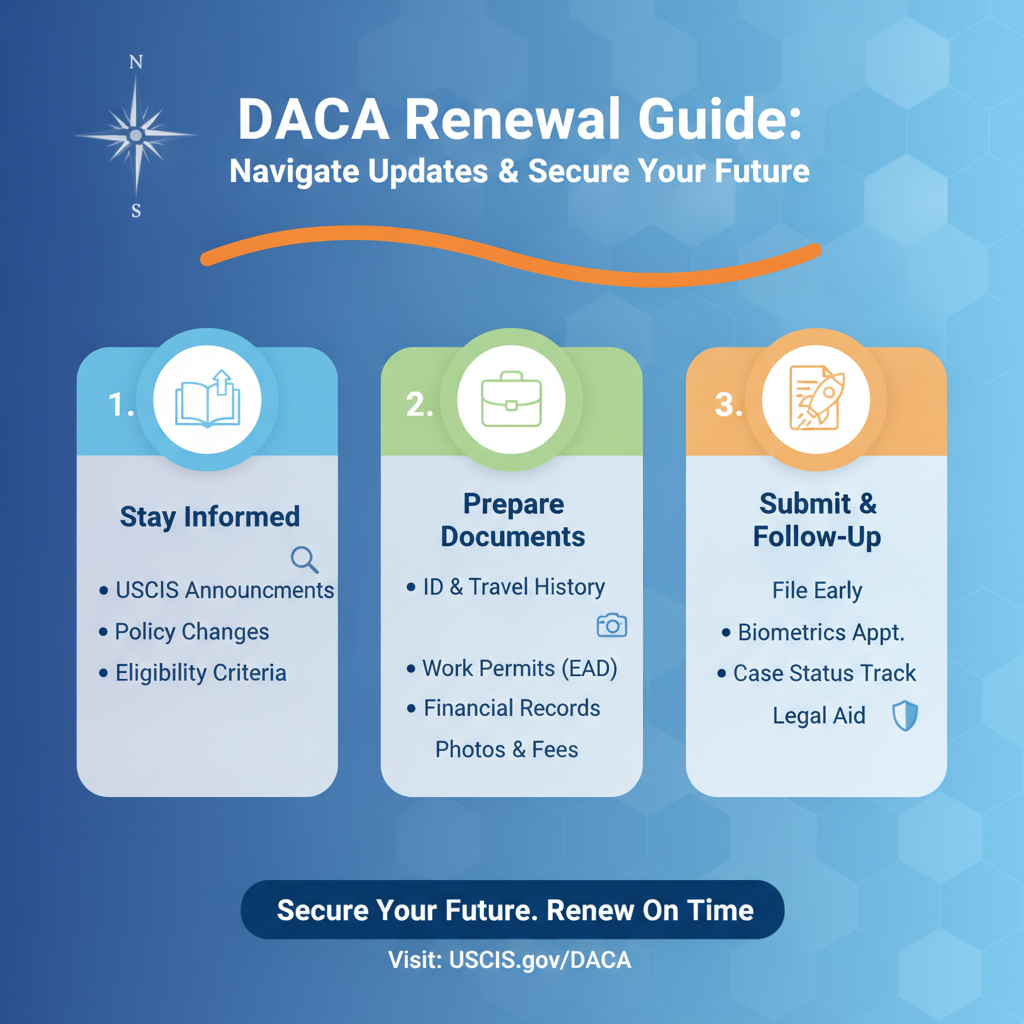
Renewing your Deferred Action for Childhood Arrivals (DACA) status is a critical process that requires meticulous attention to detail and timely submission. A lapse in DACA can have severe consequences, impacting your work authorization, driver's license, and protection from deportation. This step-by-step guide will walk you through the entire renewal process, ensuring you have all the necessary information to submit a strong application.
Important Note: This guide is for DACA renewals only. As of 2026-09-02, USCIS is not accepting initial DACA requests due to ongoing litigation.
1) Understand Your Renewal Timeline and Gather Necessary Information
The first and most crucial step is to know *when* to renew. USCIS recommends filing your DACA renewal application between 120 and 150 days before your current DACA and Employment Authorization Document (EAD) expire. Filing too early (more than 150 days) may result in rejection, while filing too late risks a lapse in your status.
- Check Expiration Dates: Locate your current DACA approval notice (Form I-797) and your EAD card (Form I-766). Note the expiration dates.
- Calculate Your Filing Window: Count back 120-150 days from the expiration date. Mark this window clearly on your calendar. For example, if your DACA expires on January 1, 2027, your ideal filing window is roughly from August 3, 2026, to September 2, 2026.
- Gather Personal Information: Have readily available your Alien Registration Number (A-Number), USCIS Online Account Number (if applicable), Social Security Number, and any previous DACA receipt numbers.
Reminder: If your DACA has already expired, you should still apply for renewal as soon as possible. USCIS generally accepts renewal requests even after expiration, but the sooner you apply, the better to minimize the period you are without DACA protection and work authorization.
2) Complete All Required USCIS Forms Accurately
The DACA renewal package consists of three essential forms. It is vital to complete them accurately, legibly, and completely. Any missing information or errors can cause delays or even rejection.
- Form I-821D, Consideration of Deferred Action for Childhood Arrivals:
- Fill out all sections truthfully. Pay close attention to questions about your travel history, criminal history, and physical presence.
- If you have had any arrests, charges, or convictions since your last DACA approval, you *must* disclose them, even if the charges were dismissed or you were found not guilty. Provide certified court dispositions for all incidents.
- Ensure your current address and contact information are up-to-date.
- Form I-765, Application for Employment Authorization:
- For DACA renewals, your eligibility category will be (c)(33).
- Answer all questions accurately, especially those related to your prior EADs.
- If you need a new Social Security card or have never had one, indicate this on the form.
- Form I-765WS, Worksheet:
- This worksheet helps USCIS determine if your economic need for employment authorization is justified.
- Provide a detailed explanation of your financial needs, income, and expenses. Be honest and thorough.
Tip: Always use the most current version of the forms available on the USCIS Forms website. Do not use outdated forms, as they will be rejected.
3) Gather All Supporting Documents
While DACA renewals typically require fewer supporting documents than initial applications, you must still provide evidence of your eligibility and identity. The specific documents you need may vary based on your individual circumstances, especially if there have been changes since your last approval.
- Identity and Work Authorization:
- Copy of your most recent EAD card (front and back).
- Copy of your most recent DACA approval notice (Form I-797 for Form I-821D).
- Copy of your birth certificate (with certified English translation if applicable).
- Copy of your passport identity page (if available).
- Photos: Two identical, passport-style color photographs taken within 30 days of filing. Write your A-Number and full name lightly on the back of each photo.
- Proof of Continuous Residence (if applicable):
- If you have maintained continuous residence and have no new adverse information (e.g., arrests, charges, or convictions) since your last DACA approval, you generally do not need to resubmit extensive documentation for continuous residence.
- However, if there have been any changes or if USCIS requests it, be prepared to submit documents like school transcripts, employment records, tax returns, utility bills, bank statements, medical records, or rent receipts.
- Proof of Education/Military Service (if applicable):
- High school diploma or GED certificate.
- Transcripts from current school or college.
- DD-214, Certificate of Release or Discharge from Active Duty (for veterans).
- Criminal History Documents (if applicable):
- Certified court dispositions for *any* arrests, charges, or convictions since your last DACA approval. This includes traffic citations that are not minor, dismissed charges, or deferred adjudications. Failure to disclose can lead to denial.
- Police reports (if available).
Recommendation: Organize your documents clearly. Make copies of everything you send to USCIS for your own records.
4) Pay the Required Fees
The DACA renewal process involves a non-refundable filing fee that must be paid at the time of submission. As of the current date, the fee structure is:
- Form I-821D: No fee.
- Form I-765 (EAD application): $410.
- Biometrics Services Fee: $85.
- Total Fee: $495.
Payment Methods:
- Personal check, cashier's check, or money order payable to "U.S. Department of Homeland Security." Do not abbreviate.
- Credit card using Form G-1450, Authorization for Credit Card Transactions.
Warning: Ensure the check or money order is correctly made out and for the exact amount. Incorrect payment methods or amounts will cause your application to be rejected. Write your A-Number on the memo line of your check or money order.
Fee Waivers: Fee waivers are generally *not* available for DACA applications, except in very limited circumstances involving extreme hardship. Consult with an attorney if you believe you qualify for a fee waiver.
5) Assemble Your Application Package and Mail It
Once all forms are completed, documents gathered, and fees prepared, it's time to assemble your package and mail it to USCIS.
- Order of Documents:
- Check or Money Order (or Form G-1450 on top).
- Two passport-style photos in a small envelope taped to the top of Form I-765.
- Form I-821D.
- Form I-765.
- Form I-765WS.
- Copies of supporting documents (EAD, DACA approval, birth certificate, etc.).
- Criminal history documents (if applicable).
- Mailing Address: Send your application to the USCIS Lockbox Facility that serves your state of residence. For Florida residents, you will typically mail to the Phoenix Lockbox address. Always check the "Where to File" section on the USCIS Form I-821D page for the most current and correct address.
- Shipping Method: Use a reputable mail service that provides tracking and delivery confirmation (e.g., USPS Certified Mail with Return Receipt, FedEx, UPS). This provides proof of mailing and delivery, which can be invaluable if your application is lost.
6) Attend Your Biometrics Appointment (if required)
After USCIS receives your application, they will send you a receipt notice (Form I-797C). Subsequently, you may receive an appointment notice (Form I-797C) for a biometrics (fingerprinting) appointment at an Application Support Center (ASC).
- Attend Promptly: It is crucial to attend this appointment on the scheduled date and time. Failure to do so can lead to delays or denial of your application.
- Required Documents: Bring your appointment notice, a valid photo ID (like your current EAD or driver's license), and any other documents specified in the notice.
- Purpose: At the ASC, your fingerprints, photograph, and signature will be collected. This information is used for background checks.
Note: USCIS sometimes reuses previously submitted biometrics, so you might not receive an appointment notice every time you renew. However, be prepared to attend if summoned.
7) Monitor Your Case Status and Respond to RFEs
Once your application is submitted, you can monitor its progress online.
- Online Case Status: Use the receipt number from your Form I-797C to check your case status on the USCIS Case Status Online tool.
- Processing Times: Keep an eye on the USCIS Processing Times page for an estimate of how long it might take. Search for Form I-821D and Form I-765 at the service center handling your case.
- Request for Evidence (RFE): If USCIS needs more information or clarification, they will send you an RFE. It is critical to respond to an RFE accurately and within the specified deadline. Failure to do so will almost certainly result in a denial.
- Approval: If your renewal is approved, you will receive an approval notice (Form I-797) for your Form I-821D and your new EAD card (Form I-766) in the mail.
Important: Keep your address updated with USCIS. If you move, file Form AR-11, Alien's Change of Address Card, and update your address on any pending applications online immediately.

Practical Steps You Can Take Today for DACA Renewal
Proactive planning is the cornerstone of a successful DACA renewal. Don't wait until the last minute. Here are practical steps you can start taking today, whether your renewal is imminent or still several months away.
Actionable Checklist (5+ items):
- Mark Your Calendar: Immediately note your DACA and EAD expiration dates. Set reminders for the 120-150 day renewal window. For Central Florida residents, a lapse in DACA could mean losing your driver's license, impacting your commute on the I-4 corridor.
- Start Saving for Fees: The total filing fee for DACA renewal is currently $495. Begin setting aside


