

Need Help? Our Orlando immigration team is ready to assist. Call +1 786-791-3106 for a free consultation, or message us online. Se Habla Español.
For hundreds of thousands of young immigrants across the United States, including a significant population right here in Florida, the Deferred Action for Childhood Arrivals (DACA) program represents a lifeline. It provides temporary protection from deportation and the ability to work legally. However, DACA has been the subject of ongoing legal battles and political debate, leading to frequent updates and persistent uncertainty. As an expert legal content writer for Imigrar, an immigration law firm dedicated to helping families stay together, we understand the critical need for clear, accurate, and timely information.
This comprehensive guide is designed to cut through the confusion, providing DACA recipients and their families with the most current information regarding DACA program updates and the essential steps for renewal. We'll cover everything from eligibility requirements and necessary forms to practical tips and common pitfalls, all with a focus on how this impacts our community in Orlando and throughout Florida.
The reporting that sparked this guide
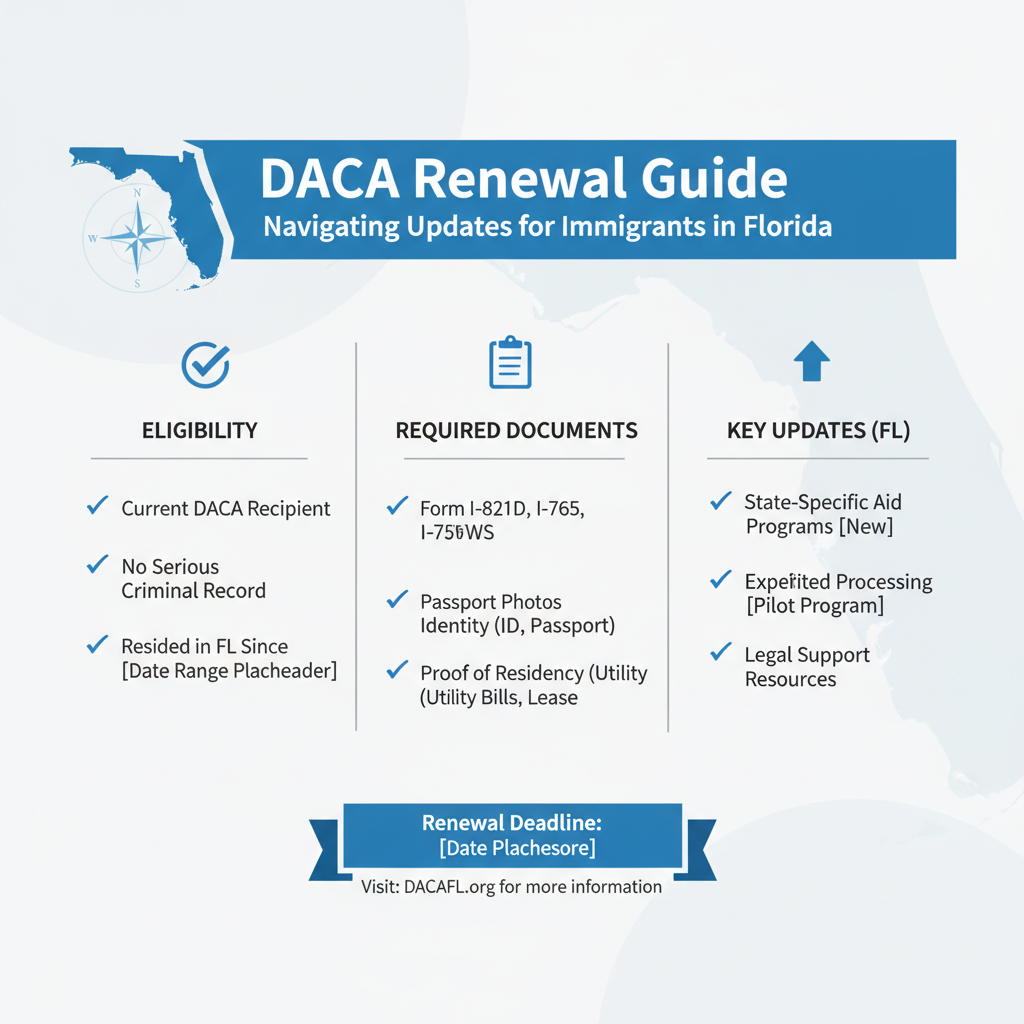
The constant stream of news surrounding DACA, particularly from official sources like USCIS, underscores the program's dynamic nature. Staying informed is paramount. This guide is inspired by the ongoing developments and the critical need for clarity on the DACA program updates and renewal process, as frequently reported by reputable news outlets tracking immigration law.
DACA Program Updates and Renewal Information (USCIS)
What This News Means for Immigrants in Orlando and Across Florida
The legal landscape surrounding DACA is complex and constantly evolving. For DACA recipients and their families in Central Florida, understanding these changes is not just important—it's essential for planning your future and maintaining your status.
Why this news is showing up now
DACA has been under a cloud of legal challenges since its inception in 2012. The program, created by executive action, has faced scrutiny over its legality, leading to numerous court cases. As of March 21, 2026, the program continues to operate under federal court orders that significantly impact its scope. While the Biden administration has sought to codify DACA into federal regulation, these efforts have been challenged in court. Specifically, a federal court ruling in Texas has found DACA unlawful, halting the processing of new DACA applications. However, this ruling has been appealed, and during the appeals process, current DACA recipients are generally permitted to apply for renewal of their deferred action and employment authorization. This ongoing legal back-and-forth means that any new court decision, administrative guidance from USCIS, or legislative action can instantly shift the program's status, making "DACA updates" a perpetual headline. The news cycle consistently reflects these legal battles, administrative adjustments, and the advocacy efforts pushing for a permanent legislative solution.
How it can affect Florida residents
Florida is home to a significant population of DACA recipients, often referred to as "Dreamers." These individuals contribute immensely to our state's economy, culture, and communities, from Orlando to Miami, Tampa to Jacksonville. The fluctuations in DACA policy directly impact their lives and the lives of their families. Here's how:
- Uncertainty and Stress: The continuous legal challenges create immense stress and uncertainty for DACA recipients and their families. The fear of potential program termination can disrupt educational and career plans, and even impact mental health.
- Employment and Education: DACA provides work authorization (via an Employment Authorization Document or EAD) and access to certain educational opportunities, including in-state tuition at some Florida institutions. Any change to the program could jeopardize these benefits, affecting livelihoods and futures.
- Driving Privileges: In Florida, DACA recipients are eligible for driver's licenses upon obtaining an EAD. A lapse in DACA status or its termination would directly impact their ability to legally drive, affecting commutes to work, school, and daily life.
- Community Impact: DACA recipients are integral members of our Florida communities. Disrupting their status would have ripple effects on local businesses, schools, and social networks, including those in Orange County and along the I-4 corridor.
- Legal Guidance: The ever-changing nature of DACA makes expert legal guidance more crucial than ever. Florida residents need reliable information to navigate renewals, understand their rights, and prepare for potential future changes.
What DACA Is (and Why It Matters)
The Deferred Action for Childhood Arrivals (DACA) program is a critical U.S. immigration policy that has impacted the lives of hundreds of thousands of young people since its implementation in 2012. Understanding what DACA is, and its significance, is the first step toward navigating its complexities.
A plain-English definition
At its core, DACA is an exercise of prosecutorial discretion by the U.S. government. It allows certain eligible undocumented immigrants who came to the United States as children to receive a renewable two-year period of deferred action from deportation and eligibility for a work permit (Employment Authorization Document or EAD). Essentially, it means that while you don't gain a permanent legal status, the government agrees not to prioritize your deportation for a set period, and you can legally work in the U.S. This temporary relief has enabled DACA recipients, often called "Dreamers," to pursue higher education, build careers, and contribute more fully to American society without the constant fear of removal.
Important: DACA does NOT provide a path to U.S. citizenship or a Green Card. It is a temporary, renewable benefit.
Key terms you need to know
Navigating DACA requires familiarity with specific immigration terms. Here are some of the most important:
- Deferred Action: This is the core benefit of DACA. It's a decision by the Department of Homeland Security (DHS) to postpone or defer taking enforcement action (like deportation) against an individual for a specific period. It is not a grant of lawful status but rather a temporary exercise of discretion.
- Employment Authorization Document (EAD): Also known as a work permit, this card (Form I-766) allows DACA recipients to legally work in the United States. It is typically valid for two years, coinciding with the period of deferred action.
- Form I-821D, Consideration of Deferred Action for Childhood Arrivals: This is the primary form used to request DACA.
- Form I-765, Application for Employment Authorization: This form is used to apply for your EAD.
- Form I-765WS, Worksheet for Form I-765, Application for Employment Authorization: This worksheet helps determine if you need to pay the biometric services fee.
- Lawful Presence: While DACA grants deferred action, it does not confer "lawful presence" for all immigration purposes. However, for certain benefits (like driver's licenses in Florida), DACA recipients are treated as lawfully present.
- Removal Proceedings: These are formal legal proceedings in immigration court to determine if an individual should be deported from the U.S. DACA provides a temporary shield from these proceedings.
- Advance Parole (Form I-131): This document allows DACA recipients to travel outside the U.S. and lawfully return. However, due to ongoing legal challenges, USCIS is currently only granting advance parole in very limited circumstances (e.g., humanitarian, educational, employment purposes). Travel without advance parole can lead to serious immigration consequences.
Need Help? Our Orlando immigration team is ready to assist. Call +1 786-791-3106 for a free consultation, or message us online. Se Habla Español.
Current Immigration Law: The Foundation for DACA
Understanding DACA requires acknowledging its unique position within U.S. immigration law. Unlike many other immigration benefits, DACA is not codified in federal statute passed by Congress. Instead, it was implemented through executive action by the Department of Homeland Security (DHS) in 2012. This makes it particularly vulnerable to legal challenges and changes in presidential administrations.
The legal basis for DACA rests on the concept of prosecutorial discretion, which is the authority of executive branch agencies (like DHS) to decide how to enforce laws. In this case, DHS decided to defer enforcement actions against a specific group of young undocumented immigrants who met certain criteria. While executive actions are generally permissible, the scope of DACA has been intensely debated in federal courts.
As of March 2026, the program operates under a federal court injunction. This means:
- No New DACA Applications: USCIS is generally prohibited from approving initial DACA requests from individuals who have never been granted deferred action under DACA.
- DACA Renewals Continue: USCIS continues to accept and process DACA renewal requests from individuals who have previously been granted DACA. This is a critical distinction and the focus of our guide.
- Advance Parole Limitations: USCIS is currently only granting advance parole for DACA recipients in very limited circumstances, primarily for urgent humanitarian, educational, or employment purposes.
For the most up-to-date official information, always refer to the USCIS official website.
Federal requirements for DACA Renewal
To be eligible for DACA renewal, you must meet the following criteria, which largely mirror the original requirements:
- You must have previously been granted DACA.
- You must not have departed the United States on or after August 15, 2012, without first obtaining advance parole.
- You must have continuously resided in the United States since the date you submitted your most recent DACA request that was approved.
- You must not have been convicted of a felony, a significant misdemeanor, or three or more other misdemeanors, and not otherwise pose a threat to national security or public safety.
Important: Even minor encounters with law enforcement can impact your eligibility. It is crucial to disclose all arrests, citations, or convictions, even if charges were dropped or expunged. Consult with an attorney if you have any criminal history.
Florida-specific considerations for DACA recipients
While DACA is a federal program, its impact and implications vary slightly by state. For DACA recipients in Florida, here are some key considerations:
- Driver's Licenses: In Florida, DACA recipients with a valid EAD are eligible to apply for a driver's license or state identification card. It is crucial to renew your DACA and EAD in a timely manner to avoid a lapse in your driving privileges.
- In-State Tuition: Florida allows DACA recipients to qualify for in-state tuition at public colleges and universities, provided they meet specific residency requirements. This is a significant benefit for Dreamers pursuing higher education in Central Florida and beyond.
- Professional Licenses: Eligibility for certain professional licenses (e.g., nursing, teaching) may vary by state and profession. While DACA grants work authorization, specific state licensing boards may have additional requirements or restrictions for non-citizens.
- Local Resources: Communities in Orlando and other major Florida cities often have non-profit organizations and legal aid groups that provide support and resources for DACA recipients. These can be valuable complements to legal counsel.
USCIS Forms for DACA Renewal:
- Form I-821D, Consideration of Deferred Action for Childhood Arrivals
- Form I-765, Application for Employment Authorization
- Form I-765WS, Worksheet for Form I-765, Application for Employment Authorization
You can find these forms and instructions on the USCIS Forms page.
How to Renew Your DACA: A Complete Step-by-Step Guide
Renewing your DACA is a critical process that requires meticulous attention to detail and timely submission. A lapse in your DACA status can lead to loss of work authorization and potential exposure to deportation. Follow this comprehensive guide to ensure a smooth renewal process.
1) Understand Eligibility & Timing
Before anything else, confirm your eligibility for renewal (as outlined in the "Federal Requirements" section). The timing of your application is crucial:
- When to File: USCIS recommends filing your DACA renewal request between 120 and 150 days before your current DACA and EAD expire. This window allows ample time for processing, including biometrics appointments, and helps prevent a lapse in employment authorization.
- Late Filing: If you miss the 150-day window but your DACA hasn't expired yet, you should still file as soon as possible. USCIS may accept applications filed closer to the expiration date.
- Expired DACA: If your DACA expired more than a year ago, or your previous DACA was terminated, USCIS instructs you to file a *new* initial DACA request. However, due to current court injunctions, USCIS is generally not processing initial DACA requests. If you are in this situation, it is critical to consult with an experienced immigration attorney immediately.
Reminder: Keep track of your DACA and EAD expiration dates. Set multiple reminders!
2) Gather Required Documents
Thorough documentation is key. While USCIS generally doesn't require resubmission of all supporting documents from your initial DACA application for renewals, it's wise to have them ready and to only submit what is necessary. Here's what you'll typically need:
- Most Recent DACA Approval Notice (Form I-797): This proves your prior DACA grant.
- Most Recent Employment Authorization Document (EAD): Your work permit card.
- Proof of Identity: Copy of your birth certificate, passport, national identity document, or school ID.
- Two Passport-Style Photos: Taken within 30 days of filing, meeting USCIS specifications. Write your A-Number on the back of each photo.
- Proof of Continuous Residence (since your last DACA approval): While not always required for renewal, it's good practice to have recent documents demonstrating you've been in the U.S. These could include:
- School transcripts/records
- Employment records/pay stubs
- Bank statements
- Rental agreements/utility bills
- Medical records
- Criminal History Records (if applicable): If you have any new arrests, citations, or convictions since your last DACA approval, you must provide certified court dispositions and police reports. Even minor incidents must be disclosed.
Warning: Never submit original documents unless specifically requested by USCIS. Always send clear copies.
3) Complete the Forms (I-821D, I-765, I-765WS)
You will need to complete three forms for your DACA renewal:
- Form I-821D, Consideration of Deferred Action for Childhood Arrivals:
- Fill out every section completely and accurately. If a question doesn't apply, write "N/A" (not applicable) or "None."
- Pay close attention to Part 2, "Information About Your Request," specifically question 1, where you indicate you are requesting a renewal.
- Review your answers carefully. Any inconsistencies with previous applications or new information (especially regarding criminal history or travel) must be explained.
- Form I-765, Application for Employment Authorization:
- In Part 2, "Application Type," select option "1.a. Permission to accept employment."
- For "Eligibility Category," enter (c)(33).
- Ensure your name, address, and other personal information match your Form I-821D.
- Form I-765WS, Worksheet for Form I-765, Application for Employment Authorization:
- This form helps USCIS determine if you are exempt from the Form I-765 fee. Most DACA renewal applicants are not exempt and will need to pay the full fee.
- Complete this worksheet as instructed.
Tip: Download the latest versions of these forms directly from the USCIS Forms page. Forms are updated periodically.
4) Prepare Supporting Evidence
While USCIS states that for renewals, you generally don't need to resubmit documents you already submitted and USCIS already has on file, it is highly recommended to include copies of your most recent DACA approval notice (Form I-797) and EAD. If there have been any changes or new developments since your last application (e.g., a new address, a new employer, or any interaction with law enforcement), you MUST include updated supporting evidence. This includes:
- Copies of all pages of your most recent Form I-797 (DACA Approval Notice).
- Copy of the front and back of your most recent EAD card.
- If you have any new criminal history, include certified court dispositions for every charge, even if dismissed.
- If you changed your name, include legal documentation of the name change.
Recommendation: Organize your documents clearly with cover sheets and tabs. This helps USCIS officers process your application more efficiently.
5) Pay the Fees
The filing fees for DACA renewal are substantial and must be paid correctly to avoid rejection of your application.
- Total Fee: The current fee for DACA renewal is $495. This includes:
- Form I-765 (Application for Employment Authorization) fee: $410
- Biometric services fee: $85
- Payment Method: You can pay by money order, personal check, cashier's check, or by credit card using Form G-1450, Authorization for Credit Card Transactions.
- Important: Make checks or money orders payable to the "U.S. Department of Homeland Security." Do NOT use abbreviations like "USDHS" or "DHS."
- Fee Waivers: Fee waivers for DACA renewals are extremely rare and only granted in very limited circumstances, generally only if you are receiving public benefits or meet specific poverty guidelines. Most DACA applicants will need to pay the full fee. Consult with an attorney if you believe you qualify for a fee waiver.
Warning: Ensure your payment method is correct and the amount is exact. Incorrect payments are a leading cause of application rejections.
6) Mail Your Application
Once all forms are completed, signed, and all required documents are gathered and copied, it's time to mail your application packet.
- Assemble Your Packet:
- Payment (check, money order, or Form G-1450)
- Two passport-style photos
- Form I-765
- Form I-765WS
- Form I-821D
- Copies of supporting documents (prior approval notices, EAD, criminal records if applicable)
- Where to Mail: The mailing address depends on where you live. Always check the "Direct Filing Addresses for Form I-821D" page on the USCIS website. For most Florida residents, you will likely mail to a USCIS Lockbox facility in Chicago or Lewisville, TX.
- Shipping: Use a reliable mail service that provides tracking and delivery confirmation (e.g., USPS Certified Mail, FedEx, UPS). This provides proof of mailing and delivery.
- Keep Copies: Make a complete copy of your entire application packet for your records before mailing it.
Reminder: Double-check the mailing address on the USCIS website for Form I-821D before sending. Addresses can change.
7) Attend Biometrics Appointment & Await Decision
After USCIS receives your application, you will receive a receipt notice (Form I-797C). Subsequently, you will receive an appointment notice for biometrics (fingerprints, photos, and signature) at an Application Support Center (ASC).
- Biometrics Appointment:
- Attend your appointment on time at the designated ASC (e.g., the Orlando USCIS Field Office, if your case is assigned there).
- Bring your appointment notice, a valid photo ID (like your current EAD or passport), and the forms you submitted.
- This step is mandatory. Failure to attend will likely lead to denial.
- Await Decision: After your biometrics, USCIS will process your application. You can check the status of your case online using the receipt number provided on your Form I-797C at USCIS Case Status Online.
- Processing Times: DACA renewal processing times can vary. Check the USCIS Processing Times website for current estimates for Form I-821D and Form I-765. For Central Florida residents, processing times are generally consistent nationwide.
- Approval/RFE/Denial: You will receive a decision notice. If approved, you will receive a new Form I-797 and your new EAD card. If USCIS needs more information, they will send a Request for Evidence (RFE). If denied, it's crucial to consult an attorney immediately to understand your options.
Practical Steps You Can Take Today for DACA Renewal
Don't wait until the last minute to begin your DACA renewal process. Proactive planning can prevent unnecessary stress and potential lapses in your status. Here are practical steps you can take today:
- Check Your Expiration Date: Locate your current DACA approval notice (Form I-797) and EAD card. Note the expiration dates. Mark your calendar for the 150-day and 120-day renewal windows.
- Start Gathering Documents: Even if your renewal isn't due for several months, begin collecting copies of your most recent DACA approval, EAD, and any documents related to continuous residence or new criminal history (if applicable).
- Review Your Criminal Record: Seriously consider whether you have had any interactions with law enforcement since your last DACA approval. Even minor traffic citations or arrests that were dismissed must be disclosed. It's better to consult an attorney to assess the impact than to omit information.
- Save for Fees: The $495 filing fee is a significant expense. Start saving now so you have the funds ready when it's time to file.
- Update Your Address with USCIS: If you've moved since your last DACA application, ensure your address is updated with USCIS. You can do this online using the USCIS Change of Address Online tool (Form AR-11). This ensures you receive all notices, including your biometrics appointment.
- Seek Legal Advice: If you have any doubts about your eligibility, new criminal history, or simply want peace of mind, schedule a consultation with an experienced immigration attorney. Imigrar offers free consultations for DACA recipients.
Document preparation guidance
- Organize: Create a dedicated folder for your DACA renewal documents.
- Label Clearly: Use sticky notes or section dividers to label different types of documents (e.g., "Form I-821D," "Form I-765," "Photos," "Prior Approvals").
- Photocopy Everything: Make clear, legible copies of all documents. Send copies, not originals (unless USCIS specifically requests an original).
- Keep a Master Copy: After assembling your final packet, make an identical copy for your personal records before mailing. This is your insurance policy.
Timeline expectations
- Filing Window: 150 to 120 days before expiration.
- Receipt Notice: Within 2-4 weeks of mailing.
- Biometrics Appointment Notice: Within 3-8 weeks of mailing.
- Biometrics Appointment: Typically 3-5 weeks after receiving the notice.
- Decision/EAD Card: Varies significantly. Check USCIS Processing Times. It can range from a few weeks to several months after biometrics.
Warning: While USCIS aims to process renewals within this timeframe, delays are common. Filing early is your best defense against a lapse in work authorization.
Need Help? Our Orlando immigration team is ready to assist. Call +1 786-791-3106 for a free consultation, or message us online. Se Habla Español.
How Imigrar Helps DACA Recipients in Orlando and Beyond
At Imigrar, we understand the profound impact DACA has on the lives of young immigrants and their families. Our mission, "Keep Families Together," extends to ensuring that DACA recipients can maintain their deferred action and continue to contribute to our vibrant communities in Orlando, throughout Florida, and nationwide.
Our experience and expertise
Our legal team has extensive experience navigating the complexities of DACA applications and renewals, as well as the ever-changing legal landscape surrounding the program. We stay abreast of the latest court rulings, administrative guidance from USCIS, and potential legislative developments. We have successfully assisted numerous DACA recipients, providing peace of mind through careful preparation and strategic guidance.
We are well-versed in the specific challenges and nuances that can arise during the DACA renewal process, including:
- Assessing eligibility, especially for those with past criminal history or travel outside the U.S.
- Ensuring all forms (Form I-821D, Form I-765, Form I-765WS) are completed accurately and completely, minimizing the risk of RFEs or denials.
- Compiling comprehensive supporting documentation tailored to your unique situation.
- Guiding clients through the biometrics appointment and understanding processing timelines.
- Advising on potential avenues for permanent residency or other immigration relief, where applicable.
- Representing


