What This News Means for Immigrants in Orlando and Across Florida
Why this news is showing up now
The Deferred Action for Childhood Arrivals (DACA) program has been a subject of intense legal and political debate since its inception in 2012. The program, created by executive action, has faced numerous court challenges, culminating in rulings that have significantly impacted its scope. Most notably, a federal court ruling in July 2021 declared DACA unlawful, preventing U.S. Citizenship and Immigration Services (USCIS) from approving new initial DACA requests. This ruling, upheld by the Fifth Circuit Court of Appeals in October 2022, means that individuals who have never before been granted DACA are generally unable to apply at this time. However, a crucial aspect of the court's decision is that it allowed USCIS to continue accepting and processing DACA renewal requests. This means that current DACA recipients can still maintain their deferred action status and employment authorization, provided they meet the eligibility criteria and follow the proper renewal procedures. In August 2022, the Department of Homeland Security (DHS) issued a final rule codifying DACA into federal regulation. While this rule aims to fortify the program, it still remains subject to the ongoing court injunctions. The legal battles are far from over, with the case now back in a federal district court in Texas for further proceedings. This constant back-and-forth in the courts creates a perpetual state of flux, making it imperative for DACA recipients and their families to stay informed about the latest developments directly from official sources like USCIS and to seek expert legal guidance. The news cycle around DACA is often driven by these legal proceedings, administrative updates from USCIS, and discussions in Congress about potential legislative solutions.How it can affect Florida residents
Florida is home to a significant population of DACA recipients, often referred to as "Dreamers." These individuals contribute immensely to our state's economy, culture, and communities. From the bustling streets of Miami to the thriving businesses in Orlando and across the I-4 corridor, Dreamers are an integral part of Florida's fabric. For Florida residents holding DACA, the current situation means several key things: * **Continued Eligibility for Renewal:** If you currently have DACA, you are eligible to apply for renewal. This is a critical point that allows many to maintain their work authorization and protection from deportation. * **Uncertainty for New Applicants:** Unfortunately, if you have never had DACA before, USCIS is currently prohibited from approving your initial application. This leaves many young, aspiring Floridians in a state of limbo, unable to access the opportunities DACA provides. * **Impact on Employment and Education:** DACA allows recipients to obtain an Employment Authorization Document (EAD), enabling them to work legally and contribute to the Florida workforce. It also can provide access to in-state tuition at some public colleges and universities in Florida, although state-specific policies can vary. The ability to renew DACA is vital for maintaining these critical benefits. * **Local Community Impact:** The DACA program helps keep families together and allows individuals to pursue their dreams without the constant fear of deportation. Any changes or disruptions to the program directly affect thousands of families in Orange County and throughout Central Florida, impacting their stability, mental health, and overall well-being. * **Need for Vigilance:** Given the program's precarious legal standing, Florida Dreamers must remain vigilant about deadlines, legal updates, and potential legislative actions. Proactive planning and seeking professional legal advice are more important than ever. At Imigrar, located in Orlando, we are deeply committed to serving the DACA community across Florida. We understand the unique challenges faced by immigrants in our state and are here to provide the support and expertise needed to navigate these complex immigration pathways.Need Help with Your DACA Renewal? Don't navigate the complexities alone. Our Orlando immigration team is ready to assist. Call +1 786-791-3106 for a free consultation to discuss your DACA renewal, or message us online. Se Habla Español.
What DACA Is (and Why It Matters)
The Deferred Action for Childhood Arrivals (DACA) program is a landmark immigration policy that has provided a lifeline to hundreds of thousands of young people who were brought to the United States as children. Understanding what DACA is, its purpose, and the key terms associated with it is crucial for anyone impacted by this program.A plain-English definition
At its core, DACA is a discretionary immigration policy that allows certain undocumented immigrants who came to the United States as children to receive a renewable two-year period of **deferred action** from deportation. This means that for a specified period, the U.S. government agrees not to pursue their removal from the country. In addition to deferred action, DACA recipients are also eligible to apply for an **Employment Authorization Document (EAD)**, which allows them to legally work in the United States. It is absolutely crucial to understand what DACA is *not*. DACA is **not** a pathway to U.S. citizenship or lawful permanent residency (a "Green Card"). It does not grant legal status; rather, it provides temporary protection from deportation and work authorization. While it has provided stability and opportunities for many, it does not change an individual's underlying immigration status.Key terms you need to know
To fully grasp the implications of DACA, it’s important to familiarize yourself with some key terms: * **Deferred Action:** This is the core benefit of DACA. It's a decision by the government to defer (postpone) removal action against an individual. It does not confer any lawful status but protects the individual from deportation for a specific period. * **DACA Recipient / Dreamer:** These terms refer to individuals who have been granted deferred action under the DACA program. The term "Dreamer" originated from the proposed "DREAM Act" (Development, Relief, and Education for Alien Minors Act), a legislative effort that sought to provide a pathway to legal status for similar individuals. * **Employment Authorization Document (EAD) / Work Permit:** This is a card issued by USCIS that proves an individual is authorized to work in the United States. DACA recipients receive an EAD, typically valid for two years, corresponding to their period of deferred action. * **USCIS (U.S. Citizenship and Immigration Services):** The federal agency responsible for administering the DACA program, processing applications, and issuing deferred action and EADs. * **Advance Parole:** This is a travel document that allows certain non-citizens to travel outside the U.S. and return without risking their deferred action status. While DACA recipients *can* apply for advance parole, it is granted only for specific humanitarian, educational, or employment purposes and comes with significant risks. It is paramount to consult an attorney before applying for or traveling with advance parole. * **Initial Request vs. Renewal Request:** An **initial request** is an application for DACA by someone who has never been granted it before. A **renewal request** is an application by someone who has previously been granted DACA and wishes to extend their deferred action and EAD. As of May 2026, USCIS is generally prohibited from approving initial DACA requests due to court orders, but renewals are still being processed. * **Final Rule:** In the context of DACA, this refers to the regulation published by the Department of Homeland Security in August 2022, which codified the DACA program into federal regulation, aiming to strengthen its legal footing. Despite this, the program remains subject to ongoing judicial review and injunctions. Understanding these terms is vital for DACA recipients and their families as they navigate the application and renewal process and discuss their situation with legal professionals.Current Immigration Law: The Foundation of DACA
DACA, unlike many other immigration benefits, is not established by an act of Congress. Instead, it was implemented through an executive action by the Secretary of Homeland Security in 2012. This distinction is crucial because it means DACA's existence and parameters have always been, and continue to be, subject to changes in administrative policy and intense judicial scrutiny.Federal requirements
While DACA is an administrative policy and not a statutory law, the Department of Homeland Security (DHS) established specific criteria that individuals must meet to be considered for deferred action. These criteria were codified in the **2022 DACA Final Rule** (87 FR 53152) and remain the basis for renewal applications. To be eligible for DACA (both initial and renewal, though initial applications are currently not being processed), an individual must generally demonstrate that they: 1. **Were under the age of 31** as of June 15, 2012. 2. **Came to the United States before reaching their 16th birthday.** 3. **Have continuously resided in the United States** since June 15, 2007, up to the present time. This means maintaining a physical presence in the U.S. during this period. 4. **Were physically present in the United States** on June 15, 2012, and at the time of making their request for deferred action. 5. **Had no lawful status** on June 15, 2012. 6. **Are currently in school, have graduated or obtained a certificate of completion from high school, have obtained a general education development (GED) certificate, or are an honorably discharged veteran of the Coast Guard or Armed Forces of the United States.** 7. **Have not been convicted of a felony, a significant misdemeanor, or three or more other misdemeanors, and do not otherwise pose a threat to national security or public safety.** **Important:** For renewal requests, applicants must have previously received DACA. USCIS reviews each case individually to determine if the criteria continue to be met. Any criminal convictions, even minor ones, or significant periods of absence from the U.S. since the last DACA grant could jeopardize a renewal. The primary USCIS forms associated with DACA are: * **Form I-821D, Consideration of Deferred Action for Childhood Arrivals:** This is the main request form for DACA. * **Form I-765, Application for Employment Authorization:** This form is used to request an Employment Authorization Document (EAD), which allows you to work legally. * **Form I-765 Worksheet:** This supplemental form provides additional information required for the I-765 application. For the most up-to-date information and to download these forms, always refer to the USCIS official website.Florida-specific considerations
While DACA is a federal program, its impact can be shaped by state-level policies, and Florida is no exception. For DACA recipients in Central Florida and statewide, understanding these nuances is important: * **Driver's Licenses:** DACA recipients in Florida are generally eligible to apply for a Florida driver's license upon presentation of their EAD and other required identification documents. This is a critical benefit for daily life, employment, and navigating Florida’s expansive roadways, including the I-4 corridor. * **In-State Tuition:** Florida has specific laws regarding in-state tuition eligibility for undocumented students. While DACA itself does not automatically grant in-state tuition, Florida Statute 1009.26 allows certain high school graduates (including some DACA recipients) who attended Florida high schools for at least three years and graduated from a Florida high school, or received a GED in Florida, to qualify for in-state tuition rates at public colleges and universities. This is a significant advantage for Dreamers pursuing higher education in the state. * **Professional Licenses:** The ability for DACA recipients to obtain professional licenses (e.g., nursing, teaching, cosmetology) varies by state and specific profession. In Florida, some professions may have specific requirements or restrictions based on immigration status. It’s crucial to research the specific licensing board requirements for your chosen field. * **State-Level Legislation:** Florida's legislative environment can be dynamic regarding immigration. While DACA is a federal program, state laws can affect the daily lives of DACA recipients, from access to certain public benefits to interactions with law enforcement. Staying informed about Florida-specific legislative proposals is advisable. **Reminder:** While DACA provides important protections and benefits, it does not alter your status as an undocumented immigrant under federal law. It is a temporary measure, and its future remains subject to ongoing legal and political developments. For personalized advice regarding your situation in Florida, especially concerning any interactions with state agencies or local law enforcement, consulting with an experienced immigration attorney at Imigrar is highly recommended.How to Renew Your DACA: A Complete Step-by-Step Guide
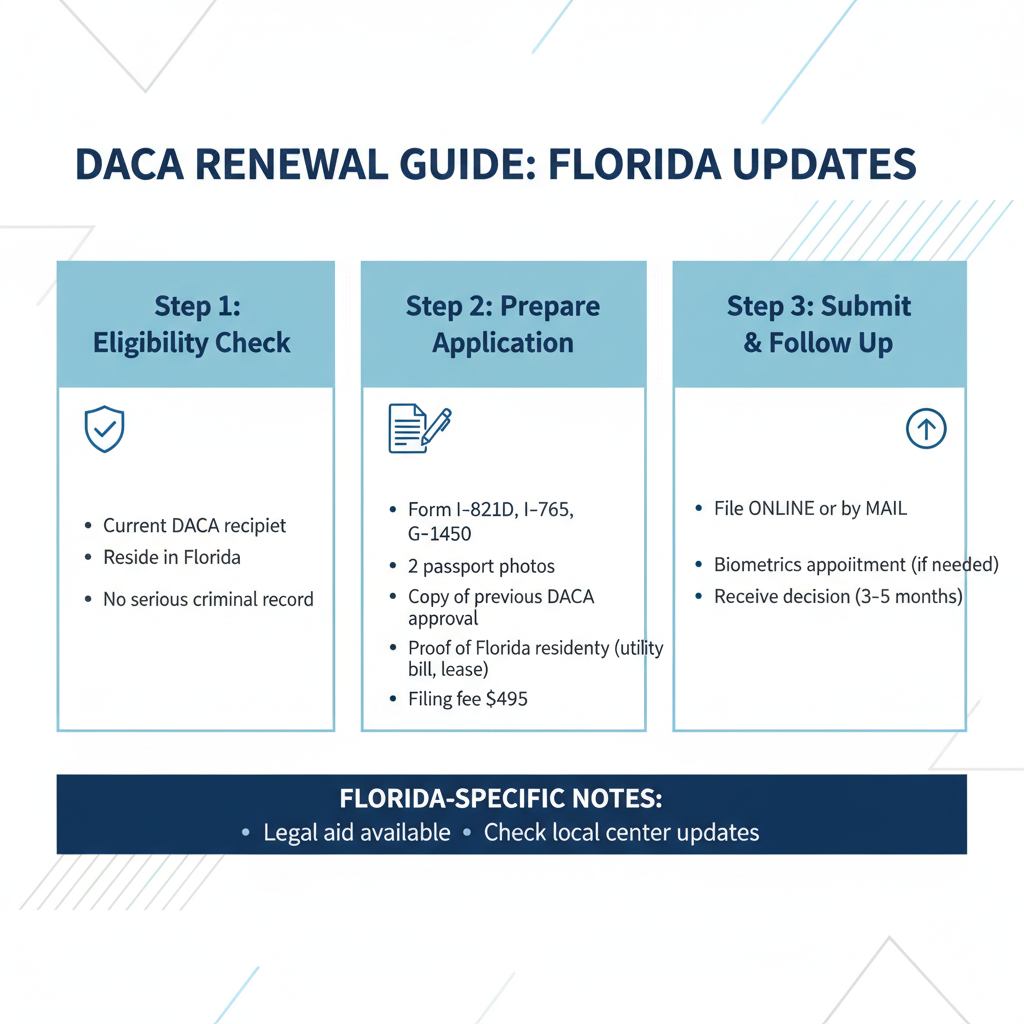
For current DACA recipients, understanding the renewal process is paramount to maintaining your deferred action and employment authorization. The renewal process can seem daunting, but by following these steps carefully, you can increase your chances of a successful outcome. **Important:** USCIS strongly recommends filing your DACA renewal request between **120 and 150 days** before your current DACA and EAD expire. Filing too early or too late can lead to complications.1) Determine Your Eligibility for Renewal
Before you begin gathering documents, confirm that you still meet the DACA eligibility criteria. * You must have previously been granted DACA. * You must not have departed the United States on or after August 15, 2012, without first obtaining **advance parole**. * You must have continuously resided in the United States since you submitted your most recent DACA request that was approved. * You must not have been convicted of a felony, a significant misdemeanor, or three or more other misdemeanors, and do not otherwise pose a threat to national security or public safety. **Key Action:** Review your personal history since your last DACA approval. Any arrests, convictions, or significant travel outside the U.S. without advance parole must be disclosed and will require careful legal review.2) Gather Required Documents
Organization is key. Collect all necessary supporting documents before filling out any forms. * **Proof of Identity:** * Copy of your previous EAD card (front and back). * Copy of your previous DACA approval notice (Form I-797C). * Copy of your valid passport (if available). * Copy of your birth certificate with a certified English translation (if original is not in English). * **Proof of Continuous Residence (since your last DACA approval):** * Utility bills (electricity, water, gas) * Bank statements * School transcripts or diplomas * Employment records (pay stubs, tax returns like Form W-2) * Rental agreements or mortgage statements * Medical records * Affidavits from individuals who can attest to your continuous presence. * **Proof of Education (if applicable, for initial DACA, but good to have for renewal history):** * High school diploma or GED certificate. * College transcripts. * **Proof of Criminal History (if applicable):** * Certified court dispositions for any arrests or convictions, even if expunged or minor. * Police clearance reports. * **Two Passport-Style Photos:** Taken within 30 days of filing. Write your name and A-Number lightly on the back. **Warning:** Do not send original documents unless specifically requested by USCIS. Provide clear, legible copies.3) Complete the Forms (I-821D, I-765, I-765WS)
Accuracy is paramount when completing these forms. * **Form I-821D, Consideration of Deferred Action for Childhood Arrivals:** * Carefully read all instructions. * Fill out all sections completely and accurately. If a question does not apply, write "N/A" (not applicable). * Ensure all information matches your previous DACA application and supporting documents. * For renewal, check the box indicating you are filing a "Renewal Request." * **Form I-765, Application for Employment Authorization:** * Fill out all sections. * For "Eligibility Category," enter **(c)(33)**. * Ensure your name and address match your I-821D. * **Form I-765 Worksheet:** * Complete this form providing details of your travel history and any criminal history. **Important:** Use black ink only. Do not use correction fluid or tape. If you make a mistake, start over with a fresh form or clearly cross out the error, write the correct information, and initial it. It is highly recommended to type the forms if possible for clarity.Overwhelmed by DACA Renewal Forms? Imigrar can help ensure your application is accurate and complete. Contact our Orlando office at +1 786-791-3106 for expert assistance with your DACA renewal, or message us online. Se Habla Español.
4) Prepare Your Filing Packet
Organize your application packet meticulously. * **Order of Documents:** While USCIS doesn't always specify an exact order, a logical arrangement helps the adjudicator. A common practice is: 1. Check/money order for fees (on top). 2. Cover letter (optional, but recommended, listing contents). 3. **Form I-821D** 4. **Form I-765** 5. **Form I-765 Worksheet** 6. Two passport-style photos (placed in a small plastic bag and stapled to a form, or attached as per USCIS instructions). 7. Copies of all supporting documents, clearly labeled. * **Copies:** Make a complete copy of the *entire* filing packet for your records before sending it. This is your proof of what you submitted.5) Pay the Filing Fees
There are specific fees associated with DACA renewal. * As of May 2026, the total fee for DACA renewal is typically **$495**, which includes: * **$85** for the biometrics services fee. * **$410** for the **Form I-765** (Employment Authorization) application fee. * There is no separate fee for **Form I-821D**. * **Payment Method:** You can pay by money order, personal check, cashier's check, or by credit card using **Form G-1450, Authorization for Credit Card Transactions**. * **Payee:** Make checks or money orders payable to "U.S. Department of Homeland Security." Do NOT use abbreviations. * **Fee Waivers/Exemptions:** Fee waivers are generally NOT available for DACA applications. However, in very limited circumstances, you may be exempt from the biometrics fee if you are eligible for an income-based fee exemption for certain public benefits. This is rare for DACA and should be discussed with an attorney.6) Mail Your Application
Send your completed packet to the correct USCIS lockbox facility. The correct address depends on your state of residence and the carrier you use (USPS vs. FedEx/UPS/DHL). * For Florida residents, you will typically mail your DACA renewal application to the USCIS Chicago Lockbox. * **USPS Address:** USCIS Attn: DACA P.O. Box 805288 Chicago, IL 60680-5288 * **FedEx, UPS, DHL Deliveries:** USCIS Attn: DACA (Box 805288) 131 S. Dearborn St., 3rd Floor Chicago, IL 60603-5517 * **Tracking:** Always send your application with a tracking number (e.g., Certified Mail with Return Receipt from USPS, or similar services from private carriers). This provides proof of delivery.7) Attend Biometrics Appointment (if requested)
After USCIS receives your application, they will send you a receipt notice (Form I-797C) and, typically, an appointment notice for biometrics (fingerprints and photo). * **Attend on Time:** It is crucial to attend your biometrics appointment at the scheduled time and location, which for Central Florida residents might be the Orlando USCIS Field Office or a nearby Application Support Center (ASC). * **Required Documents:** Bring your appointment notice, a valid photo ID (e.g., passport, state ID, driver's license), and any other documents specified in the notice. * **Purpose:** Biometrics are used for background checks. Missing this appointment can lead to denial of your application. If you cannot attend, follow the instructions on the notice to reschedule immediately. After your biometrics appointment, you will await a decision from USCIS. You can check your case status online using the receipt number provided on your **Form I-797C**. The processing times can vary significantly, so monitoring the USCIS Processing Times website is advisable.Practical Steps You Can Take Today for DACA Renewal
Being proactive is the best strategy for a successful DACA renewal. Here are practical steps you can take starting today to prepare and ensure a smooth process. **Actionable Checklist:** 1. **Check Your Expiration Date:** Immediately locate your current DACA approval notice and EAD card. Note the expiration dates. Mark your calendar for the 150-day and 120-day windows before expiration. **Reminder:** USCIS recommends filing between **150 and 120 days** before expiration. 2. **Start Gathering Documents NOW:** Do not wait until the last minute. Begin collecting all necessary documents, including proof of continuous residence, identity, and any court dispositions if you have had any interactions with law enforcement. 3. **Review Your History:** Think back to your last DACA approval. Have there been any changes in your life that might affect your eligibility, such as travel outside the U.S. without advance parole, or any arrests, even minor ones? Be honest and thorough. 4. **Organize Your Files:** Create a dedicated folder (physical or digital) for all your DACA-related documents. Keep copies of everything you send to USCIS. This organization will save you time and stress. 5. **Consult with an Immigration Attorney:** This is perhaps the most crucial step. Even if your case seems straightforward, an attorney can review your eligibility, identify potential issues, help you complete forms accurately, and ensure your application is strong. This is especially vital if you have any criminal history, travel history, or changes in your personal circumstances. Imigrar offers free consultations for this purpose. 6. **Update Your Address with USCIS:** If you have moved since your last DACA application, you must update your address with USCIS within **10 days** of moving. Use **Form AR-11, Alien’s Change of Address Card**, or update online. Failure to do so could result in missed notices and even denial of your application. 7. **Save for Fees:** The filing fees are substantial ($495). Start saving now so you have the funds readily available when it's time to file. **Document Preparation Guidance:** * **Legibility:** Ensure all copies of your documents are clear and easy to read. * **Translations:** If any document is in a language other than English, you must provide a complete and accurate English translation, certified by the translator as competent to translate and that the translation is accurate. * **Accuracy:** Double-check every single piece of information on your forms against your supporting documents. Even small discrepancies can cause delays. * **Consistency:** Ensure your name, date of birth, and other identifying information are consistent across all forms and documents. **Timeline Expectations:** * **Filing Window:** Aim to file your renewal request between **150 and 120 days** before your current DACA and EAD expire. * **Too Early:** If you file more than 150 days early, USCIS may reject your application. * **Too Late:** If you file less than 120 days, you risk having a gap in your work authorization, which can affect employment, driver's license renewal, and other aspects of your life. * **Receipt Notice:** You should receive a **Form I-797C** receipt notice within 2-3 weeks of USCIS receiving your application. * **Biometrics Appointment:** An appointment notice typically arrives 3-5 weeks after filing. The actual appointment is usually scheduled 2-4 weeks after the notice. * **Processing Times:** USCIS processing times vary widely. You can monitor the USCIS Processing Times page for the latest estimates. For DACA renewals, processing can take anywhere from 3 to 6 months, or sometimes longer. * **Decision:** You will receive a written notice of USCIS's decision. If approved, you will receive a new EAD card. **Important:** Do not let your DACA expire. A lapse in DACA status can have serious consequences, including potential loss of employment, driver's license, and increased risk of deportation. Plan ahead, stay organized, and seek legal help if you have any doubts.