


As of February 15, 2026, the Deferred Action for Childhood Arrivals (DACA) program continues to be a critical topic for hundreds of thousands of individuals across the United States, including many here in Florida. Navigating the complexities of DACA, especially amidst ongoing legal challenges and administrative updates from USCIS, can be daunting. At Imigrar, we understand the importance of clear, accurate, and actionable information for DACA recipients and their families.
The Reporting That Sparked This Guide
The information and guidance provided in this article are based on the latest available updates regarding the DACA program, as reported by various reputable sources tracking immigration law and policy. We continuously monitor official announcements and legal developments to ensure our clients receive the most current advice.
For the latest official news and administrative updates directly from the government, always refer to:
DACA Program Updates and Renewal Information (USCIS)
What This News Means for Immigrants in Orlando and Across Florida
The DACA program, initiated in 2012, has provided a lifeline for eligible undocumented young people who came to the U.S. as children. It offers temporary protection from deportation and the ability to obtain a work permit (Employment Authorization Document, or EAD). However, DACA has faced significant legal challenges over the years, leading to periods of uncertainty.
Why this news is showing up now
The DACA program remains in a state of flux due to ongoing litigation. While the program’s future is debated in courts, the U.S. Citizenship and Immigration Services (USCIS) continues to accept and process DACA renewal applications. New DACA applications, however, are generally not being accepted or processed due to a federal court order. The current news often revolves around court hearings, potential legislative actions (or lack thereof), and USCIS guidance for existing DACA recipients regarding their renewal process. For DACA recipients, staying informed about these updates is not just helpful, it’s critical for maintaining their status.
How it can affect Florida residents
Florida is home to a significant population of DACA recipients, often referred to as "Dreamers." These individuals contribute immensely to our communities, economy, and culture, particularly in vibrant areas like Orlando and Central Florida. Any changes or updates to the DACA program directly impact their ability to work legally, pursue higher education, and live without immediate fear of deportation. For DACA recipients in Florida, understanding the precise requirements and deadlines for renewal is paramount to maintaining their protected status and employment authorization. Delays or errors in the renewal process could lead to loss of work authorization and protection from removal, with profound consequences for individuals and their families. This is why our Orlando immigration team at Imigrar is dedicated to providing clear guidance and support.
What DACA Is (and Why It Matters)
The Deferred Action for Childhood Arrivals (DACA) program is an immigration policy established by the Obama administration in June 2012. It allows certain undocumented immigrants who entered the country as minors to receive a renewable two-year period of deferred action from deportation and eligibility for a work permit. DACA recipients are not granted a pathway to U.S. citizenship or lawful permanent resident status, but it provides them with a temporary sense of stability and the ability to contribute more fully to American society.
A plain-English definition
Simply put, DACA is a temporary program that offers certain young immigrants who came to the U.S. as children two main benefits: protection from deportation and the ability to get a work permit. This protection lasts for two years and can be renewed. It doesn't give you a green card or citizenship, but it allows you to work legally and live without the immediate threat of being removed from the country. It's intended for individuals who have grown up in the U.S., often having no memory of their country of birth, and who meet specific educational and conduct requirements.
Key terms you need to know
- Deferred Action: This is the core of DACA. It means that the U.S. government has decided not to pursue deportation against an individual for a specific period. It is a discretionary act by the government and does not grant legal status.
- Dreamer: A common term used to refer to young undocumented immigrants who were brought to the U.S. as children, often associated with the proposed "DREAM Act" legislation that inspired DACA.
- Employment Authorization Document (EAD): Also known as a work permit, this card allows DACA recipients to legally work in the United States. It is typically valid for two years, matching the DACA deferral period.
- Unlawful Presence: Being in the U.S. without permission. DACA provides relief from the accrual of unlawful presence, which can trigger bars to re-entry if one leaves the U.S.
- USCIS: U.S. Citizenship and Immigration Services, the government agency responsible for processing DACA applications and renewals.
- Removal Proceedings: Formal legal actions initiated by the government to deport an individual from the U.S. DACA provides protection from these proceedings.
Need Help? Navigating DACA renewals can be complex, especially with changing legal landscapes. Our Orlando immigration team is ready to assist. Call +1 786-791-3106 for a free consultation, or message us online. Se Habla Español.
Current Immigration Law: The Foundation for DACA
DACA was established through executive action under the authority granted to the executive branch to set immigration enforcement priorities. It is not a statutory law passed by Congress, which is why it has been subject to various legal challenges. The program's legal foundation rests on the concept of prosecutorial discretion – the government's ability to decide whom to prioritize for deportation.
Currently, DACA is operating under an injunction from a federal court in Texas. This injunction means that USCIS is prohibited from granting initial DACA requests. However, USCIS is permitted to continue accepting and processing renewal requests for individuals who have previously been granted DACA.
Federal requirements
To be eligible for DACA renewal, applicants must meet the original DACA requirements and not have been disqualified since their last approval. The core federal requirements for DACA, which generally still apply for renewals, include:
- You were under the age of 31 as of June 15, 2012.
- You came to the United States before reaching your 16th birthday.
- You have continuously resided in the United States since June 15, 2007, up to the present time.
- You were physically present in the United States on June 15, 2012, and at the time of making your request for deferred action with USCIS.
- You had no lawful status on June 15, 2012.
- You are currently in school, have graduated or obtained a certificate of completion from high school, have obtained a general education development (GED) certificate, or are an honorably discharged veteran of the Coast Guard or Armed Forces of the United States.
- You have not been convicted of a felony, a significant misdemeanor, or three or more other misdemeanors, and do not otherwise pose a threat to national security or public safety.
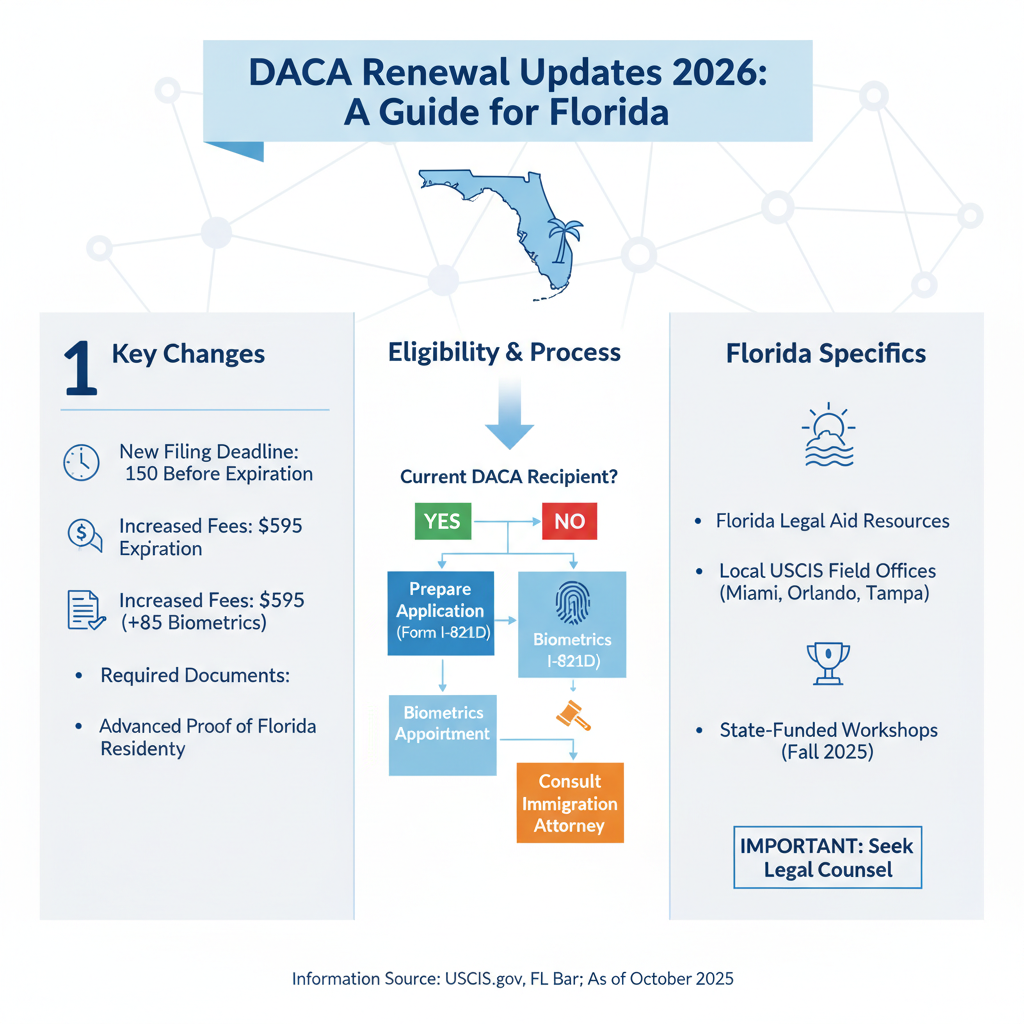
Important: USCIS advises DACA recipients to file their renewal requests between 120 days and 150 days before their current DACA and EAD expire. Filing too early or too late can lead to complications.
The primary forms required for DACA renewal are: Form I-821D (Consideration of Deferred Action for Childhood Arrivals), Form I-765 (Application for Employment Authorization), and Form I-765WS (Worksheet for Form I-765, Application for Employment Authorization).
For official forms and the latest guidance, always refer to the USCIS official website.
Florida-specific considerations
While DACA is a federal program, its impact can vary at the state level. In Florida, DACA recipients have seen some progress regarding in-state tuition eligibility at state colleges and universities, often through legislative efforts. However, these benefits are tied directly to maintaining valid DACA status. For Central Florida residents, understanding the specific requirements for state benefits and how they interact with federal DACA status is crucial. The Orlando USCIS Field Office, while not processing initial DACA applications, may be involved in biometrics appointments for renewal applicants from Orange County and surrounding areas.
Need Help? Our Orlando immigration team is ready to assist. Call +1 786-791-3106 for a free consultation, or message us online. Se Habla Español.
How to Renew Your DACA: A Complete Step-by-Step Guide
Renewing your DACA status is a meticulous process that requires attention to detail and timely action. Follow these steps carefully to ensure a smooth renewal application.
1) Determine Your Eligibility for Renewal
Before you begin, confirm you still meet the DACA renewal criteria. You must have continuously resided in the U.S. since your last DACA approval, and not have been convicted of a felony, a significant misdemeanor, or three or more other misdemeanors, nor pose a threat to national security or public safety. If you have traveled outside the U.S. without advance parole or had any brushes with law enforcement since your last approval, consult an immigration attorney immediately.
- Check your current DACA and EAD expiration dates.
- Review your personal history for any disqualifying events.
- Confirm continuous residence since your last DACA grant.
2) Gather Required Documents
Even for renewals, it's wise to have supporting documents ready, especially if there have been significant changes in your life (e.g., name change, new school, new address) or if you want to strengthen your case. While USCIS may not always require extensive documentation for renewals if your previous application was well-supported, it's best to be prepared.
- Copies of your previous DACA approval notices (Form I-797).
- Copy of your current Employment Authorization Document (EAD).
- Proof of continuous residence since your last DACA grant (e.g., utility bills, school records, employment records, bank statements, medical records).
- Passport-style photos (2 identical, taken within 30 days of filing).
- Any documents related to arrests, citations, or convictions, if applicable (even if dismissed or minor).
- Proof of current school enrollment, high school diploma, GED, or military discharge.
3) Complete the Forms (I-821D, I-765, I-765WS)
You will need to complete three forms for your DACA renewal application:
- Form I-821D, Consideration of Deferred Action for Childhood Arrivals: Carefully fill out all sections. Ensure consistency with your previous applications.
- Form I-765, Application for Employment Authorization: This is for your work permit. For item 27, enter (c)(33) as your eligibility category.
- Form I-765WS, Worksheet for Form I-765, Application for Employment Authorization: This form helps USCIS determine if you have an economic need for employment. Be honest and thorough.
Reminder: Download the latest versions of these forms directly from the USCIS Forms page. Do not use outdated forms.
4) Prepare Your Filing Fee
The filing fee for DACA renewal is currently $495 (as of February 2026). This includes the Form I-765 fee and the biometrics services fee. There is no separate fee for Form I-821D. The fee must be paid by money order, personal check, cashier’s check, or credit card using Form G-1450 (Authorization for Credit Card Transactions). Make checks payable to "U.S. Department of Homeland Security." Do not send cash.
- Verify the current fee amount on the USCIS website.
- Prepare a money order or check for $495.
- Alternatively, complete Form G-1450 for credit card payment.
5) Assemble and Mail Your Application
Organize your application packet meticulously. It's often recommended to place the fee on top, followed by Form I-821D, Form I-765, Form I-765WS, supporting documents, and photos. Make a complete copy of your entire application packet for your records before mailing. Send your application to the appropriate USCIS Lockbox Facility. The correct address depends on your state of residence.
For Florida residents, your DACA renewal application should be sent to the USCIS Chicago Lockbox. Check the USCIS filing addresses page for the most current instructions.
- Review all forms for accuracy and completeness.
- Attach two passport-style photos.
- Include your payment.
- Make a complete copy of everything for your records.
- Mail the packet via certified mail with return receipt requested for proof of delivery.
6) Attend Biometrics Appointment (if requested)
After filing, USCIS will send you a receipt notice (Form I-797C). Subsequently, you may receive an appointment notice (Form I-797C) for a biometrics (fingerprints, photos, signature) appointment at an Application Support Center (ASC). It is crucial to attend this appointment. If your case is in Orlando or Central Florida, you will likely be scheduled at the Orlando USCIS Field Office or a nearby ASC.
- Bring your appointment notice and a valid photo ID.
- Arrive on time for your appointment.
7) Monitor Your Case Status
You can track the status of your application online using the receipt number provided on your Form I-797C. Visit the USCIS Case Status Online tool. USCIS will mail you a decision notice once your application has been processed. If approved, you will receive a new DACA approval notice and an EAD card.
- Check your case status regularly online.
- Keep all correspondence from USCIS.
- Contact USCIS or your attorney if you notice unusual delays or issues.
Practical Steps You Can Take Today
Being proactive is key to a successful DACA renewal. Here’s an actionable checklist:
- Start Early: Mark your calendar for 150 days before your DACA and EAD expire. This gives you ample time to gather documents and address any potential issues without rushing.
- Organize Your Documents: Create a dedicated folder for all your immigration documents. Keep copies of everything you submit to USCIS.
- Review Your History: Think back to your last DACA approval. Have there been any arrests, citations, or significant changes in your education or residence? Be prepared to document these.
- Check USCIS Website: Regularly visit USCIS's DACA page for the latest policy updates, forms, and filing addresses.
- Seek Legal Counsel: If you have any doubts about your eligibility, past criminal history, or the application process, consult an experienced immigration attorney.
- Save for Fees: Begin saving the $495 filing fee well in advance.
- Update Your Address: If you've moved, ensure you update your address with USCIS immediately by filing Form AR-11, Alien's Change of Address Card, online or by mail.
Document preparation guidance
When preparing documents, always provide clear, legible copies. Do not send originals unless specifically requested by USCIS. If a document is not in English, you must include a complete and accurate English translation certified by a competent translator. For Florida residents, especially those in Orange County, ensure your address on all documents matches your current residence to avoid processing delays.
Timeline expectations
USCIS generally recommends filing your DACA renewal application between 150 and 120 days before your current DACA and EAD expire. This timeframe allows for typical processing times and helps avoid a lapse in your work authorization. While USCIS aims to process renewals within 120 days, processing times can vary significantly. You can check current USCIS Processing Times online. It's not uncommon for processing to take longer, especially if USCIS requests additional evidence or if there are administrative backlogs. Filing outside this window (too early or too late) can create problems, including potential denial or a lapse in employment authorization.
Need Help? Don't risk a lapse in your DACA status. Our Orlando immigration team provides expert guidance for renewal applications. Call +1 786-791-3106 for a free consultation, or message us online. Se Habla Español.
How Imigrar Helps Immigrants in Orlando
At Imigrar, we understand the profound impact DACA has on individuals and families throughout Florida. Our mission, "Keep Families Together," resonates deeply with the experiences of Dreamers. We are committed to providing expert legal assistance and compassionate support to help you navigate the complexities of immigration law.
Our experienced immigration attorneys in Orlando specialize in DACA renewals, family-based petitions, and other immigration matters. We stay up-to-date on the latest USCIS policies, court rulings, and legislative developments to provide you with accurate and timely advice. Whether you're preparing your first renewal or facing unique challenges, we're here to guide you every step of the way.
We offer comprehensive services, including:
- Personalized eligibility assessments for DACA renewal.
- Assistance with gathering and organizing all required documentation.
- Thorough preparation and review of Form I-821D, Form I-765, and Form I-765WS.
- Guidance on responding to Requests for Evidence (RFEs) from USCIS.
- Representation and advice regarding any potential issues or complications.
- Strategic planning for future immigration possibilities, if available.
We believe that everyone deserves access to quality legal representation. That's why we offer a free consultation to discuss your DACA renewal needs and answer your initial questions. Our team is fluent in both English and Spanish, ensuring clear communication and understanding. Se Habla Español.
Frequently Asked Questions About DACA Renewal
Q: Am I still eligible for DACA renewal if I left the U.S. without advance parole?
A: Generally, leaving the U.S. without a valid advance parole document may terminate your DACA status. If you departed the U.S. without advance parole after receiving DACA, you likely lost your deferred action and may not be eligible for renewal. This is a critical issue, and you should immediately consult an immigration attorney at Imigrar to assess your specific situation and understand any potential consequences or alternative options.
Q: How does a criminal record impact my DACA renewal eligibility?
A: A criminal record can significantly jeopardize your DACA renewal. You are not eligible if you have been convicted of a felony, a significant misdemeanor, or three or more other misdemeanors. A significant misdemeanor includes offenses like domestic violence, sexual abuse, burglary, DUI, drug distribution, or unlawful possession of a firearm. Even minor offenses should be disclosed and may require detailed legal explanation. It is crucial to consult an attorney if you have any criminal history, no matter how minor you perceive it to be, before filing your renewal application.
Q: What is the recommended timeline for filing my DACA renewal application?
A: USCIS recommends filing your DACA renewal application between 150 and 120 days before your current DACA and Employment Authorization Document (EAD) expire. This window provides sufficient time for USCIS to process your application and ideally issue your new EAD before your current one expires, preventing a lapse in your work authorization. Filing too early (more than 150 days) may result in denial, and filing too late (less than 120 days) increases the risk of your EAD expiring before renewal, potentially leading to job loss.
Q: What documents are absolutely essential for a DACA renewal application?
A: The core documents required for DACA renewal are the completed Form I-821D, Form I-765, and Form I-765WS, along with the filing fee. You will also need two passport-style photos. While USCIS may not always request extensive supporting documents for renewals, it's prudent to include copies of your previous DACA approval notice, current EAD, and any documents proving continuous residence (e.g., pay stubs, bank statements, school records) since your last approval. If you have any new criminal history or significant changes to your life, additional documentation will be necessary.
Q: What are the total costs associated with DACA renewal, and are fee waivers available?
A: The total filing fee for a DACA renewal application is currently $495 (as of February 2026). This includes the Form I-765 fee and the biometrics services fee. Unfortunately, USCIS no longer accepts fee waiver requests for DACA applications (initial or renewal). You must pay the full fee. If you cannot afford the fee, you might explore options such as seeking assistance from non-profit organizations that offer financial help or loan programs, or saving up well in advance.
Q: What happens if my DACA renewal application is denied?
A: If your DACA renewal application is denied, you will lose your protection from deportation and your employment authorization. You will then be considered an undocumented immigrant subject to removal proceedings. The denial notice will usually state the reason for the denial. Depending on the reason, you may be able to appeal the decision, file a motion to reopen, or reapply if the issue can be corrected. It is absolutely critical to consult an experienced immigration attorney immediately upon receiving a denial to understand your options and next steps. Do not delay, as your legal status will be at risk.
Q: Can I travel outside the U.S. while my DACA renewal is pending?
A: It is generally not advisable to travel outside the U.S. while your DACA renewal is pending. Even with a valid advance parole document, travel can complicate your application and potentially lead to issues upon re-entry, especially given the current legal uncertainties surrounding DACA. If you must travel, you should apply for and receive an advance parole document (Form I-131) *before* you leave the U.S. Traveling without advance parole will likely trigger a termination of your DACA status and could bar you from returning to the U.S. for many years. Always consult an immigration attorney before planning any international travel.
Common Mistakes (and How to Avoid Them)
DACA renewals are too important to leave room for error. Avoiding these common mistakes can significantly increase your chances of a smooth approval.
Mistake #1: Filing Your Renewal Too Late (or Too Early)
As mentioned, the optimal filing window is 150 to 120 days before expiration. Filing too late can lead to a lapse in your work authorization, potentially causing you to lose your job. Filing too early (e.g., 6 months in advance) can result in USCIS rejecting your application.
How to Avoid: Mark your calendar for the 150-day window and set multiple reminders. Start preparing your application well in advance so you can submit it within the recommended timeframe. Use the USCIS Processing Times page to get an estimate of how long your renewal might take and plan accordingly.
Mistake #2: Incomplete or Inaccurate Forms
Even a small error or an unanswered question on Form I-821D, Form I-765, or Form I-765WS can lead to delays, a Request for Evidence (RFE), or even a denial. Inconsistencies with previous applications can also raise red flags.
How to Avoid: Double-check every field on every form. Ensure your name, date of birth, and address are consistent across all documents. If a question doesn't apply, write "N/A" (not applicable). Review your previous DACA application to ensure consistency. Consider having an attorney review your forms before submission.
Mistake #3: Not Disclosing All Information, Especially Criminal History
Some applicants mistakenly believe that if a past arrest or citation was dismissed, expunged, or minor, they don't need to disclose it. This is a dangerous assumption. USCIS requires full disclosure of all contacts with law enforcement. Failure to disclose can be seen as misrepresentation and lead to denial, and in some cases, allegations of fraud.
How to Avoid: Be completely honest and transparent about your history. If you have any criminal record, no matter how insignificant


