


In the dynamic landscape of U.S. immigration policy, programs like Deferred Action for Childhood Arrivals (DACA) remain a topic of critical importance and frequent discussion. For hundreds of thousands of individuals who call the United States home, DACA offers a measure of stability, work authorization, and protection from deportation. As an immigration law firm deeply committed to keeping families together, Imigrar understands the anxiety and questions that arise with every update regarding DACA. This comprehensive guide aims to provide clarity on the latest DACA program updates and offer a detailed roadmap for the renewal process, especially for our community members in Orlando and throughout Florida.
Today, 2026-03-07, we revisit the DACA program to ensure you have the most current and actionable information at your fingertips. While new applications for DACA remain paused due to ongoing litigation, renewals are still being processed. Understanding the nuances of these policies and adhering to strict application protocols is paramount.
Need Help with Your DACA Renewal? Don't navigate the complexities alone. Our Orlando immigration team at Imigrar is ready to assist you with your DACA renewal application. Call +1 786-791-3106 for a free consultation, or message us online. Se Habla Español.
The reporting that sparked this guide
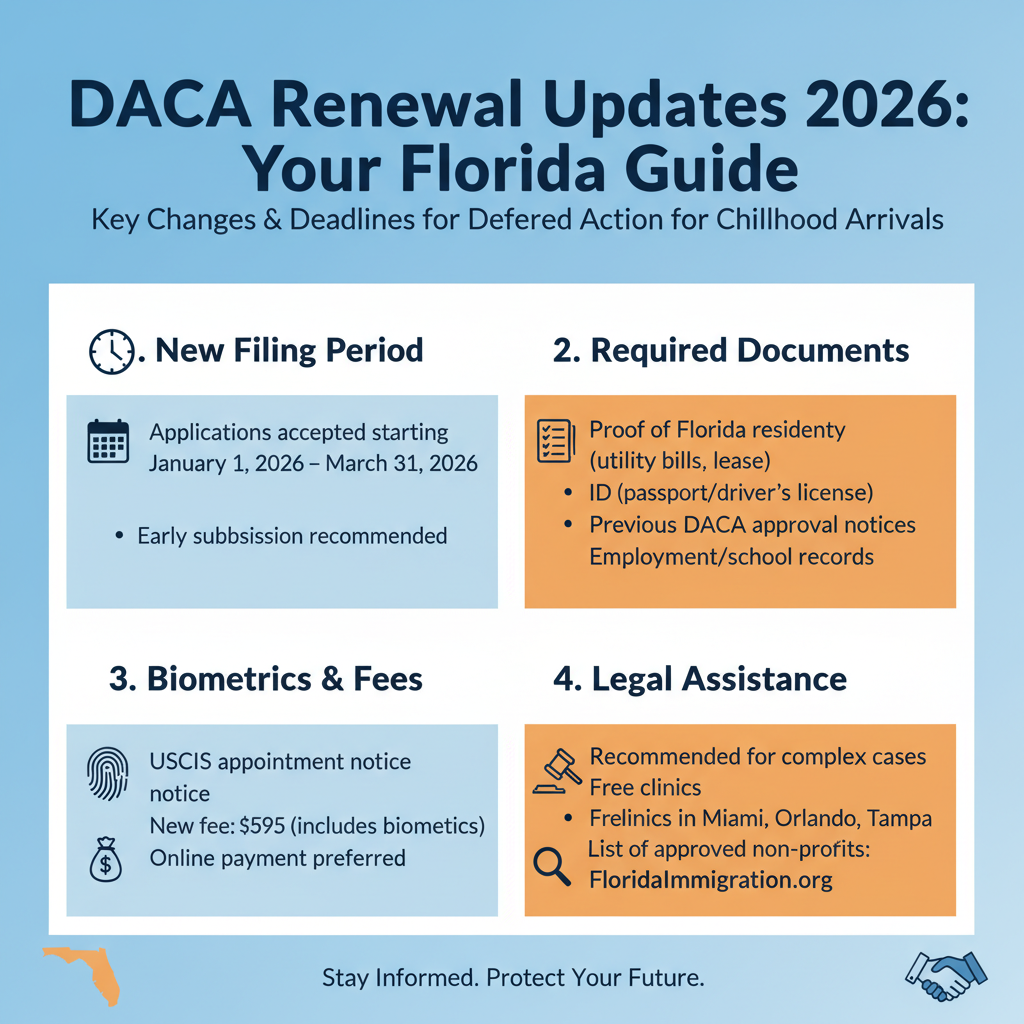
Our commitment to providing timely and accurate information is fueled by continuous monitoring of official sources and news outlets. The recent discussions and updates surrounding the DACA program, particularly from DACA Program Updates and Renewal Information (USCIS), highlight the ongoing need for clear, accessible guidance for DACA recipients.
What This News Means for Immigrants in Orlando and Across Florida
The DACA program's status is a constant topic in national news, impacting communities nationwide, including the vibrant immigrant populations in Orlando and across Florida. For DACA recipients, any news related to the program can be a source of anxiety or hope.
Why this news is showing up now
The Deferred Action for Childhood Arrivals (DACA) program has been the subject of intense legal and political debate since its inception in 2012. The program's very existence has been challenged in federal courts, leading to various injunctions and orders that have shaped its current operational status. The latest news cycle often reflects developments in these ongoing legal battles. For instance, recent court decisions have affirmed that while the Department of Homeland Security (DHS) can continue to process DACA renewals, it is enjoined from approving any new initial DACA requests. This means that individuals who have never received DACA cannot apply, but those who previously held DACA status are generally eligible to renew. These judicial mandates are frequently reviewed and discussed, leading to regular updates in the news as the legal process unfolds.
Furthermore, administrative actions by USCIS, such as changes to filing procedures, fee adjustments, or policy clarifications, also generate news. As of 2026-03-07, the core message remains consistent: DACA renewals are proceeding, but new applications are not. This distinction is crucial and often emphasized in current reporting, ensuring recipients understand their rights and responsibilities.
How it can affect Florida residents
Florida is home to a significant population of DACA recipients, often referred to as Dreamers. For these individuals, the implications of DACA updates are profound and far-reaching:
- Employment Stability: DACA provides recipients with an Employment Authorization Document (EAD), allowing them to legally work in the U.S. Any uncertainty surrounding DACA directly impacts their ability to maintain employment, support their families, and contribute to Florida's economy. Many DACA recipients are essential workers, contributing significantly to sectors like healthcare, agriculture, and hospitality across Central Florida and beyond.
- Educational Opportunities: In Florida, DACA recipients are eligible for in-state tuition at public colleges and universities, provided they meet certain residency requirements. The continuation of DACA ensures these educational pathways remain open, allowing Dreamers to pursue higher education and build better futures in the state.
- Driver's Licenses: With a valid EAD and DACA status, recipients in Florida can obtain a driver's license, enabling them to commute to work, school, and fulfill daily needs. Without DACA, this essential privilege would be jeopardized.
- Community Integration: DACA status fosters a sense of belonging and stability, allowing individuals to integrate more fully into their communities without the constant fear of deportation. For families in Orlando and surrounding areas, DACA helps keep loved ones together and allows them to plan for the future.
- Legal Planning: The ongoing legal challenges mean that DACA recipients must be proactive about their status. This includes diligently renewing their DACA and EAD, exploring other potential immigration pathways if available, and staying informed about legislative efforts that could offer a more permanent solution. For residents in Orange County and along the I-4 corridor, access to reliable legal counsel is especially important given the high concentration of immigrant families.
The news updates serve as a constant reminder for Florida's DACA recipients to remain vigilant and ensure their paperwork is always in order. Failing to renew DACA in a timely manner can lead to a lapse in work authorization and protection from deportation, creating immense hardship for individuals and their families.
What DACA Is (and Why It Matters)
The Deferred Action for Childhood Arrivals (DACA) program is a critical, albeit temporary, immigration policy that has impacted the lives of hundreds of thousands of young people across the United States. Its existence and ongoing legal battles underscore the complex realities of immigration in America.
A plain-English definition
At its core, DACA is a U.S. immigration policy that allows certain undocumented immigrants who entered the country as minors to receive a renewable two-year period of deferred action from deportation. This means the government agrees not to pursue their removal from the U.S. For those granted DACA, it also provides eligibility for a work permit, known as an Employment Authorization Document (EAD), enabling them to legally work in the United States. It is crucial to understand that DACA is not a path to U.S. citizenship or a green card; it is a temporary, discretionary relief from deportation.
The program was established by the Obama administration in June 2012, designed to protect young people who were brought to the U.S. as children and who meet several key criteria, often referred to as "Dreamers." These individuals have grown up in the U.S., attended schools here, and often know no other home.
Key terms you need to know
Understanding these terms is essential for navigating the DACA landscape:
- Deferred Action: This is a discretionary determination by USCIS to defer removal action against an individual. It does not confer lawful status but acknowledges that the government will not pursue deportation during the period of deferral.
- DACA Recipient: An individual who has been granted deferred action under the DACA program.
- Dreamer: A term often used to describe young undocumented immigrants who were brought to the U.S. as children, including those eligible for DACA. The term originates from the proposed "DREAM Act" legislation.
- Employment Authorization Document (EAD): Also known as a work permit, this card allows individuals with certain immigration statuses (including DACA recipients) to legally work in the U.S. It is typically valid for two years for DACA recipients.
- USCIS: U.S. Citizenship and Immigration Services, the federal agency responsible for administering the DACA program, processing applications, and issuing EADs. You can find official information and forms on the USCIS official website.
- Court Injunction: A legal order issued by a court that prohibits a party (in this case, the government) from performing a specific action. Court injunctions are why USCIS is currently enjoined from accepting new DACA applications.
- Advance Parole: A document issued by USCIS that allows certain non-citizens to travel abroad and return to the U.S. without abandoning their application for adjustment of status or other forms of relief. DACA recipients can apply for advance parole for humanitarian, educational, or employment purposes, though approval is discretionary and subject to specific rules.
Considering Your DACA Renewal? Imigrar provides comprehensive legal support for DACA renewals and explores all possible long-term immigration solutions. Reach out to our Orlando office at +1 786-791-3106 for expert guidance. Se Habla Español.
Current Immigration Law: The Foundation for DACA
The DACA program exists within a complex framework of U.S. immigration law, though it is not a statutory law passed by Congress. Instead, it is a discretionary policy implemented through executive action. Understanding its legal footing is crucial, especially given the ongoing litigation that impacts its scope.
DACA was established through a memorandum issued by the Secretary of Homeland Security. It grants eligibility for deferred action to individuals who meet specific criteria, essentially using prosecutorial discretion to prioritize enforcement efforts. This means that while DACA recipients are not granted lawful immigration status, the government has chosen to defer their removal from the country. The legal challenges against DACA argue that the executive branch overstepped its authority by creating such a broad program without congressional approval. These challenges have resulted in federal court orders that significantly limit the program, specifically prohibiting USCIS from accepting new initial DACA applications.
Federal requirements for DACA (for renewals)
While new DACA applications are not being accepted, individuals who previously received DACA can apply for renewal if they continue to meet the original 2012 guidelines. These guidelines include:
- Were under the age of 31 as of June 15, 2012.
- Came to the United States before reaching their 16th birthday.
- Have continuously resided in the United States since June 15, 2007, up to the present time.
- Were physically present in the United States on June 15, 2012, and at the time of making their request for deferred action with USCIS.
- Had no lawful immigration status on June 15, 2012.
- Are currently in school, have graduated or obtained a certificate of completion from high school, have obtained a general education development (GED) certificate, or are an honorably discharged veteran of the Coast Guard or Armed Forces of the United States.
- Have not been convicted of a felony, a significant misdemeanor, or three or more other misdemeanors, and do not pose a threat to national security or public safety.
For renewal applications, USCIS primarily reviews whether the applicant has maintained these criteria since their last DACA grant. Any criminal history, prolonged absences from the U.S. without advance parole, or other adverse factors can jeopardize a renewal.
The primary forms used for DACA renewal are:
- Form I-821D, Consideration of Deferred Action for Childhood Arrivals: This is the main form to request DACA.
- Form I-765, Application for Employment Authorization: This form is used to apply for your work permit.
- Form I-765WS, Worksheet: This worksheet helps you determine if you need to provide additional information to establish an economic need to work.
All forms and their latest versions are available on the USCIS Forms page.
Florida-specific considerations
For DACA recipients residing in Florida, there are specific state-level considerations that make maintaining DACA status particularly important:
- In-State Tuition: As mentioned, Florida law allows DACA recipients who meet specific residency requirements to qualify for in-state tuition at Florida's public colleges and universities. This significantly reduces the financial burden of higher education. Loss of DACA status could impact this eligibility.
- Driver's Licenses: The Florida Department of Highway Safety and Motor Vehicles (FLHSMV) issues driver's licenses to individuals who present a valid Employment Authorization Document (EAD). Without a current EAD, DACA recipients in Florida would be unable to legally drive, hindering their ability to work, attend school, and participate in daily life across cities like Orlando, Tampa, and Miami.
- State-Level Advocacy: Florida has a significant population of Dreamers, leading to various advocacy efforts at the state level to support DACA recipients. Staying connected with local community organizations can provide valuable resources and support.
- Local USCIS Field Office: While DACA applications are processed by specific USCIS Service Centers, the Orlando USCIS Field Office serves residents in Central Florida for other immigration matters and can sometimes provide limited assistance or information in person for certain situations. However, DACA renewals are typically mailed directly to a designated USCIS Lockbox facility.
The legal landscape surrounding DACA is constantly shifting. This makes it imperative for DACA recipients in Florida to stay informed and seek legal counsel. Consulting with an experienced immigration attorney in Orlando can help you understand how federal and state laws impact your specific situation.
How to Renew Your DACA: A Complete Step-by-Step Guide
Renewing your DACA and EAD is a critical process that requires attention to detail and timely submission. A lapse in your DACA status can have serious consequences, including loss of work authorization and protection from deportation. Here’s a comprehensive, step-by-step guide to help you through the renewal process.
1) Determine Your Eligibility for Renewal
Before you begin, confirm that you are eligible to renew your DACA. Generally, if you previously received DACA, you are eligible to renew if you have:
- Not departed the United States since August 15, 2012, without first obtaining advance parole.
- Continuously resided in the United States since the date you submitted your most recent DACA request that was approved.
- Not been convicted of a felony, a significant misdemeanor, or three or more other misdemeanors, and do not otherwise pose a threat to national security or public safety.
Important: If you have any new arrests, criminal convictions, or significant travel outside the U.S. since your last DACA approval, it is highly advisable to consult with an immigration attorney before filing your renewal. These factors could impact your eligibility.
2) Gather Required Documents
Accurate and complete documentation is key to a successful DACA renewal. While you generally don't need to resubmit documents already provided in a previous accepted DACA request (unless there's a change), it's wise to have everything ready. Here’s a checklist:
- Copies of Previous DACA Approval Notices: Your most recent Form I-797, Approval Notice for Form I-821D and Form I-765.
- Copy of Your Current EAD Card: Front and back.
- Two Passport-Style Photos: Taken within 30 days of filing, with your name and A-number written lightly on the back.
- Proof of Continuous Residence (if applicable): If you have new gaps in residence or your previous documentation was insufficient, you may need to provide additional evidence. Examples include school transcripts, employment records, utility bills, bank statements, or medical records for the entire period since your last DACA approval.
- Evidence of Educational or Military Status (if applicable): If your educational or military status has changed significantly since your last application (e.g., you graduated high school or earned a GED).
- Certified Court Dispositions (if applicable): If you have any arrests or criminal convictions since your last DACA approval, you must provide certified court dispositions for all incidents, even if charges were dropped or expunged.
- Copies of Any Advance Parole Documents: If you traveled outside the U.S. with advance parole since your last DACA approval.
Reminder: Do not send original documents unless specifically requested by USCIS. Always send clear copies. Keep a complete copy of everything you send to USCIS for your records.
3) Complete Forms I-821D, I-765, and I-765WS
You must complete and sign three forms for your DACA renewal:
- Form I-821D, Consideration of Deferred Action for Childhood Arrivals: Fill out every section accurately. Pay close attention to Part 1 (Information About You), Part 2 (Basis for Requesting Deferred Action), and Part 3 (Criminal, National Security, and Public Safety Information). Be truthful and disclose all requested information.
- Form I-765, Application for Employment Authorization: Complete this form to renew your work permit. For DACA renewals, the eligibility category is (c)(33). Ensure your name and address match exactly across all forms.
- Form I-765WS, Worksheet: This form helps USCIS determine if you have an economic need to work. Carefully complete the worksheet, providing details about your income, expenses, and assets.
Warning: Use the latest version of these forms, available on the USCIS Forms page. Outdated forms will be rejected. If you are unsure about any question, consult with an immigration attorney.
4) Prepare Your Application Packet
Organizing your application packet correctly can prevent delays. USCIS recommends assembling your packet in a specific order:
- Payment (check or money order) clipped to the top of Form I-765.
- Form I-821D.
- Form I-765.
- Form I-765WS.
- Two passport-style photographs.
- Supporting documents (copies of previous DACA notices, EAD, proof of continuous residence, criminal dispositions, etc.).
Use paper clips instead of staples for organization, and ensure all documents are legible. Place all documents in a sturdy envelope.
5) Pay the Filing Fees
The total filing fee for DACA renewal is currently $495 (as of 2026-03-07). This includes:
- $410 for Form I-765 (Application for Employment Authorization).
- $85 for biometric services (fingerprints).
Important: There is no separate fee for Form I-821D. You must submit one payment for the total amount. You can pay by money order, personal check, cashier's check, or by credit card using Form G-1450, Authorization for Credit Card Transactions. Make checks payable to "U.S. Department of Homeland Security." Do not abbreviate. Fee waivers are extremely rare for DACA renewals and are generally not available. Ensure your payment is correct; incorrect payments will lead to rejection of your application.
6) Mail Your Application
Once your packet is complete and fees are prepared, mail it to the correct USCIS Lockbox facility. The mailing address depends on where you live. For Florida residents, you typically mail your DACA renewal application to the USCIS Chicago Lockbox. Always check the "Direct Filing Addresses for Form I-821D" page on the USCIS official website to confirm the correct address, as these can change.
Recommendation: Send your application via certified mail with a return receipt requested. This provides proof that you mailed your application and that USCIS received it. This is crucial for your records.
7) What to Expect After Filing
After mailing your application, here’s a general timeline of what to expect:
- Receipt Notice: Within 2-4 weeks, you should receive a Form I-797C, Notice of Action, confirming that USCIS has received your application. This notice will include a receipt number, which you can use to track your case status online at the USCIS Case Status Online tool.
- Biometrics Appointment Notice: Within another 2-6 weeks, you will receive an appointment notice for biometrics (fingerprints, photos, and signature) at an Application Support Center (ASC). It is crucial to attend this appointment.
- Processing Time: DACA renewal processing times can vary. You can check current processing times on the USCIS Processing Times page. Generally, it can take anywhere from 3 to 6 months.
- Approval/RFE/Denial:
- Approval: If approved, you will receive an approval notice for Form I-821D and your new EAD card in the mail.
- Request for Evidence (RFE): USCIS may send an RFE if they need additional information or clarification. Respond promptly and completely to avoid delays or denial.
- Denial: If your application is denied, USCIS will send a denial letter explaining the reasons. A denial can have serious consequences; immediately consult an attorney if this occurs.
Reminder: File your renewal application between 120 to 150 days (approximately 4 to 5 months) before your current DACA and EAD expire. Filing too early may result in rejection, and filing too late could lead to a lapse in your status.
Don't Risk a DACA Lapse! Imigrar ensures your renewal application is filed correctly and on time. Protect your future and employment. Call our Orlando immigration lawyers today at +1 786-791-3106 for a free consultation. Se Habla Español.
Practical Steps You Can Take Today for DACA Renewal
Proactive preparation is your best defense against common pitfalls in the DACA renewal process. Don't wait until the last minute. Here are actionable steps you can take starting today, especially if you are a DACA recipient in Central Florida.
Actionable checklist with 5+ items:
- Check Your Expiration Date: Locate your current EAD card and DACA approval notice. Mark your expiration date prominently on your calendar. Calculate the 120- to 150-day window before expiration for filing your renewal.
- Start Gathering Documents NOW: Even if your renewal isn't due for months, begin collecting copies of your previous DACA approvals, EAD, and any new supporting documents (e.g., school records, employment history, any court dispositions).
- Review Your Criminal Record: Obtain a copy of your criminal record from local law enforcement agencies if you have any arrests or citations since your last DACA approval. Even minor incidents must be disclosed.
- Update Your Address with USCIS: If you've moved since your last application, file Form AR-11, Alien's Change of Address Card, online or by mail. This ensures you receive all notices from USCIS.
- Consult an Immigration Attorney: Especially if you have any questions about eligibility, criminal history, or travel outside the U.S. A free consultation with Imigrar can provide immense clarity and peace of mind.
- Save for Filing Fees: The $495 filing fee is mandatory. Start setting aside funds now to ensure you have the full amount when it's time to file.
Document preparation guidance
- Organize Everything: Create a dedicated folder for your DACA renewal documents. Use dividers for different categories (forms, photos, previous approvals, supporting evidence, criminal records).
- Make Clear Copies: Ensure all photocopies are clear, legible, and true representations of the originals. USCIS will reject blurry or unreadable documents.
- No Originals (Unless Requested): Never send original documents (like your birth certificate or passport) unless USCIS specifically asks for them. Always keep your originals safe.
- Translations: If any supporting documents are not in English, you must submit a complete English translation along with a certification from the translator stating that they are competent to translate and that the translation is accurate.
- Keep a Copy of Your Entire Application: Before mailing, make a complete photocopy of your entire application packet, including the forms, photos, payment, and all supporting documents. This will be invaluable if USCIS sends an RFE or if you need to refer to your submission.
Timeline expectations
- Filing Window: Aim to file your DACA renewal application between 120 and 150 days before your current DACA and EAD expire. This typically allows enough time for processing without a lapse in status.
- USCIS Processing Times: As mentioned, processing times can vary significantly. Check the USCIS Processing Times page regularly for updates. Be prepared for it to take several months.
- Biometrics Appointment: Expect to receive a biometrics appointment notice within 2-6 weeks after USCIS receives your application. The appointment itself will be scheduled a few weeks after the notice.
- Decision and Card Delivery: Once approved, it can take 1-2 weeks for your EAD card to be mailed to you.
Important: If your EAD expires and you have not yet received your new card, you cannot legally work. This is why timely filing within the recommended window is absolutely crucial for DACA recipients in Florida who rely on their work authorization.

How Imigrar Helps DACA Recipients in Orlando and Beyond
Navigating the DACA renewal process, especially with its evolving legal context, can be daunting. At Imigrar, we understand the profound impact DACA has on individuals and families in Orlando, Central Florida, and across the nation. Our firm is dedicated to providing expert, compassionate legal assistance to help you maintain your deferred action status and employment authorization.
Our experience and expertise
Imigrar boasts a team of experienced immigration attorneys who stay meticulously updated on all DACA program developments, court decisions, and USCIS policy changes. Our expertise allows us to:
- Provide Accurate Guidance: We offer precise, up-to-date information on DACA eligibility requirements and the


