


The landscape of U.S. immigration policy is constantly evolving, and for Deferred Action for Childhood Arrivals (DACA) recipients, staying informed is not just helpful—it's essential. As an immigration law firm dedicated to "Keep Families Together," Imigrar understands the profound impact these updates have on individuals and families across Orlando, Florida, and the entire nation. This comprehensive guide, informed by the latest news and official sources, aims to provide clarity, practical advice, and actionable steps for DACA recipients navigating their renewal process in 2026.
The reporting that sparked this guide
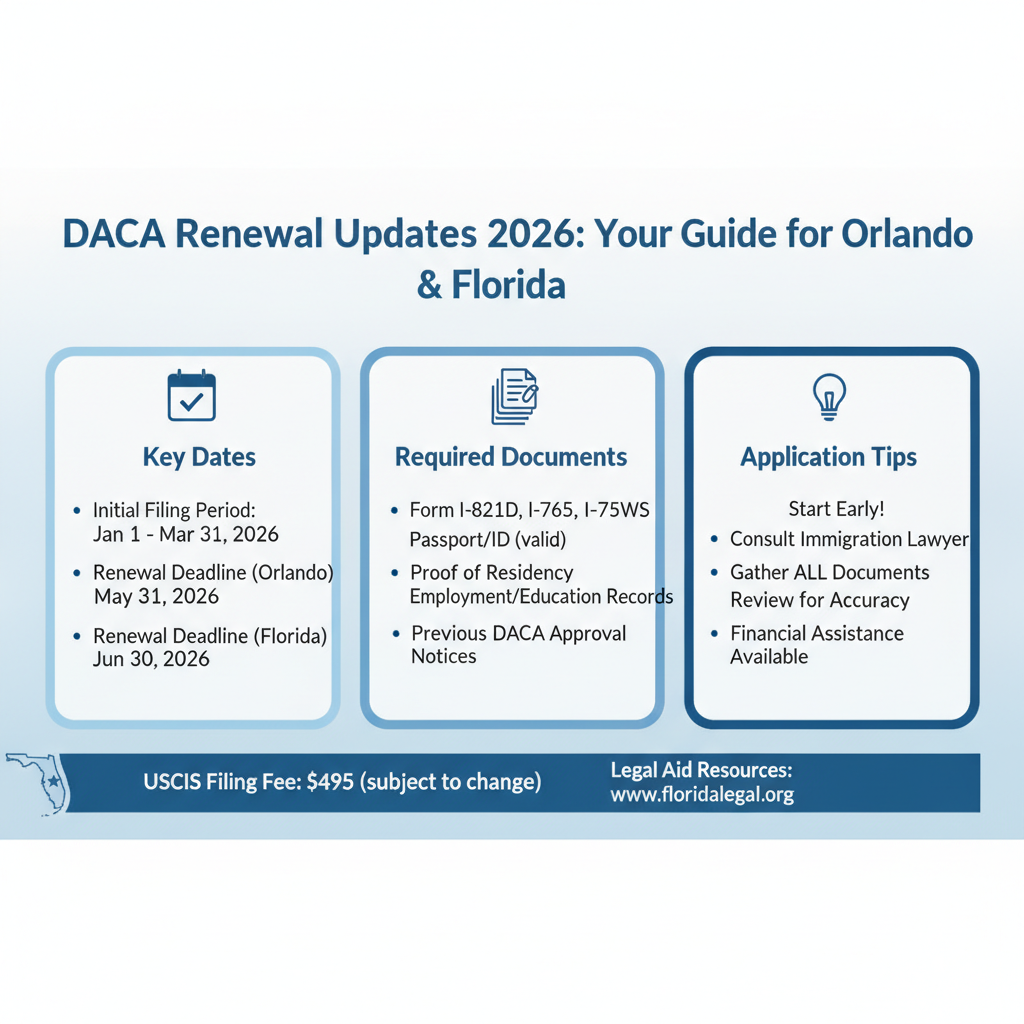
The information and guidance in this article are rooted in ongoing developments surrounding the DACA program. We closely monitor official announcements and legal proceedings that impact DACA recipients. For the latest official updates and policy changes directly from the source, please refer to the DACA Program Updates and Renewal Information (USCIS) and the USCIS official website.
What This News Means for Immigrants in Orlando and Across Florida
For hundreds of thousands of DACA recipients nationwide, and particularly the tens of thousands residing in Florida, every news update about the program carries significant weight. Understanding the implications of these developments is crucial for maintaining your deferred action status and work authorization.
Why this news is showing up now
The DACA program, first established in 2012, has faced persistent legal and political challenges since its inception. While USCIS continues to accept and process DACA renewal applications, the program itself remains under a cloud of uncertainty due to ongoing litigation. Recent news often revolves around court decisions, appeals, and administrative actions that seek to either terminate, preserve, or codify DACA. For example, the Fifth Circuit Court of Appeals has previously ruled DACA unlawful, yet left in place the ability for current recipients to renew. Subsequent actions by federal district courts continue to shape the program's future, often leading to a complex, sometimes contradictory, legal environment. These legal battles mean that DACA's status is frequently in the headlines, prompting USCIS to issue guidance and updates, primarily concerning renewal procedures and eligibility for existing recipients. Today, 2026-07-18, DACA renewals are still being processed, but the underlying legal challenges persist, making it vital for recipients to stay informed and act proactively.
How it can affect Florida residents
Florida is home to one of the largest populations of DACA recipients in the United States. For these individuals, the ability to renew DACA is directly linked to their capacity to work legally, obtain a driver's license, and pursue educational opportunities. Any changes or delays in the DACA program can have immediate and profound effects on their daily lives and economic stability. Without DACA, recipients could lose their employment authorization, face difficulties renewing their driver's licenses (which are tied to immigration status in Florida), and potentially become subject to deportation proceedings. For Central Florida residents, particularly those in Orlando and surrounding Orange County, maintaining DACA status means continuing to contribute to the local economy and community. The uncertainty surrounding DACA can also create significant stress and anxiety for families, many of whom have built their lives in Florida and consider it home. Imigrar is deeply committed to serving this community, providing steadfast legal support through these turbulent times.
Need Help? Our Orlando immigration team is ready to assist. Call +1 786-791-3106 for a free consultation, or message us online. Se Habla Español.
What DACA Is (and Why It Matters)
The Deferred Action for Childhood Arrivals (DACA) program is a lifeline for hundreds of thousands of young people across the U.S., offering temporary relief from deportation and the ability to work legally. Understanding its core components is the first step toward navigating the renewal process effectively.
A plain-English definition
DACA stands for Deferred Action for Childhood Arrivals. In simple terms, it's a U.S. immigration policy that grants certain undocumented individuals who came to the U.S. as children a temporary reprieve from deportation (known as "deferred action") and permission to work legally (through an Employment Authorization Document, or EAD). It is not a path to a Green Card or U.S. citizenship, but it provides crucial temporary stability and opportunities for eligible individuals often referred to as "Dreamers." The deferred action status is typically granted for a period of two years and must be renewed to maintain its benefits.
Key terms you need to know
- Deferred Action: A discretionary decision by the Department of Homeland Security (DHS) to delay removal proceedings against an individual. It does not confer lawful status but provides temporary protection from deportation.
- DACA Recipient: An individual who has been granted deferred action under the DACA program.
- Employment Authorization Document (EAD): Also known as a work permit, this card allows DACA recipients to legally work in the U.S. It typically has a validity period of two years, aligning with DACA status.
- USCIS: U.S. Citizenship and Immigration Services, the federal agency responsible for administering immigration and naturalization adjudication functions. They process DACA applications.
- ICE: U.S. Immigration and Customs Enforcement, the federal agency responsible for enforcing immigration laws within the U.S.
- Removal Proceedings: Formal legal proceedings in immigration court to determine if an individual should be deported from the U.S.
- Advance Parole: A document issued by USCIS that allows certain non-citizens to travel outside the U.S. and return without jeopardizing their immigration application or status. For DACA recipients, advance parole has been significantly restricted due to ongoing legal challenges, primarily limited to humanitarian, educational, or employment purposes under very specific circumstances.
- Continuous Residence: A requirement for DACA eligibility, meaning the applicant must have resided continuously in the U.S. for a specified period.
DACA matters because it empowers young people who have grown up in the U.S. to live, work, and contribute to their communities without the constant fear of deportation. It allows them to pursue higher education, build careers, and support their families, integrating more fully into the American social and economic fabric. Without DACA, these individuals would face immense barriers, impacting not only their personal lives but also the communities and economies they enrich, including Orlando and the broader Florida region.
Current Immigration Law: The Foundation of DACA
It's important to understand that DACA is not a law passed by Congress but rather an administrative policy. Its legal foundation has been the subject of intense debate and numerous court challenges. While its future remains uncertain, the current legal framework allows for renewals.
Federal requirements
The DACA program was established through a memorandum issued by the Secretary of Homeland Security in 2012. It grants a form of prosecutorial discretion to eligible individuals. To be considered for DACA, individuals had to meet several key criteria, which remain the basis for renewal eligibility:
- Were under the age of 31 as of June 15, 2012.
- Came to the U.S. before reaching their 16th birthday.
- Have continuously resided in the U.S. since June 15, 2007, up to the present time.
- Were physically present in the U.S. on June 15, 2012, and at the time of making their request for deferred action with USCIS.
- Had no lawful status on June 15, 2012.
- Are currently in school, have graduated or obtained a certificate of completion from high school, have obtained a general education development (GED) certificate, or are an honorably discharged veteran of the Coast Guard or Armed Forces of the United States.
- Have not been convicted of a felony, a significant misdemeanor, or three or more other misdemeanors, and do not pose a threat to national security or public safety.
For renewals, the primary requirement is that you must have previously been granted DACA. You must also continue to meet the original criteria, particularly the continuous residence requirement and the absence of disqualifying criminal convictions. USCIS evaluates each renewal application to ensure ongoing eligibility.
The forms required for DACA renewal are:
- Form I-821D, Consideration of Deferred Action for Childhood Arrivals
- Form I-765, Application for Employment Authorization
- Form I-765WS, Worksheet for Form I-765
You can find these forms and detailed instructions on the USCIS Forms page.
Important: As of 2026-07-18, USCIS continues to accept and process DACA renewal requests. However, due to ongoing litigation, USCIS is currently prohibited from granting initial DACA requests. This means only those who have previously been granted DACA are eligible to apply for renewal.
Florida-specific considerations
While DACA is a federal program, its benefits and limitations can interact with state laws and policies. For DACA recipients in Florida:
- Driver's Licenses: In Florida, DACA recipients are generally eligible to obtain a driver's license, as their EAD serves as proof of legal presence and work authorization. However, the validity of the driver's license is tied to the expiration date of the EAD. Therefore, a timely DACA renewal is crucial to avoid a lapse in driving privileges.
- In-State Tuition: Florida state law generally does not grant in-state tuition rates to DACA recipients. While some state universities and colleges may have specific policies or scholarships, DACA recipients typically face out-of-state tuition costs, which can be a significant financial barrier to higher education.
- Professional Licenses: The ability to obtain professional licenses (e.g., for nursing, teaching, engineering) often depends on state-specific regulations regarding immigration status. DACA recipients should consult with relevant state licensing boards for specific requirements.
- Local Advocacy: Florida has a vibrant community of DACA advocates and organizations working to support Dreamers and push for more inclusive state policies. Staying connected with these groups can provide additional resources and support.
Navigating these state-specific nuances while managing federal immigration processes can be complex. Imigrar, based in Orlando, is intimately familiar with Florida's legal landscape and how it intersects with federal immigration law, providing tailored advice to our clients.
How to Renew Your DACA: A Complete Step-by-Step Guide
Renewing your DACA status is a critical process that requires careful attention to detail and timely submission. Below is a comprehensive, step-by-step guide to help you through the process.
1) Determine Your Eligibility for Renewal
Before gathering documents, confirm you still meet the DACA renewal criteria. The primary requirement is that you must have previously received DACA. Additionally, you must still meet the original eligibility requirements, especially regarding continuous residence and criminal history. USCIS will review your entire history since your initial DACA grant, so any new criminal offenses, even minor ones, must be disclosed and could impact your eligibility.
- Check your current DACA and EAD expiration dates: Note these dates carefully. USCIS recommends filing your renewal application 120 to 150 days before your current DACA and EAD expire. Filing too early (more than 150 days) may result in rejection, while filing too late risks a lapse in your work authorization and deferred action.
- Review your personal history: Ensure there have been no changes to your criminal record that could disqualify you.
- Confirm continuous residence: Be prepared to demonstrate that you have continuously resided in the U.S. since your initial DACA grant.
2) Gather Required Documents
While DACA renewals generally require less evidence than initial applications, it's crucial to provide all necessary supporting documents to prove your continued eligibility and identity. Organize these documents meticulously.
- Previous DACA Approval Notices: Your most recent Form I-797, Approval Notice for DACA, and your most recent EAD card.
- Proof of Identity: Copies of your passport, birth certificate (with translation if not in English), or state-issued ID (e.g., Florida driver's license).
- Proof of Continuous Residence: Although often not explicitly requested for renewals if your previous DACA was granted, it's wise to have evidence of continuous residence in the U.S. since your last DACA approval. This could include:
- Bank statements
- Utility bills
- Employment records (pay stubs, W-2s)
- School records (transcripts, diplomas)
- Medical records
- Rental agreements or mortgage statements
- Photos: Two identical passport-style photos taken within 30 days of filing your application. Write your name and Alien Registration Number (A-Number) lightly on the back of each photo.
- Criminal History Records (if applicable): If you have had any arrests, charges, or convictions since your last DACA approval, you must obtain certified court dispositions and arrest records for each incident. Even minor infractions must be disclosed.
- Proof of Financial Hardship (if requesting a fee waiver): Documentation such as income statements, tax returns, or proof of receipt of means-tested benefits.
Reminder: Always make copies of all documents for your records before sending them to USCIS.
3) Complete Required Forms
Accuracy is paramount when filling out immigration forms. Any errors or omissions can lead to delays or even denial. Use the most recent versions of the forms available on the USCIS official website.
- Form I-821D, Consideration of Deferred Action for Childhood Arrivals:
- Fill out every section completely and accurately. If a question does not apply, write "N/A" (not applicable).
- Ensure your name, address, and A-Number match your previous applications exactly.
- In Part 1, check "renewal request."
- In Part 2, carefully answer all questions regarding your eligibility, especially those related to continuous residence and criminal history.
- Sign and date the form.
- Form I-765, Application for Employment Authorization:
- This form is for your work permit. In Part 2, under "Application Type," check "Permission to accept employment."
- For Question 27, "Eligibility Category," enter (c)(33) for DACA recipients.
- Sign and date the form.
- Form I-765WS, Worksheet:
- This worksheet helps USCIS determine if you have an economic need to work. Complete it accurately, providing details about your income, expenses, and assets.
- You must submit this worksheet even if you don't believe you have an economic need; it's a mandatory part of the DACA renewal application.
- Form G-1145, E-Notification of Application/Petition Acceptance (Optional but Recommended): This form allows USCIS to send you an email or text message when they accept your application.
Warning: Never leave any required field blank. If a question is not applicable, write "N/A." If a numerical answer is zero, write "0."
4) Prepare Your Application Packet
Organize your application packet in a clear, logical manner. This helps USCIS officers process your application more efficiently.
- Cover Letter (Optional but Recommended): A brief letter listing the contents of your application packet can be helpful.
- Order of Forms: Place the forms in the following order from top to bottom:
- Payment (check or money order clipped to the top)
- Form G-1145 (if used)
- Two passport-style photos in a small envelope, labeled with your name and A-Number.
- Form I-821D
- Form I-765
- Form I-765WS
- Copies of supporting documents (e.g., previous DACA approval, EAD, identity documents, criminal dispositions).
- Do not staple documents together unless specifically instructed. Use binder clips or paper clips to keep sections organized.
5) Pay the Filing Fees
As of 2026-07-18, the total filing fee for DACA renewal is $495. This includes $410 for Form I-765 and $85 for biometrics services. There is no fee for Form I-821D itself. Always double-check the current fees on the USCIS official website, as they can change without prior notice.
- Payment Method: You can pay by money order, personal check, cashier's check, or by credit card using Form G-1450, Authorization for Credit Card Transactions.
- Payable To: Make checks or money orders payable to "U.S. Department of Homeland Security." Do not abbreviate.
- Fee Waivers/Reductions: USCIS has very limited fee waiver criteria for DACA renewals. Generally, you must be receiving means-tested benefits, have an income below 150% of the Federal Poverty Guidelines, or demonstrate extreme financial hardship. If you qualify, you must submit Form I-912, Request for Fee Waiver, along with supporting documentation. Consult with an attorney before attempting a fee waiver, as they are rarely granted for DACA renewals and can delay processing.
6) Mail Your Application
Send your completed application packet to the correct USCIS lockbox facility. The mailing address depends on where you live and whether you are using the U.S. Postal Service (USPS) or a courier service (FedEx, UPS, DHL).
- Check USCIS Website for Correct Address: The specific mailing address for DACA renewal applications can change. Always verify the correct address on the USCIS DACA page or the instructions for Form I-821D.
- For Florida Residents (as of 2026):
- For USPS: USCIS, P.O. Box 20700, Phoenix, AZ 85036-0700
- For FedEx, UPS, DHL: USCIS, Attn: DACA, 1820 E. Skyharbor Circle S, Suite 100, Phoenix, AZ 85034
- Certified Mail with Return Receipt: Always send your application via certified mail with a return receipt requested. This provides proof that your application was sent and received by USCIS, which can be invaluable if there are any issues or delays.
7) Attend Biometrics Appointment (If Required) and Monitor Your Case
After filing, you will receive a receipt notice, and possibly a biometrics appointment notice.
- Receipt Notice: Within a few weeks, you should receive Form I-797C, Notice of Action, confirming that USCIS has received your application. This notice will include a receipt number that you can use to track your case online via the USCIS Case Status Online Tool.
- Biometrics Appointment: Most DACA renewal applicants will receive an appointment notice for biometrics (fingerprints, photos, signature). This appointment will typically be at an Application Support Center (ASC). Important: You must attend this appointment. Failure to do so can lead to denial of your application. If you are in Orlando, your appointment will likely be at the Orlando USCIS Field Office or another nearby ASC.
- Monitor Processing Times: You can check estimated processing times for Form I-821D and Form I-765 on the USCIS Processing Times page. Search for "I-821D" under the "California Service Center" or "Nebraska Service Center," as these centers typically process DACA applications.
- Decision: Once your application is processed, you will receive a decision notice. If approved, you will receive a new EAD card and a new Form I-797 approval notice.

Practical Steps You Can Take Today for DACA Renewal
Proactive planning is key to a smooth DACA renewal process. Don't wait until the last minute!
Actionable Checklist
- Check Your Expiration Date: Immediately verify the expiration date on your current EAD and DACA approval notice. Mark your calendar for 120-150 days before expiration as your target filing window.
- Start Gathering Documents Early: Begin collecting all necessary documents now, especially if you need to request court records for any past incidents.
- Save for Fees: The $495 filing fee is a significant cost. Start saving money or exploring payment options well in advance.
- Update Your Address with USCIS: If you have moved since your last DACA application, file Form AR-11, Alien's Change of Address Card, online or by mail, within 10 days of moving. This ensures you receive all USCIS notices.
- Consult with an Immigration Attorney: Even if you've renewed before, legal advice can catch potential issues and ensure your application is flawless. This is especially true if you have any criminal history, even minor infractions, or if you've had significant changes in your life circumstances.
- Make Copies of Everything: Before mailing your application, make a complete set of copies of all forms and supporting documents for your personal records.
- Stay Informed: Regularly check the USCIS official website for any updates or changes to DACA policy or procedures.
Document preparation guidance
- Organize Chronologically: If submitting multiple documents for continuous residence or employment, arrange them in chronological order (oldest to newest).
- Clear Copies: Ensure all copies are clear and legible. Do not send original documents unless specifically requested by USCIS.
- Translations: Any document not in English must be accompanied by a complete and accurate English translation and a certification by the translator that they are competent to translate and that the translation is accurate.
- Avoid Unnecessary Documents: Only send documents specifically requested or those directly relevant to your eligibility. Overwhelming USCIS with irrelevant paperwork can slow down processing.
Timeline expectations
- Filing Window: Aim to file your DACA renewal application 120 to 150 days before your current DACA and EAD expire.
- Receipt Notice: Expect to receive a receipt notice (Form I-797C) within 2-4 weeks after filing.
- Biometrics Appointment: A biometrics appointment notice typically arrives 3-8 weeks after filing. The actual appointment usually occurs 2-4 weeks after the notice.
- Processing Time: USCIS processing times for DACA renewals can vary significantly, often ranging from 3 to 6 months, but sometimes longer. You can check current estimates on the USCIS Processing Times page.
- Decision and EAD Delivery: Once approved, your new EAD card and approval notice should arrive within 1-2 weeks after the decision is made.
Important: If your D


