


The reporting that sparked this guide: DACA Program Updates and Renewal Information (USCIS)
What This News Means for Immigrants in Orlando and Across Florida
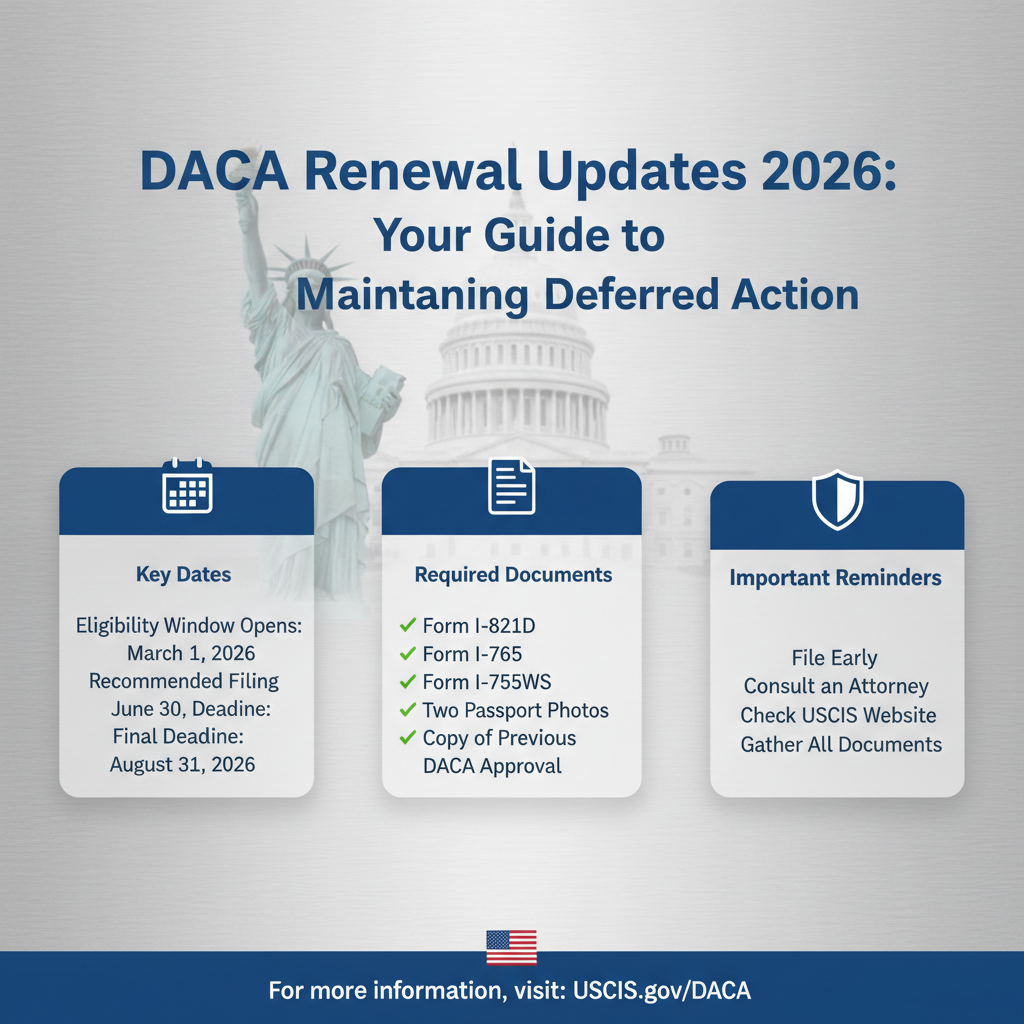
For hundreds of thousands of young immigrants across the United States, including a significant population right here in Orlando and throughout Florida, the Deferred Action for Childhood Arrivals (DACA) program represents more than just a document; it’s a lifeline. It provides protection from deportation and the ability to work legally, offering a semblance of stability and opportunity that many have never known. The news and updates surrounding DACA are a constant source of both hope and anxiety for these individuals and their families. At Imigrar, we understand the profound impact these developments have on your lives and are committed to keeping you informed and empowered.
Why this news is showing up now
DACA has been a subject of intense legal and political debate since its inception in 2012. The program, created through executive action, has faced numerous court challenges, pushing its future into a state of perpetual uncertainty. As of 2026, the program continues to operate under a complex legal landscape. While U.S. Citizenship and Immigration Services (USCIS) is generally prohibited from approving new initial DACA requests due to ongoing litigation (specifically, the ruling from the Southern District of Texas, affirmed by the Fifth Circuit Court of Appeals), they are still accepting and processing DACA renewal applications. This means that for current DACA recipients, staying informed about the renewal process, potential changes, and deadlines is absolutely critical.
The "news" often refers to the latest court filings, administrative directives from USCIS, or even legislative efforts (or lack thereof) in Congress to provide a permanent solution for Dreamers. Each development, no matter how small, sends ripples through the DACA community, emphasizing the importance of accurate, timely information.
How it can affect Florida residents
Florida is home to one of the largest populations of DACA recipients in the country. Many DACAmented individuals live and work across the state, contributing significantly to our economy and communities, from the bustling tourism industry in Orlando to the agricultural fields of South Florida. For these residents, DACA protection is essential for maintaining their jobs, pursuing higher education, obtaining driver's licenses, and simply living without the constant fear of deportation.
Specifically, for Central Florida residents, including those in Orlando, Orange County, and along the I-4 corridor, updates to DACA directly impact their ability to continue their lives here. A lapse in DACA status can lead to loss of employment authorization, potential loss of state-issued identification, and the renewed risk of removal. Understanding the renewal process and adhering to timelines is not merely a bureaucratic task; it's fundamental to maintaining one's life and future in Florida. Imigrar recognizes these unique local needs and is here to provide tailored assistance to our neighbors.
Need Help? Our Orlando immigration team is ready to assist. Call +1 786-791-3106 for a free consultation, or message us online. Se Habla Español.
What DACA Is (and Why It Matters)
The Deferred Action for Childhood Arrivals (DACA) program was established on June 15, 2012, by the Department of Homeland Security (DHS) under the Obama administration. It provides a discretionary immigration benefit to eligible young undocumented immigrants who came to the United States as children. DACA is not a pathway to U.S. citizenship or lawful permanent residency (a "green card"), but it offers crucial temporary protections.
A plain-English definition
Simply put, DACA allows certain individuals who entered the U.S. without authorization as children to request "deferred action" from deportation. This means the government agrees to postpone any deportation proceedings against them for a renewable period, typically two years. Alongside this deferred action, DACA recipients are also eligible to apply for an Employment Authorization Document (EAD), commonly known as a work permit. This EAD allows them to legally work in the U.S. and often obtain a Social Security number and a driver's license, opening doors to education, employment, and a more stable life.
Important: DACA status is temporary and must be renewed regularly. It does not confer permanent legal status and can be revoked at any time by the government, especially if the recipient commits certain crimes or poses a public safety threat.
Key terms you need to know
- Deferred Action: A discretionary decision by the U.S. government to postpone removal action against an individual. It does not grant lawful status but provides temporary relief from deportation.
- DACA Recipient / Dreamer: An individual who has been granted deferred action under the DACA program. The term "Dreamer" often refers to these individuals, stemming from the DREAM Act (Development, Relief, and Education for Alien Minors Act), proposed legislation that would have provided a path to legal status for similar populations but never passed Congress.
- Employment Authorization Document (EAD): Also known as a work permit, this card proves an individual is authorized to work in the United States. DACA recipients receive an EAD, typically valid for two years, concurrent with their deferred action period.
- USCIS (U.S. Citizenship and Immigration Services): The government agency responsible for administering immigration and naturalization benefits, including DACA applications and renewals.
- DHS (Department of Homeland Security): The federal department that oversees USCIS, Immigration and Customs Enforcement (ICE), and Customs and Border Protection (CBP).
- Form I-821D: The Application for Deferred Action for Childhood Arrivals.
- Form I-765: The Application for Employment Authorization.
- Form I-765WS: The Worksheet for Form I-765, explaining the economic need for employment.
Current Immigration Law: The Foundation for DACA
DACA exists in a unique and precarious legal space. It was created through executive action, not through a specific act of Congress, which has been the primary basis for legal challenges against the program. Its legal foundation rests on the concept of "prosecutorial discretion," which allows immigration authorities to decide whom to prioritize for deportation and whom to allow to remain in the country. This discretion is a long-standing principle in immigration law, but its application to a broad category of individuals like DACA recipients has been highly contested.
As of April 2026, the program's future remains tied up in federal courts. The Southern District of Texas has found DACA unlawful and has issued an injunction preventing USCIS from granting initial DACA requests and EADs to new applicants. This decision was affirmed by the Fifth Circuit Court of Appeals, and the case is expected to continue its journey through the legal system, potentially reaching the Supreme Court again. However, critically, the court orders have allowed USCIS to continue accepting and processing DACA renewal requests for current recipients. This distinction is paramount for those currently holding DACA status.
Federal requirements for DACA renewal
To be eligible for DACA renewal, you generally must meet the following federal requirements:
- You must have previously been granted DACA.
- You must not have departed the United States on or after August 15, 2012, without advance parole.
- You must have continuously resided in the United States since the date your most recent DACA request was approved.
- You must not have been convicted of a felony, a significant misdemeanor, or three or more other misdemeanors, and not otherwise pose a threat to national security or public safety.
Reminder: USCIS conducts a thorough background check for every renewal application. Any new brushes with the law, even minor ones, should be discussed with an immigration attorney before filing your renewal.
The primary forms you will need to submit for DACA renewal are:
- Form I-821D, Consideration of Deferred Action for Childhood Arrivals
- Form I-765, Application for Employment Authorization
- Form I-765WS, Worksheet
You can find the most current versions of these forms and their instructions on the USCIS Forms page. Always use the latest edition to avoid delays or rejections.
Florida-specific considerations for DACA recipients
While DACA is a federal program, its impact and certain benefits can vary at the state level. In Florida, DACA recipients generally:
- Driver's Licenses: Are eligible to apply for a Florida driver's license or state identification card, using their EAD as proof of legal presence.
- In-State Tuition: May be eligible for in-state tuition at Florida public colleges and universities, provided they meet other residency requirements. This has been a significant advocacy win for Dreamers in Florida.
- Professional Licenses: Can apply for various professional licenses (e.g., nursing, teaching, cosmetology) as their EAD provides work authorization. However, specific state board requirements vary.
- Employment: Are legally authorized to work in Florida with their EAD, contributing to local economies across Orange County and beyond.
Navigating state-specific benefits and requirements can sometimes be complex. Imigrar can provide guidance on these local considerations to help you maximize your DACA benefits in Florida.
For more detailed information on DACA, always refer to the USCIS official website.
Need Assistance with DACA Renewal? Don't risk your future. Contact Imigrar in Orlando for expert legal support. Call +1 786-791-3106 for a free consultation. Se Habla Español.
How to Renew Your DACA: A Complete Step-by-Step Guide
Renewing your DACA is a critical process that requires meticulous attention to detail and adherence to strict timelines. Missing a deadline or submitting an incomplete application can lead to a lapse in your work authorization and deferred action, potentially exposing you to removal proceedings. Here’s a comprehensive, step-by-step guide to help you through the DACA renewal process.
1) Determine Your Eligibility and When to File
Before gathering documents or filling out forms, confirm your eligibility for renewal. As stated earlier, you must have previously been granted DACA and meet the continuous residency and clean criminal record criteria. The most crucial aspect of this step is timing:
- When to File: USCIS recommends filing your DACA renewal request 120 to 150 days (approximately 4 to 5 months) before your current DACA and EAD expire. This timeframe accounts for potential processing delays and allows USCIS sufficient time to review your application.
- Why Timing Matters: Filing too early (more than 150 days) might result in USCIS rejecting your application. Filing too late (less than 90 days before expiration) significantly increases the risk of your DACA expiring before your renewal is approved, leading to a gap in employment authorization and legal protection.
- Warning: If your DACA expires before your renewal is approved, you will be considered out of DACA status. This can have serious consequences, including the inability to work and potential deportation risk.
2) Gather All Required Documents
While USCIS often reuses information from your previous DACA application, it's essential to provide updated documentation and be prepared to submit everything again if requested. For renewals, the primary focus is on proving continuous residence and good moral character since your last DACA approval.
Required Documents (General List):
- Copy of your previous EAD card (front and back).
- Copy of your previous DACA approval notice (Form I-797C, Notice of Action).
- Two passport-style photos (taken within 30 days of filing).
- Proof of continuous residence in the U.S. since your last DACA approval date (e.g., bank statements, utility bills, school transcripts, employment records, medical records, tax returns). Ensure these documents cover the entire renewal period.
- If you have traveled outside the U.S. with advance parole since your last DACA grant, provide copies of your passport entry/exit stamps and advance parole document.
- Any new criminal records, even minor traffic infractions, and their certified dispositions (court documents showing the outcome). Even if charges were dismissed, you must disclose them.
- Any updated personal information (e.g., name change, new address).
Tip: Create a checklist and make copies of all documents for your records before sending them to USCIS.
3) Complete Forms I-821D, I-765, and I-765WS
Accuracy and completeness are paramount when filling out these forms. Use black ink and write clearly, or type your responses. Do not leave any fields blank; if a question does not apply to you, write "N/A" (Not Applicable).
- Form I-821D, Application for Deferred Action for Childhood Arrivals:
- Carefully review all sections, especially Part 2 (Information About Your Current Request) and Part 3 (Eligibility Information).
- Ensure your current address is accurate.
- Answer all questions truthfully, especially those pertaining to criminal history, even if you think a minor incident is irrelevant.
- Form I-765, Application for Employment Authorization:
- Select "Renewal of my permission to accept employment" in Part 1, Item 1.b.
- For "Eligibility Category" in Part 2, Item 27, enter (c)(33).
- Ensure your name matches your previous EAD and other official documents.
- Form I-765WS, Worksheet:
- This form is mandatory and helps USCIS determine your economic need for employment.
- Provide a detailed explanation of your current financial situation, including income, expenses, and any dependents.
Warning: Inconsistent information between forms or with previous applications can raise red flags and lead to requests for evidence (RFEs) or even denial.
4) Prepare Your Application Packet
Once your forms are complete and documents gathered, organize your application packet neatly. While USCIS doesn't mandate a specific order, a well-organized submission can aid in processing.
- Recommended Order:
- Payment (check or money order on top).
- Form I-821D.
- Form I-765.
- Form I-765WS.
- Supporting documents (copies of EAD, approval notices, continuous residence proof, photos, criminal dispositions, etc.).
- Payment: The current filing fee for DACA renewal is $495 (as of April 2026), which includes the Form I-765 fee ($410) and the biometrics services fee ($85). You can pay by money order, personal check, cashier's check, or credit card using Form G-1450, Authorization for Credit Card Transactions. Make checks payable to "U.S. Department of Homeland Security."
- Important: Do not staple your application. Use paper clips to hold sections together.
5) Submit Your Application
Mail your complete application packet to the correct USCIS lockbox facility. The address depends on your state of residence. For Florida residents, you typically mail to the USCIS Chicago Lockbox. Always double-check the USCIS website for the most current filing addresses, as they can change.
- Mailing Address (for Florida residents, verify on USCIS website):
- For U.S. Postal Service (USPS):
USCIS
Attn: DACA
P.O. Box 805210
Chicago, IL 60680-5210 - For FedEx, UPS, and DHL deliveries:
USCIS
Attn: DACA (Box 5210)
131 South Dearborn Street, 3rd Floor
Chicago, IL 60603-5517
- For U.S. Postal Service (USPS):
- Shipping Method: Always use a mailing service that provides tracking and delivery confirmation (e.g., USPS Certified Mail with Return Receipt, FedEx, UPS). This provides proof of submission.
6) Attend Your Biometrics Appointment (If Required)
After USCIS receives your application, they will send you a receipt notice (Form I-797C) confirming your submission. A few weeks later, you may receive an appointment notice (Form I-797C) for a biometrics services appointment at a local Application Support Center (ASC). While many DACA renewals do not require a new biometrics appointment if your fingerprints are still valid, be prepared to attend if summoned.
- What to Bring: Your appointment notice, a valid photo ID (e.g., passport, EAD, driver's license).
- Purpose: Biometrics (fingerprints, photograph, signature) are used for background checks.
- Location: For Orlando residents, your appointment will likely be at the Orlando USCIS Field Office or another nearby ASC.
7) Receive Your Decision
After your biometrics appointment (if applicable) and background checks are completed, USCIS will adjudicate your case. You will receive a written decision by mail.
- Approval: If approved, you will receive an approval notice (Form I-797) for your Form I-821D, followed by your new EAD card (Form I-766) in the mail.
- Request for Evidence (RFE) or Notice of Intent to Deny (NOID): If USCIS needs more information or intends to deny your application, they will send an RFE or NOID, giving you a deadline to respond. Respond promptly and thoroughly.
- Denial: If your application is denied, you will receive a denial notice explaining the reasons. It is crucial to consult with an immigration attorney immediately to understand your options.
Confused about DACA renewal forms or deadlines? Let Imigrar guide you. We offer free consultations for DACA recipients in Orlando and nationwide. Call +1 786-791-3106 today! Se Habla Español.
Practical Steps You Can Take Today for DACA Renewal
Proactive planning is your best defense against a lapse in DACA status. Don't wait until the last minute to begin preparing for your renewal. Here are practical steps you can take right now:
Actionable Checklist:
- Check Your Expiration Date: Locate your current EAD card and DACA approval notice. Note the expiration date for both. Set reminders 6 months, 5 months, and 4 months before this date.
- Start Saving for Fees: The DACA renewal fee is $495. Begin setting aside funds now to ensure you have the full amount when it's time to file.
- Gather Continuous Residence Proof: Look for documents that demonstrate your presence in the U.S. since your last DACA approval. This includes utility bills, bank statements, pay stubs, school records, and medical bills. Organize them by date.
- Review Your Criminal History: Honestly assess if you've had any encounters with law enforcement, no matter how minor, since your last DACA approval. Obtain certified court dispositions for all incidents.
- Update Your Address with USCIS: If you've moved since your last application, file Form AR-11, Alien's Change of Address Card, online or by mail. This ensures you receive all notices from USCIS.
- Consult an Immigration Attorney: If you have any concerns about your eligibility, criminal history, or simply want professional assistance to ensure a smooth process, schedule a consultation with an experienced immigration lawyer like those at Imigrar.
Document Preparation Guidance
- Keep Everything Organized: Create a dedicated folder for your DACA documents. Label sections clearly (e.g., "EAD Copies," "Proof of Residence," "Criminal Records").
- Make Copies: Always keep a complete copy of your entire application packet, including all forms and supporting documents, for your own records before mailing.
- Translate Foreign Documents: If any of your supporting documents are in a language other than English, you must submit a certified English translation along with a copy of the original document.
- Originals vs. Copies: Generally, USCIS requires copies of supporting documents, not originals (unless specifically requested). Do not send original birth certificates, passports, or EADs unless explicitly instructed.
Timeline Expectations
- Processing Times: USCIS processing times for DACA renewals can vary significantly. You can check the current processing times for Form I-821D and Form I-765 on the USCIS Processing Times page. Select "I-821D, Consideration of Deferred Action for Childhood Arrivals" and "I-765, Application for Employment Authorization" for the Service Center that processes DACA (currently, Nebraska Service Center or California Service Center, depending on your address).
- Typical Range: While 120-150 days is the recommended filing window, actual processing can take anywhere from 2 to 6 months, sometimes longer.
- Expedited Processing: Expedited processing for DACA renewals is rarely granted and only in cases of severe urgency (e.g., life-threatening illness, extreme financial loss). You must provide substantial evidence to support an expedite request.
- Monitor Your Case: Use your receipt number (from Form I-797C) to track the status of your application online via the USCIS "Case Status Online" tool.
How Imigrar Helps DACA Recipients in Orlando and Beyond
At Imigrar, we understand that navigating the DACA renewal process, especially with its ongoing legal uncertainties, can be daunting. Our mission, "Keep Families Together," extends to ensuring DACA recipients can continue to live and work without fear.
Our experience and expertise
Our firm, based in Orlando, Florida, has extensive experience assisting DACA recipients with their renewals. We are intimately familiar with the specific requirements of Form I-821D and Form I-765, the nuances of providing continuous residence proof, and the critical importance of a clean criminal record. We stay abreast of the latest court rulings and USCIS policy changes affecting DACA, ensuring your application is prepared according to the most current guidelines.
Whether you're located near the Orlando USCIS Field Office, elsewhere in Central Florida, or anywhere nationwide, our team is equipped to provide comprehensive support. We assist with:
- Thorough eligibility assessments.
- Meticulous preparation and review of all required forms and documents.
- Guidance on gathering difficult-to-obtain evidence.
- Addressing any past criminal history or immigration issues that might complicate your renewal.
- Responding to Requests for Evidence (RFEs) or Notices of Intent to Deny (NOIDs).
- Strategic advice on the ongoing legal landscape of DACA.
Free consultation offer
We believe everyone deserves access to expert legal advice. That's why Imigrar offers a free consultation for DACA recipients. This is your opportunity to discuss your specific situation, ask questions, and receive personalized guidance from an experienced immigration attorney. We will assess your eligibility, identify potential challenges, and outline a clear path forward for your DACA renewal.
Se Habla Español. Our team is fluent in both English and Spanish, ensuring clear communication and understanding for all our clients. We are here to serve the diverse communities of Orlando, Florida, and beyond, making sure language is never a barrier to quality legal representation.

Frequently Asked Questions About DACA Renewals
Q: Can I apply for DACA for the first time in 2026?
A: No. Due to ongoing federal court orders, USCIS is currently prohibited from granting initial DACA requests. They are only accepting and processing DACA renewal requests from individuals who have previously been granted DACA.
Q: What if I have a criminal record since my last DACA approval? Will I still be eligible to renew?
A: It depends on the nature and severity of the crime. USCIS reviews criminal history very strictly. You are generally ineligible if you have been convicted of a felony, a "significant misdemeanor" (e.g., domestic violence, sexual abuse, burglary, DUI), or three or more "other misdemeanors." Even minor offenses or arrests that didn't lead to conviction must be disclosed. It is absolutely crucial to consult with an immigration attorney at Imigrar before filing your renewal if you have any criminal history since your last DACA grant. We can assess the impact and advise on the best course of action.
Q: Is DACA a path to a green card or U.S. citizenship?
A: No, DACA itself does not provide a direct pathway to a green card or U.S. citizenship. It only grants temporary protection from deportation and work authorization. While some DACA recipients may be able


