

The landscape of immigration law is constantly evolving, and for hundreds of thousands of young people across the United States, few programs hold more significance than Deferred Action for Childhood Arrivals (DACA). As we move through 2026, DACA continues to be a topic of critical discussion, legal challenges, and ongoing administrative processes. For DACA recipients in Orlando, throughout Florida, and nationwide, staying informed about the latest updates and understanding the renewal process is not just recommended—it’s essential.
At Imigrar, an immigration law firm based in Orlando, Florida, we understand the anxieties and uncertainties that DACA recipients and their families face. Our mission, "Keep Families Together," drives us to provide accurate, timely, and actionable information. This comprehensive guide is designed to cut through the complexity, offering clear steps and expert advice on DACA program updates and the crucial renewal process.
The reporting that sparked this guide:
The continuous legal and administrative developments surrounding DACA are frequently in the news, impacting the lives of countless individuals. Recent reports from official government sources like USCIS highlight the ongoing importance of timely renewals and adherence to current guidelines.
DACA Program Updates and Renewal Information (USCIS)
What This News Means for Immigrants in Orlando and Across Florida
For the approximately 24,000 DACA recipients residing in Florida, and especially those living in or around Orlando and the I-4 corridor, news related to DACA program updates carries significant weight. These updates dictate the stability of their lives, their ability to work legally, and their protection from deportation. Understanding the nuances of these changes is paramount.
Why this news is showing up now
The DACA program, originally established in 2012, has been subject to numerous legal challenges and policy shifts over the past decade. Despite various attempts to terminate or significantly alter it, the program continues to exist, primarily due to court injunctions and administrative directives. As of mid-2026, the program's future remains a subject of ongoing litigation, particularly stemming from the U.S. District Court for the Southern District of Texas ruling that found DACA unlawful. This ruling, however, has been stayed for current DACA recipients, meaning that while new applications are generally not being processed, renewals are. The continuous legal battles, appeals, and administrative responses from the Department of Homeland Security (DHS) and USCIS mean that "DACA program updates" are a constant fixture in immigration news cycles. Each court filing, DHS memo, or USCIS announcement can create new questions and anxieties for Dreamers and their families.
Furthermore, the administrative burden of processing hundreds of thousands of renewals nationwide requires USCIS to regularly issue guidance, update forms, and adjust processing protocols, all of which contribute to the ongoing news around DACA. For those whose deferred action is set to expire, these updates are not abstract legal discussions but direct impacts on their daily lives.
How it can affect Florida residents
Florida is home to a substantial DACA population. For these individuals, news about DACA directly impacts their employment, educational opportunities, and overall sense of security. An interruption in the ability to renew DACA can mean losing work authorization, facing the threat of deportation, and disrupting their lives and the lives of their families who depend on them. In Central Florida, a region known for its diverse communities and thriving economy, DACA recipients are integral members of the workforce and contribute significantly to the local economy.
Specifically, an inability to renew DACA could lead to:
- Loss of Employment Authorization: Without a valid Employment Authorization Document (EAD), DACA recipients cannot legally work, jeopardizing their livelihoods and their ability to support their families. This is a critical concern for many in Orlando's service, tourism, and healthcare industries.
- Increased Risk of Deportation: Deferred action provides protection from deportation. Without it, individuals are once again vulnerable to removal proceedings, causing immense stress and instability for families, many of whom have U.S. citizen children.
- Disruption of Education: Many DACA recipients are pursuing higher education. The loss of DACA can impact their ability to continue their studies, obtain in-state tuition benefits where applicable, and achieve their academic goals.
- Driver's License Issues: In Florida, a valid EAD is often required to obtain or renew a driver's license. Losing DACA status can therefore impact mobility and daily life.
The ongoing legal uncertainty means that the current policy allowing renewals could change. Therefore, all eligible Florida residents are urged to prioritize their DACA renewals and seek legal counsel to ensure compliance with the latest requirements. The Orlando USCIS Field Office, while not directly handling DACA applications, is a local touchpoint for many immigration services, and understanding the broader federal context is vital for those living in Orange County and surrounding areas.
Need Help? Navigating DACA renewals can be complex. Our Orlando immigration team is ready to assist. Call +1 786-791-3106 for a free consultation, or message us online. Se Habla Español.
What DACA Is (and Why It Matters)
To fully grasp the significance of DACA updates, it’s crucial to understand what the program entails and its profound impact on individuals and communities.
A plain-English definition
DACA, or Deferred Action for Childhood Arrivals, is an immigration policy established by the Obama administration in June 2012. It allows certain undocumented immigrants who came to the United States as children to receive a renewable two-year period of deferred action from deportation and eligibility for a work permit (Employment Authorization Document or EAD). Essentially, it provides temporary protection from being removed from the country and the legal ability to work, study, and obtain a driver's license. It does not provide a path to U.S. citizenship or a green card, but it offers a measure of stability and opportunity for individuals often referred to as "Dreamers."
The key benefit of DACA is the discretion exercised by the government not to pursue removal proceedings against eligible individuals. This discretion is renewable, meaning recipients must apply periodically to maintain their status. Important: While DACA provides significant benefits, it is not a permanent immigration status and its future remains subject to legal and political challenges.
Key terms you need to know
Understanding the following terms will help you navigate DACA information more effectively:
- Deferred Action: This is a discretionary determination by the government to defer removal action against an individual. It does not grant lawful status but provides temporary protection from deportation.
- DACA Recipient / Dreamer: An individual who has been granted deferred action under the DACA program. The term "Dreamer" often refers more broadly to young undocumented immigrants who arrived in the U.S. as children.
- Employment Authorization Document (EAD): Also known as a work permit, this card allows individuals to legally work in the United States. DACA recipients receive an EAD valid for the period of their deferred action.
- USCIS (U.S. Citizenship and Immigration Services): The government agency responsible for administering the DACA program, including processing applications for deferred action and employment authorization. This is the primary agency you will interact with for renewals.
- DACA Renewal: The process by which current DACA recipients apply to extend their deferred action and employment authorization for another two-year period. As of 2026, this is the primary action available to DACA-eligible individuals, as initial (first-time) DACA applications are generally not being accepted.
- Prosecutorial Discretion: The authority of government attorneys and immigration officials to decide whether to pursue or decline to pursue a case, including deportation. DACA is an exercise of prosecutorial discretion.
- Biometrics: The collection of unique physical characteristics (fingerprints, photographs, signatures) used for identity verification and background checks. USCIS often requires DACA applicants to attend a biometrics appointment.
Current Immigration Law: The Foundation for DACA
While DACA itself is not a statutory law passed by Congress, it operates within the framework of existing immigration laws and executive authority. Its legal basis stems from the concept of prosecutorial discretion within the Department of Homeland Security (DHS), which has the authority to decide whom to prioritize for removal and whom to grant temporary relief.
Federal requirements
The DACA program was established via a memorandum issued by the Secretary of Homeland Security. The current iteration of DACA, as of 2026, largely follows the guidelines set forth in the 2012 memo, updated by subsequent legal and administrative actions. Important: As a result of ongoing litigation, USCIS is currently accepting requests to renew DACA but, in general, is not processing initial DACA requests (first-time applications). This distinction is critical.
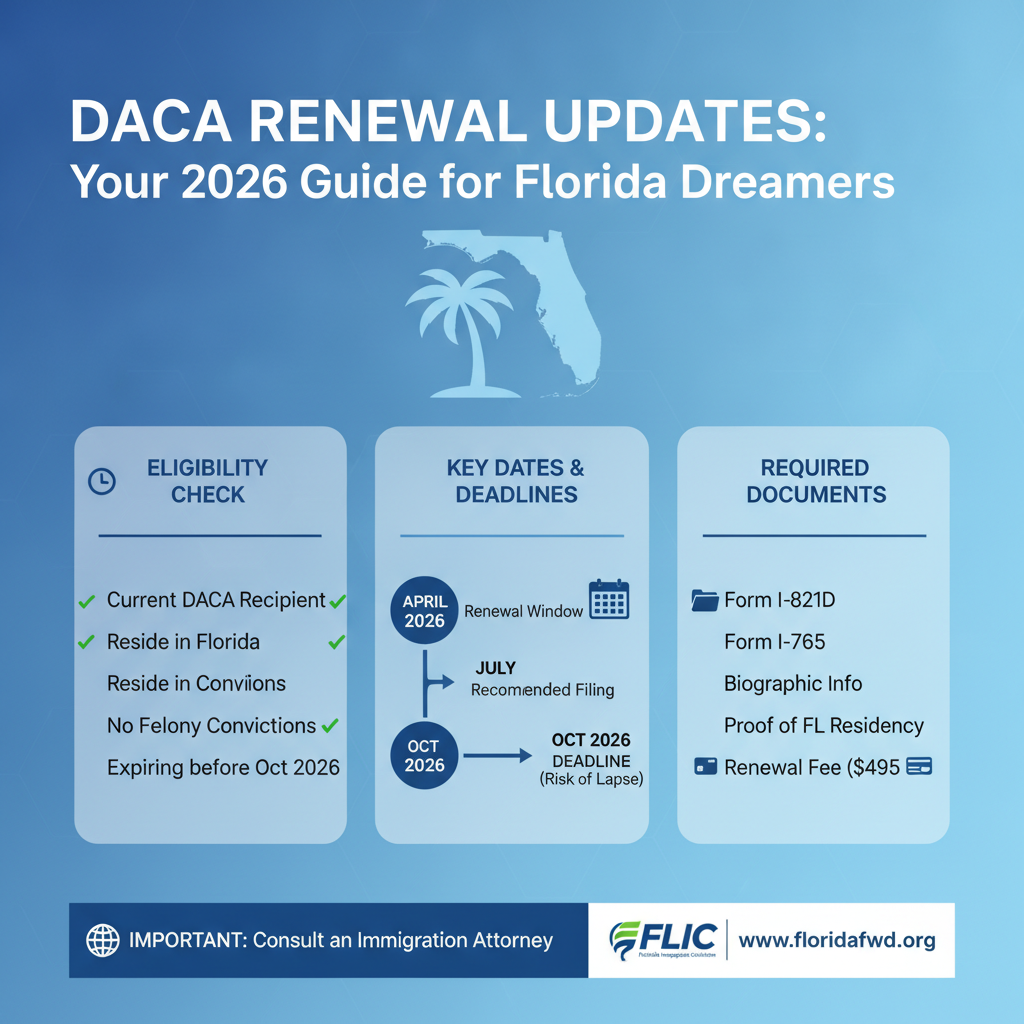
To be eligible for DACA renewal, applicants must meet the following criteria:
- Previously Granted DACA: You must have been previously granted DACA.
- Continuous Residence: You must have continuously resided in the United States since you submitted your most recent DACA request that was approved.
- Not Disqualified: You must not have departed the United States on or after August 15, 2012, without advance parole; or have been convicted of a felony, a significant misdemeanor, or three or more other misdemeanors; or otherwise pose a threat to national security or public safety.
When applying for renewal, you generally need to submit:
- Form I-821D, Consideration of Deferred Action for Childhood Arrivals
- Form I-765, Application for Employment Authorization
- Form I-765WS, Worksheet
- Any supporting documentation for new information (e.g., new arrests, travel outside the U.S. with advance parole).
These forms and detailed instructions are available on the USCIS Forms page. It is always advisable to download the latest versions directly from the official website to ensure you have the most up-to-date editions.
The legal challenges, particularly the injunction from the U.S. District Court for the Southern District of Texas, have created a complex environment. While the Biden administration has sought to fortify DACA through new regulations, the program's long-term future still hinges on ongoing legal battles. For now, the ability to renew DACA remains intact for eligible individuals.
Florida-specific considerations
While DACA is a federal program, its impact and certain ancillary benefits can vary by state. For DACA recipients in Florida, understanding these local considerations is important:
- Driver's Licenses: In Florida, a valid EAD issued by USCIS is generally required to obtain or renew a driver's license or state identification card. Therefore, maintaining your DACA status and EAD is crucial for driving privileges in the state.
- In-State Tuition: Florida law does not automatically grant DACA recipients eligibility for in-state tuition at public colleges and universities. However, specific state policies and individual institutional decisions may allow some DACA recipients to qualify for in-state tuition rates, often if they meet certain residency requirements separate from their immigration status. It's vital to check with individual educational institutions in Orlando and across Florida.
- Professional Licenses: The ability to obtain professional licenses (e.g., for nursing, teaching, real estate) in Florida can vary. While DACA provides work authorization, state licensing boards may have additional requirements related to immigration status.
- Local Resources: Communities in Central Florida, including Orlando, have various non-profit organizations and legal aid groups that offer support to immigrant populations, including DACA recipients. These organizations can be valuable resources for information and assistance.
For any specific questions related to Florida state benefits or requirements tied to your DACA status, it’s best to consult with an immigration attorney or relevant state agencies. The team at Imigrar is deeply familiar with both federal immigration law and its intersection with Florida-specific considerations.
For the most accurate and up-to-date information directly from the source, always refer to the USCIS official website.
Concerned about your DACA renewal? Don't risk delays or denial. Imigrar offers expert guidance for DACA recipients in Orlando and nationwide. Call +1 786-791-3106 for a free consultation. Se Habla Español.
How to Renew Your DACA: A Complete Step-by-Step Guide
Renewing your DACA is a critical process that requires attention to detail and timely action. Missing deadlines or making errors can lead to delays or even denial, putting your deferred action and work authorization at risk. Follow this comprehensive step-by-step guide to ensure a smooth renewal process.
1) Determine Your Eligibility and When to Apply
Eligibility: First, confirm you meet the federal renewal requirements: you must have previously received DACA, resided continuously in the U.S. since your last DACA approval, and not have disqualifying criminal convictions or security threats. If you've traveled outside the U.S. without advance parole since August 15, 2012, or have new criminal history, consult an attorney immediately.
When to Apply: USCIS recommends filing your DACA renewal request approximately 120 to 150 days (roughly 4 to 5 months) before your current DACA and EAD expire. Filing too early (more than 150 days) may result in USCIS rejecting your application. Filing too late (less than 120 days) significantly increases the risk of your DACA expiring before your renewal is processed, leading to a lapse in work authorization and protection from deportation. If your DACA has already expired, you should still apply for renewal as soon as possible, as USCIS accepts requests even after expiration, though you will experience a lapse in status.
Reminder: Mark your calendar with your DACA and EAD expiration dates and plan your renewal submission accordingly. For Central Florida residents, a lapse in work authorization can quickly impact your job and financial stability.
2) Gather Required Documents
Thorough preparation of your documents is key to a successful renewal. While DACA renewals typically require less evidence than initial applications, you must still provide certain documentation, especially if there have been changes in your life since your last approval.
Required Documents Checklist:
- Copies of Previous DACA Approval Notices: Include copies of your most recent Form I-797 (Approval Notice for Form I-821D) and your most recent EAD card (front and back).
- Proof of Identity: A copy of your birth certificate, passport, or national identity document.
- Photographs: Two identical, passport-style color photographs taken within 30 days of filing. Write your name and A-Number lightly on the back of each photo.
- Proof of Continuous Residence (if applicable): If you have moved, changed jobs, or otherwise had significant life changes, you may need to provide updated proof of continuous residence in the U.S. since your last DACA approval. Examples include:
- School records (transcripts, diplomas)
- Employment records (pay stubs, W-2s, employment verification letters)
- Medical records (clinic visits, hospital records)
- Rental agreements, utility bills, bank statements
- Tax returns
- Travel History (if applicable): If you traveled outside the U.S. with advance parole since your last DACA approval, you must include copies of your Form I-512L (Advance Parole Document) and entry/exit stamps from your passport.
- Criminal History (if applicable): If you have been arrested, charged, or convicted of any crime since your last DACA approval (even if charges were dropped or expunged), you must provide certified court dispositions for all incidents. Warning: Failure to disclose any criminal history can lead to denial and severe immigration consequences. Consult an attorney if you have any arrests or convictions.
Reminder: Do NOT send original documents unless specifically requested by USCIS. Always send high-quality copies.
3) Complete the Forms Accurately
The accuracy of your forms is paramount. Any errors, omissions, or inconsistencies can lead to requests for evidence (RFEs), delays, or even rejection. Always use black ink and ensure your answers are consistent across all forms.
Forms to Complete:
- Form I-821D, Consideration of Deferred Action for Childhood Arrivals:
- Carefully review each question.
- Pay special attention to Part 1 (Information About You) and Part 2 (Eligibility Information).
- Ensure your address is current and matches your mailing address.
- Sign and date the form.
- Form I-765, Application for Employment Authorization:
- In Part 2, Question 27, for Eligibility Category, enter (c)(33).
- Sign and date the form.
- Form I-765WS, Worksheet:
- This form is required for DACA applicants to justify the economic necessity for employment.
- Provide details about your income, expenses, and assets.
- Sign and date the form.
Important: If you need help understanding any question or are unsure how to answer, seek legal advice. Do not leave any required fields blank; if a question doesn't apply, write "N/A."
4) Prepare Your Application Packet
Organizing your application packet correctly can help USCIS process your request efficiently.
Packet Assembly:
- Cover Letter (Optional but Recommended): A simple cover letter listing the contents of your application can be helpful.
- Payment: Place your check or money order on top of the packet.
- Forms:
- Form I-821D
- Form I-765
- Form I-765WS
- Supporting Documents: Organize your supporting documents in the order they are referenced in the forms or the cover letter. Include copies of your previous DACA approval, EAD, identity documents, photos, and any other evidence.
- Copies: Make a complete copy of the entire application packet for your records before mailing it.
Reminder: Do not use staples. Use paper clips or binder clips to hold documents together. Ensure all pages are readable and correctly oriented.
5) Pay the Required Fees
DACA renewal requires a specific fee payment, which covers both the Form I-765 and the biometrics services fee.
Current Fees (as of 2026):
- Form I-765 Filing Fee: $410
- Biometrics Services Fee: $85
- Total: $495
Payment Method: You must pay with a money order, personal check, cashier’s check, or by credit card using Form G-1450, Authorization for Credit Card Transactions. Make checks or money orders payable to "U.S. Department of Homeland Security." Do not abbreviate. Ensure the amount is exact.
Important: Fee waivers for DACA renewal applications are generally not available. USCIS has a very strict policy regarding DACA fees.
6) Mail Your Application to USCIS
The correct mailing address depends on your state of residence. For Florida residents, DACA renewal applications are sent to a specific USCIS Lockbox facility.
Mailing Address for Florida Residents:
- For U.S. Postal Service (USPS):
USCIS Attn: DACA P.O. Box 660860 Dallas, TX 75266-0860 - For Express Mail and Courier Deliveries (e.g., FedEx, UPS, DHL):
USCIS
        Attn: DACA
        2501 S. State Hwy. 121 Business
        Suite 400
        Lewisville, TX 75067-8003
Recommendation: Always use a mailing service that provides tracking and delivery confirmation (e.g., USPS Certified Mail with Return Receipt, FedEx, UPS). This provides proof of submission and delivery, which is crucial for your records.
7) Attend Your Biometrics Appointment (If Required)
After USCIS accepts your application, you will typically receive a receipt notice (Form I-797C, Notice of Action). Following this, you may receive an appointment notice for biometrics collection at an Application Support Center (ASC).
- What to Expect: The biometrics appointment involves taking your fingerprints, photograph, and signature. This data is used for background checks.
- What to Bring: Bring your appointment notice (Form I-797C) and a valid photo ID (e.g., passport, EAD, driver's license).
- Location: For residents of Orlando and Central Florida, your biometrics appointment will likely be scheduled at the local USCIS Application Support Center.
- Important: Do not miss your biometrics appointment. If you have an unavoidable conflict, immediately contact USCIS to request a reschedule, though this can cause significant delays.
After your biometrics appointment, USCIS will continue to process your application. You can check the status online using the receipt number provided on your Form I-797C at USCIS Case Status Online. If approved, you will receive a new Form I-797 approval notice and your new EAD card in the mail.

Practical Steps You Can Take Today
Proactive preparation is your best defense against potential issues with your DACA renewal. Here’s an actionable checklist to help you get started today:
- 1. Mark Your Calendar: Note your DACA and EAD expiration dates prominently. Set a reminder to start preparing 150 days before expiration.
- 2. Organize Your Documents: Create a dedicated folder (physical or digital) for all DACA-related documents. Include copies of previous approval notices, EADs, birth certificates, and any records of continuous residence.
- 3. Review Your History: Reflect on any significant events since your last DACA approval, such as arrests (even minor ones), citations, or travel outside the U.S. Gather all relevant documents (e.g., court dispositions, advance parole documents).
- 4. Update Your Address: If you have moved, ensure your address is updated with USCIS using Form AR-11, Alien's Change of Address Card, and update it on any pending applications. This is critical for receiving important notices.
- 5. Take New Passport Photos: Obtain two recent, passport-style photos. Many pharmacies and photo studios in Orlando offer this service.
- 6. Consult an Immigration Attorney: Even if your case seems straightforward, a consultation with an experienced attorney can identify potential issues, ensure accuracy, and provide peace of mind. This is especially true if you have any arrests, prior deportations, or complex travel history.
- 7. Save for Fees: The DACA renewal fee is $495. Begin saving this amount well in advance to avoid last-minute financial stress.
Document preparation guidance
- Copies, Not Originals: Always submit clear, legible copies of all supporting documents. Keep your originals safe.
- Translations: If any document is not in English (e.g., a foreign birth certificate), you must include a complete English translation certified by a competent translator. The translator must provide a statement certifying their competence and the accuracy of the translation.
- Affidavits: In some cases, if formal documents are unavailable, affidavits from individuals who can attest to your continuous residence might be accepted. Consult an attorney for guidance on this.
Timeline expectations
While USCIS processing times can fluctuate, here's a general expectation for DACA renewals:
- Application Submission to Receipt Notice: 1-3 weeks. You'll receive Form I-797C.
- Receipt Notice to Biometrics Appointment


