


Navigating the complex and ever-changing landscape of U.S. immigration law can be daunting, especially when it concerns programs as vital and frequently debated as Deferred Action for Childhood Arrivals (DACA). For hundreds of thousands of young people across the country, including a significant population right here in Florida, DACA offers a crucial lifeline, providing temporary protection from deportation and the ability to work legally.
At Imigrar, we understand the profound impact that DACA has on individuals and families. Our mission, "Keep Families Together," drives us to provide clear, accurate, and timely information to help you understand your rights and responsibilities.
Need Help with Your DACA Renewal? Don't navigate the complexities alone. Our Orlando immigration team is ready to assist. Call +1 786-791-3106 for a free consultation, or message us online. Se Habla Español.
The reporting that sparked this guide
Recent news and ongoing discussions from government sources like USCIS consistently highlight the critical need for DACA recipients to remain vigilant about their status and renewal process. While the program's long-term future continues to be debated in courts and legislative chambers, the immediate priority for current beneficiaries is to ensure their deferred action and work authorization remain current.
For the most up-to-date information and official announcements, always refer to reputable sources:
What This News Means for Immigrants in Orlando and Across Florida
The continuous stream of news and updates regarding the DACA program carries significant weight for the immigrant community, particularly for those residing in Florida. As of 2026, the DACA program remains in a state of flux, primarily due to ongoing legal challenges that prevent USCIS from approving new initial DACA applications in most circumstances. However, USCIS continues to accept and process DACA renewal applications, making staying informed about the renewal process absolutely critical.
Why this news is showing up now
The DACA program, initially established in 2012, has faced numerous legal battles and policy changes throughout its existence. The current situation stems largely from a July 2021 ruling by a federal judge in Texas, which found DACA unlawful. This ruling, while allowing renewals to continue for current beneficiaries, blocked USCIS from approving new initial DACA applications. This decision was largely upheld by the U.S. Court of Appeals for the Fifth Circuit in October 2022, which then sent the case back to the lower court for further review of the new DACA regulation issued by the Department of Homeland Security (DHS) in August 2022.
As of March 2026, the legal challenges persist. The lower court in Texas is currently reviewing the legality of the 2022 DACA regulation. This ongoing litigation means that while the program is not entirely terminated, its future remains precarious. Every administrative update from USCIS, every court filing, and every policy discussion generates news because it impacts the lives of hundreds of thousands of individuals. For DACA recipients, this constant flow of information underscores the importance of prompt renewal and maintaining impeccable records, as the program's status could change with little notice. The Biden administration has committed to defending DACA, but its ultimate fate rests with the courts.
How it can affect Florida residents
Florida is home to one of the largest populations of DACA recipients in the United States. Estimates suggest tens of thousands of DACA beneficiaries reside in the Sunshine State, contributing significantly to its economy and culture. For these individuals, the ability to renew their DACA status means:
- Continued Employment: DACA provides an Employment Authorization Document (EAD), allowing recipients to work legally. A lapse in DACA status can lead to job loss, economic hardship, and instability for families. Many DACA recipients in Orlando and across the I-4 corridor are essential workers, small business owners, and vital contributors to their communities.
- Educational Opportunities: DACA status can impact eligibility for in-state tuition at Florida colleges and universities, making higher education more accessible. Losing DACA can jeopardize academic pursuits and future career prospects.
- Driver's Licenses: DACA recipients in Florida are generally eligible to obtain a driver's license, which is crucial for daily life, commuting to work or school, and maintaining independence in a state heavily reliant on personal transportation.
- Protection from Deportation: Most importantly, DACA provides temporary protection from removal from the U.S., offering peace of mind to individuals who have known no other home.
For Central Florida residents, particularly those in Orlando, Kissimmee, and other Orange County areas, the community impact is profound. Many DACA recipients are integral parts of their families and communities, supporting parents, siblings, and children. Any threat to DACA directly impacts family unity, a core value at Imigrar. Staying informed and proactively renewing your DACA is not just a personal matter; it's a community imperative.
What DACA Is (and Why It Matters)
Deferred Action for Childhood Arrivals, commonly known as DACA, is an immigration policy established by the Obama administration in June 2012. It offers certain eligible young undocumented immigrants who came to the United States as children a temporary form of administrative relief from deportation. While it does not grant legal status or a pathway to U.S. citizenship, it provides two crucial benefits: deferred action (protection from deportation) and eligibility for an Employment Authorization Document (EAD), which allows recipients to work legally in the U.S.
A plain-English definition
Think of DACA as a temporary pause button on deportation. It's not a green card, and it's not citizenship. Instead, if you meet specific criteria, the government agrees not to pursue your removal from the country for a renewable two-year period. During this time, you can also apply for a work permit. This allows young people, often called DREAMers, who grew up in the U.S. and consider it their home, to pursue education, build careers, and contribute to their communities without the constant fear of being separated from their families and lives.
DACA was created in response to the stalled legislative efforts to pass the DREAM Act, which would have provided a path to legal status for these individuals. It represents an exercise of "prosecutorial discretion" by the Department of Homeland Security, meaning the government chooses to focus its enforcement resources elsewhere, rather than on these low-priority individuals.
Key terms you need to know
Understanding the terminology surrounding DACA is essential for every recipient and their family:
- Deferred Action: This is the core benefit of DACA. It means that the U.S. government has chosen to "defer" or postpone any action to remove an individual from the country. It is temporary and does not confer lawful immigration status. It simply means you are not a priority for deportation during the period of deferred action.
- Employment Authorization Document (EAD): Often referred to as a "work permit," the EAD is a physical card that allows foreign nationals, including DACA recipients, to work legally in the United States. It is typically valid for two years, coinciding with the period of deferred action granted under DACA. Without a valid EAD, DACA recipients cannot legally work.
- Advance Parole: This is a travel document issued by USCIS that allows certain non-citizens to travel outside the U.S. and be "paroled" back into the country. For DACA recipients, Advance Parole has historically been an avenue to travel for humanitarian, educational, or employment purposes. Important: Due to current legal challenges, USCIS is generally not granting Advance Parole to DACA recipients, except in very limited circumstances or for those who already have it. Attempting to travel without valid Advance Parole can lead to being denied re-entry and placed in removal proceedings. Always consult an experienced immigration attorney before considering any international travel.
- DREAMers: This widely used term refers to young undocumented immigrants who were brought to the U.S. as children. It originates from the proposed "Development, Relief, and Education for Alien Minors Act" (DREAM Act), which has been introduced in Congress multiple times but has never passed. DACA recipients are often referred to as DREAMers.
- USCIS (U.S. Citizenship and Immigration Services): This is the federal agency within the Department of Homeland Security responsible for administering the country's lawful immigration system. USCIS processes DACA applications, renewals, and other immigration benefits. Their official website (www.uscis.gov) is the primary source for forms, instructions, and policy updates.
DACA matters because it provides a measure of stability and opportunity for young people who have lived most of their lives in the U.S. It allows them to pursue their potential, contribute to their communities, and live without the constant fear of deportation, upholding the principle of "Keep Families Together" that Imigrar champions.
Current Immigration Law: The Foundation for DACA
While DACA itself is not a law passed by Congress, it operates within the framework of existing immigration law and is an exercise of executive authority. The foundational law governing immigration in the United States is the Immigration and Nationality Act (INA). The INA sets forth the conditions for entry, stay, and removal of non-citizens, as well as the various categories of visas and immigration benefits. DACA, specifically, is a policy rooted in the concept of "prosecutorial discretion," which allows immigration enforcement agencies to prioritize certain cases over others.
The authority for DACA stems from the Department of Homeland Security's (DHS) inherent power to decide who to pursue for removal and who to allow to remain in the country temporarily. It's a discretionary decision, not a statutory right. This distinction is crucial because it means DACA's existence is more vulnerable to changes in administration policy and court challenges compared to a congressionally enacted law.
Federal requirements for DACA Renewal
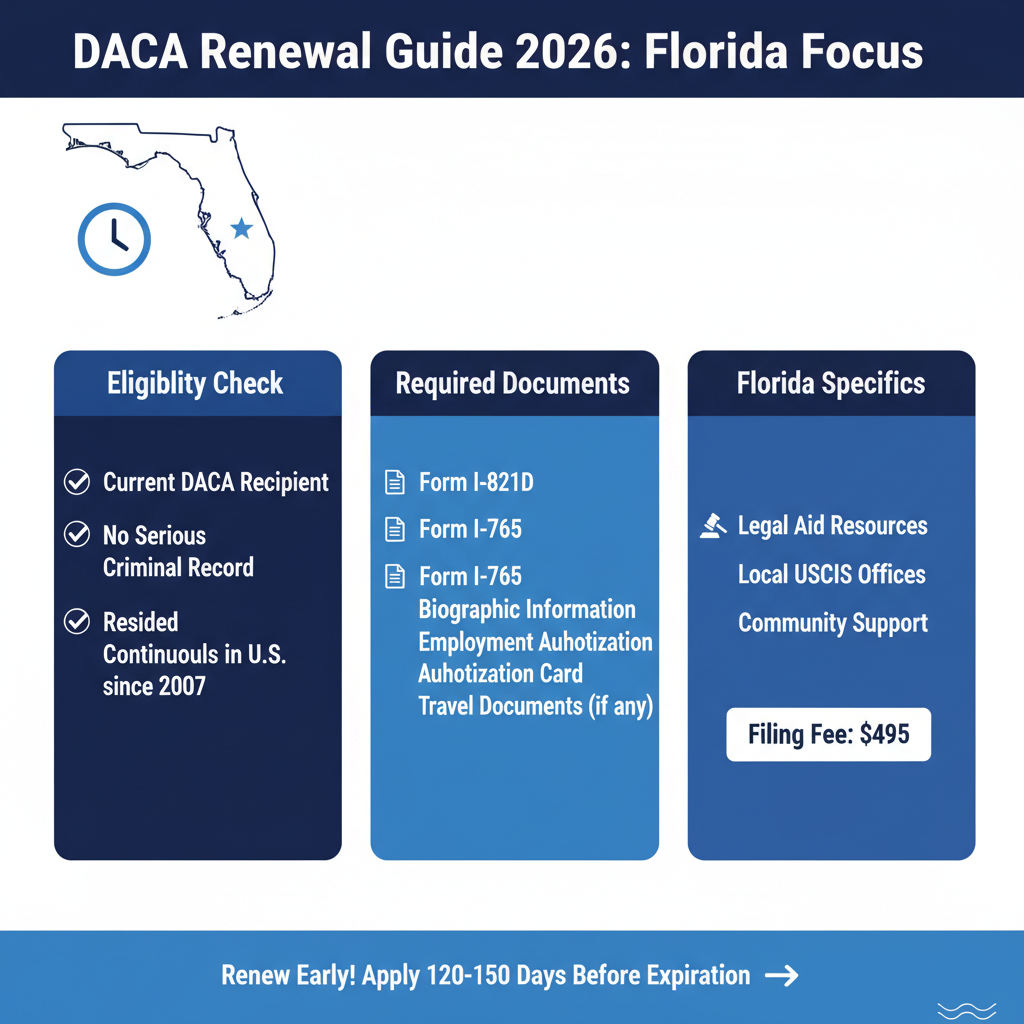
As of March 2026, USCIS is accepting and processing DACA renewal applications. To be eligible for renewal, you must meet the following federal requirements:
- You must have previously received deferred action under DACA. USCIS is generally not accepting initial DACA applications due to federal court orders.
- You must have continuously resided in the United States since the date you submitted your most recent DACA request that was approved.
- You must not have departed the United States on or after August 15, 2012, without first obtaining Advance Parole.
- You must not have been convicted of a felony, a significant misdemeanor, or three or more other misdemeanors, and must not pose a threat to national security or public safety.
The forms required for DACA renewal are:
- Form I-821D, Consideration of Deferred Action for Childhood Arrivals: This is the primary form to request deferred action. For renewal, you will indicate that you are requesting a renewal.
- Form I-765, Application for Employment Authorization: This form is used to apply for your work permit. DACA recipients typically file this concurrently with Form I-821D.
- Form I-765WS, Worksheet: This worksheet must be submitted with Form I-765 to demonstrate an economic need for employment authorization.
All forms and their latest instructions can be found on the USCIS Forms page. It is imperative to use the most current versions of the forms available on the USCIS official website at www.uscis.gov.
Florida-specific considerations
While DACA is a federal program, its impact and certain benefits can have state-specific nuances. For DACA recipients in Florida, these considerations include:
- Driver's Licenses: In Florida, DACA recipients are generally eligible to obtain a driver's license upon presenting their valid Employment Authorization Document (EAD) and other required identification documents to the Florida Department of Highway Safety and Motor Vehicles (FLHSMV). This is a critical benefit for navigating daily life in Central Florida, where public transportation options can be limited outside major urban centers like Orlando.
- In-State Tuition: Florida law has provisions that may allow DACA recipients to qualify for in-state tuition at public colleges and universities under specific circumstances, often tied to continuous enrollment and residency within the state. It's important to check with individual institutions for their specific policies and requirements, as eligibility can sometimes be complex and subject to interpretation.
- Community Resources: Florida has a robust network of community organizations and advocacy groups dedicated to supporting DACA recipients and their families. These local resources, particularly in areas like Orlando and throughout Orange County, can offer additional guidance, workshops, and support services beyond legal assistance.
Understanding both the federal requirements and how DACA interacts with Florida state policies is key to maximizing the benefits of your deferred action. The legal team at Imigrar, based in Orlando, is deeply familiar with these intersections and can provide tailored advice for our Florida clients.
Is Your DACA Expiring Soon? Don't risk losing your protection and work authorization. Imigrar offers expert guidance for DACA renewals. Call +1 786-791-3106 today for a free consultation. Se Habla Español.

How to Renew Your DACA: A Complete Step-by-Step Guide
Renewing your DACA is a critical process that requires attention to detail and timely action. Missing deadlines or submitting an incomplete application can lead to a lapse in your deferred action and employment authorization, which can have severe consequences. Follow this comprehensive step-by-step guide to ensure a smooth renewal process.
1) Confirm Your Eligibility for DACA Renewal
Before you begin assembling your application, it's crucial to confirm that you continue to meet the renewal eligibility criteria. Remember, initial DACA applications are generally not being processed, so this guide focuses exclusively on renewals.
- Previous DACA Grant: You must have previously been granted deferred action under DACA.
- Continuous Residence: You must have continuously resided in the United States since the date you submitted your most recent DACA request that was approved.
- No Significant Criminal Record: You must not have been convicted of a felony, a significant misdemeanor, or three or more other misdemeanors. Additionally, you must not pose a threat to national security or public safety. Even minor infractions should be disclosed and discussed with an attorney.
- No Unlawful Departures: You must not have departed the United States on or after August 15, 2012, without first obtaining Advance Parole.
Important: If any of your circumstances have changed since your last DACA application (e.g., new criminal history, extended travel abroad), it is highly advisable to consult with an immigration attorney before proceeding with your renewal.
2) Gather All Required Documents
Thorough documentation is key to a successful DACA renewal. Organize your documents carefully.
- Previous DACA Approval Notice (Form I-797C): This document confirms your previous DACA grant.
- Current Employment Authorization Document (EAD): Your work permit card.
- Proof of Continuous Residence: Provide evidence to show you have continuously resided in the U.S. since your last DACA approval. This might include:
- School transcripts or diplomas
- Employment records (pay stubs, W-2s)
- Bank statements
- Utility bills (electricity, water, gas, internet)
- Rental agreements or mortgage statements
- Medical records
- Affidavits from credible witnesses (use sparingly and with legal advice)
- Identity Documents:
- Copy of your birth certificate (with certified translation if not in English)
- Copy of your passport (if you have one)
- Copy of any government-issued ID.
- Marriage Certificate/Divorce Decree: If your name has changed since your last DACA application due to marriage or divorce, include relevant official documentation.
- Criminal Records: If you have any new arrests, charges, or convictions (even minor ones or those that were expunged) since your last DACA approval, you must obtain certified court dispositions for each case and provide them. Failure to disclose can lead to denial and severe consequences.
- Two Passport-Style Photos: Ensure these photos meet USCIS specifications (2x2 inches, white background, full-face view). Write your name and A-number lightly on the back of each photo.
3) Complete Forms I-821D, I-765, and I-765WS
Accuracy and completeness are paramount when filling out these forms. Always use the latest versions from the USCIS Forms website.
- Form I-821D, Consideration of Deferred Action for Childhood Arrivals:
- Fill out all sections completely and accurately.
- For Part 1, Question 1, check "I am requesting a renewal of DACA."
- Ensure all dates, addresses, and personal information match your previous DACA application and supporting documents.
- Sign and date the form. An unsigned form will be rejected.
- Form I-765, Application for Employment Authorization:
- Complete all sections. For Question 27, "Eligibility Category," enter (c)(33), which is the category for DACA recipients.
- Ensure your name and address match Form I-821D.
- Sign and date the form.
- Form I-765


